ICP Pre-Solicitation Conference Agenda 0800 Opening Remarks 0805 End - - PowerPoint PPT Presentation

icp pre solicitation conference agenda
SMART_READER_LITE
LIVE PREVIEW

ICP Pre-Solicitation Conference Agenda 0800 Opening Remarks 0805 End - - PowerPoint PPT Presentation

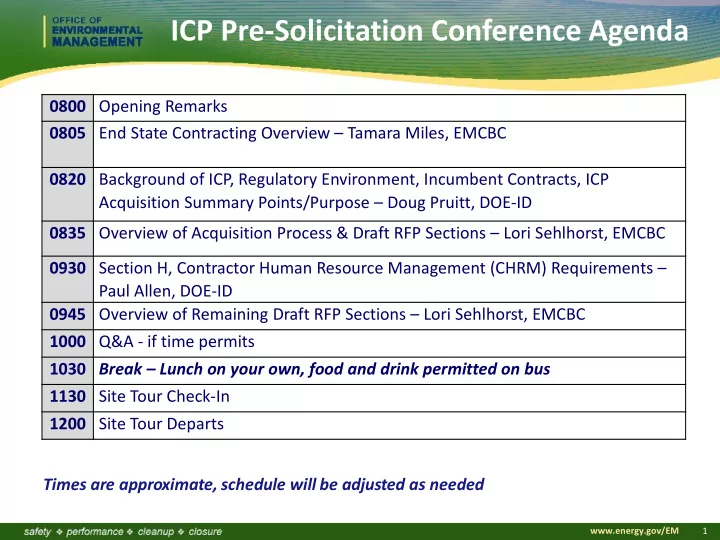
ICP Pre-Solicitation Conference Agenda 0800 Opening Remarks 0805 End State Contracting Overview Tamara Miles, EMCBC 0820 Background of ICP, Regulatory Environment, Incumbent Contracts, ICP Acquisition Summary Points/Purpose Doug Pruitt,


slide-1
SLIDE 1

www.energy.gov/EM 1

ICP Pre-Solicitation Conference Agenda

0800 Opening Remarks 0805 End State Contracting Overview – Tamara Miles, EMCBC 0820 Background of ICP, Regulatory Environment, Incumbent Contracts, ICP Acquisition Summary Points/Purpose – Doug Pruitt, DOE-ID 0835 Overview of Acquisition Process & Draft RFP Sections – Lori Sehlhorst, EMCBC 0930 Section H, Contractor Human Resource Management (CHRM) Requirements – Paul Allen, DOE-ID 0945 Overview of Remaining Draft RFP Sections – Lori Sehlhorst, EMCBC 1000 Q&A - if time permits 1030 Break – Lunch on your own, food and drink permitted on bus 1130 Site Tour Check-In 1200 Site Tour Departs Times are approximate, schedule will be adjusted as needed

slide-2
SLIDE 2

www.energy.gov/EM 2

Idaho Cleanup Project Draft Request For Proposal Pre-Solicitation Conference SOL No. 89303319REM000034

Lori Sehlhorst Doug Pruitt Procuring Contracting Officer Team Lead for Solid Waste Disposition Office of Environmental Management (EM) EM Consolidated Business Center and Idaho Operations Office February 25, 2020

slide-3
SLIDE 3

www.energy.gov/EM 3

Logistics/Ground Rules

  • No audio or video recording permitted.
  • Questions should be submitted via the notecards

provided.

  • DOE may attempt to answer questions during the

pre-solicitation conference today , time permitting.

  • Comments may also be submitted to the procurement

email address at ICP@emcbc.doe.gov for DOE’s consideration in preparing the Final RFP .

slide-4
SLIDE 4

www.energy.gov/EM 4

Logistics/Ground Rules

  • Nothing stated or presented during this conference

should be construed as a revision to the Draft RFP.

  • T
  • day’s briefing slides, Q&As, and the attendee list

will be posted on the procurement website.

  • The written terms and conditions of the Final RFP

, once released, will govern over information presented today.

  • Information provided today is at a summary level and

subject to change.

slide-5
SLIDE 5

www.energy.gov/EM 5

ICP Pre-Solicitation Conference Agenda

0800 Opening Remarks 0805 End State Contracting Overview – Tamara Miles, EMCBC 0820 Background of ICP, Regulatory Environment, Incumbent Contracts, ICP Acquisition Summary Points/Purpose – Doug Pruitt, DOE-ID 0835 Overview of Acquisition Process & Draft RFP Sections – Lori Sehlhorst, EMCBC 0930 Section H, Contractor Human Resource Management (CHRM) Requirements – Paul Allen, DOE-ID 0945 Overview of Remaining Draft RFP Sections – Lori Sehlhorst, EMCBC 1000 Q&A - if time permits 1030 Break – Lunch on your own, food and drink permitted on bus 1130 Site Tour Check-In 1200 Site Tour Departs Times are approximate, schedule will be adjusted as needed

slide-6
SLIDE 6

www.energy.gov/EM 6

Opening Remarks

Connie Flohr, Manager

Idaho Cleanup Project

slide-7
SLIDE 7

www.energy.gov/EM 7

DOE EM End State Contracting Overview

Tamara L. Miles

Procurement Director EM Consolidated Business Center

slide-8
SLIDE 8

www.energy.gov/EM 8

End State Contracting Model (ESCM)

  • Concerted effort within EM to reinvigorate the nuclear waste cleanup

completion mindset

  • ESCM employs a Two-Step Process:

1) Competitive qualifications-based Single Award Indefinite Delivery/Indefinite Quantity (IDIQ) Request for Proposal (RFP) 2) Post-award negotiation of discrete scopes of work through effective partnering on a Task Order (TO) basis (Cost Reimbursement or Fixed Price)

  • Provides EM the ability to partner with industry and stakeholders at this

critical juncture of the Program to openly negotiate the right, risk-based Interim and Final End States to reach completion at many of our sites

  • Developed with detailed consideration of industry feedback on the Draft

RFPs issued for the Hanford Central Plateau Cleanup Contract and Nevada Environmental Program Services Contract Financial Liability & Environmental Risk Reduction

slide-9
SLIDE 9

www.energy.gov/EM 9

ESCM Step 1– Streamlined Source Selection

ESCM: ESCM Streamlined Source Selection: Technical Evaluation Factors 1. Key Personnel 2. Technical & Management Approach (Transition, representative Task Order(s), IDIQ Management, Small Business Participation) 3. Past Performance (Descending order of importance) 1. Key Personnel 2. Past Performance 3. Management Approach (Transition, IDIQ Management, Small Business Participation) (Descending order of importance) Cost/Price Cost and Fee for representative Task Order(s), including Transition

  • Transition Task Order
  • Fully burdened labor rates (excluding

fee) for one-year period applied to DOE-provided direct labor hours

  • Key Personnel Salaries (one-year)
  • Fee/Profit (one-year)

Basis for Award (no change) Technical Evaluation Factors are Significantly More Important than Cost/Price Technical Evaluation Factors are Significantly More Important than Cost/Price Transition Period 60 Days 90 Days, plus Implementation Period

slide-10
SLIDE 10

www.energy.gov/EM 10

ESCM Step 2 - Post Award Task Orders

  • Up to 10-year Ordering Period with Minimum Guarantee

established

  • During Implementation Period, negotiate TO(s) for near

term scope(s) of work (not evaluated during pre-award)

  • Partner with contractor and regulators (as necessary) to

agree on next discrete, scope segment(s) to negotiate

  • Risk-based approach for site closure or end states resulting in:
  • More realistic, reliable pricing of higher fidelity scope
  • Appropriate incentive structure with balanced risk/reward
  • Improved contractor accountability
  • “Off Ramp” - If cannot agree on reasonable prices and/or

contractor performance is subpar, contract can be ended with no termination liability after minimum ordering guarantee is satisfied.

slide-11
SLIDE 11

www.energy.gov/EM 11

ESCM Benefits

Flexible, Cost- Effective Environmental Cleanup Reduced Procurement Lead Time & Less Upfront Proposal Cost Lower Cost of Entry for Companies New to EM Market Less Risky/Complex Pre-Award Evaluation Discrete Scopes for Greater Pricing Reliability & Equitable Risk Sharing Optimal Solutions Based on Known Conditions, Funding, and Priorities Fewer Contract Changes

slide-12
SLIDE 12

www.energy.gov/EM 12

ESC Acquisitions

Hanford Central Plateau Cleanup Contract Hanford Tank Closure Contract Nevada Environmental Program Services Savannah River Integrated Mission Completion Contract Idaho Cleanup Project

slide-13
SLIDE 13

www.energy.gov/EM 13

Summary

  • ESCM, a paradigm shift in contracting, achieves EM objectives
  • Reinvigorate nuclear waste cleanup completion mindset
  • Focus on reducing financial liability and environmental risks
  • Bolster efforts to get off the GAO High Risk List for Contract Management
  • EM continues to be as transparent and collaborative as possible

with industry regarding ESCM and all procurement actions

  • EM continues to streamline the acquisition process and

requirements and increase consistency across procurement actions

  • Primary takeaway for industry is to provide candid feedback to

the procurement teams

slide-14
SLIDE 14

www.energy.gov/EM 14 9

Background of ICP, Regulatory Environment, Incumbent Contracts, ICP Acquisition Summary Points/Purpose

Doug Pruitt

DOE-ID

slide-15
SLIDE 15

www.energy.gov/EM 15

Idaho Cleanup Project: Vision and Mission

Vision:

  • The Contractor and DOE will

accomplish the safe environmental cleanup of the Idaho site to honor commitments to stakeholders, reduce risks to people and communities, and relieve future generations of environmental and financial liabilities.

Mission Statement:

  • The Contractor and DOE will

implement fresh solutions to safely integrate, accelerate and deliver the ICP project compliantly, on schedule and within budget.

slide-16
SLIDE 16

www.energy.gov/EM 16

Idaho Cleanup Project Mission

Three Main Operating Areas:

  • INTEC

 10 nuclear facilities

  • RWMC

 2 nuclear facilities

  • Fort St. Vrain

Idaho Nuclear Technology and Engineering Center (INTEC) Radioactive Waste Management Complex (RWMC)

Main Missions:

  • Transuranic and mixed low-level waste

characterization and shipping

  • Environmental restoration of legacy

waste under CERCLA

  • Spent nuclear fuel management
  • High-level waste management
  • Liquid waste treatment
slide-17
SLIDE 17

www.energy.gov/EM 17

Regulatory Drivers

Idaho Settlement Agreement

  • All TRU waste removed from Idaho by 2018
  • All spent fuel placed in dry storage by 2023
  • Remove all spent fuel from Idaho by 2035
  • Treat and have all high-level waste road-ready to remove from Idaho by

2035 RCRA Site Treatment Plan

  • Provides framework for mixed waste management at INL Site, including

Calcine CERCLA Federal Facility Agreement/Consent Order

  • Governs environmental restoration activities
  • Complete exhumation by 2023
  • Complete Sub-surface Disposal Areas (SDA) Cover Construction by 2028
  • Primary focus for ICP is SDA, Test Area North Groundwater treatment,

and maintain previous remedies

slide-18
SLIDE 18

www.energy.gov/EM 18

Incumbent Contracts

Fluor Idaho, LLC:

 Contract Type: CPIF, CPFF  Award Value: $1.5 Billion  Current Value: $2 Billion  Performance Period: June, 2016 to May, 2021  Scope: Idaho Cleanup Project (all work other than NRC-regulated spent fuel)

Spectra Tech, Inc. (STI):

 Contract Type: Firm Fixed Price  Award Value: $31.6 Million  Current Value: $45 Million  Performance Period: June, 2016 to March, 2021  Scope: Manage NRC-Licensed Facilities

Fort St. Vrain independent spent fuel storage installation

slide-19
SLIDE 19

www.energy.gov/EM 19

ICP Acquisition: Summary Points

  • Procurement Method: Full and Open Competition
  • NAICS Code: 562910, Environmental Remediation Services, Small Business

Size Standard 750 employees

  • Contract Type: Single award IDIQ contract under which Cost

Reimbursement or Fixed Price Task Orders may be issued

  • Minimum and Maximum Value of Services: $6.4B IDIQ Maximum Ordering

Value (ceiling) & Guaranteed Minimum of $500,000

  • Contract Term: 10-year ordering period with the ability to issue tasks for up

to 5 additional years, prior to the last day of the 10-year base IDIQ contract

  • Incumbent Contracts’ End Dates:

(1) NRC Licensed Facilities (STI) Contract End Date: March 31, 2021 (2) ICP Core (Fluor Idaho) Contract End Date: May 31, 2021

slide-20
SLIDE 20

www.energy.gov/EM 20

ICP Scope of Work

Nine Major Scope Elements: 1. RWMC Closure (RCRA and CERCLA completions) 2. Complete TRU Waste Shipments Out of the State of Idaho 3. Sodium Bearing Waste Processed and Tank Farm Closure Complete 4. Complete Calcine Retrieval Project 5. Maintain Facilities and Infrastructure 6. Maintain Regulatory Compliance 7. Spent Nuclear Fuel (SNF) Operations and Management

  • Includes current NRC Licensing scope, with the exception of Fort St.

Vrain physical security services, which will be procured as a Small Business Set Aside.

8. SNF Disposition 9. Facility Decontamination and Decommissioning (D&D)

slide-21
SLIDE 21

www.energy.gov/EM 21

Purpose of Pre-Solicitation Conference and Overview of Acquisition Process

Lori Sehlhorst

Contracting Officer EM Consolidated Business Center

slide-22
SLIDE 22

www.energy.gov/EM 22

Purpose of Pre-Solicitation Conference

Early engagement with interested parties to highlight information regarding the Draft RFP , including:

  • Suitability of the proposal instructions and

evaluation criteria,

  • Availability of reference documents, and
  • Other industry questions.
slide-23
SLIDE 23

www.energy.gov/EM 23

Acquisition Process

  • Interested parties should submit questions, comments,

input for DOE consideration to the following email address: ICP@emcbc.doe.gov by March 6th, 2020.

  • Comments shall be submitted in the Microsoft Excel

format provided on the procurement website (please do not edit the format with the exception of adding rows as needed).

  • DOE will carefully consider comments/input received in

response to the Draft RFP in preparing the Final RFP . However, DOE is not required to officially respond to verbal or written questions or comments pertaining to the Draft RFP .

slide-24
SLIDE 24

www.energy.gov/EM 24

Acquisition Process

  • Primary takeaway for industry is to understand these

initiatives, look to identify these items in Draft RFPs, and provide feedback to the procurement teams.

  • The Final RFP is anticipated to be issued in Spring 2020.
  • Once the Final RFP is issued, interested parties should

submit questions/comments to email address: ICP@emcbc.doe.gov

  • DOE will post questions and answers, without attribution,

to the procurement website at: https://www.emcbc.doe.gov/SEB/icp/

slide-25
SLIDE 25

www.energy.gov/EM 25

Procurement Website

slide-26
SLIDE 26

www.energy.gov/EM 26

Acquisition Process

  • Industry will have 30 calendar days from the date the Final RFP

is released to prepare and submit a proposal to DOE.

  • The proposal shall consist of three separate volumes:

Volume I – Offer and Other Documents. Volume II – T echnical and Management Proposal. Volume III – Cost and Fee Proposal.

  • Minimum Proposal Acceptance Period will be 270 calendar

days after due date for receipt of proposals.

  • Government intends to award a contract without discussions,

as stated in Sections L and M of the RFP .

  • Full and Open Competition under NAICS Code 562910,

Environmental Remediation Services, SB size standard 750 employees.

slide-27
SLIDE 27

www.energy.gov/EM 27

Overview of Draft RFP Sections Sections L and M (pre-award)

Lori Sehlhorst

Contracting Officer EM Consolidated Business Center

slide-28
SLIDE 28

www.energy.gov/EM 28

Streamlined Source Selection Procedures

  • The Vol. II technical evaluation will consider:

1) Key Personnel (including Oral Presentations and Program Manager Oral Interview); 2) Past Performance; and 3) Management Approach. Key Personnel is more important than Past Performance. Past Performance is more important than Management Approach.

  • The Vol. III cost evaluation (Total Evaluated Price) will consider:

1) Transition Cost; 2) Proposed fully burdened labor rates (excluding fee) for FY 2022 applied to the DOE provided direct labor hours; 3) Key Personnel Costs (one year); and 4) Proposed fee/profit (by Task Order type) for a one-year period (FY 2022).

Basis for Award: Vol. II Technical Evaluation Factors, when combined, are significantly more important than Vol. III Total Evaluated Price.

slide-29
SLIDE 29

www.energy.gov/EM 29

Vol II – Section L General Instructions

Section L.10 (a) - Definitions. (1) Offeror. The term “Offeror,” as used in this Section L, refers to the single entity submitting the proposal. The Offeror may be a single corporation or a “Contractor team arrangement” as defined in FAR 9.601(1), for example, a Limited Liability Company (LLC), Limited Liability Partnership (LLP), Joint Venture (JV), or similar entity or arrangement. The Offeror may be an existing or newly formed business

  • entity. The term “newly formed entity” refers to any business entity (e.g. JV, LLP,

LLC, or similar entity or arrangement) formed solely for the purpose of submitting a proposal for this procurement. Such an entity may not have a record of its own past performance due to the fact that it may have been formed recently by affiliated entities for the purpose of submitting a proposal for this

  • procurement. If the Offeror is a newly formed entity, it must be legally

established on or before the date for submission of proposals. (2) Teaming Subcontractor. A “Teaming Subcontractor” is any subcontractor that will perform work that is incorporated into the Offeror’s Technical and Management Proposal and that the prime Offeror considers necessary to enhance its team’s Technical and Management Proposal or ability to meet delivery requirements within the Master IDIQ PWS. Teaming Subcontractors count toward fulfillment of the Section H Clause entitled, Subcontracted Work, requirement and other small business goals in this Contract.

slide-30
SLIDE 30

www.energy.gov/EM 30

Vol II – Factor 1, Key Personnel

Key Personnel Evaluation (a) Three required positions along with any additional KP positions proposed by the Offeror (no limit) 1) Program Manager (most important) 2) ESH&Q Manager 3) Business Manager (b) Resume (c) Key Personnel Team The evaluation will include an assessment of the proposed KP experience in the following elements: 1) Recent and relevant experience in direct project execution in the field; 2) Experience at partnering and good-faith negotiations with client(s) that achieved measurable performance improvements; 3) Experience in incentive-based contracting resulting in a significant performance improvement or an end-state completion; and 4) Experience in successful regulatory interactions and compliance with demonstrated positive benefit to the Government. (d) Oral problem scenarios – Key personnel (e) Oral interview – Program Manager

slide-31
SLIDE 31

www.energy.gov/EM 31

Section H. Key Personnel – Fee Reductions

Contract fee reductions for changes to Key Personnel (per Section H clause):

  • Program Manager – If removed, replaced, or diverted within three

years of being placed in the position (NTP for Transition), the earned fee under the Contract may be permanently reduced by $500,000 for each and every such occurrence.

  • Other than Program Manager – If removed, replaced, or diverted

within three years of being placed in the position (NTP for Transition), the earned fee may be permanently reduced by up to $250,000 for each and every such occurrence.

slide-32
SLIDE 32

www.energy.gov/EM 32

Vol II – Factor 2, Past Performance

  • The Past Performance section of the proposal shall be limited to the:

1) Attachment L-3, Past Performance Reference Information Forms (7-page limit per contract) 2) Attachment L-5, List of Contracts Terminated for Default 3) Attachment L-10, List of DOE Contracts 4) Past Performance Consent Statement(s)

  • Contracts information. The Offeror, to include all members of a teaming

arrangement, as defined in FAR 9.601(1), shall provide past performance information on up to three (3) contracts per member, either currently being performed or completed by the Offeror/members, and up to two (2) contracts, either currently being performed or completed for each proposed Teaming Subcontractor.

  • The Offeror shall only provide past performance information for contracts

that are currently being performed or have been completed within the last three (3) years from the original solicitation issuance date (e.g. Final RFP issuance date)

slide-33
SLIDE 33

www.energy.gov/EM 33

Vol II – Factor 2, Past Performance

  • Similar scope, size, and complexity are defined as follows: scope – type of

work (e.g., work as identified in the Master IDIQ PWS); size – dollar value (approximate average annual value) and contract period of performance; and complexity – performance challenges (e.g., overcoming barriers for completion/closure-type projects to safely accelerate work scope; management of complex CHRM requirements set forth in Section H; relevant types of waste and associated processing through final disposition; handling, storage and transfer of spent nuclear fuel; maintaining, operating and performing D&D as a CERCLA Non-Time Critical Removal Action of aging nuclear facilities; maintaining compliance in a complex regulatory environment; implementation of environmental, safety and health requirements of 10 CFR 830 and 10 CFR 835 related to Nuclear Safety, Quality, and Occupational Radiological Protection, and 10 CFR 851 Worker Safety and Health; relevant RCRA and CERCLA performance; and successful partnerships with the Government, Client, and Regulators).

slide-34
SLIDE 34

www.energy.gov/EM 34

Vol II – Factor 2, Past Performance

  • Sources of past performance information. The Government may consider past

performance information from sources other than those provided by the Offeror, such as commercial and government clients, government records, regulatory agencies, and government databases such as the Government’s Contractor Performance Assessment Reporting System (CPARS). The Government may contact any or all of the references provided by the Offeror and will consider such information obtained in its evaluation. Note: DOE contracts are not necessarily evaluated with more relevance than non-DOE contracts, based on the sole fact that it was work for DOE. The evaluation of relevancy is based on the factors listed above [size, scope and complexity].

  • DOE will be considering relevant and very relevant only for Past Performance
  • In addition, the Government may consider any other information determined

to be reasonably predictive of the quality of the Offeror’s performance under this proposed contract, such as information bearing on the Offeror’s integrity and business ethics. This other information is not limited to contracts found to be relevant to this procurement in terms of scope, size, and complexity.

slide-35
SLIDE 35

www.energy.gov/EM 35

Vol II – Factor 2, Past Performance

  • Newly formed entity and predecessor companies. The evaluation of past

performance for the Offeror and any Teaming Subcontractor(s) may be based on the past performance of its parent organization(s), member organizations in a joint venture, limited liability company, or other similar or affiliated companies, provided the Offeror’s proposal demonstrates that the resources of the parent, member, or affiliated company will be provided or relied upon in contract performance such that the parent, member, or affiliate will have meaningful involvement in contract performance. Meaningful involvement means the parent, member, or affiliate will provide material supplies, equipment, personnel, or other tangible assets to contract performance; or that the common parent will utilize the expertise, best practices, lessons learned, or similar resources from the affiliate to affect the performance of the Offeror. Past performance information from predecessor companies that existed prior to any mergers or acquisitions may also be considered where the Offeror’s proposal demonstrates such performance reasonably can be predictive of the Offeror’s performance.

  • Refer to Question 21 on the Attachment L-3 form requiring such details.
slide-36
SLIDE 36

www.energy.gov/EM 36

Vol II – Factor 3, Mgmt. Approach

Management Approach (15 page limit).

  • Contract Transition Approach: DOE will evaluate the Offeror’s approach to

achieve the Contract Transition Task Order requirements, including Contractor Human Resource Management (CHRM) requirements in Section H, for the safe, effective, and efficient transfer of responsibility for execution of the Master IDIQ Contract with little or no disruption to ongoing operations.

  • IDIQ Management Approach: DOE will evaluate the Offeror’s management

approach to effectively manage, implement (including good faith negotiations with DOE), and execute multiple Task Orders for the Master IDIQ PWS; to interface and collaborate with other site contractors; and to partner with DOE and the Regulators to achieve desired End States.

  • Small Business Participation: DOE will evaluate the Offeror’s approach to meet
  • r exceed the small business subcontracting requirement of 15% of the

cumulative value of Task Orders, including subcontracting of meaningful work scope.

slide-37
SLIDE 37

www.energy.gov/EM 37

Vol III – Cost and Fee

  • Vol. III will be evaluated for cost realism and cost reasonableness per FAR

15.404-1. DOE will not determine an overall estimated total Contract value for evaluation as part of this evaluation. The cost evaluation will include:

  • a cost realism analysis of the Offeror’s proposed Contract Transition Task Order costs,
  • a cost reasonableness analysis of the proposed fully burdened labor rates (excluding

fee) for FY 2022 applied to the DOE provided direct labor hours, and

  • a cost reasonableness analysis of the key personnel costs (first year)
  • The fee/profit evaluation will include:

* The fee/profit percentages proposed for each Task Order type will be incorporated into the master contract at B.5 DOE-B-2015 Task Order Fee/Profit Ceiling (Oct 2014) (Revised) and will be considered ceiling fee/profit percentages for the duration of the 10-year contract ordering period.

Gov’t Fiscal Year Task Order Type Estimated Costs Proposed Fee/Profit Percentage* Proposed Fee/Profit FY 2022 CPAF $200,000,000 [Offeror Fill-In]* $[Offeror Fill-In] FY 2022 CPIF $ 80,000,000 [Offeror Fill-In]* $[Offeror Fill-In] FY 2022 CPFF $ 40,000,000 [Offeror Fill-In]* $[Offeror Fill-In] FY 2022 FFP $ 80,000,000 [Offeror Fill-In]* $[Offeror Fill-In] Total $400,000,000 $[Offeror Fill-In]

slide-38
SLIDE 38

www.energy.gov/EM 38

Foreign Ownership, Control, or Influence (FOCI)

K.5, FAR Certification Regarding Facility Clearance – Foreign Ownership, Control or Influence (FOCI) Information, is applicable to all Offerors in terms of either new FOCI registrations or documentation of the existing facility clearance. L.11 (h) Facility clearance verification (Vol. I Responsibility Determination)

  • Required for the Offeror, JV/LLC member(s), and Teaming Subcontractors (if applicable)

who will perform work under a contract resulting from this solicitation and require access authorizations (see Section L provision entitled, DEAR 952.204-73, Facility Clearance)

  • All Offerors, JV/LLC member(s), and Teaming Subcontractors (if applicable) that do not

possess a CAGE code or DOE/NRC Facility Clearance number, shall complete the required entries into the DOE Foreign Ownership, Control, or Influence (FOCI) Electronic Submission System (ESS) located at https://foci.anl.gov/. Use of the DOE FOCI ESS is mandatory for all Offerors, JV/LLC member(s), and Teaming Subcontractors (if applicable) that do not possess a Facility Clearance.

  • Designate all Key Management Personnel (KMP) (specific to FOCI only; this is not the

same as Key Personnel as defined in Section H) in e-FOCI and the security clearance held by each, as applicable. At a minimum, KMP must include the positions of the President and Facility Security Officer (FSO).

slide-39
SLIDE 39

www.energy.gov/EM 39

Foreign Ownership, Control, or Influence (FOCI)

L.11 (h) Facility clearance verification (Vol. I Responsibility Determination) (cont.)

  • If any member of the Offeror (including Teaming Subcontractors) is under FOCI, the

Offeror shall submit a draft FOCI Mitigation Plan for review by the appropriate Cognizant Security Office (CSO). If the CSO has questions regarding any of the FOCI Verification, Facility Clearance Information, and/or the draft FOCI Mitigation Plan, it may reach out to the Offeror during the evaluation process for clarifications. Note: This will not constitute “negotiations” (or “discussions”) as defined in paragraph (d) of FAR 15.306, Exchanges with Offerors After Receipt of Proposals or obligate the Government to conduct discussions; nor constitute a “proposal revision” as defined in FAR 15.001.

  • Highly encouraged to transmit FOCI information before proposal receipt deadline
  • Electronic signatures cannot be accepted; thus, the signed original SF-328, and any other

forms requiring a signature or seal shall be printed, signed, and submitted to the federal FOCI Operations Manager at the mailing address provided in the system.

  • When filling out the New User Registration information in the DOE FOCI ESS, select “DOE

Idaho Operations Office” as the FOCI Office

  • Include the solicitation name and number in the “Reason for Request” field.
  • If the Department identifies missing information, the Offeror shall submit any

information requested by the Department (FOCI Manager or CO) as soon as possible.

slide-40
SLIDE 40

www.energy.gov/EM 40

Contractor Human Resource Management (CHRM) Requirements CHRM Overview

Paul Allen

ID Contractor Industrial Relations

slide-41
SLIDE 41

www.energy.gov/EM 41

Draft RFP – Section H Noteworthy Contractor Human Resource Clauses:

  • H.4

WORKFORCE TRANSITION AND EMPLOYEE HIRING PREFERENCES

  • H.5

EMPLOYEE COMPENSATION: PAY AND BENEFITS

  • H.7

WORKFORCE TRANSITION AND BENEFITS TRANSITION: PLANS AND TIMEFRAMES

  • H.8

POST CONTRACT RESPONSIBILITIES FOR PENSION AND OTHER BENEFIT PLANS

  • H.9

LABOR RELATIONS

  • H.10 WORKFORCE RESTRUCTURING
slide-42
SLIDE 42

www.energy.gov/EM 42

Draft RFP – Section H CHRM Summary

  • The CHRM clauses include a large volume of critical information

related to transitioning the existing workforce, their pay and their benefits, and managing those HR elements through the period of performance.

  • Offerors should review ALL of the CHRM, Section H clauses in
  • detail. They will describe your responsibilities regarding such

workforce-related matters as:

– The obligation to hire existing employees where ever possible and the rules that govern that process; – The obligation to co-sponsor the INL Employee Retirement Plan (a Defined Benefit Pension Plan) for eligible employees and the rules that govern that responsibility; – The obligation to provide comparable health and welfare benefits that incumbent employees currently receive; – The obligation to recognize the existing Collective Bargaining Units as the representatives for their respective memberships

slide-43
SLIDE 43

www.energy.gov/EM 43

Draft RFP – Section H

H.4 WORKFORCE TRANSITION AND EMPLOYEE HIRING PREFERENCES:

  • Service employees are to be provided “the right of first refusal” for the

same or similar jobs for which they are qualified (FAR 52.222-17, Nondisplacement of Qualified Workers)

  • All incumbent employees below the first level of supervision are to be

provided “preference in hiring” according the hierarchy established in H.4(b)

  • The intent of this clause is to protect the interests of qualified

incumbent employees in maintaining their existing employment status even though they will be working for a new company. There are many important considerations in this clause and Offerors are advised to read it carefully.

slide-44
SLIDE 44

www.energy.gov/EM 44

Draft RFP – Section H

H.5 EMPLOYEE COMPENSATION: PAY AND BENEFITS

  • Contractor will be required to become a Sponsor to the existing INL

Retirement Plans (or comparable successor plans) for eligible “grandfathered” employees.

  • Contractor will be required to provide Market Based or Corporate retirement

plans for all other employees as required.

  • The INL Employee Retirement Plan (INLERP) and the INL Employee Investment

Plan (INLEIP) are posted to EMCBC ICP Core Acq. website at: https://www.emcbc.doe.gov/SEB/ICP/.

– Battelle Energy Alliance (BEA) is the Lead Plan Sponsor for both plans

  • Becoming a Sponsor to the Plans subjects the Contractor to the requirements
  • f Employee Retirement Income Security Act of 1974 (ERISA), and the Internal

Revenue Code.

  • All costs associated with plan Sponsorship are fully reimbursable by the

Government or paid by the Plan trust.

  • Questions or concerns with Sponsorship should be directed to your ERISA

Attorney, Actuary, or Accountant

slide-45
SLIDE 45

www.energy.gov/EM 45

Draft RFP – Section H

H.5 EMPLOYEE COMPENSATION: PAY AND BENEFITS

  • Incumbent Employees are to be provided:

– Equivalent base pay for at least the first year – Comparable benefits package to what they currently receive

  • Non-incumbent Employees are to be provided total pay and benefits package

that provides for market-based retirement and medical benefit plans that are competitive with the industry from which the Contractor recruits its employees

slide-46
SLIDE 46

www.energy.gov/EM 46

Draft RFP – Section H

H.7 WORKFORCE TRANSITION AND BENEFITS TRANSITION

  • Critical Plans to be submitted for Contracting Officer Approval:

– Workforce Transition Plan – Benefits Transition Plan

  • Know who will be responsible for these activities immediately

– Reporting/Submittal Requirements to CO – 10 days to 30 days after effective date of the Transition Task Order

slide-47
SLIDE 47

www.energy.gov/EM 47

Draft RFP – Section H

H.9 LABOR RELATIONS

Per paragraph(b):

  • For work currently performed by members of the United Steelworkers Local

652 (USW), the Operating Engineers Local 370 (OEs) and the International Brotherhood of Teamsters, Chauffeurs, Warehousemen and Helpers Local 983 (Teamsters) on the effective date of this Contract, the Contractor agrees to initially consult with these unions regarding the initial terms and conditions of employment and to recognize these unions as the collective bargaining representative(s) for employees performing work that has historically and traditionally been performed by members of these unions and is covered in the scope of this contract, and to bargain in good faith to a collective bargaining agreement that gives due consideration to applicable terms and conditions of the existing collective bargaining agreement(s) for work at the Idaho Cleanup Project.

slide-48
SLIDE 48

www.energy.gov/EM 48

Draft RFP – Section H

H.9 LABOR RELATIONS

Per paragraph (k):

  • INL Site Construction Jurisdiction Procedural Agreement (SJPA) and the INL

Site Stabilization Agreement (SSA). The Contractor and its subcontractors at all tiers performing work covered by the Wage Rate Requirements (Construction) (formerly known as the Davis- Bacon Act) shall become signatory to the INL SJPA and INL SSA. The Contractor employees and subcontractor employees performing such work shall receive pay and benefits consistent with the SSA unless otherwise negotiated between the Contractor and the Idaho Building and Construction Trades Council. Copies of the SSA and SJPA are available at https://www.emcbc.doe.gov/SEB/ICP/. The SJPA and the SSA apply to construction performed under the contract consistent with the terms of the SJPA and the SSA.

slide-49
SLIDE 49

www.energy.gov/EM 49

Draft RFP – Section H

H.10 WORKFORCE RESTRUCTURING

  • Requirements are set forth in this clause should the Contractor be required to

conduct workforce restructuring.

slide-50
SLIDE 50

www.energy.gov/EM 50

Overview of Draft RFP Sections B, J, H (post-award)

Lori Sehlhorst

Contracting Officer EM Consolidated Business Center

slide-51
SLIDE 51

www.energy.gov/EM 51

Section B – Task Order Fee/Profit Ceiling

B.5 DOE-B-2015 Task Order Fee/Profit Ceiling (Oct 2014) (Revised)

(a) Task Order fee/profit ceilings will adhere to the following criteria. (1) CPIF Task Orders. The maximum fee amount shall not exceed 15 percent of the target cost, and shall serve as the maximum fee ceiling. The target fee ceiling amount that can be negotiated is [Offeror Fill-In] percent of the target cost. (2) CPAF Task Orders. The award fee ceiling amount that can be negotiated is [Offeror Fill- In] percent of the estimated cost. There is no base fee available under CPAF task orders. (3) CPFF Task Orders. The fixed fee ceiling amount that can be negotiated is [Offeror Fill-In] percent of the estimated cost. (4) Hybrid Task Orders. Task orders comprising multiple CLIN types shall apply the fee/profit ceiling(s) at the CLIN level. (5) Firm Fixed Price Task Orders. The profit ceiling amount that can be negotiated, as specified as a percentage of the negotiated cost, is [Offeror Fill-In] percent. (b) The fee (target, award, or fixed)/profit amount for each Task Order will be negotiated and established based on risk and complexity. The Contractor may propose a fee/profit amount it determines appropriate as long as the proposed amount adheres to the criteria above. (c) The ceiling percentages shall at no time exceed any statutory limitations imposed by 10 United States Code (U.S.C.).) 2306(d), 41 U.S.C. 3905, and FAR 15.404-4(c)(4)(i).

slide-52
SLIDE 52

www.energy.gov/EM 52

Section B – Performance Management Incentive Clause

B.13 Performance Management Incentive

The Performance Management Incentive (PMI) fee provides the Contractor an

  • pportunity to earn fee based upon continued successful performance, and doing

business in a manner that brings the best value to the Government. A Performance Management Incentive (PMI) fee of [$TBD] per fiscal year* will be earned based upon successful contractor performance in, but not limited to, the following areas: (1) meeting regulatory or court-ordered milestones; (2) quality assurance performance per Section C.9.3.12 and Section E clause FAR 52.246-11; (3) maintaining facilities and other infrastructure throughout the performance period to function at the same level and in the same condition as existed by the end of the transition task order period of performance; (4) management of the Contractor’s team, including teaming subcontractors; (5) establishment, maintenance, and effective implementation of business systems; and (6) IDIQ management including, timely, good-faith contract/task order negotiations with DOE. *Amount may be prorated based on the timing of the 12-month fiscal year.

slide-53
SLIDE 53

www.energy.gov/EM 53

Section B – Performance Management Incentive Clause

B.13 Performance Management Incentive (cont.)

In the event the Contractor’s performance is deemed inadequate and after notification by the CO to the Contractor, the CO has discretion for the amount of the PMI fee reduction, up to $[TBD], per each fiscal year. The CO also has the discretion to allow the Contractor to correct performance issues with the intent to recover any withheld PMI fee. At the discretion of the CO, potential fee recovery may extend beyond the applicable fiscal year in which the fee reduction occurred, based on the Contractor’s corrective actions. The PMI is a contract-wide incentive measured against all of elements of the PWS (excluding Transition), but will be administered under the ICP Essential Missions Task Order as a stand-alone fee pool. Fee actions described in this provision will not duplicate fee actions on a Task Order-specific basis. Quarterly provisional PMI fee payments will be paid by taking 80% of the PMI fee divided by four quarters for each 12 month period, minus any PMI actions. The remaining 20% of the PMI fee will be held until the end of each fiscal year. The PMI fee is considered earned at the end of the fiscal year, minus any PMI fee reductions described above. Additionally, the Implementation Period Task Order will have a similar PMI fee of $[TBD] for the 120-day task order period. Refer to the Implementation Task Order for specific details.

slide-54
SLIDE 54

www.energy.gov/EM 54

Task Order Overview (Att. J-12)

Title TO Type Duration

  • 1. Transition Period

Cost (No Fee) 3 mo. (March 1, 2021 – May 31, 2021)

  • 2. Implementation Period Task Order
  • Assume full responsibility for work performance
  • Keep existing work ongoing while end-state task orders are put in

place.

CPFF 4 mo. (June 1, 2021 – Sept. 30, 2021)

  • 3. ICP Essential Missions Task Order
  • Buried waste exhumation completion by 2023
  • AMWTP Waste certification and shipping (includes CH-TRU and RH-

TRU) to meet ISA 2018 milestone

  • SNF cask transfers, moves, and demonstrations (includes Navy SNF)

to achieve all SNF in dry storage by 2023

CPAF 24 mo. (Oct. 1, 2021 – Sept. 30, 2023)

  • 4. IWTU Operations Task Order
  • Continue uninterrupted operations

TBD TBD (Oct. 1, 2021 – TBD)

  • 5. RCRA Closure and D&D of AMWTP, ARPs
  • RCRA closure and D&D of ARP facilities and AMWTP WMF-636 to

allow SDA Cap construction by 2028

  • AMWTP RCRA Closure and planning for D&D of all treatment

facilities in SDA Cap footprint to allow SDA Cap construction by 2028

TBD TBD

  • 6. Navy Scope
  • D&D of prototype reactor facilities

TBD TBD

slide-55
SLIDE 55

www.energy.gov/EM 55

  • Specific task orders will be issued (Section J attachments) throughout the

ten-year contract ordering period to implement various aspects of this master performance work statement. The CO will issue a Request for Task Order Proposal (RTP) in accordance with the Master IDIQ Contract Section

  • H. 51 Task Ordering Procedure, paragraph (c).
  • The Contractor shall expediently provide the CO with the requested task
  • rder proposal(s) that are compliant with FAR Subpart 15.4, paragraph (f)
  • f the H.51 clause (refers to Att. J-11 IDIQ Labor Rate Schedule), section

B.5 fee/profit ceilings, and also include separate small business subcontracting goals specific to each Task Order.

  • DRAFT RTPs are provided in the Draft RFP via Section J attachments:
  • J-14 Implementation Period Task Order
  • J-15 ICP Essential Missions Task Order
  • J-16 IWTU Operations Task Order

Section H.51 – Task Ordering Procedure

slide-56
SLIDE 56

www.energy.gov/EM 56

H.52 SUBCONTRACTED WORK

The Contractor shall subcontract (in accordance with the definition at FAR Subpart 44.1) at least fifteen (15) percent of the cumulative value of Task Orders issued under this contract to small

  • businesses. The Contractor’s subcontracted work shall be in compliance with the approved

Section J, Attachment J-9 entitled, Master Small Business Subcontracting Plan and the separate subcontracting goals submitted and approved at the Task Order level. Unless otherwise approved in advance by the CO, work to be performed by subcontractors selected after Contract and Task Order award shall be acquired through competitive procurements, to the extent required, with an emphasis on fixed-price subcontracts to the extent practicable. The use of cost-reimbursement, time-and-materials, and labor-hour subcontracts shall be minimized. The separate subcontracting goals submitted at the Task Order level shall identify timely, discrete, and meaningful scopes of work that can be awarded to small business concerns. Meaningful work is work that is important to the performance of the technical and management approach defined by the prime contractor. It is characterized by strong technical content (e.g., discrete and distinct technical or programmatic scopes of work) and contributes to the successful achievement of DOE’s goals. It should have a performance-based

  • utcome that directly contributes to the overall contract outcome(s). Also, the Contractor shall

respond to past performance inquiries for subcontractors upon request from DOE and other Federal agencies.

Section H – Subcontracted Work

slide-57
SLIDE 57

www.energy.gov/EM 57

H.57 PARTNERING The Contractor and the Government will establish a non-binding, signed Partnering Agreement for the ICP at the INL Site. The agreement will establish a common vision with supporting goals and objectives, and expectations of doing business together in a manner that brings the best value to the Government. Partnering between DOE and the Contractor shall be conducted in a manner similar to the DOD Integrated Product and Process Development (IPPD) framework. The IPPD technique simultaneously integrates all essential activities to facilitate meeting cost and performance

  • bjectives.

Section H – Partnering

slide-58
SLIDE 58

www.energy.gov/EM 58

H.66 ORGANIZATIONAL CONFLICT OF INTEREST – AFFILIATE (S) The prime contractor, [Offeror to insert name of Prime Contractor] comprised of [Offeror to insert names of partner companies], is responsible for the completion of all aspects of this contract. In order to effectively and satisfactorily execute its responsibility to manage and accomplish the contract work, the prime contractor must have complete objectivity in its oversight and management of its subcontractors. Therefore, consistent with the principle contained in Federal Acquisition Regulation subpart 9.5 and specifically section 9.505(a), and notwithstanding any other provision of this Contract, the prime contractor is, absent prior written consent from the CO as provided herein, prohibited from entering into a subcontract arrangement with any affiliate or any affiliate of its partners, or utilize any affiliate or affiliate of its partners, to perform work under a subcontract. Such contractual relationship(s) are presumed to create an impaired objectivity type conflict of

  • interest. If the contractor believes the capabilities of an affiliate could be utilized in such a

manner as to neutralize or avoid the existence of an organizational conflict of interest, the Contractor must obtain the CO’s written consent prior to before placing the subcontract. For the purpose of this clause, affiliation occurs when a business concern is controlled by

  • r has the power to control another or when a third party has the power to control both.

Section H – OCI Affiliate Clause

slide-59
SLIDE 59

www.energy.gov/EM 59

Questions?

Q&A Session (time permitting)

slide-60
SLIDE 60

www.energy.gov/EM 60

Site Tour (12pm – 6pm)

  • Participants attending the site tour should plan to check-in

with a valid form of picture ID at the lobby of the Tingey Administration Building (TAB), no later than 11:30am to allow time for badging, a safety briefing, and security inspections.

  • Walk-ins will not be permitted.
  • The bus transporting participants to the site will leave

promptly at 12:00pm (noon).

  • Due to the remote location of the tour, participants must

bring their own lunch. Participants will be permitted to eat and drink on the bus.

  • Prohibited items brought to the INL Site will be confiscated..

No photos allowed.

slide-61
SLIDE 61

www.energy.gov/EM 61

One-on-One Session Logistics/Ground Rules

  • The purpose of the one-on-one sessions is to discuss the recently

issued ICP Draft RFP, 89303319REM000034.

  • Meetings will not be more than 35 minutes.
  • Opportunity for interested parties to present their thoughts and

suggestions on the procurement.

  • There will be no negative ramifications for a firm choosing not to

participate or cancelling their scheduled time.

  • DOE is not requesting and will not accept company marketing material.
  • Walk-ins will not be permitted.