Master thesis: Calculation of Wave Forces on Offshore Wind Turbine - - PowerPoint PPT Presentation

master thesis
SMART_READER_LITE
LIVE PREVIEW

Master thesis: Calculation of Wave Forces on Offshore Wind Turbine - - PowerPoint PPT Presentation

Master thesis: Calculation of Wave Forces on Offshore Wind Turbine Jacket Substructures using REEF3D MSc student: Seimur Shirinov Supervisor: Hans Bihs Co-supervisors: Arun Kamath Ankit Aggarwal ISSUES 1. Highly varying aerodynamic and


slide-1
SLIDE 1

Master thesis:

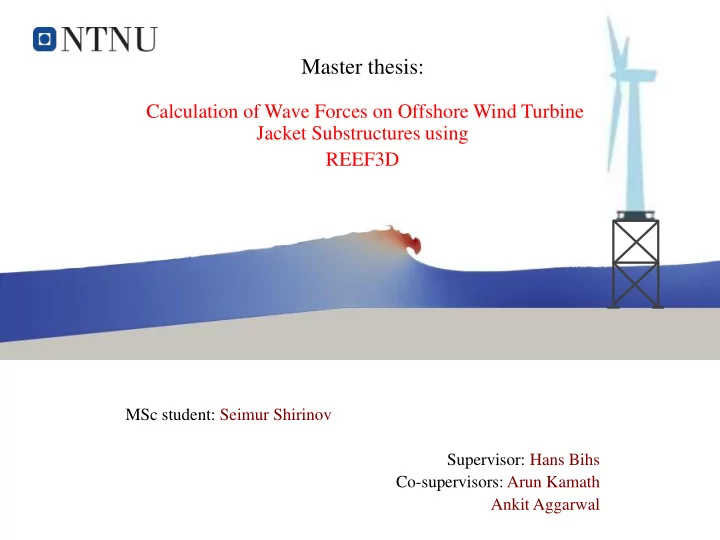
Calculation of Wave Forces on Offshore Wind Turbine Jacket Substructures using REEF3D

MSc student: Seimur Shirinov Supervisor: Hans Bihs Co-supervisors: Arun Kamath Ankit Aggarwal

slide-2
SLIDE 2

1. Highly varying aerodynamic and hydrodynamic loads 2. Harsh sea environment such as in North sea 3. Considerable costs and time required by laboratory experiments 4. Complex behavior of the forces acting on the structure under breaking waves 5. Breaking waves exerting very high impact forces in very short duration 6. The performance and fatigue life of the

  • ffshore wind turbine is strongly affected

ISSUES

  • Fig. 1. Dong et al. (2012)
slide-3
SLIDE 3

REEF3D open-source software

  • Reynolds Averaged Navier-Stokes

equations + Continuity equation

  • Turbulence modeling
  • Wave theories applications
  • Numerical Wave Tank setup
  • Fig. 2. Wave interacting with a Jacket Structure, Hans Bihs, 2018, reef3d.com
slide-4
SLIDE 4

Thesis focus on:

1. Breaking wave loads on the jacket 2. local forces on the members of the jacket structure 3. Analysis with different wave parameters and different orientations of the jacket 4. Validation of numerical results

  • Fig. 3. Wei et al. (2017)
slide-5
SLIDE 5

Large Wave Flume (GWK) of the Coastal Research Centre (FZK) in Hannover, Germany.

  • Fig. 4. Mo et al. (2007)
  • Fig. 5. Comparison of numerical results for total dynamic forces
  • n Cylinder pile with experimental data.
slide-6
SLIDE 6

Wave slamming forces on truss structures in shallow water, GWK, Hannover, Germany

  • Fig. 6.3. Arntsen et al. (2013)

G3 G6 G5 G4 G2 G1

  • Fig. 6.1, 6.2 Arntsen et al. (2013)
slide-7
SLIDE 7

2D Model (1/2) for Non-breaking wave

  • Fig. 7. Comparison of the free surface elevations of numerical results with experimental data at different gauge

locations.

Free-surface elevation at Gauge 2

G1 G2

Free-surface elevation at Gauge 1

slide-8
SLIDE 8

3D Model (2/2) for Non-breaking wave

  • Fig. 8. Comparison of the free surface elevations for

2D and 3D at Gauge 2

  • Fig. 9. Comparison of the total dynamic forces on the

the structure.

slide-9
SLIDE 9

2D Model (1/2) for Breaking wave

  • Fig. 10. Comparison of the free surface elevation (a) and horizontal particle velocities (b) of numerical results with experimental at

Gauge 1 location Gauge 1

FSF and Velocity profiles at Gauge 1