Masters Thesis Presentation Day Division of Building Technology - - - PDF document

master s thesis presentation day
SMART_READER_LITE
LIVE PREVIEW

Masters Thesis Presentation Day Division of Building Technology - - - PDF document

Masters Thesis Presentation Day Division of Building Technology - 2019-06-10 Location: SB-H4, Chalmers University of Technology, Sven Hultins gata 6, (maps.chalmers.se ) Time: 9:00 15:00 We hereby invite you to the presentation day for


slide-1
SLIDE 1

Master’s Thesis Presentation Day

Division of Building Technology - 2019-06-10

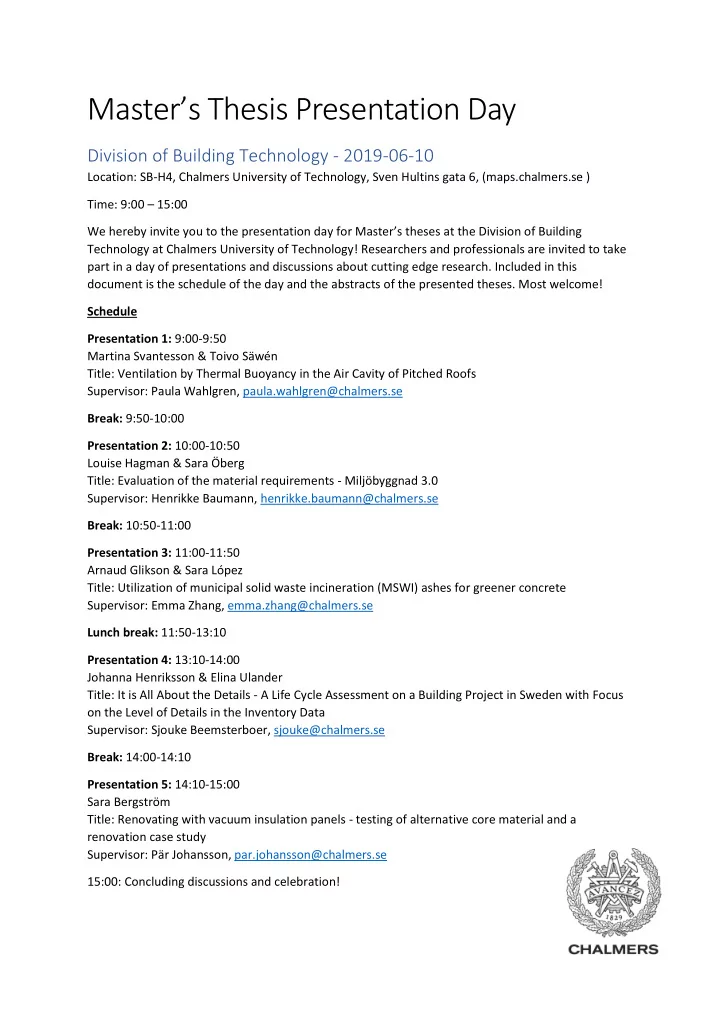
Location: SB-H4, Chalmers University of Technology, Sven Hultins gata 6, (maps.chalmers.se ) Time: 9:00 – 15:00 We hereby invite you to the presentation day for Master’s theses at the Division of Building Technology at Chalmers University of Technology! Researchers and professionals are invited to take part in a day of presentations and discussions about cutting edge research. Included in this document is the schedule of the day and the abstracts of the presented theses. Most welcome! Schedule Presentation 1: 9:00-9:50 Martina Svantesson & Toivo Säwén Title: Ventilation by Thermal Buoyancy in the Air Cavity of Pitched Roofs Supervisor: Paula Wahlgren, paula.wahlgren@chalmers.se Break: 9:50-10:00 Presentation 2: 10:00-10:50 Louise Hagman & Sara Öberg Title: Evaluation of the material requirements - Miljöbyggnad 3.0 Supervisor: Henrikke Baumann, henrikke.baumann@chalmers.se Break: 10:50-11:00 Presentation 3: 11:00-11:50 Arnaud Glikson & Sara López Title: Utilization of municipal solid waste incineration (MSWI) ashes for greener concrete Supervisor: Emma Zhang, emma.zhang@chalmers.se Lunch break: 11:50-13:10 Presentation 4: 13:10-14:00 Johanna Henriksson & Elina Ulander Title: It is All About the Details - A Life Cycle Assessment on a Building Project in Sweden with Focus

  • n the Level of Details in the Inventory Data

Supervisor: Sjouke Beemsterboer, sjouke@chalmers.se Break: 14:00-14:10 Presentation 5: 14:10-15:00 Sara Bergström Title: Renovating with vacuum insulation panels - testing of alternative core material and a renovation case study Supervisor: Pär Johansson, par.johansson@chalmers.se 15:00: Concluding discussions and celebration!

slide-2
SLIDE 2

Presentation 1: 9:00-9:50 Martina Svantesson & Toivo Säwén Title: Ventilation by Thermal Buoyancy in the Air Cavity of Pitched Roofs Supervisor: Paula Wahlgren, paula.wahlgren@chalmers.se Abstract A parallel roof is a roof construction commonly used for Nordic roof constructions. It is ventilated through an air cavity for the removal of heat and moisture. The air flow is driven by wind pressure and thermal buoyancy, governed by climatic conditions, and resisted by air flow resistances affected by the design of the cavity geometry, including cavity height and inclination. Research has been performed on wind driven cavity ventilation, mainly for the purpose of heat removal. However, few studies have considered the effect of thermal buoyancy as the main driving force, or studied the air cavity from the perspective of moisture removal. Also, there is a lack of quantitative guidelines for the design of air cavities in roof constructions in Sweden, making it difficult to evaluate a proposed roof design. This study investigates how the air cavity design affects the thermal buoyancy effect through an experimental and a numerical study. Experimental tests of an overheated roofing were conducted

  • n a full-scale roof model, with a cavity length of 3.5 m, corresponding to a solar heated roof. Cavity

heights between 23 and 70 mm as well as roof inclinations between 5 and 45° were tested for different heat fluxes applied to the system. Surface and air temperatures were measured. The air velocity in the cavity was determined by smoke tests. Numerical modelling of the same heated air cavity was also performed, using the CFD module of the FEM software COMSOL Multiphysics, aiming to replicate the experimental results. The experimental and numerical results were used to characterise the driving forces and resistances for air flow through the dimensionless Grashof number. A theoretical model of the thermal and fluidomechanic behaviour in the air cavity was devised, as a basis for further studies of the moisture conditions in an air cavity. The study shows that increased cavity heights and higher inclinations cause larger air flow rates, while the air velocity reaches a maximum value. The higher flow rates cause decreased air and surface temperatures. The results imply that the thermal buoyancy effect may play an important role when evaluating the performance of cavity ventilated roof constructions from a moisture perspective in Swedish climates. However, further research is required to ascertain the impact of these findings regarding moisture safety. Keywords: natural convection, air flow, parallel roof, cavity ventilation, CFD

slide-3
SLIDE 3

Presentation 2: 10:00-10:50 Louise Hagman & Sara Öberg Title: Evaluation of the material requirements - Miljöbyggnad 3.0 Supervisor: Henrikke Baumann, henrikke.baumann@chalmers.se Abstract The construction sector accounts for a large part of the greenhouse gas emissions that are released in Sweden each year. Within the sector the environmental focus has up until recently mostly been about decreasing the need for energy during the use phase. However, now with more energy-efficient solutions, the focus has shifted more towards decreasing the negative impact caused by building

  • materials. This change can clearly be seen in the Swedish environmental certification system

Miljöbyggnad, which puts significantly higher demands on the material indicators in their last version, Miljöbyggnad 3.0. This has resulted in questions among the actors who use it. With this background the aim of this report was formed. Evaluating and clarifying what the new material requirements in Miljöbyggnad 3.0 mean for the actors in the construction sector. The report should answer if the market is prepared to meet the demands of materials and services needed to reach grade gold in the three material indicators. To answer this, the current state of knowledge was investigated. Looking at what has been written about the sector's view on environmental certification, as well as what is currently being discussed regarding the three material indicators; documentation of building materials; phasing out hazardous substances; and the climate impact of structural framework and foundations. Furthermore, to connect the literature to practice an interview study was performed, based on people connected to a particular case object. From the study it was shown that there are different opinions among the actors, regarding the consequences of this new version. What is shown to be questioned the most are non-documented building materials and uncertainties around the indicator considering frame and foundation. Some actors think the requirements in this particular indicator could be presented more clearly, and that the requirements regarding EPDs (environmental product declarations) are not connected to reality.

slide-4
SLIDE 4

Presentation 3: 11:00-11:50 Arnaud Glikson & Sara López Title: Utilization of municipal solid waste incineration (MSWI) ashes for greener concrete Supervisor: Emma Zhang, emma.zhang@chalmers.se Abstract Owing to the varying characteristics of municipal solid waste incineration (MSWI) ashes and the lack

  • f harmonized standards and regulations, a substantial portion of MSWI ashes are simply used as

landfilling cover at the present, which can be better utilized in the viewpoint of sustainability. This study aims at using and developing experimental methods to assess the reactivity of MSWI ashes under alkaline activation to evaluate their potential use as a binding agent. A new test, solution test, was developed in this work and performed on two kinds of MSWI ashes. The results were compared to an existing method, 𝑆3 test. The solution test and 𝑆3 test involve different activators, such as 𝐷𝑏(𝑃𝐼)2, 𝑂𝑏𝑃𝐼 and 𝐿𝑃𝐼. The Reactivity of the reacted mixtures were mainly determined by thermogravimetric analysis (TGA). The experiment results from 𝑆3 test revealed that a concrete pore solution environment is not able to activate RISE BA and STENA BA. Portlandite doesn’t act as a good enough activator. The experiment results from the solution test showed that 𝑂𝑏𝑃𝐼 and 𝐿𝑃𝐼 activators added in order to reach a 𝑞𝐼 of 14, were able to activate RISE BA in addition to SLAG. However, STENA BA were still inert. Keywords: Alkaline activation, bottom ashes, greener concrete, reactivity assessment, thermogravimetric analysis

slide-5
SLIDE 5

Presentation 4: 13:10-14:00 Johanna Henriksson & Elina Ulander Title: It is All About the Details - A Life Cycle Assessment on a Building Project in Sweden with Focus

  • n the Level of Details in the Inventory Data

Supervisor: Sjouke Beemsterboer, sjouke@chalmers.se Abstract The use of LCA in the building industry has increased rapidly during the last decade. However, focus has mainly been on the use stage of the building life cycle. This thesis aims to investigate in the early stage of the life cycle and, will also investigate the effects of performing a full LCA when using a comprehensive list of inventory data. The thesis consists of a literature review and a case study where an LCA of the product stage of a building project is conducted. The case study is based on a highly detailed cost calculation of the project, based on construction documents. It is concluded that there is no single definition of a full LCA. However, the general opinion is that a full LCA is in some way more detailed. Either in terms of impact categories, life cycle stages or building materials included inventory data. When including highly detailed inventory data, several assumptions and calculations regarding size and content of an article are needed to transform the original article to a reference material. In the thesis, the transformation steps are documented in a new tool called Transformation Index. A low Transformation Index is considered beneficial, both regarding the workload needed by the analyst as well as the accuracy of the results. It is concluded that the transformations require knowledge regarding the building industry in general as well as specific knowledge regarding the project. Further, the case study indicates that the benefits of including more details varies depending on which impact category that is evaluated. It is also concluded that the workload and results regarding climate change varies significantly when using different environmental certifications. To summarise, it is all about the details.

slide-6
SLIDE 6

Presentation 5: 14:10-15:00 Sara Bergström Title: Renovating with vacuum insulation panels: testing of alternative core material and a renovation case study Supervisor: Pär Johansson, par.johansson@chalmers.se Abstract The building sector needs to save energy and the regulations are becoming stricter with regards to energy used for heating. The regulations also apply to renovations, and for some buildings with cultural value external insulation is not a possibility. To minimise the loss of real estate with internal insulation, superinsulation materials might be used. For one such material, vacuum insulation panels (VIP), the production process is energy consuming. Previous research has shown that the core materials contribute to around 90% of the total production energy of the panels, and a decrease of up to 45% would be possible with alternative core materials and procedures. A possible alternative core material made from algae has been tested with regards to specific heat capacity, density, hygroscopic properties and thermal conductivity. Based on calculations of the thermal conductivity at different pressure, the performance as a core material in a vacuum insulation has been estimated. The tests and calculations show that the material made from algae does not have the properties that would make it suitable to be a core material in VIP at the current conditions, but further development and more research is needed. On the building scale, thermal bridges is another aspect of saving energy which become more dominant when insulating with a superinsulation material. Simulations have been made to estimate the thermal bridges in a brick building from 1890 with internal insulation of VIP, with focus on the thermal bridge at the floor joist. The results show that the heat flow through the wall almost doubles with the presence of the floor joist for a wall insulated with 50 mm VIP.