Mass Spectrometry Proteomics for the Computational Biologist - - PowerPoint PPT Presentation

mass spectrometry proteomics for the computational
SMART_READER_LITE
LIVE PREVIEW

Mass Spectrometry Proteomics for the Computational Biologist - - PowerPoint PPT Presentation

Mass Spectrometry Proteomics for the Computational Biologist December 1, 2006 John T. Prince our ability to collect large proteomic data sets already outstrips our ability to validate, to interpret and to integrate such data for the


slide-1
SLIDE 1

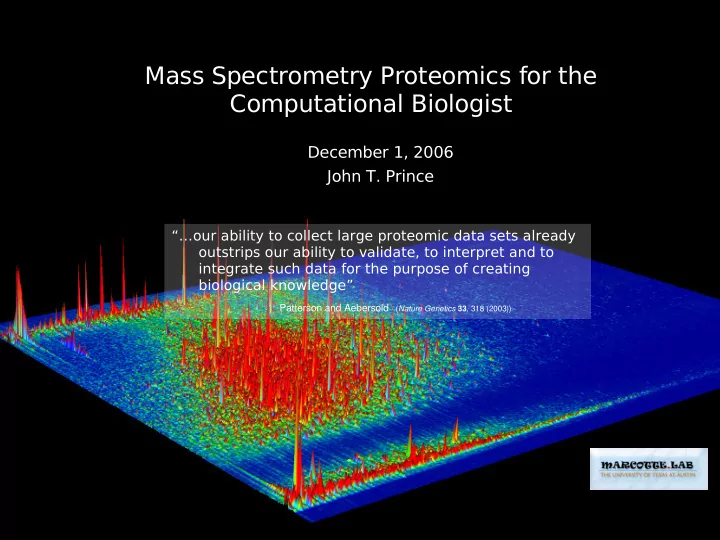
Mass Spectrometry Proteomics for the Computational Biologist

December 1, 2006 John T. Prince

“…our ability to collect large proteomic data sets already

  • utstrips our ability to validate, to interpret and to

integrate such data for the purpose of creating biological knowledge”

Patterson and Aebersold (Nature Genetics 33, 318 (2003))

slide-2
SLIDE 2

Mass Spectrometry (MS) Proteomics

Needs Computational Biologists

“…our ability to collect large proteomic data sets already outstrips our ability to validate, to interpret and to integrate such data for the purpose of creating biological knowledge”

Patterson and Aebersold (Nature Genetics 33, 318

(2003))

slide-3
SLIDE 3

MS Proteomics

How? Data? Problems?

slide-4
SLIDE 4

Why Proteomics?

and not just Transcriptomics

Proteins are the actual players mRNA not necessarily proportional to protein level

translational control degradation

Post-translational modifications alter cell state Cellular localization

slide-5
SLIDE 5

Mass Spec (Proteomics)

Ionization

MALDI ESI

m/z Analysis

TOF Quadrupole Ion Trap FTICR Orbitrap

slide-6
SLIDE 6

MALDI

Matrix Assisted Laser Desorption Ionization

http://www.eurogentec.com/module/images2/p23_3.jpg

slide-7
SLIDE 7

ESI Electrospray Ionization

http://www.phoenix-st.com/images/splash2.jpg

slide-8
SLIDE 8

TOF

Time of Flight

vacuum vacuum

high velocity low velocity

detector

TOF (reflectron)

detector

slide-9
SLIDE 9

Q

(e.g., Q-TOF, QQQ)Quadrupole

http://www.bris.ac.uk/nerclsmsf/images/quadrupole.gif http://www.rzuser.uni-heidelberg.de/~bl5/ency/pics/t_tsq1.jpg

QQQ

slide-10
SLIDE 10

Quadrupole Ion Trap

http://www.rzuser.uni-heidelberg.de/~bl5/ency/pics/q_trap01.jpg

  • K. Yoshinari, Rapid Commun. Mass Spectrom. 14, 215-223 (2000)
slide-11
SLIDE 11

FT-ICR

Fourier Transform Ion Cyclotron Resonance

http://www.ivv.fraunhofer.de/ms/ms-analyzers.html

slide-12
SLIDE 12

FT-Orbi

Orbitrap

http://www.spectroscopynow.com/ftp_images/orbitrap_0505.jpg

(from Linear Ion Trap via C trap)

slide-13
SLIDE 13

Mass Spectrometry (Proteomics)

Ionization ESI (Electrospray Ionization) MALDI (Matrix Assisted Laser Desorption Ionization) m/z Analysis TOF (Time of Flight) Q ([e.g. Q-TOF] Quadrupole) Ion Trap FTICR (Fourier Transform Ion Cyclotron Resonance) Orbitrap

slide-14
SLIDE 14

Data

Spectrum ESI Protein Spectrum 2D MALDI imaging PMF (peptide mass fingerprinting) LC-MS Peptide Fragmentation MudPIT

slide-15
SLIDE 15

Spectrum

m/z ion count MH+ MH+ M2H++

(peak heights are the number of ions that hit the detector at the given m/z)

slide-16
SLIDE 16

Why Not Proteins?

http://www-methods.ch.cam.ac.uk/siteimages/sw3.jpg http://www.nature.com/nbt/journal/v21/n3/images/nbt0303-255-T1.gif

Multiple Charge States (ESI) PTMs (Post-Translational Modifications)

slide-17
SLIDE 17

MALDI on Biological Sample

http://www.mcb.mcgill.ca/~hallett/GEP/PLecture4/image002.gif

Signal Processing

Classification Analysis

slide-18
SLIDE 18

  • rganize data

integrate data

mine data

MALDI-TOF Application

http://www.mc.vanderbilt.edu/msrc/images/maldi_ms_principle.jpg

slide-19
SLIDE 19

PMF

Peptide Mass Fingerprinting

http://www.spectroscopynow.com/ftp_images/2Fig3.gif

statistical validation

slide-20
SLIDE 20

elution prediction

registration m/z

LC-MS

Liquid Chromatography MS

Reverse Phase Chromatography (RPC)

http://www.ionsource.com/tutorial/chromatography/rphplc10.gif

ESI MS t i m e ( h y d r

  • p

h

  • b

i c i t y )

slide-21
SLIDE 21

MS/MS (Peptide Fragmentation)

http://www.mcb.mcgill.ca/~hallett/GEP/PLecture5/PLecture5.html

slide-22
SLIDE 22

Peptide Fragmentation (MS/MS)

Ala Phe Thr Gly

diagram adopted from Mayo Clin Proc. 2002;77:1185-1196

71.03 147.06 101.04 57.02

m/z intensity (ion count)

AFTG

b1 y3 b2 y2 b2 y1

b1 b2 b3 AFTG (MH+)

peptide break

slide-23
SLIDE 23

Shotgun Proteomics

quantitation peptide fragmentation prediction spectra comparison metrics peptides to proteins integrating bayesian priors

slide-24
SLIDE 24

MuDPIT

Multidimensional Protein Identification Technology

SCX (Strong Cation Exchange) RP (Reverse Phase-C18)

Ion Trap ESI

multi-dimensional dataset registration

slide-25
SLIDE 25

PTM's

Post-translational Modifications

http://www.nature.com/nbt/journal/v21/n3/images/nbt0303-255-T1.gif

slide-26
SLIDE 26

Spectra In Metric-Space

2300 points (at random) in 3D space

slide-27
SLIDE 27

Data Format/Storage/Sharing

Object Models still being worked out Huge Datasets

how much to save? how much is it worth?

Sharing

OPD Peptide Atlas PRIDE GPM

slide-28
SLIDE 28

Biological Integration

slide-29
SLIDE 29

mRNA vs. Protein

Chen et. al. Gygi et. al. Griffin et. al. Washburn et. al. Futcher et. al. Ideker et. al.

Source

rp = 0.94 rs = 0.59 b rp = 0.356 c 106 mid-log Yeast 57 stage I, 19 stage III, 9 non-neoplastic 2% ethanol/ 2% galactose rich/minimal 2% ethanol/ 2% glucose +/- gal (gal inducing media)

Perturbation (or sample)

Lung

adenocarcinomas

Yeast Yeast Yeast Yeast

Subject

rp = -0.025 d 98 (165 prots) rs = 0.21 245 rs = 0.45 678 rs = 0.74 rp = 0.76 a 148 rp = 0.61 289

Correlation

Num Genes

Chen et. al. Gygi et. al. Griffin et. al. Washburn et. al. Futcher et. al. Ideker et. al.

Source

rp = 0.94 rs = 0.59 b rp = 0.356 c 106 mid-log Yeast 57 stage I, 19 stage III, 9 non-neoplastic 2% ethanol/ 2% galactose rich/minimal 2% ethanol/ 2% glucose +/- gal (gal inducing media)

Perturbation (or sample)

Lung

adenocarcinomas

Yeast Yeast Yeast Yeast

Subject

rp = -0.025 d 98 (165 prots) rs = 0.21 245 rs = 0.45 678 rs = 0.74 rp = 0.76 a 148 rp = 0.61 289

Correlation

Num Genes

a = after normalizing the data b = calculated by Futcher et. al. c = 73 genes with lower abundance transcripts d = after detailed statistical analysis
slide-30
SLIDE 30

Disulfide Bonds

Expected fraction: 1 - (1-freq)^n [Rolling one “6” in n rolls is 1 – (5/6)^n]

Using RasMol amino acid color scheme

slide-31
SLIDE 31

180 220 256 292 320 328

Capillary Temperature (deg C)

slide-32
SLIDE 32

Acknowledgments

  • Dr. Edward Marcotte
  • Dr. Klaus Linse
  • Dr. Maria Person
  • Dr. Aleksey Nakorshevskiy
  • Dr. Rong Wang
  • Dr. Peng Lu

Zhihua Li