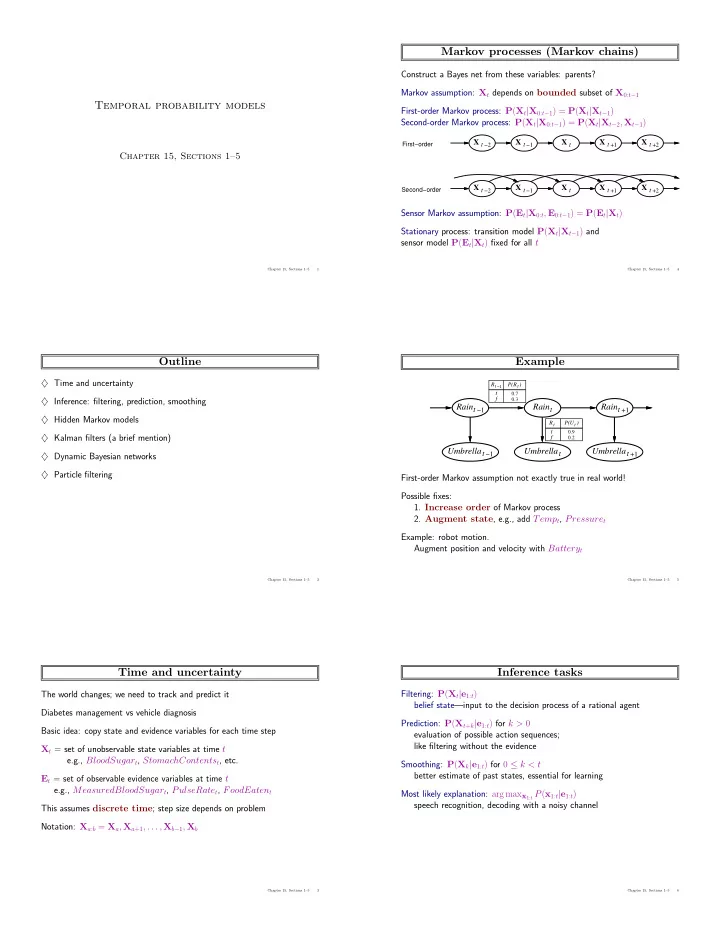

Temporal probability models
Chapter 15, Sections 1–5
Chapter 15, Sections 1–5 1Outline
♦ Time and uncertainty ♦ Inference: filtering, prediction, smoothing ♦ Hidden Markov models ♦ Kalman filters (a brief mention) ♦ Dynamic Bayesian networks ♦ Particle filtering
Chapter 15, Sections 1–5 2Time and uncertainty
The world changes; we need to track and predict it Diabetes management vs vehicle diagnosis Basic idea: copy state and evidence variables for each time step Xt = set of unobservable state variables at time t e.g., BloodSugart, StomachContentst, etc. Et = set of observable evidence variables at time t e.g., MeasuredBloodSugart, PulseRatet, FoodEatent This assumes discrete time; step size depends on problem Notation: Xa:b = Xa, Xa+1, . . . , Xb−1, Xb
Chapter 15, Sections 1–5 3Markov processes (Markov chains)
Construct a Bayes net from these variables: parents? Markov assumption: Xt depends on bounded subset of X0:t−1 First-order Markov process: P(Xt|X0:t−1) = P(Xt|Xt−1) Second-order Markov process: P(Xt|X0:t−1) = P(Xt|Xt−2, Xt−1)
X t −1 X t X t −2 X t +1 X t +2 X t −1 X t X t −2 X t +1 X t +2
First−order Second−order
Sensor Markov assumption: P(Et|X0:t, E0:t−1) = P(Et|Xt) Stationary process: transition model P(Xt|Xt−1) and sensor model P(Et|Xt) fixed for all t
Chapter 15, Sections 1–5 4Example
t
Rain
t
Umbrella Raint −1 Umbrellat −1 Raint +1 Umbrellat +1
Rt −1
t
P(R ) 0.3 f 0.7 t
t
R
t
P(U ) 0.9 t 0.2 f
First-order Markov assumption not exactly true in real world! Possible fixes:
- 1. Increase order of Markov process
- 2. Augment state, e.g., add Tempt, Pressuret
Example: robot motion. Augment position and velocity with Batteryt
Chapter 15, Sections 1–5 5Inference tasks
Filtering: P(Xt|e1:t) belief state—input to the decision process of a rational agent Prediction: P(Xt+k|e1:t) for k > 0 evaluation of possible action sequences; like filtering without the evidence Smoothing: P(Xk|e1:t) for 0 ≤ k < t better estimate of past states, essential for learning Most likely explanation: arg maxx1:t P(x1:t|e1:t) speech recognition, decoding with a noisy channel
Chapter 15, Sections 1–5 6