
SLIDE 1
March 2013
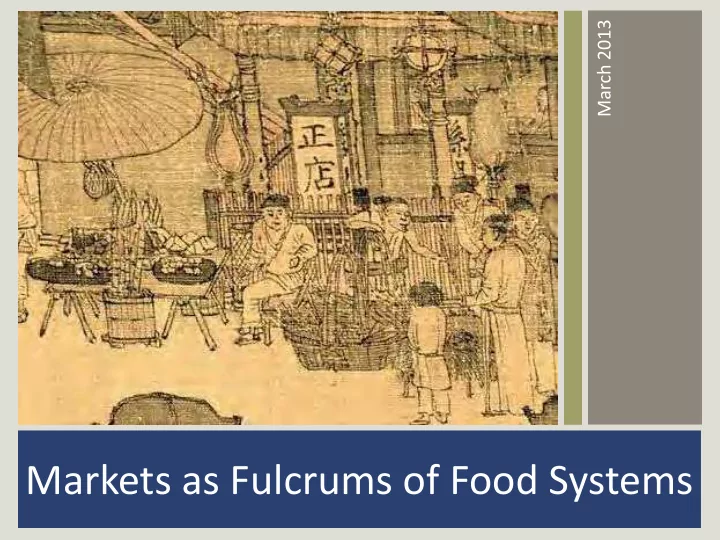
Markets as Fulcrums of Food Systems A community food system is one - - PowerPoint PPT Presentation
March 2013 Markets as Fulcrums of Food Systems A community food system is one in which "food production, processing, distribution and consumption are integrated to enhance the environmental, economic, social and nutritional health of a
March 2013
Farmers Market Coalition’s Triple Bottom Line: Markets benefit vendors, shoppers and the surrounding community
A community food system is one in which "food production, processing, distribution and consumption are integrated to enhance the environmental, economic, social and nutritional health of a particular place." From Discovering the Food System: A
Primer on Community Food Systems, Cornell University.
1970: Back-to-land farmers organize farmers markets
1990s: Main Street and neighborhood
movement 2005+: Public Health advocates begin to use markets
Economic capital: market sales, Main Street sales, vendor-vendor sales, sales per square foot, sales tax collected, jobs created… Goal: Wealth creation in the region.
Social capital = building trust and civic engagement between: vendor-shopper, vendor- vendor, neighbor-neighbor, , generations, rural-urban, market organizer-vendor, market organizer-shopper, market organization-partner
Goal: Bridging and bonding
Intellectual capital = Can be measured by recipes given, demos done, fact sheets produced, school tours… Sharing information and learning new things.
Natural capital = Agricultural land expanded, farmers adding products, sustainable methods of harvesting Protecting or reviving foodshed, watershed and green space.
Great markets seek out different indicators and audiences constantly, moving between them to
Great markets see their place in the context of the larger movement.
Great markets also serve a long period of time,
different times in their “conversion.”
What’s next then? Who’s not here?
m ari n ers m atch
f a r me r s ma r k e t r e l i e f f
h e r
s r e t u r ni ng f r
t h e se a
. . . w hi l e s up p l i es l as t!f in ally s om ethi n g go o d
the ho ri zo n
m arin ers m atch is a j1
s how us your an d p icture i. d. co m m ercial f f i i s s h h i i n n g g l l i i c c e e n n s s e e W e bel i eve f arm ers m ark ets are good fit’ s as eas y as 1- 2 - 3
r e c e i v e
$ 4
i n m ark et tok en s f2 3
T ues days N ew O rl ean s T hurs days B ay S t. Loui s T hurs days N ew O rl ean s S aturdays Lon g B each S aturdays N ew O rl ean s S aturdays O cean S pri n gsImmigrant issues? Disaster Recovery? Worker-Ownership? Food workers rights? Heirloom foods? Fair Trade?