SLIDE 1
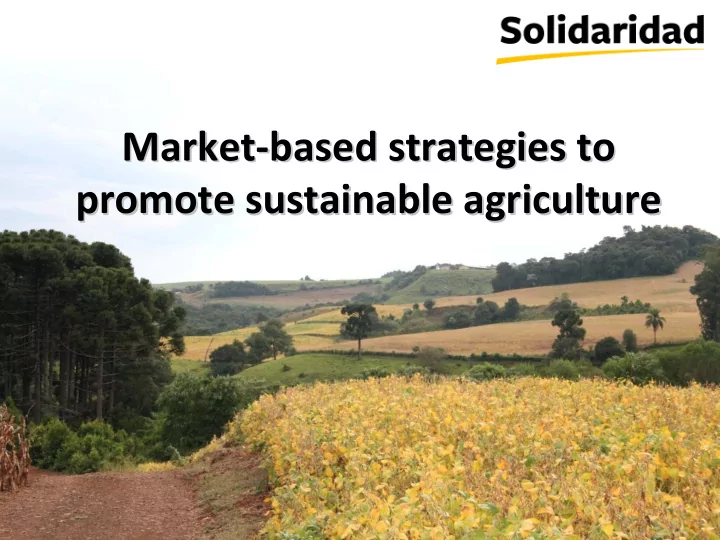
Market Market‐ ‐based strategies to based strategies to promote sustainable agriculture promote sustainable agriculture
SLIDE 2 Solidaridad
- Development Foundation of Dutch origin
- Launched in 1969 by the Catholic and Protestant Dutch
churches for development aid in Latin America
- In the 1980’s, World pioneer in the development of fair trade
products
- In the 1990’s and 2000’s,
increased scope ‐ fair and sustainable supply chains from producer to consumer, created through fair trade and corporate social responsibility.
- Different labels and engagement in multi‐stakeholders
initiatives (round‐tables)
- In 2000’s, no more ties to the churches
- Creation of the Solidaridad Network
SLIDE 3 Solidaridad chains of
coffee, tea, cotton, cocoa, gold, soy, palm oil, sugarcane and tropical fruits
Regional offices in Europe, Asia, Africa and Latin America
SLIDE 4 Round Tables and Industry Codes Corporate Social Responsibility Consumer labels
Consumers Retail and brands Sectors
Utz Certified Good Inside – Coffee, cocoa, tea SA 8000 – Clothing, footwear Fair Wear – Clothing – 4C: Common Code for the Coffee Community – RSPO: Palm oil – RTRS: Soy
- BSI: Sugar cane
- BCI: Cotton
EKO – Organic MAX HAVELAAR – Fair Trade
Brands and labels work to change sectors
regulation
SLIDE 5
Solidaridad initiatives
SLIDE 6
Solidaridad active engagement in roundtable
SLIDE 7 Exporters
Companies
Consumers
- Training
- Self‐
- rganization
- Certification
- Market access
- Sustainable
production
trading conditions
consumption
raising
processing & marketing
responsibility
sustainable products
Solidaridad works throughout the value chain
Producers Producer capacity building Match making
Civil society communication
Developing sustainable supply chains with multiple stakeholders
SLIDE 8
Brazilian Sustainable Soybean Family Farming
800 farmers 10-30 ha farms Family labor Food and cash crop production (no monoculture) Adding value on the farm (processing) Environmental preservation Food sovereignty in the region
SLIDE 9
SLIDE 10 Smallholder soybean farmers in Brazil
Soy Brazil Family Farms Large farms Estabelecimentos 164.011 51.966 Quantidade produzida (mi/t) 6,404 34,308 Área colhida (mi de ha) 2,707 12,939 Valor da produção (bi de R$) 2,891 14,249
Censo Agropecuário 2006 do Instituto Brasileiro de Geografia e Estatica (IBGE), a Agricultura Familiar é responsável por 16% da produção de soja no País.
SLIDE 11 Partners of the project
- Gebana/Coopafi: joint project helping family farmers
growing towards RTRS certification level
- Backed by Solidaridad, WWF and RTRS through co-
funding of development process
- Dutch dairy giant FrieslandCampina and Keurslagers
(quality butchers association) OTHER current clients
SLIDE 12
- Certificates for responsible soybean :
Independently audited proof 55 criteria verified: 37 minor, 13 major, 5 disqualifying Non-GM soy produced by produced family farmers Guaranteed no slave labor, no child labor, no deforestation
Outcomes
SLIDE 13 Responsible Family Soy Farming
KEURSLAGER
SLIDE 14 Certification bottlenecks for family farms
- Economies of scale
- Lack of education
- Poor technology
- Lack of capital
- Group certification
- Group organization
SLIDE 15 Certification opportunities for family farms
- Access to (new) markets
- Access to technical support
- Access to organizational support
- (Increased) access to credit
- Improved productivity
- Improved efficiency
- Better terms of trade
SLIDE 16 European Brand Support to Family Soy Farming
KEURSLAGER
SLIDE 17
Indian Sustainable Family Farming
0.5 - 2 ha farms Family labor Food and cash crop production (no monoculture) No child labor Reduction of pesticides Environmental preservation Food sovereignty in the region
SLIDE 18 Why companies engage
– Avoid being linked to bad practices by linking to good practices
- Social licence to operate
– Contribute to local development – Be able to show your commitment to shareholders, clients and general public
- Guarantee a responsible supply chain
- Be among the early movers
SLIDE 19
Name and Shame Campaings
Market campaigns to “name & shame” com- panies with social & environmental problems (To be Niked)
SLIDE 20
Why Does Business Engage The Soybean Case
SLIDE 21
REQUALIFICATION PROGRAM FOR SUGARCANE RURAL WORKERS
Beyond Certification Initiatives
SLIDE 22
Objectives of the program
Training and requalifying 3,500 cane cutters and community members per year for jobs in the sugar mills, ethanol plants and to work in other sectors, as a response to the process of mechanizing the sugarcane harvest to eliminate burning.
SLIDE 23
SLIDE 24
Thank You! Year report on www.solidaridadnetwork.org