March 28, 2018 Workshop 1: Short Term Debris Operations LOCATION: - - PowerPoint PPT Presentation

march 28 2018
SMART_READER_LITE
LIVE PREVIEW

March 28, 2018 Workshop 1: Short Term Debris Operations LOCATION: - - PowerPoint PPT Presentation

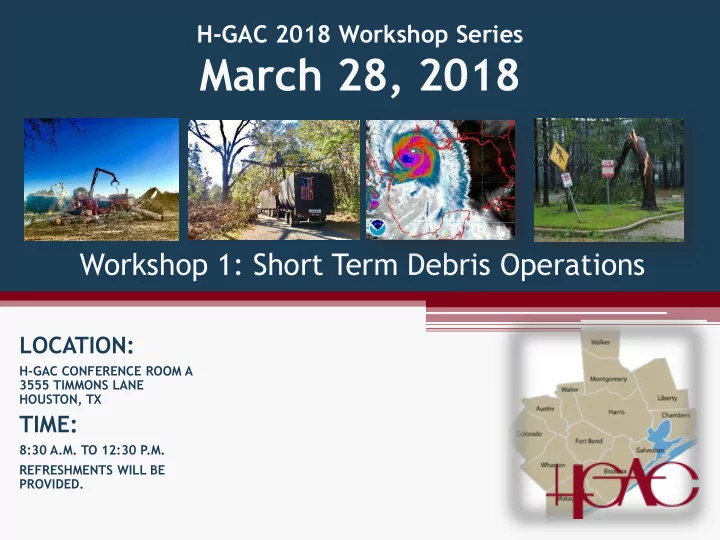
H-GAC 2018 Workshop Series March 28, 2018 Workshop 1: Short Term Debris Operations LOCATION: H-GAC CONFERENCE ROOM A 3555 TIMMONS LANE HOUSTON, TX TIME: 8:30 A.M. TO 12:30 P.M. REFRESHMENTS WILL BE PROVIDED. Agenda Introductions and

slide-1
SLIDE 1

H-GAC 2018 Workshop Series

March 28, 2018

Workshop 1: Short Term Debris Operations

LOCATION:

H-GAC CONFERENCE ROOM A 3555 TIMMONS LANE HOUSTON, TX

TIME:

8:30 A.M. TO 12:30 P.M. REFRESHMENTS WILL BE PROVIDED.

slide-2
SLIDE 2

Agenda

  • Introductions and Purpose
  • Debris Estimating
  • Contracting Debris Services
  • Mobilization of Resources
  • Break
  • Debris Clearance and Collection from the Right of

Way

  • Debris Management Site Selection and Operation
  • Break
  • Dangerous Trees
  • Project Worksheets
  • Meeting with FEMA

2

slide-3
SLIDE 3

Welcome

  • Introductions
  • Name
  • Agency

3

slide-4
SLIDE 4

Part 1: Debris Estimating

slide-5
SLIDE 5

Purpose of Debris Estimates

  • Important part of preliminary

damage assessments.

  • Helps to determine if a disaster

declaration should be approved.

  • Needed to understand the

scope and potential costs of response and recovery.

  • Needed to make decisions

regarding staffing, equipment, contractors and resource support.

5

slide-6
SLIDE 6

Guidance for Debris Estimating

  • Debris Estimating Guide,

FEMA 329, 2010

6

slide-7
SLIDE 7

Processes for Debris Estimates

  • Ground measurements
  • Aerial and satellite

photographs

  • Computer models

7

slide-8
SLIDE 8

Ground Measurements

  • Divide the area into

sections.

  • Determine if street by

street estimates or a representative sample is appropriate.

  • Obtain personnel and

equipment to conduct assessments.

8

slide-9
SLIDE 9

Ground Measurement Equipment

  • Digital camera or smart phone
  • Measuring tape or wheel
  • Calculator or smart phone
  • GPS unit
  • Note paper
  • Maps of the area
  • Laser rangefinder
  • Vehicle
  • Safety – Water, first aid kit,

mosquito repellent

9

slide-10
SLIDE 10

Ground Measurement Considerations

  • Depending on how soon the estimate is taken

there may still be eligible debris inside the homes and in the yards of residences.

  • Eligible hanging limbs and dangerous trees

should be included.

  • Ineligible debris (e.g. old tires, commercial

debris, old tires, debris generated before the disaster) should NOT be counted in the estimate.

10

slide-11
SLIDE 11

Ground Measurements - Piles

  • One acre of debris 10 feet high = 16,133 cubic

yards (CY)

11

slide-12
SLIDE 12

Ground Measurements - Piles

  • Approximate the debris

piles using cubes.

  • One cubic yard is about

the size of a standard washing machine.

12

slide-13
SLIDE 13

Ground Measurements – General Buildings Formula

  • Multiply building length, width and height by a

constant of .33 (to account for air space in the building) and divide by 27.

  • Measurements must be in feet.

13

slide-14
SLIDE 14

Ground Measurements – Single Family Residence Formula

  • Multiply structure length x width x number of

stories x a constant of 0.20 x a vegetative cover multiplier (VCM).

  • Length and width must be in feet.

14

slide-15
SLIDE 15

VCM

  • Light, 1.1 multiplier –

More ground is visible than trees.

  • Common to newer

subdivisions.

15

League City – Bay Colony Subdivision

slide-16
SLIDE 16

VCM

  • Medium, 1.3 multiplier

– Uniform pattern of

  • pen space and tree

canopy cover

  • This is the most

commonly used multiplier

16

Houston – Lazybrook Subdivision

slide-17
SLIDE 17

VCM

  • Heavy, 1.5 multiplier –

The ground or houses cannot be seen due to the tree canopy cover.

17

Houston Near Memorial Drive

slide-18
SLIDE 18

Aerial Estimates

  • Aerial estimates are helpful when:
  • Estimates are needed quickly
  • There is a large debris area and it is difficult

to gain a good perspective on debris quantities.

  • Validating ground measurements or computer

models.

18

slide-19
SLIDE 19

Aerial Estimates

  • Obtain pictures and satellite

images of both before and after the disaster.

  • Select an object of reference

with known dimensions such as a vehicle or structure to establish a dimensional scale.

  • Apply the dimensional scale to

determine the size of objects in the photo.

19

slide-20
SLIDE 20

Computer Models

  • HAZUS-MH

Software

  • Hurrevac – U.S.

Army Corps of Engineers

20

slide-21
SLIDE 21

Computer Model Data

  • Historic data on debris quantities.
  • GIS data on topography, land use and

development.

  • Disaster specific information such as storm

category.

  • Combines data elements to determine a debris

estimate.

21

slide-22
SLIDE 22

Part 2: Contracting Debris Haulers and Monitors

slide-23
SLIDE 23
  • The magnitude of debris

and resources needed to respond may overwhelm the local jurisdiction.

  • Experienced contractors

may provide the staffing, expertise and equipment needed to address the need.

Procurement of Contractor Services

23

slide-24
SLIDE 24
  • Local governments must

use their own documented procurement procedures that reflect State and local laws and regulations, providing those laws and regulations conform with Federal laws and standards.

Rules Regarding the Use of Contractors

24

slide-25
SLIDE 25
  • Provide full and open competition
  • Conduct all necessary affirmative steps to ensure

the use of minority businesses, women’s business enterprises, and labor surplus area firms when possible

  • Exclude contractors that develop or draft

specifications, requirements, statements of work, etc.

  • Maintain written standards of conduct governing

employees who engage in the selection, award, and administration of contracts

Federal Contracting Standards

25

slide-26
SLIDE 26
  • Maintain records

sufficient to detail the history of the procurement

  • Rationale for the

method of procurement

  • Selection of contract

type

  • Contractor selection
  • r rejection
  • The basis for the

contract price

Federal Contracting Standards

26

slide-27
SLIDE 27
  • Micro-purchase
  • Small purchase procedure
  • Sealed bid (formal

advertising)

  • Competitive proposal

Acceptable Procurement Methods

27

slide-28
SLIDE 28
  • FEMA may reimburse costs incurred under a contract

procured through a noncompetitive proposal only when:

  • The item is only available from a single source
  • The public exigency or emergency for the

requirement will not permit a delay resulting from competitive solicitation

  • FEMA or the Recipient expressly authorizes a

noncompetitive proposal in response to a written request from the Applicant

  • After solicitation of a number of sources, competition

is determined inadequate

Procurement Methods

28

slide-29
SLIDE 29
  • FEMA reimburses costs incurred using three

types of contract payment obligations:

  • Fixed-price
  • Cost-reimbursement
  • Time and materials (to a limited extent)

FEMA does not reimburse costs incurred under a cost plus a percentage of cost contract or a contract with a percentage of construction cost method.

Types of Contracts

29

slide-30
SLIDE 30
  • In issuing contracts the jurisdiction should:
  • Have required provisions in all contracts

awarded.

  • Maintain oversight to ensure contractors

perform according to the conditions and specifications of the contract and any purchase orders.

Monitoring Contractor Performance

30

slide-31
SLIDE 31
  • Equal Employment Opportunity
  • Copeland ‘‘Anti-Kickback’’ Act
  • Davis-Bacon Act
  • Contract Work Hours and Safety Standards Act
  • Clean Air Act and the Federal Water Pollution

Control Act

  • Byrd Anti-Lobbying Amendment
  • Debarment and Suspension
  • See 2 CFR §215.48 for contract provision

requirements

Required Provisions

31

slide-32
SLIDE 32

Part 3: Mobilization of Resources

slide-33
SLIDE 33

Contacting Resources

  • Maintain a contact list of:
  • Local staff
  • Mutual aid partners
  • Debris contractor
  • Debris monitoring firm
  • Contacts needed for

resource requests and sharing situational awareness

33

slide-34
SLIDE 34

Contacting Resources

  • Provide information to staff

regarding:

  • When and where to report
  • To whom they should report
  • Where to park
  • What they will be doing
  • How long they are likely to be

deployed

34

slide-35
SLIDE 35

Contacting Resources (continued)

  • How they should dress
  • What they should bring with them (food,

water, personal protective gear, clothing, etc.)

  • What they should not bring with them (their

children, all the food from their freezer to store at the EOC, etc.)

  • Importance of documenting hours and

activities

35

slide-36
SLIDE 36

Staging Equipment

  • Identify an area where equipment can be safely

staged until needed. Considerations in staging equipment includes:

  • Out of harms way from the disaster
  • Secure – fencing, lighting, security, etc.
  • Easy ingress and egress

36

slide-37
SLIDE 37

Staging Equipment (continued)

  • Paved surface or surface able to

accommodate the equipment to be stored there

  • At or near fueling resources
  • Access to restrooms, water, food

and lodging

  • Designate a staging manager
  • Communications

37

slide-38
SLIDE 38

Conduct Regular Operational Briefings

  • Update on the status of
  • perations
  • Objectives
  • Assignments and strategies
  • Safety considerations
  • Weather and other

environmental considerations

  • Date, time and location of

next briefing

38

slide-39
SLIDE 39

Assignments to Staff

  • Provide clear instructions regarding:
  • Where they will be working and for how long
  • Tasks to be performed
  • Logistical considerations
  • Processes for documenting activities,

equipment use and hours

  • Who to contact with questions or concerns
  • Safety

39

slide-40
SLIDE 40

Other Considerations in Mobilization

  • Do not ask someone to do something that is

above their training or capabilities.

  • Understand who talks, and who doesn’t talk, to

the media.

  • Inspect equipment for safety prior to each use.
  • Employ the use of checklists.
  • Monitor staff for job performance, stress,

hydration, safety, and exhaustion.

40

slide-41
SLIDE 41

Part 4: Debris Clearance and Collection on the ROW

slide-42
SLIDE 42

Emergency Roadway Clearance

42

slide-43
SLIDE 43

Emergency Roadway Clearance

  • Clear roads to

allow the safe passage of emergency vehicles.

  • Debris is pushed
  • ff the road and
  • n to the ROW.

43

slide-44
SLIDE 44

Road Clearance Resources

  • Force account
  • Contractors
  • Mutual Aid

44

slide-45
SLIDE 45

Road Clearance Priorities

  • Critical roads with

access to:

  • Fire stations
  • Police stations
  • Hospitals
  • Nursing facilities
  • Pump stations
  • Utilities

45

slide-46
SLIDE 46
  • Truck certification is the

process used to document the capacity

  • f debris removal trucks.

Truck Certification

46

slide-47
SLIDE 47

Truck Certification

  • Truck certifications should

include:

  • Unique truck number
  • Driver name
  • Driver phone number
  • License number, state issued,

and expiration date

  • Tag number, state issued, and

expiration date

  • Vehicle measurements
  • Sketch of the vehicle

47

slide-48
SLIDE 48

Debris Collection Along the ROW

  • Establish priorities for

collection of debris

  • Clearly communicate

instructions to the public for segregation

  • f debris.
  • Use GIS maps to track

progress and assign routes to crews.

48

slide-49
SLIDE 49

49

Debris Collection Within the ROW

slide-50
SLIDE 50

Debris Monitoring

50

slide-51
SLIDE 51

51

Additional Passes Throughout the Community

slide-52
SLIDE 52

Track Debris Collection Progress

52

slide-53
SLIDE 53

Part 5: DMS Selection and Operation

slide-54
SLIDE 54
  • Temporarily store

debris and conduct some form of reduction before the debris is transported to a final disposal facility.

Purpose of a Debris Management Site

54

slide-55
SLIDE 55

Considerations in selection of a DMS:

  • Current availability
  • Duration of availability
  • Site ingress/egress
  • Geographic location within the jurisdiction
  • A minimum of 10 acres of usable land

55

slide-56
SLIDE 56
  • Photograph the site.
  • Record physical

features.

  • Conduct historical

evaluation.

  • Sample soil and

water.

  • Get site approval

from TCEQ.

DMS Guidance

56

slide-57
SLIDE 57
  • Well-drained site with soils suitable for

supporting heavy vehicles and equipment

  • Easy access to transportation routes
  • Strategic placement to minimize debris

transportation requirements and travel time to and from loading points

  • Located as close as possible to the

concentrations of disaster debris

  • Access to electrical and water utilities for site
  • perations
  • Minimum potential for disruption of critical

services

Considerations in selection of a DMS:

57

slide-58
SLIDE 58
  • Chipping and

grinding

Debris Reduction Methods

58

slide-59
SLIDE 59

Debris Reduction Methods

  • Reduction via

Open Burning

59

slide-60
SLIDE 60

Debris Reduction Methods

  • Reduction via

Air-Curtain Incineration

60

slide-61
SLIDE 61

61

Debris Diverted from Waste Stream

slide-62
SLIDE 62

Part 6: Dangerous Trees

slide-63
SLIDE 63

Eligible Vegetative Debris

  • Includes tree limbs, branches, stumps or trees

that are still in place but damaged to the extent they pose an immediate threat.

  • They are not eligible if the damage existed

prior to the incident, or if the item is in a natural area and does not extend over improved property or public use areas, such as trails, sidewalks, or playgrounds.

63

slide-64
SLIDE 64

Broken Limbs

64

  • Must be 2 inches or

larger in diameter and pose an immediate threat.

  • Only minimum cut is

eligible.

slide-65
SLIDE 65

Broken Limbs on Private Property

  • Not eligible unless:
  • The limbs or branches extend over the public

ROW.

  • The limbs or branches pose an immediate

threat.

  • The Applicant removes the hazard from the

ROW without entering the private property.

65

slide-66
SLIDE 66

Tree Removal

66

  • Eligible if:
  • Has a split trunk
  • Has a broken canopy
  • Is leaning at an

angle greater than 30 degrees

slide-67
SLIDE 67

Tree Removal – Root Ball Exposed

  • If less than 50 percent of the root ball is

exposed, FEMA will only provide funding to flush cut the tree and dispose of the cut portion by volume or weight.

67

  • If 50 percent or more of

the root ball is exposed removal of the tree and root ball and filling the root ball hole are eligible.

slide-68
SLIDE 68

Stump Removal

  • Removal of a stump and

filling the root ball hole are eligible if 50 percent

  • r more of the root ball

is exposed.

  • Grinding a stump in

place is eligible if it is less costly than removal.

68

slide-69
SLIDE 69

Stump Removal

69

  • FEMA will only reimburse contracted cost on a

per stump basis if:

  • The stump is 2 feet or larger in diameter

measured 2 feet above the ground.

  • Extraction is required as part of the removal.
  • If less than 2 feet in diameter, FEMA only

provides funding based on weight or volume.

slide-70
SLIDE 70

Documentation Requirements

  • Photograph or video documentation that shows

the item is on public property.

  • Diameter of each item removed.
  • Measurement must be 2 feet up the trunk for

stumps and 4.5 feet for trees.

  • Quantity of material to fill root-ball holes.
  • Equipment used to perform the work.

70

slide-71
SLIDE 71

Part 7: Project Worksheets

slide-72
SLIDE 72

Public Assistance Program Field Operations Pocket Guide FEMA P-1011

  • Describes the fundamentals to

be followed in PA field

  • perations nationally in order to

streamline processes for more efficient program delivery and provides detailed instructions on critical elements of the Project Worksheet (PW)2 development process.

72

slide-73
SLIDE 73

Purpose of the Project Worksheet (PW)

  • Provides details of the Applicant’s project
  • Gives a detailed description of the disaster-

related damage and dimensions.

  • Lists the associated scope of work (SOW) and

costs.

73

slide-74
SLIDE 74

Purpose of the PW

  • FEMA, through PW

approval, will obligate the approved funding, which will be made available to the State for distribution to the Applicant.

74

slide-75
SLIDE 75

Information Needed

  • Copy of the debris removal contractor

contract(s)

  • Copy of the debris monitoring firm contract(s)
  • Information on the procurement process of the

debris removal and monitoring contracts

  • Address (if available) and GPS coordinates for

all DMS

75

slide-76
SLIDE 76

Information Needed (continued)

  • Debris volume and costs estimates (using USACE

model and damage assessment reports)

  • Monitoring cost estimate (based on budgeted

labor hours)

  • Brief debris removal plan overview

76

slide-77
SLIDE 77

Project Worksheets

  • If the project involves multiple locations, FEMA

may use site sheets to differentiate damage, work, and costs by site within the PW.

  • The disaster damage and dimensions, scope of

work, and costs for each site are documented

  • n separate site sheets.

77

slide-78
SLIDE 78

Completing the PW

  • ALL PWs must be entered directly into EMMIE

by the project specialist.

78

slide-79
SLIDE 79

Completing the PW

  • Describe the location(s)
  • Describe the disaster related damage
  • Indicate if the Applicant has elected to use

the Alternate Procedures.

  • Define the scope of work.
  • Describe any special considerations.
  • Describe locations, dimensions, damage for

each site if there are multiple locations.

79

slide-80
SLIDE 80

Cost Estimates

  • The basis for cost estimates (e.g., actual

costs, unit costs) must be fully documented.

  • If the alternate procedures is used funding

will be fixed at the estimate agreed upon by the applicant, the grantee and FEMA.

80

slide-81
SLIDE 81

Cost Estimates

  • Estimates should include

all work items required to complete the scope of work, including all soft cost and preliminary engineering report costs.

81

slide-82
SLIDE 82

Administrative Costs

  • The applicant is entitled to reimbursement for

administrative costs incurred to help formulate a specific PW.

  • Administrative costs must be based on specific

tasks and associated costs as opposed to a percentage of the eligible work.

82

slide-83
SLIDE 83

Part 8: Meeting with FEMA

slide-84
SLIDE 84

Request a Meeting with the FEMA Public Assistance Officer (PAO)

  • Summarize the jurisdiction’s debris clearing

and removal operations to date

  • Review debris and cost estimates
  • Review any Disaster-Specific Guidance (DSG)

documents issued by FEMA

84

slide-85
SLIDE 85

Meeting with the PAO

  • Examine the jurisdiction’s

debris removal plan

  • Provide contact information

for the monitoring firm, debris removal contractors and key personnel

  • Determine additional

information the PAO will need to generate PWs.

85

slide-86
SLIDE 86

Recovery Operations

  • Conduct ongoing daily or weekly meetings with

FEMA.

  • Clearly communicate debris removal plans and
  • perations with FEMA.
  • Clear communication fosters a coordinated

effort that enhances the transparency of the

  • peration for auditors and ensures maximum

FEMA reimbursement.

86

slide-87
SLIDE 87

Force Account Records

  • Maintain force account labor records
  • Hours worked
  • Activity sheets tying those hours worked to

eligible disaster activities.

  • Document equipment usage.
  • Who
  • What
  • When
  • Where

87

slide-88
SLIDE 88

Contractor Procurement

  • Contract procurement records.
  • Rationale for the method of

procurement

  • Selection of contract type
  • Contractor selection or

rejection

  • The basis for the contract

price

88

slide-89
SLIDE 89

FEMA Approval for Gated Community and Private Property Debris Removal

  • Eligibility of gated community and private

property debris removal is determined by FEMA

  • n a case-by-case basis.
  • The private property debris must constitute an

immediate threat to life, public health, or safety, or to the economic recovery of the community at large.

89

slide-90
SLIDE 90

Info Needed for Gated Community and Private Property Debris Removal

  • Immediate threat determination
  • Documentation that the debris is a threat to

public health and safety.

  • Can coordinate through the Public Health

Authority for the jurisdiction

90

slide-91
SLIDE 91

Info Needed for Gated Community and Private Property Debris Removal

  • Documentation of legal

responsibility and indemnification

91

slide-92
SLIDE 92

Close-out FEMA Meeting

  • Compile contractor

invoices, force account expenses, contracts and other documentation supporting debris

  • perations for review

during the close-out meeting with FEMA.

92

slide-93
SLIDE 93

QUESTIONS?

93

slide-94
SLIDE 94

Thank You!

94