
SLIDE 1
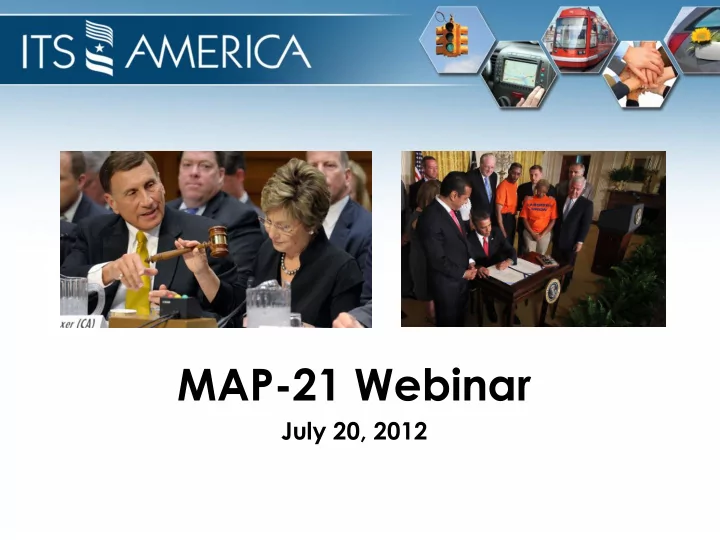
MAP-21 Webinar July 20, 2012 Where Are We Today? Moving Ahead for - - PowerPoint PPT Presentation
MAP-21 Webinar July 20, 2012 Where Are We Today? Moving Ahead for Progress in the 21 st Century Act (MAP-21) Conference Report passes Congress June 29, 2012 (House vote of 373-52; Senate vote of 74-19) President Obama signs MAP-21 into
Conference Report passes Congress
June 29, 2012 (House vote of 373-52; Senate vote of 74-19)
July 6, 2012
October 1, 2012
September 30, 2014
September 30, 2016
Keystone XL Pipeline? Coal Ash Deregulation? Pay-fors? No earmarks and a campaign season underway?
Current funding levels indexed to inflation LUST Trust Fund, Pensions, General Fund transfers used as pay-fors
measures, statewide and metro area performance targets
Streamlines environmental review process, expands categorical exclusions, allows initial work to begin before NEPA approval
safety, congestion, system reliability, freight movement
management and operations, incorporate performance targets
$62.5 million per year
National Goals and Performance Measures
Reduction, System Reliability, Freight Movement and Economic Vitality, Environmental Sustainability, Reduced Project Delivery Delays
agencies and stakeholders - FHWA to promulgate a rulemaking establishing performance measures and standards by April 1, 2014
annually on their progress towards meeting those targets
Consistent with ITS America’s performance measures proposal
Statewide and Metropolitan Planning
consider projects and strategies as part of their planning process that promote efficient system management and operation
– “Capital and operating costs for traffic management and traveler information monitoring, management, and control facilities and programs” – “Development and implementation of a State asset management plan…” – “Infrastructure-based intelligent transportation systems capital improvements”
– “Projects and strategies designed to support congestion pricing, including electronic toll collection and travel demand management strategies…”
– Funding doubled, eligibility expanded to include “...priority control system for emergency vehicles at signalized intersections… traffic control or other warning device at a location with high crash potential” – Data driven through planning and safety problem identification and countermeasure analysis
– “… projects to improve mobility, such as through real-time traffic, transit and multimodal traveler information… or otherwise reduces demand for roads through such means as telecommuting, ridesharing, carsharing, …and pricing”
– Expanded for projects in defined corridors that demonstrate substantial investment in fixed transit facilities including transit stations, ITS technology, traffic signal priority, and off-board fare collection
– “Transit-related intelligent transportation systems…”, “safety and security equipment and facilities” (including ITS solutions), and “the introduction of new technology through innovative and improved products…”
– Statewide and Metro Planning: “promotes efficient system management and
– New funding for technology demonstration and deployment projects, including “mobility management and improvements and travel data management systems” and “advancements in vehicle technology”
– Senate bill had funded program at $50 million – Saves Connected Vehicle Program – Requires V2V and V2I Deployment Report in 3 Years
year program to provide competitive grants to accelerate adoption of “innovative technologies” across surface transportation system
Similar to but broader than the Smart Technologies for Communities Act
improving operations and enhancing freight productivity
– Includes active traffic and demand management, accelerated deployment
real-time information, road weather management, and other ITS strategies
– Increased from $122 million to $1 billion – Threshold for ITS projects remains at $15 million – Master credit agreements allow applicants to receive funding for a program
– Rolling “first come first serve” application process
– Provides states with authority to toll new and existing highway facilities while ensuring that existing Interstate lanes that are now toll-free remain toll-free – HOV to HOT lane conversions must include automated toll collection systems and establish policies to manage demand using variable pricing – Within four years, all toll facilities on the federal–aid highway system must implement technologies or business practices that provide for the interoperability of electronic toll collection programs
– Goals include “to used advanced technology to improve the safety and data of the network” – “ITS…, real-time traffic, … multi-modal transportation information systems” are all eligible for a federal match up to 95% – State Freight Plans must consider innovative technologies and operational strategies, including ITS, that improve freight safety and efficiency
– Declaration of Policy: “it is in the national interest to promote the use of innovative technologies that increase the efficiency of construction, improve the safety, and extend the service life of highways and bridges … including state of the art intelligent transportation system technologies – Federal share can be up to 100 percent
House THUD Appropriations bill approved Includes amendments to prohibit spending on VMT user fee research or implementation, GPS tracking Senate timeline unclear
Highway Trust Fund programs protected Potential impact on Amtrak, some transit and aviation programs
Join ITS America’s Campaign for Intelligent Transportation Solutions
– Has improved Congressional and media relations – ITS industry at the table for key legislative debates – Has created new opportunities: Capitol Hill Tech Showcase, Smart Solution Spotlight, increased news coverage
debates including MAP-21 implementation
Congressional Roundtable membership, other benefits
Continue to educate your Senators, Congressmen, other electeds
Contact ITS America: Quentin Kelly ITS America Campaign Director 202-721-4212 qkelly@itsa.org Paul Feenstra Principal, Keystone Public Affairs 202-721-4237 pfeenstra@itsa.org or paul@kpa-llc.com Charlie Tennyson Member Services Coordinator 202-721-4207 ctennyson@itsa.org