Many thanks to the organizers Asia: Austrian Radiologists presents - - PowerPoint PPT Presentation

many thanks to the organizers
SMART_READER_LITE
LIVE PREVIEW

Many thanks to the organizers Asia: Austrian Radiologists presents - - PowerPoint PPT Presentation

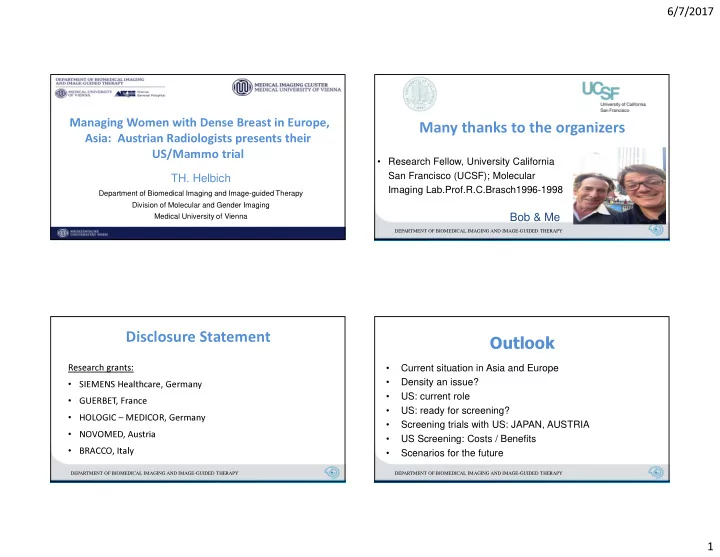
6/7/2017 Managing Women with Dense Breast in Europe, Many thanks to the organizers Asia: Austrian Radiologists presents their US/Mammo trial Research Fellow, University California San Francisco (UCSF); Molecular TH. Helbich Imaging


slide-1
SLIDE 1

6/7/2017 1

1

  • TH. Helbich

Department of Biomedical Imaging and Image-guided Therapy Division of Molecular and Gender Imaging Medical University of Vienna

Managing Women with Dense Breast in Europe, Asia: Austrian Radiologists presents their US/Mammo trial

DEPARTMENT OF BIOMEDICAL IMAGING AND IMAGE-GUIDED THERAPY

  • Research Fellow, University California

San Francisco (UCSF); Molecular Imaging Lab.Prof.R.C.Brasch1996-1998

Bob & Me

Many thanks to the organizers

DEPARTMENT OF BIOMEDICAL IMAGING AND IMAGE-GUIDED THERAPY

Disclosure Statement

Research grants:

  • SIEMENS Healthcare, Germany
  • GUERBET, France
  • HOLOGIC – MEDICOR, Germany
  • NOVOMED, Austria
  • BRACCO, Italy

DEPARTMENT OF BIOMEDICAL IMAGING AND IMAGE-GUIDED THERAPY

Outlook

  • Current situation in Asia and Europe
  • Density an issue?
  • US: current role
  • US: ready for screening?
  • Screening trials with US: JAPAN, AUSTRIA
  • US Screening: Costs / Benefits
  • Scenarios for the future
slide-2
SLIDE 2

6/7/2017 2

DEPARTMENT OF BIOMEDICAL IMAGING AND IMAGE-GUIDED THERAPY

WHO (IARC-Meeting 2002)

No evidence that self examination is helpful! No evidence that self examination is helpful!

Thomas et al, JNCI 2002

Shanghai trial: Role of “Self-examination” No Screening or Self - examination

DEPARTMENT OF BIOMEDICAL IMAGING AND IMAGE-GUIDED THERAPY

MG - SCREENING

EU goes with WHO recommendation

  • MG-SCREENING 50 – 70y.
  • BCA mortality reduction (30%)

5-year survival rate in EU-countries identical (+/- 5%

  • f difference)

Improve quality of life of women with BCA

EU goes with WHO recommendation

  • MG-SCREENING 50 – 70y.
  • BCA mortality reduction (30%)

5-year survival rate in EU-countries identical (+/- 5%

  • f difference)

Improve quality of life of women with BCA

DEPARTMENT OF BIOMEDICAL IMAGING AND IMAGE-GUIDED THERAPY

EU and MG - Screening

FIN; NL; S; UK; NOR; GER; LUX; E; DK FIN; NL; S; UK; NOR; GER; LUX; E; DK

DEPARTMENT OF BIOMEDICAL IMAGING AND IMAGE-GUIDED THERAPY

Why do we miss a cancer? 15-30% Why do we overdiagnose? 30-51%

slide-3
SLIDE 3

6/7/2017 3

DEPARTMENT OF BIOMEDICAL IMAGING AND IMAGE-GUIDED THERAPY

The Breast on Mammography

Two component tissue:

  • fatty tissue (dark)
  • fibroglandular tissue (white)

Fatty Scattered Density Extremely Dense

Yaffe et al, Breast Cancer Research 2009

DEPARTMENT OF BIOMEDICAL IMAGING AND IMAGE-GUIDED THERAPY

Contrast poor (white cancer and white

tissue)

density: 4.7-fold increase of risk to develop

BCA

density: BCAs later seen (BCA larger & LN+) density: 18-fold risk of interval cancer density: largest population of women with

15-25% life time risk

“unpleasant situation”: MG sensitivity low

and increased risk of BCA

The dense Breast

Brem R et al AJR 2014

DEPARTMENT OF BIOMEDICAL IMAGING AND IMAGE-GUIDED THERAPY DEPARTMENT OF BIOMEDICAL IMAGING AND IMAGE-GUIDED THERAPY

US of the Breast

slide-4
SLIDE 4

6/7/2017 4

DEPARTMENT OF BIOMEDICAL IMAGING AND IMAGE-GUIDED THERAPY

US guided Breast Biopsy

DEPARTMENT OF BIOMEDICAL IMAGING AND IMAGE-GUIDED THERAPY

Density and Influence on Sensitivity

DEPARTMENT OF BIOMEDICAL IMAGING AND IMAGE-GUIDED THERAPY

Adjunct Value of Breast US

DEPARTMENT OF BIOMEDICAL IMAGING AND IMAGE-GUIDED THERAPY

Adjunct Value of Breast US

slide-5
SLIDE 5

6/7/2017 5

DEPARTMENT OF BIOMEDICAL IMAGING AND IMAGE-GUIDED THERAPY

high frequency US performed by experienced

technologist or radiologists

has been shown to detect MG

  • ccult BCA

US of the breast

Brem R et al AJR 2014

DEPARTMENT OF BIOMEDICAL IMAGING AND IMAGE-GUIDED THERAPY

REASONS for Cancer Misses at MG

  • Reasons for nondetection at MG
  • 355 US only detected BCA
  • MGs reviewed (5 rads): indeed negative or recall?
  • 63 (19%) recalled; 272 (81%) no MG findings
  • 63 (19%) interpretative errors (of: 82% subtle findings)
  • 272 (81%): 78% overlapping tissue,
  • and 3% not on MG

DEPARTMENT OF BIOMEDICAL IMAGING AND IMAGE-GUIDED THERAPY

REASONS for Cancer Misses at MG

  • 272 (81%): 78% overlapping tissue,
  • and 3% not on MG

DEPARTMENT OF BIOMEDICAL IMAGING AND IMAGE-GUIDED THERAPY

REASONS for Cancer Misses at MG

  • 272 (81%): 78% overlapping tissue,
  • and 3% not on MG
slide-6
SLIDE 6

6/7/2017 6

DEPARTMENT OF BIOMEDICAL IMAGING AND IMAGE-GUIDED THERAPY

REASONS for Cancer Misses at US

  • Reasons for non-detection at US
  • 230 women with 230 pairs of US exams (prior / subsequent)
  • all found to have BCA
  • 72 (31%) visible findings
  • 72 (69%) no findings
  • No findings: aggressive BCA (Triple-, Grade 2-3; sg)

DEPARTMENT OF BIOMEDICAL IMAGING AND IMAGE-GUIDED THERAPY

REASONS for Cancer Misses at US

  • 72 (31%): visible findings
  • 57 /72 (79%): actionable findings
  • 2 most finding: 39% misinterpretation ( NOT CIRCUMSCRIBED MARGIN)

& 17% multiple distracting lesions

DEPARTMENT OF BIOMEDICAL IMAGING AND IMAGE-GUIDED THERAPY

REASONS for Cancer Misses at US

  • 72 (31%): visible findings
  • 57 /72 (79%): actionable findings
  • 2 most finding: 39% misinterpretation ( NOT CIRCUMSCRIBED MARGIN)

& 17% multiple distracting lesions

DEPARTMENT OF BIOMEDICAL IMAGING AND IMAGE-GUIDED THERAPY

REASONS for Cancer Misses at US

  • Pay ATTENTION
  • Margin : non circumscribed
  • Assess multiple lesions separately
slide-7
SLIDE 7

6/7/2017 7

DEPARTMENT OF BIOMEDICAL IMAGING AND IMAGE-GUIDED THERAPY

IS IT EFECTIVE TO SCREEN

WOMEN WITH DENSE BREAST WITH ULTRASOUND ??

US of the breast

DEPARTMENT OF BIOMEDICAL IMAGING AND IMAGE-GUIDED THERAPY

  • Objectives: effectiveness & safety of MG vs. MG&US
  • For breast cancer screening
  • Women at average risk

Cochrane Review

DEPARTMENT OF BIOMEDICAL IMAGING AND IMAGE-GUIDED THERAPY

  • Selection:
  • Randomized controlled trials (RCTs)
  • Prospective non-randomized controlled trials
  • Low risk of bias and >500 participants
  • Efficacy and harms
  • Population: women 40-75y, AVERAGE RISK FOR BCA

Cochrane Review

DEPARTMENT OF BIOMEDICAL IMAGING AND IMAGE-GUIDED THERAPY

Cochrane review (2731 citations)

slide-8
SLIDE 8

6/7/2017 8

DEPARTMENT OF BIOMEDICAL IMAGING AND IMAGE-GUIDED THERAPY

Cochrane review

  • Conclusion:
  • “no methodically sound evidence” to justify adjunct US in women at

average BCA risk

  • one study approaching J-START

DEPARTMENT OF BIOMEDICAL IMAGING AND IMAGE-GUIDED THERAPY

EVIDENCE SYNTHESIS 2016

  • Purpose:
  • Review the evidence on the accuracy and reproducibility of the BIRADS

– ACR Scoring of breast density

  • Performance and clinical outcome (HHUS, ABUS, MRI, DBT)

DEPARTMENT OF BIOMEDICAL IMAGING AND IMAGE-GUIDED THERAPY

Breast Density Assessment NOT ROBUST!

  • No gold standard for density determination
  • No studies, which evaluated the accuracy
  • 70% of women would be placed in the same density category at two

exams (30% NOT!!!) by different radiologist

  • 13-18% complete change (dense to non-dense)
  • One in five women would be placed into a different density category by

the same radiologist at the next screening exam

DEPARTMENT OF BIOMEDICAL IMAGING AND IMAGE-GUIDED THERAPY

Effectiveness of Supplement Screening

  • No studies which examined the impact of supplement screening on

BCA recurrence or mortality

  • Observational studies: detection rate, recall and BX rates
slide-9
SLIDE 9

6/7/2017 9

DEPARTMENT OF BIOMEDICAL IMAGING AND IMAGE-GUIDED THERAPY

Supplement Screening

DEPARTMENT OF BIOMEDICAL IMAGING AND IMAGE-GUIDED THERAPY

multicenter study 2009-11 15318 women (25-94y) ACR density 3-4 MG followed by US Follow-up 1 year ABUS system (sono.v, U-systems), exam

time 15mins.; Reading time for radiologist: 2.9mins.

Automated Breast US

DEPARTMENT OF BIOMEDICAL IMAGING AND IMAGE-GUIDED THERAPY

BCA: MG: 82; US:112 CA/1000: MG: 5.4; US: 7.3; DIFF 1.9 Recall rate/1000: MG: 15%; US: 28% Biopsy/1000: MG: 38; US: 74 Invasive BCA: MG: 62%; US: 93% (sg) DCIS (33): MG alone 11; US alone 2

US detects more important BCAs

Automated Breast US

DEPARTMENT OF BIOMEDICAL IMAGING AND IMAGE-GUIDED THERAPY

Automated US for screening

1668 patients MG and 3D-ABUS in ACR 3 + 4

CA/1000: MG: 4.2; US: 6.6; Sig. Diff: 2.4 Recall rate/1000: MG: 13%; US: 23% Diff 9%, sig.

slide-10
SLIDE 10

6/7/2017 10

DEPARTMENT OF BIOMEDICAL IMAGING AND IMAGE-GUIDED THERAPY

Automated US for screening: Facts

Automated +/- whole breast US is integrated: Need for more experience Hope to reduce scan time Hope to improve image quality Hope to increase specificity, PPV (CAD systems)

DEPARTMENT OF BIOMEDICAL IMAGING AND IMAGE-GUIDED THERAPY

Supplement Screening Conclusion

  • BI-RADS density determination not ideal
  • No studies which examined the impact of supplement screening on BCA recurrence or

mortality

  • Supplement screening:
  • Identification of more BCAs
  • More recalls and more BX
  • Better outcome? Reduction in overdiagnosis?
  • Need for RTCs and long term follow up!!!!

DEPARTMENT OF BIOMEDICAL IMAGING AND IMAGE-GUIDED THERAPY

Supplement Screening Biopsy rate(4-10%)

DEPARTMENT OF BIOMEDICAL IMAGING AND IMAGE-GUIDED THERAPY

Supplement Screening Conclusion

  • BI-RADS density determination not ideal
  • No studies which examined the impact of supplement screening on BCA recurrence or

mortality

  • Supplement screening:
  • Identification of more BCAs
  • More recalls and more BX
  • Better outcome? Reduction in overdiagnosis?
  • Need for RTCs and long term follow up!!!!
slide-11
SLIDE 11

6/7/2017 11

DEPARTMENT OF BIOMEDICAL IMAGING AND IMAGE-GUIDED THERAPY

US-Screening trial (J-START)

Japan Strategic Anti-cancer Randomized Trial Women: 40-49 years: 72.998; imaged twice in 2 years; Attendance 75%

DEPARTMENT OF BIOMEDICAL IMAGING AND IMAGE-GUIDED THERAPY

  • July 2007 – March 2011; MG (36.139) vs. MG&US (36.859)
  • MG: SENS: 77%; SPEC: 91% (sg)
  • US: SENS: 91% (sg); SPEC: 88%
  • Cancer Detection: MG: 117 vs. US: 184 (sg)
  • Stage 0&1: MG: 79 (52%) vs. US: 144 (71%) (sg)
  • Interval CA: MG: 35 vs. US: 18 (sg)

US-Screening trial (J-START)

Japan Strategic Anti-cancer Randomized Trial Women: 40-49 years: 72.998; imaged twice in 2 years

DEPARTMENT OF BIOMEDICAL IMAGING AND IMAGE-GUIDED THERAPY

US-Screening trial (J-START)

Japan strategic Anti-cancer Randomized Trial Women: 40-49 years: 72.998; imaged twice in 2 years

MG&US: 2 times more recalls and 3 times more biopsies

MG&US increases sensitivity and early CAs detection rate START: January 2014 1, First nation-wide breast cancer screening program which offers 2, Biannual MG plus immediate US (ACR density 3-4) 3, High quality standards (2000 MG/ year, exams) 4, Women 45-69 (option f 40-44, >70) 5, 600.000 screened (16% @ 4.2Mill women) 6, High-risk (MRI 25, MG 35)

slide-12
SLIDE 12

6/7/2017 12

1,615 4,928 14,838 9,470 9,341 11,176 9,824 8,747 8,418 11,807 9,047 11,576 8,280 6,773 7,146 8,042 6,647 7,162 10,095 6,573 7,898 5,532 6,415 7,384 7,137 4,440 5,851 6,234 3,698 3,203 56 459 889 907 1,098 1,521 2,070 1,792 2,182 3,656 3,656 4,106 2,928 3,455 3,893 4,2214,722 5,452 7,132 5,428 5,828 3,924 5,422 5,620 6,239 6,621 7,205 6,897 7,527 5,631 12347 1,671 5,387 15,727 10,377 10,439 12,697 11,894 10,539 10,600 15,463 12,703 15,682 11,208 10,228 11,039 12,263 11,369 12,614 17,227 12,001 13,726 9,456 11,837 13,004 13,376 11,061 13,056 13,131 11,225 8,834 13,461 2,000 4,000 6,000 8,000 10,000 12,000 14,000 16,000 18,000 20,000 KW 1 KW 2 KW 3 KW 4 KW 5 KW 6 KW 7 KW 8 KW 9 KW 10 KW 11 KW 12 KW 13 KW 14 KW 15 KW 16 KW 17 KW 18 KW 19 KW 20 KW 21 KW 22 KW 23 KW 24 KW 25 KW 26 KW 27 KW 28 KW 29 KW 30 KW 31 KW 32

Entwicklung MG-Zahlen pro KW

Kurativ SCR MG gesamt Frequenz 2011

Facts & Figures: 15% reduction of participants Participation rate ca. 45% after 2.5 years US-Screening Austria: Tyrol-report (2008-13)

DEPARTMENT OF BIOMEDICAL IMAGING AND IMAGE-GUIDED THERAPY

US Screening

  • Uncertain effect on health could effect million of women
  • More than 40% of all women dense breast (ACR 3 / 4)
  • Consequences of such initiatives/ screening programs should be

considered including harms and benefits

DEPARTMENT OF BIOMEDICAL IMAGING AND IMAGE-GUIDED THERAPY

US averts 0.36 breast cancer deaths & gains 1.7 QALYs 354 more biopsies / 1000 vs. MG screening US: cost 246 000 per QALY gained US increases cost substantially while benefits are small

Benefits, Harms, Costs

slide-13
SLIDE 13

6/7/2017 13

DEPARTMENT OF BIOMEDICAL IMAGING AND IMAGE-GUIDED THERAPY

  • MG&US increases sensitivity and early CAs detection rate
  • Small invasive BCA and LN-
  • More cancer detection: more recalls and more false positive biopsies
  • Increases cost substantially while benefits are small

Adjunct US for screening: Conclusion

DEPARTMENT OF BIOMEDICAL IMAGING AND IMAGE-GUIDED THERAPY

Scenarios I to be discussed

  • Pessimistic:
  • Considering benefits, harm, costs
  • mammography screening, if at all

DEPARTMENT OF BIOMEDICAL IMAGING AND IMAGE-GUIDED THERAPY

Scenarios II to be discussed

  • Optimistic:
  • Future of breast cancer screening will become personalized (risk

factor stratification)

  • High risk patients: MRI only
  • Density 1: MG
  • Density 2 and 3: Tomo alternatively MG plus US
  • Denisty 4: MRI only

DEPARTMENT OF BIOMEDICAL IMAGING AND IMAGE-GUIDED THERAPY

Scenarios III to be discussed

  • Futuristic but reality:
  • NO IMAGING in the first run but Liquid Biopsy and wonder bras!