
SLIDE 1
CombinatoireS July 2, 2015
- V. PILAUD
(CNRS & LIX)
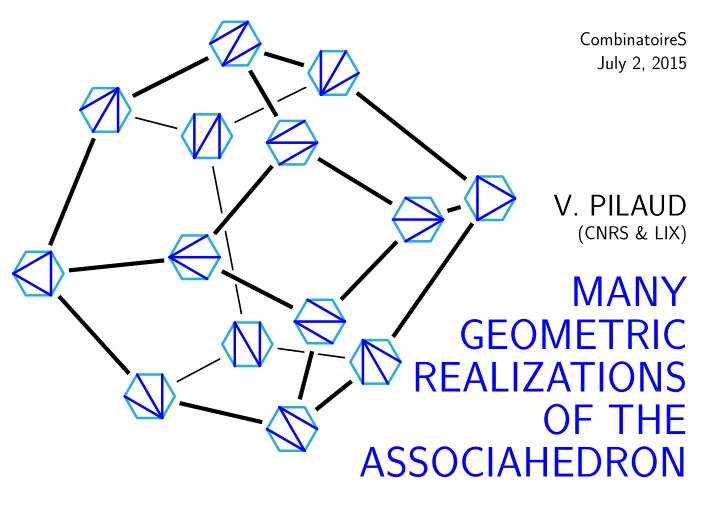
MANY GEOMETRIC REALIZATIONS OF THE ASSOCIAHEDRON POLYTOPES & - - PowerPoint PPT Presentation
CombinatoireS July 2, 2015 V. PILAUD (CNRS & LIX) MANY GEOMETRIC REALIZATIONS OF THE ASSOCIAHEDRON POLYTOPES & COMBINATORICS SIMPLICIAL COMPLEX simplicial complex = collection of subsets of X downward closed exm: 123 123 123 123
CombinatoireS July 2, 2015
(CNRS & LIX)
simplicial complex = collection of subsets of X downward closed exm:
X = [n] ∪ [n] ∆ = {I ⊆ X | ∀i ∈ [n], {i, i} ⊆ I}
12 13 13 12 23 23 23 23 12 13 13 12 1 2 3 3 2 1 123 123 123 123 123 123 123 123
polyhedral cone = positive span of a finite set of Rd = intersection of finitely many linear half-spaces fan = collection of polyhedral cones closed by faces and where any two cones intersect along a face simplicial fan = maximal cones generated by d rays
polytope = convex hull of a finite set of Rd = bounded intersection of finitely many affine half-spaces face = intersection with a supporting hyperplane face lattice = all the faces with their inclusion relations simple polytope = facets in general position = each vertex incident to d facets
P polytope, F face of P
normal cone of F = positive span of the outer normal vectors of the facets containing F normal fan of P = { normal cone of F | F face of P } simple polytope
= ⇒
simplicial fan
= ⇒
simplicial complex
Permutohedron Perm(n)
= conv {(σ(1), . . . , σ(n + 1)) | σ ∈ Σn+1} = H ∩
xj ≥
2
3412 3421 4321 4312 2413 4213 3214 1423 1432 1342 1243 1234 2134 1324 2341 2431 3124 2314
Permutohedron Perm(n)
= conv {(σ(1), . . . , σ(n + 1)) | σ ∈ Σn+1} = H ∩
xj ≥
2
3412 3421 4321 4312 2413 4213 3214 1423 1432 1342 1243 1234 2134 1324 2341 2431 3124 2314
Permutohedron Perm(n)
= conv {(σ(1), . . . , σ(n + 1)) | σ ∈ Σn+1} = H ∩
xj ≥
2
3412 3421 4321 4312 2413 4213 3214 1423 1432 1342 1243 1234 2134 1324 2341 2431 3124 2314 1211 1221 1222 1212 2212 1112 2211 2321 1321 2331 1231 1332 1322 1232 1233 1323 1223 1312 2313 1213 2113 3213 2312 3212 2311 3211 3321 1123 2123 3312
Permutohedron Perm(n)
= conv {(σ(1), . . . , σ(n + 1)) | σ ∈ Σn+1} = H ∩
xj ≥
2
k-faces of Perm(n) ≡ surjections from [n + 1]
to [n + 1 − k]
3|4|1|2 4|3|1|2 4|3|2|1 3|4|2|1 3|1|4|2 3|2|4|1 3|2|1|4 1|3|4|2 1|4|3|2 1|4|2|3 1|2|4|3 1|2|3|4 2|1|3|4 1|3|2|4 4|1|2|3 4|1|3|2 2|3|1|4 3|1|2|4 134|2 14|23 1|234 13|24 3|124 123|4 34|12 4|13|2 14|3|2 4|1|23 14|2|3 1|4|23 1|24|3 13|2|4 1|23|4 13|4|2 3|1|24 13|2|4 23|1|4 3|2|14 3|14|2 3|24|1 12|3|4 1|2|34 2|13|4 34|2|1 3|4|12 34|1|2 4|3|12
Permutohedron Perm(n)
= conv {(σ(1), . . . , σ(n + 1)) | σ ∈ Σn+1} = H ∩
xj ≥
2
k-faces of Perm(n) ≡ surjections from [n + 1]
to [n + 1 − k]
≡ ordered partitions of [n + 1]
into n + 1 − k parts
3|4|1|2 4|3|1|2 4|3|2|1 3|4|2|1 3|1|4|2 3|2|4|1 3|2|1|4 1|3|4|2 1|4|3|2 1|4|2|3 1|2|4|3 1|2|3|4 2|1|3|4 1|3|2|4 4|1|2|3 4|1|3|2 2|3|1|4 3|1|2|4 134|2 14|23 1|234 13|24 3|124 123|4 34|12 4|13|2 14|3|2 4|1|23 14|2|3 1|4|23 1|24|3 13|2|4 1|23|4 13|4|2 3|1|24 13|2|4 23|1|4 3|2|14 3|14|2 3|24|1 12|3|4 1|2|34 2|13|4 34|2|1 3|4|12 34|1|2 4|3|12
Permutohedron Perm(n)
= conv {(σ(1), . . . , σ(n + 1)) | σ ∈ Σn+1} = H ∩
xj ≥
2
k-faces of Perm(n) ≡ surjections from [n + 1]
to [n + 1 − k]
≡ ordered partitions of [n + 1]
into n + 1 − k parts
≡ collections of n − k nested
subsets of [n + 1]
34|12 134|2 3|124 13|24 123|4 1|234 14|23 3|4|1|2 4|3|1|2 4|3|2|1 3|4|2|1 3|1|4|2 3|2|4|1 3|2|1|4 1|3|4|2 1|4|3|2 1|4|2|3 1|2|4|3 1|2|3|4 2|1|3|4 1|3|2|4 4|1|2|3 4|1|3|2 2|3|1|4 3|1|2|4
Coxeter fan
= fan defined by the hyperplane arrangement
xi = xj
= collection of all cones
xi < xj if π(i) < π(j) for all surjections π : [n + 1] → [n + 1 − k]
(n − k)-dimensional cones ≡ surjections from [n + 1]
to [n + 1 − k]
≡ ordered partitions of [n + 1]
into n + 1 − k parts
≡ collections of n − k nested
subsets of [n + 1]
Associahedron = polytope whose face lattice is isomorphic to the lattice of crossing-free sets of internal diagonals of a convex (n + 3)-gon, ordered by reverse inclusion vertices ↔ triangulations edges ↔ flips faces ↔ dissections vertices ↔ binary trees edges ↔ rotations faces ↔ Schr¨
Associahedron = polytope whose face lattice is isomorphic to the lattice of crossing-free sets of internal diagonals of a convex (n + 3)-gon, ordered by reverse inclusion
(Pictures by Ceballos-Santos-Ziegler)
Tamari (’51) — Stasheff (’63) — Haimann (’84) — Lee (’89) — . . . — Gel’fand-Kapranov-Zelevinski (’94) — . . . — Chapoton-Fomin-Zelevinsky (’02) — . . . — Loday (’04) — . . . — Ceballos-Santos-Ziegler (’11)
SECONDARY POLYTOPE
Gelfand-Kapranov-Zelevinsky (’94) Billera-Filliman-Sturmfels (’90)
LODAY’S ASSOCIAHEDRON
Loday (’04) Hohlweg-Lange (’07) Hohlweg-Lange-Thomas (’12)
CHAP.-FOM.-ZEL.’S ASSOCIAHEDRON
✂ ✂ ✂ ✂ ✂ ✂ ✂ ✂ ✂✂ ❅ ❅ ❅ ❅ ✂ ✂ ✂ ✂ ✂ ✂ ✂ ✂ ✂ ✂ ✂ ✂
❅ ❅ ❅ ❇ ❇ ❇ ❇ ❇ ❇ ❅ ❅ ❅ ❅ ❅ ❅ ❅ ❅
♣♣♣♣♣♣♣♣♣♣♣♣♣♣♣♣♣♣♣♣♣♣♣♣♣♣♣♣♣♣♣♣♣♣♣♣♣♣♣♣α2
α1+α2 α2+α3 α1+α2+α3 α1 α3
(Pictures by CFZ)
Chapoton-Fomin-Zelevinsky (’02) Ceballos-Santos-Ziegler (’11)
SECONDARY POLYTOPE
Gelfand-Kapranov-Zelevinsky (’94) Billera-Filliman-Sturmfels (’90)
LODAY’S ASSOCIAHEDRON
Loday (’04) Hohlweg-Lange (’07) Hohlweg-Lange-Thomas (’12)
Hopf algebra Cluster algebras CHAP.-FOM.-ZEL.’S ASSOCIAHEDRON
✂ ✂ ✂ ✂ ✂ ✂ ✂ ✂ ✂✂ ❅ ❅ ❅ ❅ ✂ ✂ ✂ ✂ ✂ ✂ ✂ ✂ ✂ ✂ ✂ ✂
❅ ❅ ❅ ❇ ❇ ❇ ❇ ❇ ❇ ❅ ❅ ❅ ❅ ❅ ❅ ❅ ❅
♣♣♣♣♣♣♣♣♣♣♣♣♣♣♣♣♣♣♣♣♣♣♣♣♣♣♣♣♣♣♣♣♣♣♣♣♣♣♣♣α2
α1+α2 α2+α3 α1+α2+α3 α1 α3
(Pictures by CFZ)
Chapoton-Fomin-Zelevinsky (’02) Ceballos-Santos-Ziegler (’11)
Cluster algebras
✁ ✁ ✁ ✁ ✁ ✁ ✁ ✁ ✁ ✁ ❅ ❅ ❅ ✁ ✁ ✁ ✁ ✁ ✁ ✁ ✁
❅ ❅ ❍ ❍ ❍ ❍ ❍ ✁ ✁ ✁ ❇ ❇ ❇ ❇ ❍ ❍ ❍ ❅ ❅ ❅ ❅ ❅ ❅ ❅ ❍ ❍ ❍
❆ ❆
❍ ♣ ♣ ♣ ♣ ♣ ♣ ♣ ♣ ♣ ♣ ♣ ♣ ♣ ♣ ♣ ♣ ♣ ♣ ♣ ♣ ♣ ♣ ♣ ♣ ♣ ♣ ♣ ♣ ♣ ♣ ♣ ♣ ♣ ♣ ♣ ♣ ♣ ♣ ♣ ♣ ♣ ♣ ♣ ♣ ♣ ♣ ♣ ♣ ♣ ♣ ♣♣♣♣♣♣♣♣♣♣♣♣♣♣♣♣♣♣♣♣♣♣♣♣♣α2
α1+α2 α2+α3
2α2 + α3
α1 α3
2α1 + 2α2 + α3
triangulation of P ⊂ Rd = collection of triangles with corners in P such that
flip =
P point set in Rd ω : P → R height function Sub(P, ω) = projection of the lower convex hull of the point set {(p, ω(p)) | p ∈ P}
regular subdivision = subdivision S such that ∃ ω : P → Rd for which S = Sub(P, ω)
P point set in Rd ω : P → R height function Sub(P, ω) = projection of the lower convex hull of the point set {(p, ω(p)) | p ∈ P}
regular subdivision = subdivision S such that ∃ ω : P → Rd for which S = Sub(P, ω)
All triangulations of a convex polygon are regular
secondary cone of a subdivision S of P = C(S) =
ω ∈ RP
S refines S(P, ω) secondary fan of P = {C(S) | S subdivision of P}
volume vector of a triangulation T of P = Φ(T) =
p∈∆∈T vol(∆)
∈ RP
secondary polytope of P = convex hull of {Φ(T) | T triangulation of P}
regular subdivisions of P.
Gelfand-Kapranov-Zelevinsky, Discriminants, resultants, and multidimensional determinants (’94)
Non-regular triangulations and subdivisions are invisible
Secondary polytope of a convex polygon = associahedron
T binary tree
Infix search labeling = labeling with [n] with the following local rule
Rule for binary search trees
cone of a binary tree T = C(T) = {x ∈ Rn | xi ≤ xj for each edge i → j in T} sylvester fan = {C(T) | T binary tree on n nodes}
Asso(n) := conv {L(T) | T binary tree} = H ∩
H≥(i, j) L(T) := ℓ(T, i) · r(T, i)
i∈[n+1]
H≥(i, j) :=
xi ≥
2
Asso(n) := conv {L(T) | T binary tree} = H ∩
H≥(i, j) L(T) := ℓ(T, i) · r(T, i)
i∈[n+1]
H≥(i, j) :=
xi ≥
2
123 321 213 312 141
Asso(n) := conv {L(T) | T binary tree} = H ∩
H≥(i, j) L(T) := ℓ(T, i) · r(T, i)
i∈[n+1]
H≥(i, j) :=
xi ≥
2
123 321 213 132 312 231 x1=x2 x2=x3 x1=x3 141
Cambrian tree = directed and labeled (with [n]) trees with the following local rule
Rule for Cambrian trees
cone of a Cambrian tree T = C(T) = {x ∈ Rn | xi ≤ xj for each edge i → j in T} Cambrian fan = {C(T) | T binary tree on n nodes}
For any signature ε ∈ ±n+1,
Asso(ε) := conv {HL(T) | T ε-Cambrian tree}
with HL(T)j :=
if ε(j) = −
n + 2 − ℓ(T, j) · r(T, j)
if ε(j) = +
Hohlweg-Lange, Realizations of the associahedron and cyclohedron (’07) Lange-P., Associahedra via spines (’13+)
For any signature ε ∈ ±n+1,
Asso(ε) := conv {HL(T) | T ε-Cambrian tree}
with HL(T)j :=
if ε(j) = −
n + 2 − ℓ(T, j) · r(T, j)
if ε(j) = +
Hohlweg-Lange, Realizations of the associahedron and cyclohedron (’07) Lange-P., Associahedra via spines (’13+)
123 321 132 231 303
For any signature ε ∈ ±n+1,
Asso(ε) := conv {HL(T) | T ε-Cambrian tree}
with HL(T)j :=
if ε(j) = −
n + 2 − ℓ(T, j) · r(T, j)
if ε(j) = +
Hohlweg-Lange, Realizations of the associahedron and cyclohedron (’07) Lange-P., Associahedra via spines (’13+)
123 321 213 132 312 231 x1=x2 x2=x3 x1=x3 303
T◦ an initial triangulation δ, δ′ two internal diagonals
compatibility degree between δ and δ′
(δ δ′) =
−1
if δ = δ′ if δ and δ′ do not cross
1
if δ and δ′ cross compatibility vector of δ wrt T◦:
d(T◦, δ) = (δ◦ δ)
δ◦∈T◦
compatibility fan wrt T◦
D(T◦) = {R≥0 d(T◦, D) | D dissection}
Fomin-Zelevinsky, Y -Systems and generalized associahedra (’03) Fomin-Zelevinsky, Cluster algebras II: Finite type classification (’03) Chapoton-Fomin-Zelevinsky, Polytopal realizations of generalized associahedra (’02) Ceballos-Santos-Ziegler, Many non-equivalent realizations of the associahedron (’11)
Different initial triangulations T◦ yield different realizations
complete simplicial fan. Moreover, this fan is always polytopal.
Ceballos-Santos-Ziegler, Many non-equivalent realizations of the associahedron (’11)
SECONDARY POLYTOPE
Gelfand-Kapranov-Zelevinsky (’94) Billera-Filliman-Sturmfels (’90)
LODAY’S ASSOCIAHEDRON
Loday (’04) Hohlweg-Lange (’07) Hohlweg-Lange-Thomas (’12)
CHAP.-FOM.-ZEL.’S ASSOCIAHEDRON
✂ ✂ ✂ ✂ ✂ ✂ ✂ ✂ ✂✂ ❅ ❅ ❅ ❅ ✂ ✂ ✂ ✂ ✂ ✂ ✂ ✂ ✂ ✂ ✂ ✂
❅ ❅ ❅ ❇ ❇ ❇ ❇ ❇ ❇ ❅ ❅ ❅ ❅ ❅ ❅ ❅ ❅
♣♣♣♣♣♣♣♣♣♣♣♣♣♣♣♣♣♣♣♣♣♣♣♣♣♣♣♣♣♣♣♣♣♣♣♣♣♣♣♣α2
α1+α2 α2+α3 α1+α2+α3 α1 α3
(Pictures by CFZ)
Chapoton-Fomin-Zelevinsky (’02) Ceballos-Santos-Ziegler (’11)
SECONDARY POLYTOPE
A B C C D E E F F G D G B H K L L M K M N N O O H A
LODAY’S ASSOCIAHEDRON
D A E M K A B B C C D F E J G G H H I I J M F L L K
CHAP.-FOM.-ZEL.’S ASSOCIAHEDRON
A E B C C D D E A F J G H H I I J K K L L M M B F G
SECONDARY POLYTOPE
A B C C D E E F F G D G B H K L L M K M N N O O H A
LODAY’S ASSOCIAHEDRON
D A E M K A B B C C D F E J G G H H I I J M F L L K
CHAP.-FOM.-ZEL.’S ASSOCIAHEDRON
A E B C C D D E A F J G H H I I J K K L L M M B F G
A B C C D E E F F G D G B H K L L M K M N N O O H A
SECONDARY POLYTOPE
Gelfand-Kapranov-Zelevinsky (’94) Billera-Filliman-Sturmfels (’90)
D A E M K A B B C C D F E J G G H H I I J M F L L K
LODAY’S ASSOCIAHEDRON
Loday (’04) Hohlweg-Lange (’07) Hohlweg-Lange-Thomas (’12)
A E B C C D D E A F J G H H I I J K K L L M M B F G
CHAPOTON-FOMIN-ZELEVINSKY’S ASSOCIAHEDRON
Chapoton-Fomin-Zelevinsky (’02) Ceballos-Santos-Ziegler (’11)