
SLIDE 1
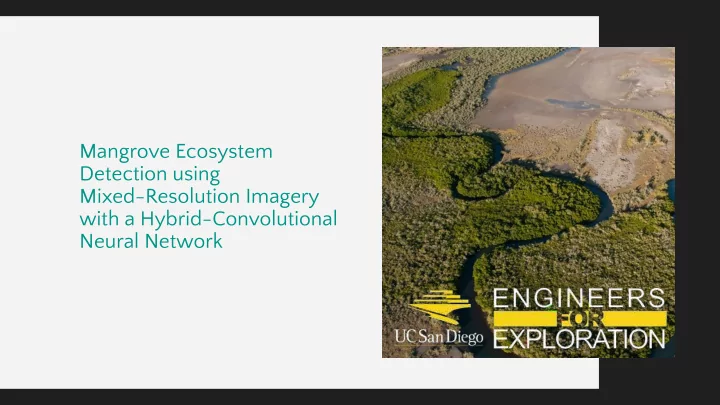
Mangrove Ecosystem Detection using Mixed-Resolution Imagery with a - - PowerPoint PPT Presentation
Mangrove Ecosystem Detection using Mixed-Resolution Imagery with a Hybrid-Convolutional Neural Network What are Mangroves? Mangroves are a type of tree species that live in the intertidal zones of the coasts of tropical areas in over 118
Mangroves are a type of tree species that live in the intertidal zones of the coasts of tropical areas in over 118 countries.
Fisheries
Mangroves offer critical nursing habitats for thousands of fish species
Protection from Tropical Storms
Mangroves act as natural storm breaks, preventing damage to communities
Carbon Sequestration
Mangroves can absorb almost twice as much CO2 in their roots compared to tropical rainforests
High Value
Because of these services, mangroves are worth up to $57,000 per hectare
plug-and-play networks.
Mangrove Extent can be used as a direct measurement for their productivity - including their economic value - how can we measure it?
Satellite Imagery
We acquired lower resolution Skywatch PlanetScope imagery (3m/pixel) to offer multispectral bands for our ML algorithms
Satellite Imagery
Planetscope Imagery is multispectral, and thus important features such as vegetation indices can be extracted for better ML performance
Drone Imagery
We fly surveys with our collaborators in Mexico to acquire recent, high resolution Drone imagery of mangroves
Drone Imagery
We have over 10TB of imagery with a resolution of 3cm/pixel, much higher than that of
(3m/pixel) Made using Agisoft Metashape
Labels
High resolution imagery allows us to make highly detailed labels using QGIS. Over 1500 person hours from volunteers was utilized to make our label dataset.
Global Mangrove Labels can be downloaded - with a catch Pixel Classifier using SAR satellite data at a resolution of ~15m^2/pix with the Extremely Randomized Trees Algorithm No Development Needed No Flexibility
(IOU)
We created a novel Hybrid-CNN that uses both satellite pixels and drone tiles to generate mangrove classification maps of higher accuracy. Such a network can use both the high resolution image features of
multispectral bands of satellite images for better extent estimations.
Hybrid CNN Architecture
Better (and more) features lead to much better performance! Satellite + Drone Features
(IOU)
(IOU)
Local 3m resolution labels from high resolution drone imagery and medium resolution satellite imagery
Local 8m resolution labels from high resolution drone imagery
(IOU)
(IOU)
(IOU)
(IOU)
(IOU)
(IOU)
Future Steps
classifications
Email: sdhicks@ucsd.edu Linkedin: sdillonhicks
Engineers for Exploration:
http://e4e.ucsd.edu
Mangrove Monitoring:
https://ucsd-e4e.github.io/mangrove/