MANCHESTER COLLEGE Department of Education LESSON PLAN BY: Alina - - PDF document

manchester college department of education lesson plan by
SMART_READER_LITE
LIVE PREVIEW

MANCHESTER COLLEGE Department of Education LESSON PLAN BY: Alina - - PDF document

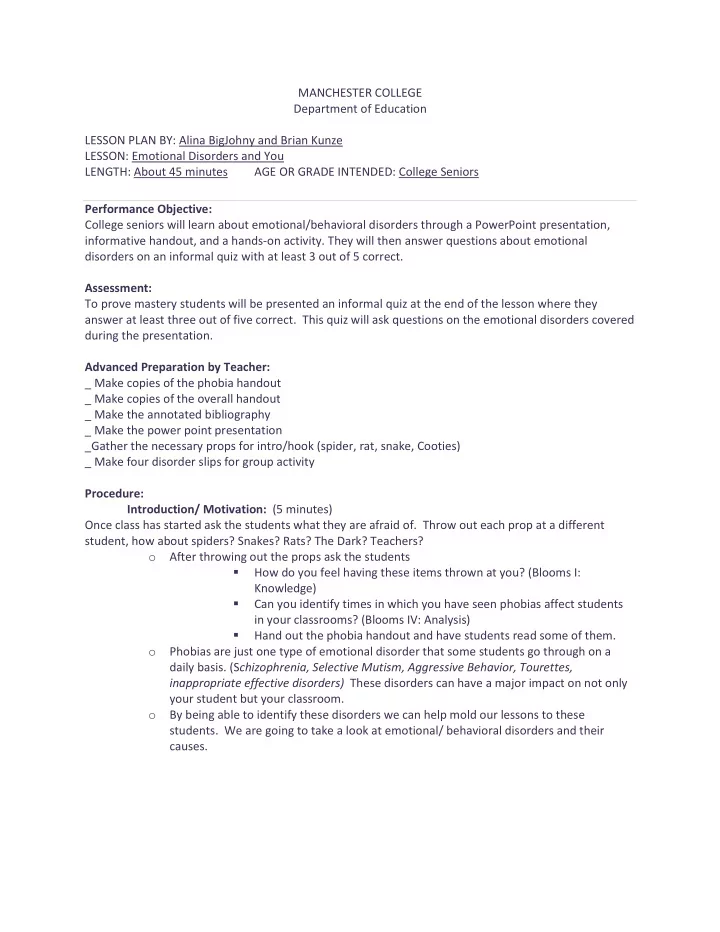
MANCHESTER COLLEGE Department of Education LESSON PLAN BY: Alina BigJohny and Brian Kunze LESSON: Emotional Disorders and You LENGTH: About 45 minutes AGE OR GRADE INTENDED: College Seniors Performance Objective: College seniors will learn


slide-1
SLIDE 1

MANCHESTER COLLEGE Department of Education LESSON PLAN BY: Alina BigJohny and Brian Kunze LESSON: Emotional Disorders and You LENGTH: About 45 minutes AGE OR GRADE INTENDED: College Seniors Performance Objective: College seniors will learn about emotional/behavioral disorders through a PowerPoint presentation, informative handout, and a hands-on activity. They will then answer questions about emotional disorders on an informal quiz with at least 3 out of 5 correct. Assessment: To prove mastery students will be presented an informal quiz at the end of the lesson where they answer at least three out of five correct. This quiz will ask questions on the emotional disorders covered during the presentation. Advanced Preparation by Teacher: _ Make copies of the phobia handout _ Make copies of the overall handout _ Make the annotated bibliography _ Make the power point presentation _Gather the necessary props for intro/hook (spider, rat, snake, Cooties) _ Make four disorder slips for group activity Procedure: Introduction/ Motivation: (5 minutes) Once class has started ask the students what they are afraid of. Throw out each prop at a different student, how about spiders? Snakes? Rats? The Dark? Teachers?

  • After throwing out the props ask the students
  • How do you feel having these items thrown at you? (Blooms I:

Knowledge)

  • Can you identify times in which you have seen phobias affect students

in your classrooms? (Blooms IV: Analysis)

  • Hand out the phobia handout and have students read some of them.
  • Phobias are just one type of emotional disorder that some students go through on a

daily basis. (Schizophrenia, Selective Mutism, Aggressive Behavior, Tourettes, inappropriate effective disorders) These disorders can have a major impact on not only your student but your classroom.

  • By being able to identify these disorders we can help mold our lessons to these
  • students. We are going to take a look at emotional/ behavioral disorders and their

causes.

slide-2
SLIDE 2

Step-by-Step Plan: 1) Power Point Presentation: slides 1-11 (15 minutes)

  • Give students presentation handout. Some spots are blank so fill them in as we go through the
  • presentation. Note: There is a back to the handout. (Gardner: Visual-Spatial)
  • Go over the power point presentation with the students.
  • After slide 6: If you notice one of your students with some of these characteristics, what would

your recommendation be to help this student? (Blooms VI: Evaluation) 2) Group Activity: Charades (10-15 minutes) Students will now have the chance to work with other students on presenting a disorder

  • Have students break up into groups of 3, one group will be a group of 2.
  • Assign each group a disorder (Schizophrenia, Aggressive Behavior, Tourettes, Depression); give

each group their corresponding disorder skit.

  • Each group will then come up with a skit, song, drawing, or activity to present to the class over

their respective disorder. (Gardner: Interpersonal & Bodily-Kinesthetic), also (Gardner: Musical, Visual-Spatial, Verbal-Linguistic; as chosen by group)

  • The only rule is that you cannot include the name of disorder in whatever you choose to
  • present. This will be similar to charades, and it will be the class’s job to figure out which

emotional disorder you are portraying.

  • Give the students five to ten minutes to create their presentations.
  • Have students present their creation and elaborate further, if needed.

3) PowerPoint Presentation: Slides 12-end (5 minutes)

  • Finish going through the rest of the PowerPoint.
  • Have students continue to fill in the handout.
  • Slide 14: What ideas do you have to modify your lessons to adapt to students with ED? (Blooms

V: Synthesis) Closure: (10 minutes)

  • Today we learned about emotional/behavioral disorders and how they will affect your
  • classroom. It is important to keep these causes and characteristics in mind when students with

exceptionalities are in your classroom.

  • Let’s take a short quiz to see how much you remember. No notes!

1) T/F: Are there any scientifically proven causes? 2) T/F: Behavioral disorder is not another name for emotional disorder? 3) T/F: ED is supported by IDEA. 4) Which one of these is not a category of identifying factors?

  • a. Biological
  • b. psychological
  • c. environmental
  • d. spiritual

5) What are three identifying characteristics of students with emotional/behavioral disorder? Adaptations/ Enrichment: 1) ADHD: During the group time, I will be walking around. When I get to his group, I will make sure to specifically ask him about his group’s given disorder to make sure that he is on task. Allow him to be the “clicker” during the PowerPoint presentation. This will make him feel important and he will more likely pay attention.

slide-3
SLIDE 3

2) Learning Disability: Have the quiz written out in some way so that she can read it, instead of just hearing the questions. Have the answers typed into her handout so that she does not struggle with listening and writing at the same time. If needed, print the PowerPoint slides

  • ut ahead of time so that she can follow along more easily.

3) Intellectual Disability: It is important to monitor peer relationships with students who have an ID. During the group work, I will make sure that this student is not being left out nor taken advantage of. If talking in front of the class is a problem, I will allow this student to show me his contribution such as artwork on the poster, instead of talking in front of the

  • class. Have the quiz written out in some way so that he can read it, instead of just hearing

the questions. Fill in the answers on the handout so that this student does not have to concentrate on listening and writing at the same time. 4) Emotional Disturbance: ED students often need positive reassurance and solid relationships. I will make sure that anytime this student answers, she is positively reinforced for

  • answering. I will make sure that her group members are students that work well with her

and do not aggravate her. Also, give her the option to work alone if she wants which means having an additional disorder typed out. For the beginning of the lesson, I will make sure that she does not have an actual fear of any of the “creepy crawlies” that we throw around. Self-Reflection: How well did the students respond to the PowerPoint? Was the hook good enough to get the class interested? How well did the hands-on activity go? Were they able to guess the other groups’ disorders? Did the students seem to grasp all of the information covered? How was the flow of the lesson- timing? What were the quiz results? Was our standard met?

slide-4
SLIDE 4

Wei Weird rd p phobia hobias

Ablut Ablutophobi bia: : Fea ear r of wash washing o ng or ba bathing ng Ari Arithmophobi bia: Fea ear o r of nu numbe bers rs Bi Biblioph bliophobi bia: Fea ear of bo books Chionophobi bia: Fea ear r of sno snow Ge Genup nuphobi bia: Fea ear r of k knee nees Venustraphobia: Also known as caligynephobia- fear of beautiful women Nomophobia: This modern phobia affects people who are very afraid of losing cell phone contact. Coprastasophobia: Some people are actually terribly afraid of becoming constipated. Arachibutyrophobia: Fear of peanut butter sticking to the roof of the mouth Ephebiphobia: fear of teenagers Pedagophobia: fear of teachers

slide-5
SLIDE 5

Alina BigJohny & Brian Kunze

Behavioral / Emotional Disorders

Identifying Characteristics: Emotional Disturbance refers to a number of different, but related, social-emotional

  • disabilities. However, individuals will meet at

least one of these characteristics (outlined in IDEA): 1) An inability to learn that cannot be explained by intellectual, sensory, or health factors. 2) An inability to build or maintain satisfactory interpersonal relationships with peers and teachers. 3) Inappropriate types of behavior or feelings under normal circumstances. 4) A general pervasive mood of unhappiness or depression. 5) A tendency to develop physical symptoms or fears associated with personal or school problems. Social: Affective: Academic: Modifications: Prepare class Teaching style: Classroom features: Content Modifications: Language arts: Math: Science: Social Studies: Visual arts/ performing arts:

slide-6
SLIDE 6

Causes:

Although the exact cause of most mental illnesses is not known, it is becoming clear through research that many of these conditions are caused by a combination of biological, psychological, and environmental factors. Emotional/behavioral disorders can affect persons of any age, race, religion, or

income. Biological: Psychological: Environmental:

slide-7
SLIDE 7

Schizophrenia Definition: a mental disorder characterized by a disintegration of the process of thinking and of emotional responsiveness Characteristics: It most commonly manifests as auditory hallucinations, paranoid or bizarre delusions, or disorganized speech and thinking, and it is accompanied by significant social or occupational dysfunction. Tourette’s Syndrome Definition: an inherited neuropsychiatric disorder with onset in childhood. People with Tourette's have normal life expectancy and intelligence Characteristics: multiple physical (motor) tics and at least one vocal (phonic) tic; these tics characteristically wax and wane. More common tics: eye blinking, coughing, throat clearing, sniffing, and facial movements. Depression Definition: a state of low mood and aversion to activity Characteristics: Depressed people may feel sad, anxious, empty, hopeless, helpless, worthless, guilty, irritable, or restless. They may lose interest in activities that once were pleasurable, experience loss of appetite or overeating, or problems concentrating, remembering details or making decisions; and may contemplate or attempt suicide. Insomnia, excessive sleeping, fatigue, loss of energy, or aches, pains, or digestive problems that are resistant to treatment may be present. Phobias (feel free to choose a specific one of your liking) Definition: an irrational, intense and persistent fear of certain situations, activities, things, animals, or people. Characteristics: The main symptom of this disorder is the excessive and unreasonable desire to avoid the feared stimulus. When the fear is beyond one's control, and if the fear is interfering with daily life, then a diagnosis under one of the anxiety disorders can be made

slide-8
SLIDE 8

Alina BigJohny & Brian Kunze EDUC 352 Presentation: Emotional/Behavioral Disturbance Annotated Bibliography 1) Bickman, L., & Rog, D. J. (1995). Children's mental health services: Research, policy, and

  • evaluation. Thousand Oaks: Sage Publications.

This book about children’s mental health problems has been put together to help psychologists and those interested in the field know how to deal with children. To help professionals learn about the issues concerning mental heath the editors, Leonard Bickman and Debra J. Rog, have compiled a book to help understand the problems faced in the field. It is the hope of these editors that others will be able to put more thought into the problems faced by children. The introductory overview gives a great description on the state of research in the field. Chapter five is particularly helpful because it talks about the services available in the schools. This book does a great job teaching the problems faced in society by professionals and kids alike. 2) "CEC | Behavior disorders/emotional disturbance." CEC | Home. Retrieved Nov. 3, 2010, from http://www.cec.sped.org/AM/Template.cfm?Section=Behavior_Disorders_Emotional_Disturban ce&Template=/TaggedPage/TaggedPageDisplay.cfm&TPLID=37&ContentID=5624 The Council for Exceptional Children has been dedicated to working on the educational success

  • f individuals with disabilities and gifts and talents. The Council for Exceptional Children has

been the larger international professional organization advocating for this children for years. They advocate for policies that advance all children in the classroom. Their website has a huge breakdown of many different disorders. Their Behavior page has many articles that explain the different effects of the emotional disorders. This database of knowledge is particularly helpful in understanding emotional disorders. 3) Chakraburtty, A. (Ed.). (Feb. 2009). Causes of mental illness. WebMD. Retrieved Nov. 1, 2010, from http://www.nichcy.org/Disabilities/Specific/Pages/EmotionalDisturbance.aspx#causes This website deals with the medical aspect of disabilities. By reading this article, readers can better understand the why and how of the disability as opposed to the behaviorisms and

  • characteristics. This article tells us that emotional disorders do not have an exact known cause;

however, they seem to be a combination of biological, psychological, and environmental factors. The article then breaks down each of these factors into specific things that could have caused a mental disorder within that factor. This article is useful so that people can understand how these disorders occur which makes it easier to know that it is not the students’ faults. 4) Emotional and behavioral disorders. (2007). National Association of Special Education Teachers. Retrieved Nov. 1, 2010, from http://www.naset.org/emotionaldisturbance2.0.html National Association of Special Education Teachers is a national membership organization that is committed to obtaining as much information and support for those preparing for or teaching in the field of special education. This site contains a plethora of information regarding every

slide-9
SLIDE 9

possible circumstance or disability that a teacher may come across. This article in general, is broken down into 26 subtopics that are each helpful in its own way. This article is particularly useful because each subtopic can lead you to another credible website full of more useful information dealing with the topic you are researching. This article does not simple state the facts but goes beyond simple research to state multiple solutions, ideas, and/or characteristics for each step of teaching a child with special needs. 5) Emotional disturbance. (June 2010). National Dissemination Center for Children with Disabilties. Retrieved Nov. 1, 2010, from http://www.nichcy.org/Disabilities/Specific/Pages/EmotionalDisturbance.aspx#causes NICHCY is an organization that was developed in order to inform the nation about disabilities of children and to provide programs and services to infants, children, and youths with disabilities. This particular article is a fact sheet that outlines several mental disorders that are often characterized under the blanket terms such as emotional disorders, behavior disorders, or mental illnesses. This article was particularly useful because its outlines the definition of specific disorders along with characteristics, causes, frequency, and help for school-aged children. The article often refers to IDEA or other national organizations’ research to make its information

  • credible. After informing the reader about emotional disorders, it then goes on to break the

disorder into more concrete illnesses such as anxiety disorders, which was very helpful information. 6) Fitzpatrick, M., & Knowlton, E. (2009). Bringing evidence-based self-directed intervention practices to the trenches for students with emotional and behavioral disorders. Preventing School Failure, 53(4), 253-266. Retrieved from Academic Search Premier database. This article covers the old notions of behavior disorders and incorporates new techniques using

  • technology. Michael Fitzpatrick and Earle Knowlton challenge the established thinking on

emotional and behavioral disorders. They use evidence based intervention strategies to help teachers learn about what students need. The most helpful part of the article was their use of technology to help students learn. They show strategies for students who struggle with emotional disorders. 7) Mastropiere, M.A. & Scruggs, T.E. (2010). The inclusive classroom: strategies for effective differentiated instruction (4th ed). Upper Saddle River: Pearson Education, Inc. (65-69). This textbook covers many different elements of differentiated instruction, which includes strategies for effective teaching of students with disabilities. Chapter three covers several different disabilities, emotional /behavioral disorders being one of them. By giving an overview

  • f the entire disorder within a few pages, readers are able to grasp the core of the disorder such

as characteristics and some adaptations for the classroom. Chapter three of this textbook was particularly useful as a starting point for this presentation so that we could take this information and expand from there. It gives brief ideas of this type of disorder and how to handle it and from there, we could ask ourselves what more we wanted to know.

slide-10
SLIDE 10