MANAGING STABILITY, PROMOTING TRANSFORMATION FOR SUSTAINED ECONOMIC - - PDF document

managing stability promoting transformation for sustained
SMART_READER_LITE
LIVE PREVIEW

MANAGING STABILITY, PROMOTING TRANSFORMATION FOR SUSTAINED ECONOMIC - - PDF document

MANAGING STABILITY, PROMOTING TRANSFORMATION FOR SUSTAINED ECONOMIC GROWTH Governors Address and Annual Bankers Dinner Jakarta, November 14 th , 2013 Honorable , Leaders and Members of House of Representatives, Supreme Court, Peoples


slide-1
SLIDE 1

1

MANAGING STABILITY, PROMOTING TRANSFORMATION FOR SUSTAINED ECONOMIC GROWTH

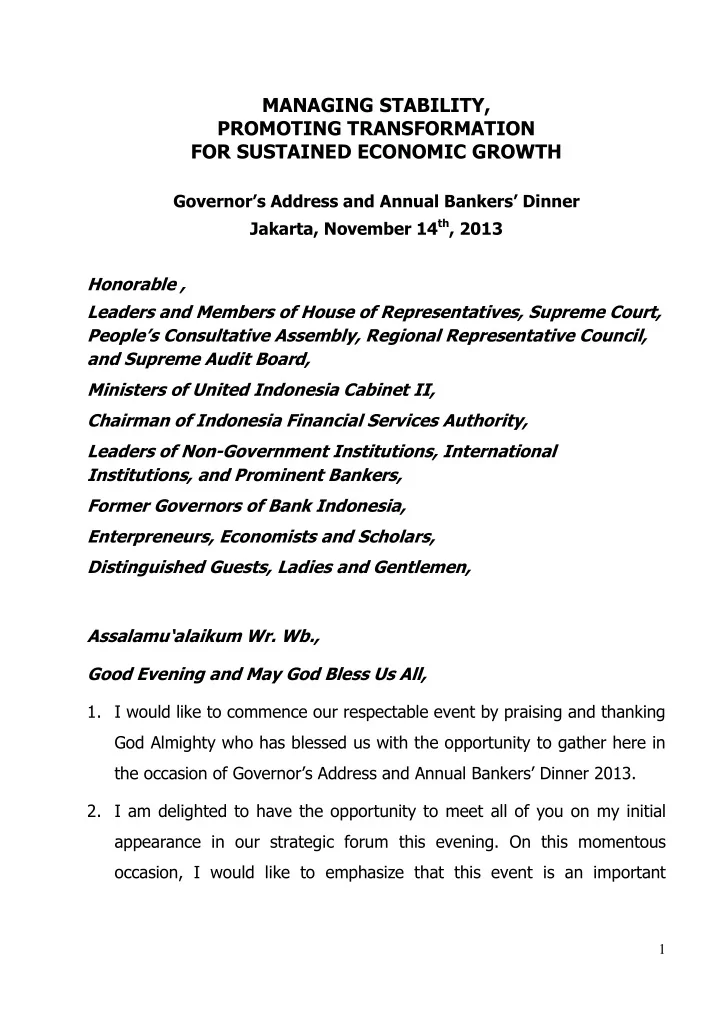
Governor’s Address and Annual Bankers’ Dinner Jakarta, November 14th, 2013 Honorable , Leaders and Members of House of Representatives, Supreme Court, People’s Consultative Assembly, Regional Representative Council, and Supreme Audit Board, Ministers of United Indonesia Cabinet II, Chairman of Indonesia Financial Services Authority, Leaders of Non-Government Institutions, International Institutions, and Prominent Bankers, Former Governors of Bank Indonesia, Enterpreneurs, Economists and Scholars, Distinguished Guests, Ladies and Gentlemen, Assalamu‘alaikum Wr. Wb., Good Evening and May God Bless Us All,

  • 1. I would like to commence our respectable event by praising and thanking

God Almighty who has blessed us with the opportunity to gather here in the occasion of Governor’s Address and Annual Bankers’ Dinner 2013.

  • 2. I am delighted to have the opportunity to meet all of you on my initial

appearance in our strategic forum this evening. On this momentous

  • ccasion, I would like to emphasize that this event is an important
slide-2
SLIDE 2

2

platform to harmonize our views on current economic condition, emerging challenges, and efforts to strengthening the measures.

  • 3. Your presence provides additional support for Bank Indonesia in

undertaking its mandates, and is essential for us to further enhance economic resilience in dealing with greater challenges ahead. In this regard, allow me to express my humble gratitude for your participation. Distinguished Guests, Ladies and Gentlemen,

[Economic Development 2013]

  • 4. Since I took my position in Bank Indonesia, I have personally

experienced formidable economic challenges [TABLE 1]. I initially joined Bank Indonesia on May 24th, 2013, just only two days after Chairman of the Federal Reserve indicated its plan to start tapering its monetary

  • stimulus. A very brief signal from the Chairman, yet it has world-wide

negative impacts. From that moment until end of August 2013, massive foreign capital flew out from our economy which eventually led to sharp depreciation of the rupiah.

  • 5. However, we observe that global issues overshadowing our economy are

much broader than the issue of the Fed’s tapering itself. We view that there are, at least, three main global issues which have created uncertainties and put more pressures on our economy in 2013.

  • 6. First, uncertainty of the speed of global recovery. The global economic

recovery process is not as expected, and even slower than previously

  • estimated. The global environment becomes more uncertain because of

the shifting of global economic landscape. I still remember, two years ago, we have had a discussion about the two-speed world recovery, i.e. slow recovery in advanced economies, and much faster recovery in

slide-3
SLIDE 3

3

emerging economies. Now, the situation has turned around. The United States’ economy has strengthened, the European economy has shown signs of escaping the crisis, while emerging economies have slowed

  • down. In other words, the phenomenon of a three-speed world recovery

has emerged [GRAPH 1].

[TABLE 1. REVISION OF GLOBAL GROWTH FORECAST 2013]

  • 7. Second, the wide-spread uncertainties as consequences of the US policy’s

indecisivenes, not only related to the withdrawal of ultra-accommodative monetary stimulus but also the debt ceiling crisis and the US government

  • shutdown. These prolonged unfavorable circumstances have triggered

global investors to re-evaluate risks and caused excessive reactions, which have led to turmoil in the global financial markets, including in Indonesia [GRAPH 2].

[GRAPH 1. A THREE SPEED WORLD RECOVERY]

slide-4
SLIDE 4

4

  • 8. Third, the uncertainty of global commodity prices. In line with the

sluggish global economic growth and heightened volatility in the global financial markets, commodity prices have continued its downward trend, confirming the end of commodities super-cycle era [GRAPH 3].

[GRAPH 2. CAPITAL FLOWS & THE IDR/USD EXCHANGE RATE] [GRAPH 3. GLOBAL COMMODITY PRICES]

Distinguished Guests, Ladies and Gentlemen,

  • 9. The three main global issues I mentioned previously have inevitably

affected the performance of Indonesia’s economy. Amidst the robust domestic demand, intense global pressures have put more burden on the current account.

slide-5
SLIDE 5

5

  • 10. The current account deficits have occured since the fourth quarter of

2011 [GRAPH 4]. Furthermore, sliding commodity prices which have started since the beginning of 2012 have affected exports that finally led to growing current account deficits.

[GRAPH 4. THE CURRENT ACCOUNT]

  • 11. These substantial current account deficits are not only caused by trade

balance deficits but also overburdened by prolonged services and income balance deficits [GRAPH 5]. On the other hand, foreign portfolio investment flows have fluctuated associated with changes in sentiment, known as risk-on and risk-off behavior in global financial markets. Together with the issues of current account deficits, turbulence in domestic financial market creates deterioration of the Indonesia balance

  • f payment posture.
  • 12. Economic adjustments are eventually unavoidable. Yet, we argue that

these economic adjustments are needed as part of rebalancing process toward a more balanced economy which is aligned with its economic fundamentals.

slide-6
SLIDE 6

6

  • 13. In line with the deterioration in the balance of payment, rupiah has

demonstrated a weakening trend. Moreover, the hike of inflation caused by the reduction in fuel subsidy is also part of the delayed adjustment

  • process. These conditions have finally led to a lower economic growth.

[GRAPH 5. THE NET SERVICES AND INCOME ACCOUNT]

Distinguished Guests, Ladies and Gentlemen, [Policy Responses and Current Economic Condition]

  • 14. The Government and Bank Indonesia have taken various policy

responses to safeguard economic adjustments. These policies are intended to maintain economic stability to ensure the process of short term adjustments remain in place. In particular, the policy responses are aiming to ensure a stable inflation, maintain exchange rate of rupiah in line with its fundamentals, and reduce current account deficits toward a more robust level.

  • 15. Within these policy directions, Bank Indonesia attempts to further

strengthen the policy mix ranging from: (i) Increasing Bank Indonesia Rate by 175 bps to the level of 7,50%, from June to November 2013; (ii) Reinforcing monetary operation; (iii) Stabilizing rupiah exchange rate; (iv) Strengthening macro-prudential policies; (v) Promoting monetary

slide-7
SLIDE 7

7

and financial system stability policy cooperation with other central banks; and (vi) Enhancing policy coordination with the Government.

  • 16. On behalf of Bank Indonesia, I would like to extend our sincere

appreciation to the Government for its policy responses. The decision to raise the subsidized fuel prices in the end of June 2013 has reduced pressures on fiscal sustainability, although this effort is inadequate to further improve current account posture. In addition, we are of the view that the Government has already taken initial positive steps by introducing the policy packages in August and October 2013. Respected Audience,

  • 17. Without intending to be complacent, it is worthy to mention that the

policy responses have demonstrated positive contributions. Various indicators reflect that economic adjustment process remain under

  • control. The trade deficits have started to decline in the third quarter of
  • 2013. The foreign capital inflows has also intensified [TABLE 2].

[TABLE 2. INDONESIA BALANCE OF PAYMENTS - QUARTERLY]

slide-8
SLIDE 8

8

  • 18. Positive developments on the balance of payment have supported the

stability of rupiah since the end of September 2013. At the same time, the micro structure of foreign exchange market shows improvement as indicated by the increase in the volume of interbank transactions and a more healthy price discovery in the forex market. A lower off-shore non- deliverable forward rate (NDF) compared to the spot rate indicates a more liquid market [GRAPH 6].

[GRAPH 6. FOREIGN EXCHANGE MARKET]

  • 19. The high level of inflation following the hike of subsidized fuel prices has

returned to its historical pattern [GRAPH 7]. This development suggests that the second round impacts of the hike of subsidized fuel prices were

  • restrained. Although the administered and volatile food prices have

significantly increased, core inflation remains below 5,0%. The inflation has surpassed its target of 4,5+1%, yet we forecast inflation in 2013 will slightly fall below 9,0%.

slide-9
SLIDE 9

9

[GRAPH 7. INFLATION]

  • 20. We expect our economy will expand by 5,7% in 2013. Although lower

than its growth in 2012 that was recorded at 6,2%, the figure is still above the estimated average growth rate of its peer countries of 3,6%

[GRAPH 8].

[GRAPH 8. INDONESIA ECONOMIC GROWTH VIS A VIS PEERS]

  • 21. The adjustment process of the Indonesia’s economy is also supported by

the stability of financial and payment system, as well as sound foreign debt level. Through a consistent policy, excessive pressures stemming from economic adjustments could be avoided [GRAPH 9].

slide-10
SLIDE 10

10

[GRAPH 9. BANKING INDICATORS]

Distinguished Guests, Ladies and Gentlemen,

[Economic Challenges and Opportunities Ahead]

  • 22. Ahead, the current challenges are not about to recede very soon. At the

present juncture when the economy is in the adjustment process to a soft landing, I see a number challenges, both global and domestic, remain at the fore. The challenges are not only those that are cyclical in nature but also those that are structural, and therefore demand our collective attention.

[TABLE 3. THE SHIFT IN GLOBAL ECONOMIC LANDSCAPE]

slide-11
SLIDE 11

11

  • 23. Along this line, we need to remain vigilant of the global economic growth
  • dynamic. While the global economy in 2014 is projected to expand at

around 3.5%, the shift in the world economic landscape is anticipated to continue [TABLE 3]. The average growth of the US and Europe, which only arrived at 2.2% and 1.4% respectively within the last two decades, is expected to rise to 3.1% and 1.6% in the next five years. On the contrary, China’s economy in the subsequent five years will have to accept a new normal growth of around 7%, after expanding at an average 10.25% in the last two decades. Similar pattern is expected to

  • ccur in other emerging markets’ economic path.
  • 24. What becomes a concern for us is the risk that the shift in the global

landscape will reverse the direction of portfolio flows to advanced countries, particularly the US [GRAPH 10]. Undeniably, the delay in the reduction of US monetary policy stimulus has provided “temporary breathing space” for us at this moment. Nonetheless, the tapering off of the US monetary stimulus is indeed an unquestionable event that will

  • ccur in the near future. As a matter of fact, several recent indicators

have started to reflect a strengthening of the US economy.

[GRAPH 10. GLOBAL CAPITAL FLOWS]

slide-12
SLIDE 12

12

  • 25. Against the background of the above global challenges, equally daunting

challenges arise in the domestic front [FIGURE 1]. The first challenge relates to our financial market that needs to be restructured. One of the issues pertains to the fragmentation of rupiah excess liquidity in the banking sector. This calls for attention as it would increase the complexities of monetary operation and disturb the stability of the financial system.

[FIGURE 1. STRUCTURAL CHALLENGES TO MONETARY POLICY IMPLEMENTATION]

  • 26. Another challenge concerning the financial market is its lack of depth and
  • liquidity. In the rupiah market, this is reflected in the low turnover and

the anomaly of price formation in the repo market [GRAPH 11]. The collateralized market does not appeal to many market participants and is more expensive compared to the uncollateralized interbank money

  • market. In the mean time, the foreign exchange market is characterized

by low volume and inactive hedging transactions. With such micro structure, the exchange rate is easily under pressure even when the demand for foreign exchange experiences a small upsurge.

slide-13
SLIDE 13

13

[GRAPH 11. DOMESTIC MONEY MARKET CONDITION]

  • 27. The second challenge deals with structural weaknesses that will inhibit
  • ur attempt to boost the economy to a higher level. Today, Indonesia

has firmed up its position as a middle income country and is in transformation from lower middle income to upper middle income [GRAPH

12]. This implies that the middle class expansion in the last decade will

continue and correspondingly our domestic market will enlarge. The structure of demand for goods and services will also be getting more diverse with increasingly complex characteristics [GRAPH 13].

[GRAPH 12. INCOME PER CAPITA]

slide-14
SLIDE 14

14

[GRAPH 13. EXPANDING MIDDLE CLASS]

  • 28. Notwithstanding, amid the changing structure of aggregate demand, I

view that the economy has expanded too rapidly and is susceptible to correction [FIGURE 2]. The Economic expansion is also followed by a weakening posture of the current account. Consequently, the pace of economic growth to a higher path is hindered.

[FIGURE 2. STRUCTURAL CHALLENGES]

slide-15
SLIDE 15

15

  • 29. I view the above impediment to economic growth as a reflection of the

existing imbalance between the structure of aggregate demand and the capability of the supply side. In the supply side, the production structure that took shape within the last decade has been gradually felt to be

  • bsolete.

[GRAPH 14. NET EXPORTS OF NATURAL RESOURCES AND LOW TECH INDUSTRY]

  • 30. This is actually a sensible development [GRAPH 14]. The existing

production structure reflects the comparative advantage that we used to utilize to take Indonesia transforming from low to middle income country. The abundant natural resources heritage outside Java and the human resources surplus in Java have become the primary assets that lifted a large part of our society out of the poverty trap. These primary resources have enabled us to build an industrial order dominated by export industries that are intensive in human and natural resources such as coal mining and crude palm oil industry.

  • 31. Nevertheless, when Indonesia finally stepped up to become a middle

income country with a growing middle class, such industrial order is no longer sufficient. The typical characteristic of a middle class society is having the desire and simultaneously the capability to purchase goods

slide-16
SLIDE 16

16

with higher quality and value added. In line with the increased complexities of the demanded goods, greater basis for comparative advantage and industrial capability are undoubtedly needed.

[GRAPH 15. SPATIAL PROFILE OF TRADE BALANCE IN NUSANTARA]

  • 32. This gap between demand and supply is increasingly fulfilled by imports,

primarily goods produced by middle and high technology industry [GRAPH

15]. The net imports of goods in this category have grown larger since

Indonesia stepped into a middle income country category in 2014. This technology deficit in the supply side is felt across the nation. Nonetheless, the stronger industrial capacity in Java has not sufficed in accommodating the substantial changes in the structure of national demand.

  • 33. I believe this condition does not stay apart from the impact of several

aspects that are inadequate and need to be improved. First, the availability of infrastructure for connectivity both digitally and physically. Second, the management of domestic energy. The energy management aspect has acquired growing attention as the augmenting demand for energy has to be fulfilled by imports, which eventually aggravates the

  • ngoing problem of current account deficit. Third, several aspects related
slide-17
SLIDE 17

17

to business climate that are under the close watch of businesses, including ease of starting up a business, legal certainty, registration of personal proprietary right, insolvency settlement, and enforcing contract.

  • 34. Overall, the above domestic structural challenges demand our increased

attention as our integration with the ASEAN Economic Community (AEC) is looming near in 2015. The question for us is “Are we able to gain the benefit of AEC and develop to be part of the global value chain, or merely become a target market?” Distinguished Guests, Ladies and Gentlemen,

[General Policy Direction]

  • 35. In the spirit of determination and thrust to respond to the challenges and

strengthen the stepping stone toward sustainable growth, allow me to convey Bank Indonesia’s policy direction ahead and a number thoughts concerning the structural reformation that we need to pursue together with the Government [FIGURE 3].

[FIGURE 3. POLICY DIRECTION]

  • 36. Let me underline that in our policy direction ahead, including in the

period of political transition in 2014, Bank Indonesia will consistently

slide-18
SLIDE 18

18

preserve the stability of the economy and the financial system. Stability needs to be prioritized in order to create a more balanced and sound economic structure, therefore becoming a strong foundation for economic transformation in the future.

  • 37. The economic balance that I am referring here is economic growth that is

supported by a sustainable posture of the current account. On the one hand, sustainable can be interpreted as a condition where exports have high value added and industries are capable of producing intermediate goods and services that so far still rely on imports. On the other hand, the financing of current account should derive from more permanent sources, i.e. Foreign Direct Investments that will propel the growth and development of advanced and globally competitive industry sector.

  • 38. With the complexities of the confronted challenges, BI’s policy direction is

measured in terms both goal and time dimensions. As regard the goal dimension, BI is not simply committed to manage inflation to be between its target range, but more broadly, is also directed to manage current account toward a sustainable path, while preserving the stability of the financial system.

  • 39. The effort to attain low inflation is not negotiable as it becomes a pre-

condition for the sustainability of the economy. Notwithstanding, the Asian and global crisis demonstrate that low inflation is not sufficient to warrant sustainable economic growth.

  • 40. The journey of our economy post 97/98 Asian shows that we need to

remain vigilant even when inflation rate remains low, because it may well be a delayed inflation which will be accompanied by increasing current account deficit. The inflation phenomenon was indeed delayed since the risk of rising inflation was temporarily absorbed by government subsidies

slide-19
SLIDE 19

19

such as fuel and energy subsidies. Inflation rate was also subdued owing to decreased pressure from imports as the prices of global commodities declined.

  • 41. From the time dimension, Bank Indonesia’s policy stance will consistently

be adopted in a time-consistent manner until the economic condition becomes more balanced. This dimension is in line with the structural challenges which will take quite a long time to be resolved.

  • 42. In sum, Bank Indonesia’s policy direction is implemented through a policy

mix in the monetary, macropudential and payment system area. Distinguished Guests, Ladies and Gentlemen,

[Monetary Policy Direction]

  • 43. In the area of monetary policy, the BI Rate will be consistently directed

towards controlling inflation to be within its target. Furthermore, the monetary policy stance is taken to support efforts in reducing the current account deficit to achieve a sustainable level and to maintain a robust financial system stability.

  • 44. The exchange rate policy is aimed at guiding the exchange rate to move

within its fundamental value acting as shock absorber instrument of the economy and not as shock amplifier. In this context, a deep and liquid foreign exchange market is needed to support a more efficient creation

  • f the exchange rate.
  • 45. The monetary policy is strengthened with a number of monetary
  • peration strategies. In the area of rupiah liquidity management, the

monetary operation strategy will be to continue to absorp structural excess liquidity in a guided and measured manner. This is conducted among others by extending the open market operation tenor through the

slide-20
SLIDE 20

20

introduction of the 1 year or longer SBI tenor and the Medium Term Notes.

  • 46. Furthermore,

Bank Indonesia will continue to strengthen the development of the rupiah and the forex money market and the deepening of the financial market. As an initial step, the facilitation of the "mini" Master Repo Agreement initiative for a number of pilotbanks is seen as a meaningful step and will contribute to the implementation of a larger scale initiatif which is the General Master Repo Agreement. In addition, Bank Indonesia will also issue a number of money market regulation and several funding instruments for financial institution liquidity management such as the revision of the commercial paper regulation and the inter bank repo transaction based on syariah principle. We will also undergo policy harmonization and increase disemination and education to the market player.

  • 47. One policy which we will continue to take to improve external endurance

is the strengthening of the second line of defence through financial cooperation with other central banks and financial authorities in the

  • region. We view these types of cooperation should be continously

stengthened to anticipate against uncertainty of risk of the global economic condition that can instantly weakened the external sector performance. Distinguished Guests, Ladies and Gentlemen,

[Macroprudential Policy Direction]

  • 48. In an effort to strengthen external sector endurance, we will also adopt

macroprudential policy through supervisory action. The macroprudential policy is aimed at strengthening credit composition extended to

slide-21
SLIDE 21

21

productive sectors with export orientation and which provide import substitute goods and support efforts to increase economic capacity.

  • 49. Bank Indonesia will also buttress the implementation of its new function

and authority as the macroprudential authority. In this context, macroprudential policy will be directed towards systemic risk management, including credit risk, liquidity risk, market risk, as well as strengthening the capital structure [FIGURE 4].

[FIGURE 4. MACROPRUDENTIAL POLICY MIX]

  • 50. In managing liquidity risk, we will improve the syariah minimum reserve

requirement and introduce a staged Liquidity Coverage Ratio (LCR) instrument starting from January 1, 2015. As the time for its implementation is nearing, I urge banks to include the LCR target in their respective 2014 Bank Business Plan. In the area of capital buffer, the calculation of bank capital will be enhanced by the incorporation of more complex and comprehensive risk elements, such as the economic cycle and assessment of banks with systemic impact.

slide-22
SLIDE 22

22

  • 51. In the area of strengthening financial system stability, I view the

enhancing of a macro-micro coordination between Bank Indonesia and OJK to be important. I have initiated the macro-micro coordination effort by the signing of the Joint Decree (SKB) on October 18, 2013. In principle, the Joint Decree includes commitment to ensure the smooth transition of the bank microprudential supervision and the effective implementation of the task, function, and authority of each institution.

  • 52. Enhancement of macro and microprudential coordination is important to

prevent any increase in regulatory cost, discourage regulatory arbitrage, and improve the quality of the Crisis Management Protocol (CMP). In the area of financial sector policy, I am confident that OJK will preserve consistency of the banking regulation and supervision and continue the policies/commitments agreed thusfar with the banking industry.

  • 53. Nevertheless, I view coordination between the two authorities can be

further strengthened with coordination and cooperation between institutions in the context of crisis prevention and resolution. Such coordination is necessary to provide legal certainty basis in terms of crisis prevention and resolution. On that note, I am hopeful that the financial system safety net law can be introduced soon to serve as an umbrella for a better cooperation between relevant authorities.

  • 54. Strengthening the financial system, specifically the banking sector,

becomes more critical in response to the implementation of the AEC in the financial services sector in the year 2020. It is in my view that improving perseverance and competitiveness as key factors to a healthy

  • competition. Banks must escalate their business scale in order to achieve

a higher level of economic of scale and concurrently an improved governance.

slide-23
SLIDE 23

23

  • 55. It is in this context that I wish to remind banks undergoing corporate

actions or holding an unfavorable governance rating and bank soundness level by the end of 2013, to adjust their ownership composition to be in line with the threshold established. Such adjustment should also follow the existing regulation in place and the transfer of ownership share to

  • ther parties must gain clearance from the authority. I wish to avoid the

buying and selling of business permit since in principle business permit granted are merely facilities provided by the state and cannot be transferred without prior approval from the rightful authority.

  • 56. The same principle also applies to the transfer of bank ownership share

to foreign investors. In principle, these investors can play a role in the national banking industry. However, it must be carried out in a proportional and reciprocal manner and delivering benefits to the

  • economy. In this context, authorities agreement and commitment

between countries is necessary to ensure equality in terms of market access as well as national treatment and an adequate cross-border supervision.

  • 57. The development of syariah financing is also a priority in strengthening

financial system stability. The relatively rapid development of legal and institutional infrastructure, as well as syariah financial market and its supporting instruments since 2008 will continue to be broaden to boost syariah principle based economic contribution to the national economic

  • growth. Within this framework, existing syariah education program will

be enhanced to become an economic movement, the so called Syariah Economic Movement which is expected to commence in the near future.

slide-24
SLIDE 24

24

Distinguised Guest, Ladies and Gentlemen,

[Payment System Policy Direction]

  • 58. In the area of payment system policy, Bank Indonesia will remain to be

the rightful authority to regulate, develop, monitor and grant payment system operation license. In this capacity, we will develop a more efficient domestic payment system industry through the improvement of payment system architecture and broadening access to payment

  • services. Such policy is taken to anticipate rising public needs for non

cash instrument payment. We will also reinforce regulatory and payment system monitoring aspect through the improvement of capacity, including improvement of the Bank Indonesia human resource competency in the area of fund transfer operation and foreign exchange merchant [FIGURE

5].

[FIGURE 5. PAYMENT SYSTEM POLICY]

  • 59. In its implementation, the payment system policy will be based on three

main strategies as follows: (1) strengthening the domestic industrial structure, (2) technical and mechanism standardization to improve efficiency, and (3) expansion of access to payment services. The first strategy is implemented through the development of the National

slide-25
SLIDE 25

25

Payment Gateway [FIGURE 6]. This initiative can increase domestic industry efficiency in terms of cost reduction – cost of transaction, mitigate systemic risk on settlement activities and broaden payment access.

[FIGURE 6. NATIONAL PAYMENT GATEWAY TIMEFRAME]

  • 60. The second strategy will be carried out by developing standardization

aspect in the national payment system industry. Such strategy will create a safe and smooth functioning of the system, preserve a healthy competition and will not create any economic rent. Furthermore, we will also promote the standardization of Government routine expenditure through non cash mechanism.

  • 61. The third strategy will be conducted as an integral part of the financial

inclusion policy supported by education program and consumer

  • protection. This is done by making use of innovation and information

technology, specifically through the simplification of know your customer, while maintaining its reliability in the implementation of the know your

slide-26
SLIDE 26

26

customer principles. To further promote non cash payment system we will explore cooperation with the Government for the possibility of providing fiscal incentive for non cash transactions. Distinguished Guests, Ladies and Gentlemen,

[Financial Inclusion and SMEs Policy Direction]

  • 62. In addition to the monetary, macroprudential, and payment system

policy, Bank Indonesia will also strengthen its policy in relation to financial inclusion and SMEs [FIGURE 7]. The two policies have roles in promoting banking intermediation and efficiency hence contributing to the strengthening of the financial system stability and supporting policy in the payment system area.

[FIGURE 7. THE SCOPE OF FINANCIAL INCLUSION & SMEs POLICY]

  • 63. The financial inclusion policy is focused on five main strategies. First,

enhancing financial education as an effort to alter financial management behaviour, especially to the low income part of society. Second, improving financial access supported by the firming up of the payment

slide-27
SLIDE 27

27

system infrastructure, utilizing information technology and innovation, as well as local economic unit network. Third, consumer protection to ensure the public’s rights when using financial access and the payment

  • system. Fourth, reduction of assymetric information by providing financial

profile data of the public currently untouched by the banking sector and commodity information data. Fifth, introduction of regulation under the financial system stability framework as well as providing policy recommendation to relevant authorities [FIGURE 8]. Meanwhile, the policy

  • n SMEs in principle adopts a similar strategy to the financial inclusion

and further complemented with the improvement of SMEs capacity.

[FIGURE 8. THE PRINCIPLES OF FINANCIAL INCLUSION & SMEs POLICY]

Distinguished guests,

<Coordination with Government>

  • 64. Efforts in responding to economic challenges necessitate coordination

with the Government, especially on issues related to structural

  • challenges. Within the scope of cyclical challenges, Bank Indonesia once

again appreciates the steps taken by Government in controlling the 2014 Budget deficit at 1,7% of GDP. That target reflects our similar perspective in prioritizing efforts for economic stabilization. Nevertheless,

slide-28
SLIDE 28

28

persistent strength in demand for subsidized fuel remains as our common challenge.

[FIGURE 9. A GLOBAL RACE TO PROSPERITY]

  • 65. In addressing the dimension of structural challenges, it is noteworthy for

us to improve the quality and speed in implementing public policy in

  • rder not to lag behind competitors in the global strategic environment

[FIGURE 9]. In this regard, a need for acceleration in various policies to

improve the quantity and quality of infrastructure, strengthening the management of domestic energy, including speeding up the development

  • f a clean and renewable alternative energy, and ameliorating every

aspect related to ease of doing business in Indonesia such as law and

  • regulation. I believe that the strengthening of every elementary aspect in
  • ur competitiveness will lessen our technology deficit and improve our

industry capabilities.

  • 66. Within the same context, Indonesia needs to strengthen its investment

strategy in promoting the development of upstream industry for intermediate goods with high value-added. Therefore, the presence of manufacturing FDI by global manufacturers of quality and who are

slide-29
SLIDE 29

29

market leaders within their respective industries must become the complementary part of our national investment policy in the future. In the same sense, Indonesia will also benefit by the downstreaming of natural resources extractive activity. Distinguished guests, Ladies and gentlement,

  • 67. I am aware completely that everything that I have conveyed regarding

improvement of production structure on the supply side could not be materialized in the near term. Nonetheless, I hold the view that not much time is available to keep postponing steps in materializing them.

  • 68. Indonesia’s position as a middle income country which is progressing to

become a high income country requires us to rethink the relevance of economic growth model that we have always been implementing. Indonesia as a middle income country could no longer rely only on cheap labor wages and extractive activities. It is about time for us to switch towards a growth model that emphasizes increased industrial capabilities.

  • 69. Also within that context, the whole efforts in overcoming the structural

deficit in the supply side need to be mounted as a joint effort in building an innovation ecosystem across Indonesia, as a “New Growth Model”. In that ecosystem, diffusion of technology, R&D and innovation activities, intellectual propery rights, risk capital and education actitives, interact with each other without barrier and supported by the availability of reliable connectivity both physical and digital.

  • 70. Encompassing all of those, we can expect that the national economy will

transform to become more reliable, efficient, and globally competitive, with sustainable economic growth in a stable economic environment.

slide-30
SLIDE 30

30

Respected audience,

[Economic Prospect 2014]

  • 71. Considering those economic challenges and the policy direction which will

be taken by Bank Indonesia and Government, it can be expected that our economy in 2014 will be in a consolidation phase [FIGURE 10].

[FIGURE 10. CYCLICAL ECONOMIC FORECAST]

  • 72. This consolidation is tied to the still unfinished economic correction

process in rectifying our current account deficit, which is expected to decrease in 2014. Imports which are increasingly manageable, along with the recovery process within the domestic economy are expected to support the improvement of the current account balance.

  • 73. Economic growth in 2014 is expected to improve within the range of 5,8-

6,2%. This prospect is supported by improvement in export along the improvement of global economy and domestic demands. However, projection of current account balance and potential downside risk in economic growth will require attention considering that the process of slowing global economy is still ongoing. The prospect could change direction if the process of global economic recovery is stopped, as happened in 2013.

  • 74. From the perspective of price, we project that inflation in 2014 will be

back under control, within the target range of 4,5±1%. This is influenced by the positive impacts from various policies taken by the Government

slide-31
SLIDE 31

31

and Bank Indonesia. Inflation of foods and inflation of administered prices are expected to be stabilized, supported by expectation of improvement in the supply and distribution of food, assuming there will be no more policy of price increases that is of strategic nature. Core inflation is expected to remain controlled due to the preservation of supply availability, stable Rupiah exchange rate, and manageable inflation expectation.

  • 75. For the prospect of banking in 2014, potentially fragile economy and

interest rates increases need to be anticipated. In this sense, we forecast that credit growth from banking in 2014 will be within the range of 15- 17%, supported by growth in Deposits along the same pace. In our assessment, that pace of credit growth is consistent with our efforts in balancing the economy. Therefore, I expect the active involvement of the banking sector to adjust the target of credit growth in each respective Bank Business Plan for 2014 to be more consistent with our effort in managing the economy towards a healthier direction. Respected ladies and gentlement,

<Medium-term prospects>

  • 76. In the medium-term perspectives of 2015-2018, global economy is

expected to grow at an average rate of 3,9%, driven by expected improvement of economic activities within the United States. Prices of non-oil and gas commodities are expected to increase, albeit limited. Nevertheless, prospect of global oil price needs to be carefully monitored because it can potentially increase due to ongoing global economic recovery.

  • 77. Indonesian economic growth is expected to reach 6,5% in 2018, if all

transformation policies in the economy proceed according to expectation

slide-32
SLIDE 32

32 [FIGURE 11]. I take the view that those policies can improve the structural

balance between demand and supply, while also easing the problem of current account balance structure. Along the same line, economic growth could be stuck at 6% if the transformation process does not proceed according to expectation.

[FIGURE 11. MEDIUM-TERM ECONOMIC PROSPECT]

Distinguished ladies and gentlemen

<Vision, Mission and Strategic Values of BI >

  • 78. In order to achieve those important targets, Bank Indonesia is

transforming itself. We have launched our vision until 2024, which is to become a central bank that is to be a credible institution and the best central bank in the region.

  • 79. We strive to be the best in the implementation of policy mix,

macroprudential development, management of capital flow, initiative policies for the creation of Regional Financial Safety Net, financial inclusion and SMEs, and the development of digital financial services. All those will proceed along the stage of restructuring, enhancing, and shaping the end state, for the achievement of low inflation and stable exchange rate.

  • 80. To support the achievement of our vision, we want to ensure that all

potential resources within our control are functioning more effectively.

slide-33
SLIDE 33

33

Therefore, our new strategic values, which comprise (1) upholding trust and integrity, (2) promoting professionalism, (3) seeking perfect performance, (4) prioritizing public interest, and (5) strengthening coordination and teamwork, will be continually strengthened to support the achievement of that vision. Distinguished ladies and gentlemen,

<Closing/Epilogue>

  • 81. Looking at the issues and challenges that we currently face, it is not

difficult for us to imagine the bigger problem that is waiting for us in the future if we fail to act quickly and appropriately. We have not achieved an optimal economic growth, while being faced with the challenge of restoring our current account balance, and simultaneously we must also continuously improve to advance the economic transformation towards the direction that we aspire to.

  • 82. In that regard, we have to commonly develop a work ethic and we will

not rest until those goals are achieved. Before concluding tonight remarks, please kindly allow me to quote a known philosopher from the 4th century BC, Cicero: “within the character of the citizen, lies the welfare of the nation.” That the development of a nation can not be separated from the work ethic and character of the nation itself.

  • 83. Allow me to conclude my remarks tonight. May God Almighty bless and

lighten our steps forward. That will be all and thank you. Wassalamu’alaikum Wr. Wb. Agus D.W. Martowardojo Governor of Bank Indonesia