Managing Free space External Fragmentation Many segments, different - - PowerPoint PPT Presentation

managing free space external fragmentation
SMART_READER_LITE
LIVE PREVIEW

Managing Free space External Fragmentation Many segments, different - - PowerPoint PPT Presentation

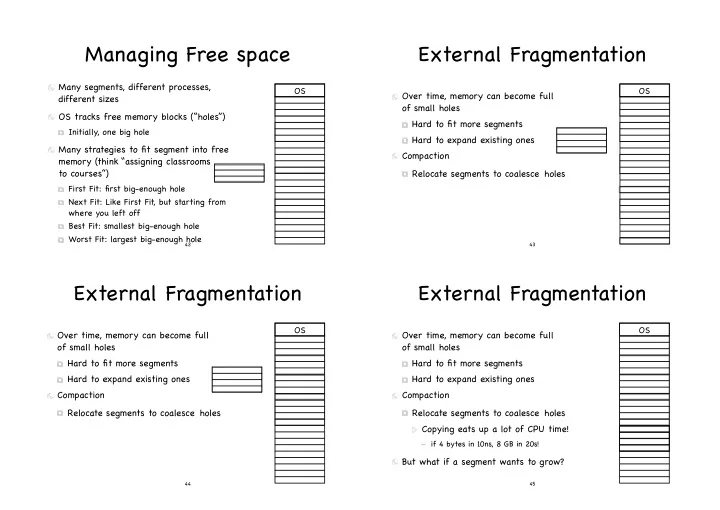
Managing Free space External Fragmentation Many segments, different processes, OS OS Over time, memory can become full different sizes of small holes OS tracks free memory blocks (holes) Hard to fit more segments Initially, one big hole


slide-1
SLIDE 1

Managing Free space

Many segments, different processes, different sizes OS tracks free memory blocks (“holes”)

Initially, one big hole

Many strategies to fit segment into free memory (think “assigning classrooms to courses”)

First Fit: first big-enough hole Next Fit: Like First Fit, but starting from where you left off Best Fit: smallest big-enough hole Worst Fit: largest big-enough hole OS

42

External Fragmentation

Over time, memory can become full

  • f small holes

Hard to fit more segments Hard to expand existing ones Compaction Relocate segments to coalesce holes

OS

43

External Fragmentation

Over time, memory can become full

  • f small holes

Hard to fit more segments Hard to expand existing ones Compaction Relocate segments to coalesce holes

OS

44

External Fragmentation

Over time, memory can become full

  • f small holes

Hard to fit more segments Hard to expand existing ones Compaction Relocate segments to coalesce holes

OS

45

Copying eats up a lot of CPU time!

if 4 bytes in 10ns, 8 GB in 20s!

But what if a segment wants to grow?

slide-2
SLIDE 2

Eliminating External Fragmentation: Swapping

Preempt processes and reclaim their memory Move images of suspended processes to swap space

  • n backing store

Ready Running Waiting Suspended

Semaphores/condition queues Ready queue Suspended queue

OS p1 p2

swap out swap in 46 Backing Store

Paging

Allocate VA & PA memory in fixed-sized chunks (pages and frames, respectively)

free frames can be tracked using a simple bitmap 0011111001111011110000 one bit/frame no more external fragmentation! but now internal fragmentation (you just can’ t win…) when memory needs are not a multiple of a page typical size of page/frame: 4KB to 16KB

Adjacent pages in VA (say, within the stack) need not map to contiguous frames in PA!

47

Virtual address

Interpret VA as comprised of two components

page: which page?

  • ffset: which byte within that page?

}

32 bits 48

Virtual address

}

  • (12 bits)

}

p (20 bits) 49

Interpret VA as comprised of two components

page: which page?

  • no. of bits specifies no. of pages in VA space
  • ffset: which byte within that page?
slide-3
SLIDE 3

Virtual address

}

}

50

Interpret VA as comprised of two components

page: which page?

  • no. of bits specifies no. of pages in VA space
  • ffset: which byte within that page?
  • no. of bits specifies size of page/frame

p (20 bits)

  • (12 bits)

Virtual address

}

}

51

To access a byte extract page number map that page number into a frame number using a page table extract offset access byte at offset in frame

2 1 6 4 8

Page Table

1 2 3 4 220 -1 . . . . . . . . . . . .

p (20 bits)

  • (12 bits)

Basic Paging

CPU

  • p

p f

  • 52

Physical Memory

Page Table

(stores frame nos)

PTBR

The Page Table lives in memory at the physical address stored in the Page Table Base Register PTBR saved/restored on context switch

Page Table Entries

Frame number Valid/Invalid bit

Set if process can reference that portion of VA space

Present bit

Set if page is mapped to a frame

Referenced bit

Set if page has been referenced

Dirty bit

Set if page has been modified

Cache disable bit

Set if page can’ t be cached

Protection bits (R/W/X)

53

3 1 5 4 9 2 11

Physical memory

7 6 5 4 3 2 1

Frame no.

Cache disable Valid Referenced Dirty Protection Present 1 1 1 1 1 1 1 1 1 1 1 1 0 0 0 0 0 0 1 1 1 0 1 1 0 0 0 0 0 0 0 0

Page table

15 14 13 12 11 10 9 8 7 6 5 4 3 2 1

}

Protection bits (R/W/X)

Frame # V P R D C

PTE:

slide-4
SLIDE 4

Page Table Entries

Frame number Valid/Invalid bit

Set if process can reference that portion of VA space

Present bit

Set if page is mapped to a frame

Referenced bit

Set if page has been referenced

Dirty bit

Set if page has been modified

Cache disable bit

Set if page can’ t be cached

Protection bits (R/W/X)

1 1 1 1 1 1 1 1 1 1 1 1 0 0 0 0 0 0 1 1 1 0 1 1 0 0 0 0 0 0 0 0

Page table

15 14 13 12 11 10 9 8 7 6 5 4 3 2 1

}

Protection bits (R/W/X)

54

Frame no.

Cache disable On disk Referenced Dirty Protection Present

Frame # V P R D C

3 1 5 4 9 2 11

Physical memory

7 6 5 4 3 2 1

PTE:

2 1 6 4 3 5 5 7

Sharing

By now, it’ s old hat:

Processes share pages by mapping virtual pages to the same frame Fine tuning using protection bits (RWX) We can refine COW to operate at the granularity of pages

  • n fork, mark all pages

read only

  • n write, copy only the

affected page set W bit in both PTEs

Page Table Process 1 Page Table Process 0 Physical Memory

55 Shared Shared

Example

A B C D E F G H I J K L

1 2

VA Space

1 2 3 4

PA Space

1 2

Page Table A B C D E F G H I J K L 1 4 3

Page size: 4 bytes

56

Space Overhead

Two sources, in tension:

data structure overhead (the Page Table itself) fragmentation

How large should a page be?

What makes up sizeofEntry?

bits to identify physical page [log2 (PA_Size / frame (aka page) size)] control bits (Valid, Present, Dirty, Referenced, etc) usually word or byte aligned (so, however many bits are needed to make it so)

57

Overhead for paging:

(#PTEs x sizeofEntry) + (#“segments” x pageSize/2) ((VA_Size/pagesize) x sizeofEntry) + (#“segments” x pageSize/2) = =

sequences of contiguous pages

slide-5
SLIDE 5

Computing Paging Overhead

1 MB maximum VA, 1 KB page, 3 “segments” (program, stack, heap) PA space is 64KB and PTE has 7 control bits

58

Overhead: 210 x 2 + 3 x 29 = (211 + 3 x 29) bytes

((220 / 210) x sizeofEntry) + (3 x 29) bytes sizeofEntry = 6 bits (26 frames) + 7 control bits byte aligned size of PTE entry: 16 bits

What is the Paging Overhead?

What’ s not to love?

Space overhead

With a 64-bit address space, size of page table can be huge

Time overhead

What before used to require one memory access, now needs two

  • ne to access the correct PTE and retrieve the

correct frame number

  • ne to access the actual physical address that

contains the data of interest

59