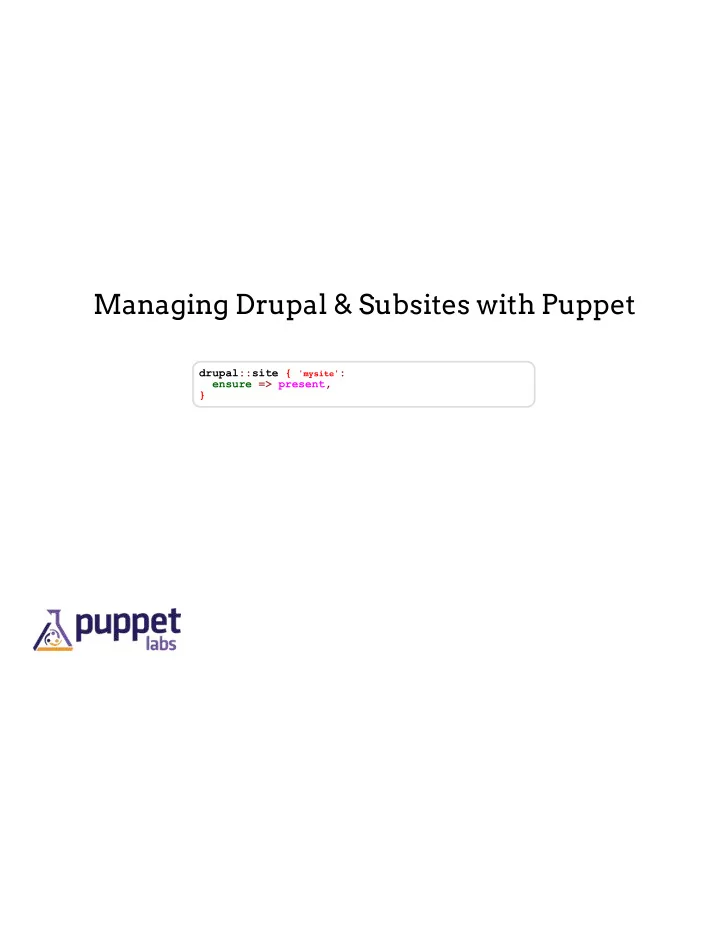
SLIDE 1 Managing Drupal & Subsites with Puppet
drupal::site { 'mysite': ensure => present, }
SLIDE 2
Setting the Scene
Starting a new project
Think about your workflow when setting up a workspace for a new project
Some existing approaches: mkdir -p sites/newsite.com/{files,modules,themes,...} Drawbacks Sure everything will just work the same... Oh wait, what version of PHP did you say you're running? Ok, let's try downgrading the date module...
SLIDE 3
Setting the Scene
Starting a new project
Think about your workflow when setting up a workspace for a new project
Some existing approaches: Start from scratch: Step 1: boot new virtual machine Step 2: install apache, mysql, php Step 3: ??? Step 4: Profit! Drawbacks:
SLIDE 4
SLIDE 5
I forgot to bump up the PHP memory_limit!
SLIDE 6 Setting the Scene
Starting a new project
Think about your workflow when setting up a workspace for a new project
Some existing approaches:
#! /bin/sh yum install apache php php-gd mysql wget http://ftp.drupal.org/files/projects/drush-7.x-5.9.tar.gz tar -xvzf drush-7.x-5.9.tar.gz echo "alias drush='php ~/drush/drush.php'" >> ~/.bash_profile source .bash_profile cd /var/www/html drush dl drupal drush site-install standard --account-name=admin --account-pass=admin \
- -db-url=mysql://drupal:p@ssword@localhost/drupal
echo "Don't forget to make php.ini updates!"
SLIDE 7 Overview
A better workflow:
binford2k:~ ben$ vagrant up clientXXX binford2k:~ ben$ vagrant ssh [root@clientXXX ~]# puppet puppet agent -t [...] notice: /Stage[main]//Node[default]/Drupal::Site[mysite.example.com]/ensure: created notice: /Stage[main]//Node[default]/Drupal_module[token]/ensure: created notice: /Stage[main]/Apache/Service[httpd]/ensure: ensure changed 'stopped' to 'running' notice: /Stage[main]/Apache/Service[httpd]: Triggered 'refresh' from 2 events notice: Finished catalog run in 17.02 seconds
SLIDE 8
Overview
Three main topics of my talk
Puppet enables a more efficient workflow Quick primer on using the Puppet language Using Puppet to manage Drupal sites
SLIDE 9
Puppet Workflow
SLIDE 10 Infrastructure as Code
Executable Documentation
class someclient { include apache, mysql, drupal drupal::site { 'someclient.com': ensure => present, } user { 'backup': ensure => present, home => '/var/spool/backups', managehome => true, } }
SLIDE 11
Declarative Model
Describe the state you want.
SLIDE 12
Maintaining State
You provision a node. Puppet configures it. Puppet maintains the desired state.
SLIDE 13
Puppet Language Primer
SLIDE 14
Puppet Resources
Resources are building blocks. They can be combined to make larger components. Together they can model the expected state of your system.
SLIDE 15
Resource Abstraction Layer
Provides a consistent model for resources across supported platforms.
SLIDE 16 Puppet Classes
Classes define a collection of resources that are managed together as a single unit.
# /etc/puppetlabs/puppet/modules/ssh/manifests/init.pp class ssh { package { 'openssh': ensure => present, } file { '/etc/ssh/sshd_config': ensure => file,
group => 'root', mode => '0644', source => 'puppet:///modules/ssh/sshd_config', require => Package['openssh'], } service { 'sshd': ensure => running, enable => true, subscribe => File['/etc/ssh/ssh_config'], } }
SLIDE 17
Modules
Modules are directories that contain configuration.
Designed to encapsulate everything related to a given configuration They have a hierarchy convention that enable the following: auto-loading of classes file-serving for templates and files auto-delivery of custom Puppet extensions easy sharing with others
SLIDE 18 Node Definitions
Multiple classes are declared together to represent a role.
For example, to build a web application on oscar.example.com:
node 'oscar.example.com' { include ssh include apache include mysql include web-app }
SLIDE 19
Learning More
Many resources available for learning
Learning Puppet tutorial http://docs.puppetlabs.com/learning/ Seriously, go there Training classes http://puppetlabs.com/training/ Fundamentals Advanced Extending Puppet IRC and all that jazz #puppet http://groups.google.com/group/puppet-users
SLIDE 20
Managing Drupal With Puppet
SLIDE 21
Managing Drupal
A Drupal install consists of:
Running services A webserver A database Packages installed services and dependencies PHP, extensions, and dependencies Drupal itself Drush (for sanity's sake) Configuration docroot settings.php php.ini sites/*
SLIDE 22
Managing Drupal
But don't reinvent the wheel
Module enables management of multisite Drupal Manages package and configuration of default instance Resource types subsites variables modules themes Configuration customize many aspects of site
SLIDE 23 Managing Drupal
Getting the module
http://forge.puppetlabs.com/binford2k/drupal
[root@training ~] puppet module search drupal Searching http://forge.puppetlabs.com ... NAME DESCRIPTION AUTHOR KEYWORDS binford2k-drupal This is a module that allows.. @binford2k cms www drupal web ... [root@classroom modules]# puppet module install binford2k/drupal Preparing to install into /etc/puppetlabs/puppet/modules ... Downloading from http://forge.puppetlabs.com ... Installing -- do not interrupt ... /etc/puppetlabs/puppet/modules └─┬ binford2k-drupal (v0.0.2) ├─┬ puppetlabs-apache (v0.6.0) │ └── puppetlabs-firewall (v0.3.0) └── puppetlabs-mysql (v0.6.1)
SLIDE 24 Managing Drupal
Using the module to manage Drupal
node 'clientXYZ.dynamic.vm' { include apache, mysql host { 'mysite.example.com': ensure => present, ip => $::ipaddress, } class { 'drupal': managedatabase => true, } drupal::site { 'mysite.example.com': database => 'mysite', dbuser => 'myuser', admin_password => 'derple', managevhost => true, managedatabase => true, } drupal_module { 'mysite.example.com::token': ensure => present, } }
SLIDE 25
Managing Drupal
Using the module to manage Drupal
SLIDE 26
Managing Drupal
See it in action
SLIDE 27
Conclusion
SLIDE 28
Recap
Three main topics of my talk
Puppet enables a more efficient workflow describe what you want let Puppet figure out how to make it happen you do something that builds value Quick primer on using the Puppet language http://docs.puppetlabs.com/learning/ http://puppetlabs.com/training/ Using Puppet to manage Drupal sites puppet module install binford2k/drupal
SLIDE 29
Questions?
Thanks for coming!
SLIDE 30