Managing a Multidisciplinary Experiential Program I NNOVATIVE D - - PowerPoint PPT Presentation

managing a multidisciplinary experiential program
SMART_READER_LITE
LIVE PREVIEW

Managing a Multidisciplinary Experiential Program I NNOVATIVE D - - PowerPoint PPT Presentation

Managing a Multidisciplinary Experiential Program I NNOVATIVE D ESIGN FOR R EAL -W ORLD E NGINEERING P ROBLEMS Presenters Joe Pacheco, Ph.D. Todd Polk, Ph.D. Robert Hart, Ph.D., P.E. Bioengineering Bioengineering Mechanical Engineering


slide-1
SLIDE 1

INNOVATIVE DESIGN FOR REAL-WORLD ENGINEERING PROBLEMS
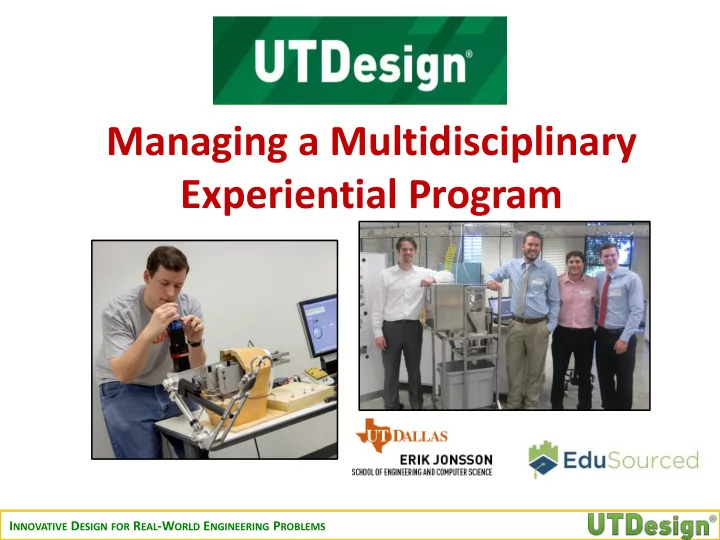
Managing a Multidisciplinary Experiential Program

slide-2
SLIDE 2

INNOVATIVE DESIGN FOR REAL-WORLD ENGINEERING PROBLEMS

Presenters

Todd Polk, Ph.D.

Bioengineering todd.polk@utdallas.edu

Robert Hart, Ph.D., P.E.

Mechanical Engineering robert.hart@utdallas.edu

Joe Pacheco, Ph.D.

Bioengineering joe.pacheco@utdallas.edu

slide-3
SLIDE 3

INNOVATIVE DESIGN FOR REAL-WORLD ENGINEERING PROBLEMS

Acknowledgements

  • Much of the work to be presented is based on

capstone programs at other universities

  • We gratefully acknowledge their contributions

and appreciate the discussions we have had with them

  • We would also like to acknowledge the

contributions and support of all the UTDesign staff and UTD administration.

3

slide-4
SLIDE 4

INNOVATIVE DESIGN FOR REAL-WORLD ENGINEERING PROBLEMS

Overview

  • Capstone at UT Dallas
  • Bringing real-world to the classroom
  • Course framework
  • Managing projects
  • Multidisciplinary aspects

4

slide-5
SLIDE 5

INNOVATIVE DESIGN FOR REAL-WORLD ENGINEERING PROBLEMS

Engineering at UT Dallas

  • Undergraduate degrees

– Biomedical Engineering – Mechanical Engineering – Electrical Engineering – Computer Engineering – Software Engineering – Computer Science

  • Engineering students

complete a two-semester senior (capstone) design course

– Team-based project – Many teams are multidisciplinary

5

slide-6
SLIDE 6

INNOVATIVE DESIGN FOR REAL-WORLD ENGINEERING PROBLEMS

Capstone Course Overview

  • Our goal is to help students make the transition

from their academic career into their professional career

  • Most projects are industry-sponsored

– Give students an opportunity to learn how to manage a project with realistic constraints and complexities

  • Key policies

– $15K sponsorship fee (includes materials and services) – IP owned by sponsor; no university involvement – Funding provided as a gift and there is no contractual relationship

6

slide-7
SLIDE 7

INNOVATIVE DESIGN FOR REAL-WORLD ENGINEERING PROBLEMS

What is UTDesign?

  • UTDesign is a collaborative program involving

all engineering departments (started in 2009)

– Provides the facilities and administrative functions needed for capstone courses – Academic aspects of capstone remain under control of individual departments

  • Advantages

– Resource sharing – Facilitates multidisciplinary projects and attitude – Encourages faculty collaboration – Single interface for corporate involvement (Give us your problem and we will build a team to solve it!)

7

slide-8
SLIDE 8

INNOVATIVE DESIGN FOR REAL-WORLD ENGINEERING PROBLEMS

UTDesign Studio

8

Seminar Room Conference Room Conf Teleconf Conf Conf Conf Conf Restrooms Kitchen Serving Area Front Desk Working spaces Connecting corridors Offices Fabrication Lab TI Innovation Lab UTDesign Capstone UTDesign Project Rooms

Project Tables - Open Lab

Offices Offices

  • 30,000 sq. ft. of space
  • Students have 24/7 access to open lab

(after on-line safety training)

  • Shop access requires additional training
slide-9
SLIDE 9

INNOVATIVE DESIGN FOR REAL-WORLD ENGINEERING PROBLEMS

Organization

9

UTDesign Support staff Engineering Director Technical Manager

Engineering Team Engineering Team Leader Team members

Corporate Mentor

Course Instructors UTD Faculty

Sponsoring Organization

Program Manager Studio Shop Manager (2 shifts) Procurement Administrative Assistant Machine Shop Staff Project Recruiter Computer Support

slide-10
SLIDE 10

INNOVATIVE DESIGN FOR REAL-WORLD ENGINEERING PROBLEMS

Overview

  • Capstone at UT Dallas
  • Bringing real-world to the classroom
  • Course framework
  • Managing projects
  • Multidisciplinary aspects

10

slide-11
SLIDE 11

INNOVATIVE DESIGN FOR REAL-WORLD ENGINEERING PROBLEMS

Finding Real World Problems

  • Project recruiting is done by UTDesign staff and

capstone instructors

  • Look for sponsors that can clearly articulate

project purpose and goals

  • Some strategies

– Build personal relationships – Reach out to alumni – Hold information sessions – Promote to trade and professional organizations – Look beyond traditional “industry”- medical schools, non-engineering companies, museums, etc.

11

slide-12
SLIDE 12

INNOVATIVE DESIGN FOR REAL-WORLD ENGINEERING PROBLEMS

Establishing the Mindset

  • Our motto: Welcome to the Real World!
  • It is critical to set the right expectations from

the beginning

  • In the first class we make it clear to students

– You are no longer a student - consider yourself a new employee at the company; we will treat you as such – You will work as part of a team to manage a realistic engineering project from beginning to end – This is a serious project for a client that has a stake in the outcome; it is not a lab or class project

12

slide-13
SLIDE 13

INNOVATIVE DESIGN FOR REAL-WORLD ENGINEERING PROBLEMS

Use of Industry Terminology

13

Academic Industry BMEN 4388/MECH 4381 UTDesign (the company name) Student Engineer Course Instructor Engineering Director Faculty Advisor Technical Manager TA Technical Assistant Sponsor/Corporate Mentor Customer/Corporate Mentor Team Leader Engineering Team Leader Class Company Meeting Assignment Project Deliverable Due Date Deadline Lecture Training Parts Ordering Procurement

slide-14
SLIDE 14

INNOVATIVE DESIGN FOR REAL-WORLD ENGINEERING PROBLEMS

Presenter

Joe Pacheco, Ph.D.

Bioengineering joe.pacheco@utdallas.edu

slide-15
SLIDE 15

INNOVATIVE DESIGN FOR REAL-WORLD ENGINEERING PROBLEMS

Overview

  • Capstone at UT Dallas
  • Bringing real-world to the classroom
  • Course framework
  • Managing projects
  • Multidisciplinary aspects

15

slide-16
SLIDE 16

INNOVATIVE DESIGN FOR REAL-WORLD ENGINEERING PROBLEMS

UTDesign Curriculum

  • Emphasis is on non-technical, professional topics

– Professional skills (emails, meetings, ethics, etc.) – Teamwork skills & conflict management – Engineering design process – Practical considerations in design – Innovation and idea generation – Project management (scope, cost, scheduling, risk) – Safety – Standards & regulation

  • We have frequent guest speakers
  • Training sessions not scheduled on several weeks

throughout the first semester and most of the second semester

16

slide-17
SLIDE 17

INNOVATIVE DESIGN FOR REAL-WORLD ENGINEERING PROBLEMS

Active Learning Strategies

  • Clicker quizzes

– Turning Point Technologies ResponseWare

  • Team activities

– Agendas and Minutes – WBS – FMEA

  • Classroom discussions

– Require participation by calling on teams to answer – keep list of teams that have been called

  • n in previous classes

17

slide-18
SLIDE 18

INNOVATIVE DESIGN FOR REAL-WORLD ENGINEERING PROBLEMS

Guest Lecture Training Sessions

  • Professional Communication and Teamwork

– Collaboration with Business Communication instructors from School of Management at UTD – Specially developed curriculum

  • Team charter
  • Conflict resolution
  • Leadership training
  • Presentation skills
  • External guest lecturers

– Topics covered: Innovation, Real-World Project Management, Ethics – Lectures are well received by students – Guest lecture topics help to reinforce topics covered by instructors

18

slide-19
SLIDE 19

INNOVATIVE DESIGN FOR REAL-WORLD ENGINEERING PROBLEMS

Problem Scoping Concept Generation Solution Realization

UTDesign Schedule and Deliverables

19

Project Definition Preliminary Design Review Detailed Design Approval Detailed Design Report UTDesign Expo Final Project Report Critical Design Review Formal Design Presentation Project Readiness Review Acceptance Test Plan Mandatory First Prototype Project Plan Deliverables: Written Meeting/Presentation

Define Problem Conceptual Design Detailed Design Handoff to Customer Customer Problem Statement & Specifications Build Prototype Validate Design

First Semester Second Semester

slide-20
SLIDE 20

INNOVATIVE DESIGN FOR REAL-WORLD ENGINEERING PROBLEMS

Problem Scoping Concept Generation Solution Realization

Recent Additions

20

Project Definition Preliminary Design Review Detailed Design Approval Detailed Design Report UTDesign Expo Final Project Report Critical Design Review Formal Design Presentation Project Readiness Review Acceptance Test Plan Mandatory First Prototype Project Plan

Define Problem Conceptual Design Detailed Design Handoff to Customer Customer Problem Statement & Specifications Build Prototype Validate Design

First Semester Second Semester

slide-21
SLIDE 21

INNOVATIVE DESIGN FOR REAL-WORLD ENGINEERING PROBLEMS

Overview

  • Capstone at UT Dallas
  • Bringing real-world to the classroom
  • Course framework
  • Managing projects
  • Multidisciplinary aspects

21

slide-22
SLIDE 22

INNOVATIVE DESIGN FOR REAL-WORLD ENGINEERING PROBLEMS

Engineering Directors

  • Oversee the entire UTDesign program
  • Conduct training
  • Set the schedule and deliverables
  • Evaluate all deliverables
  • Review all evaluations from your peers,

Technical Manager and sponsor

  • Teaching capstone takes a lot more time than a

typical class, so it is important that faculty be given adequate time

22

slide-23
SLIDE 23

INNOVATIVE DESIGN FOR REAL-WORLD ENGINEERING PROBLEMS

The Technical Manager (TM)

  • TMs are an internal resource for the teams
  • Team are expected to meet weekly with their TM
  • Roles:

– Review progress – Provide oversight & guidance – Connect the team to technical resources and experts – Available to help with any questions (technical or

  • therwise)
  • Key Point: TMs do not direct the project work
  • TM training is held at the beginning of the project

23

slide-24
SLIDE 24

INNOVATIVE DESIGN FOR REAL-WORLD ENGINEERING PROBLEMS

The Corporate Mentor (CM)

  • CM has two roles

– Customer that establishes requirements and provides feedback on concepts to establish project direction – Help the team understand the company’s technology involved in the project

  • Team are expected to meet weekly with their

CM (separate from TM meeting)

  • CM orientation session is held at the beginning
  • f the project

24

slide-25
SLIDE 25

INNOVATIVE DESIGN FOR REAL-WORLD ENGINEERING PROBLEMS

Team Formation

  • All projects are entered into EduSourced

by sponsors

  • Time is provided in first class for students

to review projects and ask questions

– Give anticipated team makeup (e.g., 3 BMEN + 3 ME)

  • Students are given a few days to complete

their bid

– Done individually using the EduSourced tool – Rank top projects – Describe relevant qualifications and skills – Upload resume – “Sell” why they should be placed on top 3 choices – Indicate preferred team member(s) & preference for team or top-ranked project

  • A summary sheet is generated for each

student and teams are formed manually by instructors

25

Last, First

slide-26
SLIDE 26

INNOVATIVE DESIGN FOR REAL-WORLD ENGINEERING PROBLEMS

Presenter

Todd Polk, Ph.D.

Bioengineering todd.polk@utdallas.edu

slide-27
SLIDE 27

INNOVATIVE DESIGN FOR REAL-WORLD ENGINEERING PROBLEMS

Managing Project Teams

  • Use a set of tools to identify those teams or

individuals in need of help

– Weekly communication

  • Hours Worked
  • Meeting Held and Attended
  • Minutes and Agendas

– Using Milestones and Deliverables – Peer evaluations (4 total) – Technical Manager evaluations

  • Team based (4 total)
  • Individual based (3 total)

– Corporate Mentor evaluations

  • Team based (2 total)

27

Middle End Middle End Peer Eval. X X X X TM - Team X X X X TM - Individual X X X CM X X First Semester Second Semester

slide-28
SLIDE 28

INNOVATIVE DESIGN FOR REAL-WORLD ENGINEERING PROBLEMS

Weekly Communication

  • Motivation

– Ensure that all teams are communicating on a regular basis with their Technical Managers, Corporate Mentors, and each other

  • One weekly communication grade per team

– Based on simple rubric on quality of Minutes and Agendas -- graded by teaching assistants – If an individual fails to submit their own hours or attendance at meetings their individual weekly communication grade is a 0

28

  • Overview
slide-29
SLIDE 29

INNOVATIVE DESIGN FOR REAL-WORLD ENGINEERING PROBLEMS

Weekly Communication

  • Motivation

– Tracking hours creates accountability for students to the course and to their teammates – Enables instructors to gauge level of commitment to project

  • Data Collection Methods

– Previous: One team member submits hours for all members once per week (using Qualtrics surveys) – Current: Individuals submit their own hours on a rolling basis (using EduSourced)

29

  • Time Sheet
slide-30
SLIDE 30

INNOVATIVE DESIGN FOR REAL-WORLD ENGINEERING PROBLEMS

Hour Tracking Metrics

  • Two key hour tracking metrics

– Average hours worked per week for each team member (our target is 10) – Contribution ratio (individual hours/avg. hours per team member)

30

slide-31
SLIDE 31

INNOVATIVE DESIGN FOR REAL-WORLD ENGINEERING PROBLEMS

Weekly Communication

  • Motivation

– Tracking teams’ meeting with their CM and TMs help instructors identify teams potentially lacking guidance – Tracking individual team members attendance at meetings creates accountability

  • Data Collection Methods

– Previous: One team member submits meetings held and attendance for whole team (using Qualtrics survey) – Current: Individuals submit their own meeting attending (using an EduSourced surveys)

31

  • TM and CM Meetings
slide-32
SLIDE 32

INNOVATIVE DESIGN FOR REAL-WORLD ENGINEERING PROBLEMS

Deliverables

  • Guidelines for each deliverable posted on

EduSourced and discussed in training sessions

  • Deliverables submitted to Milestones in

EduSourced

  • Rubrics used to evaluate deliverables

– Use of rubrics aids in ABET assessment

32

slide-33
SLIDE 33

INNOVATIVE DESIGN FOR REAL-WORLD ENGINEERING PROBLEMS

Peer Evaluation

  • Utilize questions from The Comprehensive Assessment of Team-

Member Effectiveness (CATME)*

  • Customized survey for UTD (not part of standard EduSourced

product)

33

* Ohland, M. W et al, “The comprehensive assessment of team member effectiveness: Development of a behaviorally anchored rating scale for self and peer evaluation,” Academy of Management Learning & Education, 11 (4), 609-630, 2012. * Website: http://www.catme.org

Contributing to the Team’s Work Interacting with Teammates Keeping the Team on Track Expecting Quality Having Knowledge, Skills, and Abilities

slide-34
SLIDE 34

INNOVATIVE DESIGN FOR REAL-WORLD ENGINEERING PROBLEMS

Technical Manager Evaluation

  • Technical Managers are asked to provide a performance

evaluation for the team as a whole and for each individual member of the team

– Evaluations completed in EduSourced – Mid-term and end of each semester team evaluations – End of first semester and mid-term and end of second semester individual evaluations

34

  • Team Evaluation Areas
  • f Focus
  • Technical Work
  • Deliverables
  • Meetings
  • Teamwork
  • Professionalism
  • Individual Evaluation

Areas of Focus

  • Technical Ability and

Effectiveness

  • Communication &

Contributions to meetings

  • Attitude
slide-35
SLIDE 35

INNOVATIVE DESIGN FOR REAL-WORLD ENGINEERING PROBLEMS

Corporate Mentor Evaluation

  • Corporate Mentors are asked to provide a

performance evaluation for the team as a whole

  • Evaluations completed in EduSourced at the

end of each semester

  • Team Evaluation Areas of Focus
  • Technical Work
  • Meetings
  • Attitude
  • Professionalism
  • Sponsor satisfaction

35

slide-36
SLIDE 36

INNOVATIVE DESIGN FOR REAL-WORLD ENGINEERING PROBLEMS

Continuous Monitoring

  • Engineering Directors meet regularly to review

all teams and engineers

– Hours worked – Evaluations

  • Take action as needed

– Meet with individuals or teams – Discuss issues – Require written improvement plans when needed – Follow-up to ensure goals are met

  • Dismiss students from teams in extreme

situations

36

slide-37
SLIDE 37

INNOVATIVE DESIGN FOR REAL-WORLD ENGINEERING PROBLEMS

Overview

  • Capstone at UT Dallas
  • Bringing real-world to the classroom
  • Course framework
  • Managing projects
  • Multidisciplinary aspects

37

slide-38
SLIDE 38

INNOVATIVE DESIGN FOR REAL-WORLD ENGINEERING PROBLEMS

Multidisciplinary Capstone

  • Beginning in 2014, Hart (ME) and Polk (BE)

began collaborating on capstone

– ME had one cohort completed – BE was preparing for their first cohort

  • Department capstone courses taught separately for

2 years but using the same material

  • In the Fall of 2016 the BE and ME capstone

courses were merged and taught together by Hart, Polk and Pacheco (BE – joined team in 2016)

  • One combined cohort completed, second is

nearing halfway point

38

slide-39
SLIDE 39

INNOVATIVE DESIGN FOR REAL-WORLD ENGINEERING PROBLEMS

Multidisciplinary Success

  • All BE and ME capstone students are together

in the same training (class)

– EE and CS have provided students to BE and ME teams

  • Hart, Pacheco and Polk meet outside of class for

5-10 hours weekly to plan and continually evolve the capstone program at UT Dallas

– Critical review and improvement of material presented in training – Review and updating of guidelines for deliverables – Development of rubrics for evaluating deliverables

39

slide-40
SLIDE 40

INNOVATIVE DESIGN FOR REAL-WORLD ENGINEERING PROBLEMS

Want to Learn More about Capstone?

  • Attend the 2018 Capstone Design Conference

– More information at www.capstoneconf.org

40

slide-41
SLIDE 41

INNOVATIVE DESIGN FOR REAL-WORLD ENGINEERING PROBLEMS

Thank you! Questions?

41