Management Effects on Water Quality Trends Supporting Adaptive - - PowerPoint PPT Presentation

management effects on water quality trends
SMART_READER_LITE
LIVE PREVIEW

Management Effects on Water Quality Trends Supporting Adaptive - - PowerPoint PPT Presentation

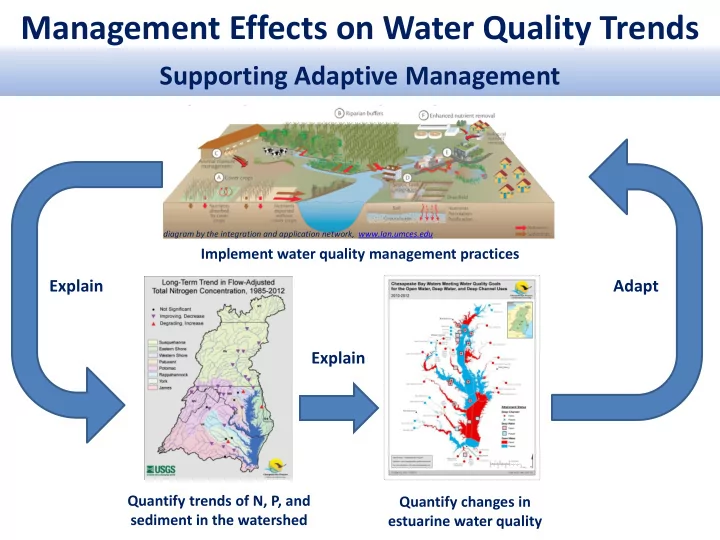
Management Effects on Water Quality Trends Supporting Adaptive Management diagram by the integration and application network, www.Ian.umces.edu Implement water quality management practices Explain Adapt Explain Quantify trends of N, P, and


slide-1
SLIDE 1

Management Effects on Water Quality Trends

Supporting Adaptive Management

Quantify trends of N, P, and sediment in the watershed Quantify changes in estuarine water quality Implement water quality management practices

Explain Explain Adapt

diagram by the integration and application network, www.Ian.umces.edu

slide-2
SLIDE 2

Management Effects on Water Quality Trends

Driver: Chesapeake Bay TMDL

Chesapeake Bay TMDL 2017 Mid-Point Assessment Objectives: 1. Gather input from the Partnership on issues and priorities to be addressed in order to help meet the goal of all practices in place by 2025 to meet water quality standards; 2. Based on these priorities, review the latest science, data, tools and BMPs, incorporate as appropriate into the decision-support tools that guide implementation, and consider lessons learned; and 3. Help jurisdictions prepare Phase III WIPs, which will guide milestones and implementation from 2018 to 2025.

slide-3
SLIDE 3

Management Effects on Water Quality Trends

Strategy: An Integrated Approach

Use improved understanding of trends to enhance Chesapeake Bay Program Models. Analyze and Explain water-quality trends in Chesapeake Bay and its watershed. Enhance approaches to assessing attainment of water- quality standards using tidal monitoring data . Synthesize and communicate results and implications for the TMDL.

slide-4
SLIDE 4

Management Effects on Water Quality Trends

Challenges

Environmental setting

  • Climatic variability
  • Residence times of nutrients and sediments
  • Estuarine circulation of nutrients
  • Lag time between implementation of management practices and water

quality response Anthropogenic drivers

  • Demographic shifts
  • Changes in agriculture and land development
  • Diverse and diffuse implementation of best management practices (BMPs)

Availability of sufficient, high-quality data

  • Implementation of BMPs
  • Spatial and temporal density of monitoring data

Scale Issues Climate Change Lags Data

slide-5
SLIDE 5

Management Effects on Water Quality Trends

Workshop Goals

Identify promising approaches to:

  • Enhance trend detection methods
  • Identify information needed to better explain trends
  • Better quantify the factors driving observed changes in water

quality in Chesapeake Bay and its watershed

slide-6
SLIDE 6

Management Effects on Water Quality Trends

Workshop Approach

  • Jumpstart Videos provide background information on climatic,

environmental, and anthropogenic drivers as well as available data;

  • A set of targeted talks provide information and context for group

discussions;

  • Breakout discussions generate new ideas and recommendations on

necessary data and quantitative approaches for explaining trends.