Malika KONG Pharmacist, MPH Profile Pharmacist, MPH and is a - - PDF document

malika kong
SMART_READER_LITE
LIVE PREVIEW

Malika KONG Pharmacist, MPH Profile Pharmacist, MPH and is a - - PDF document

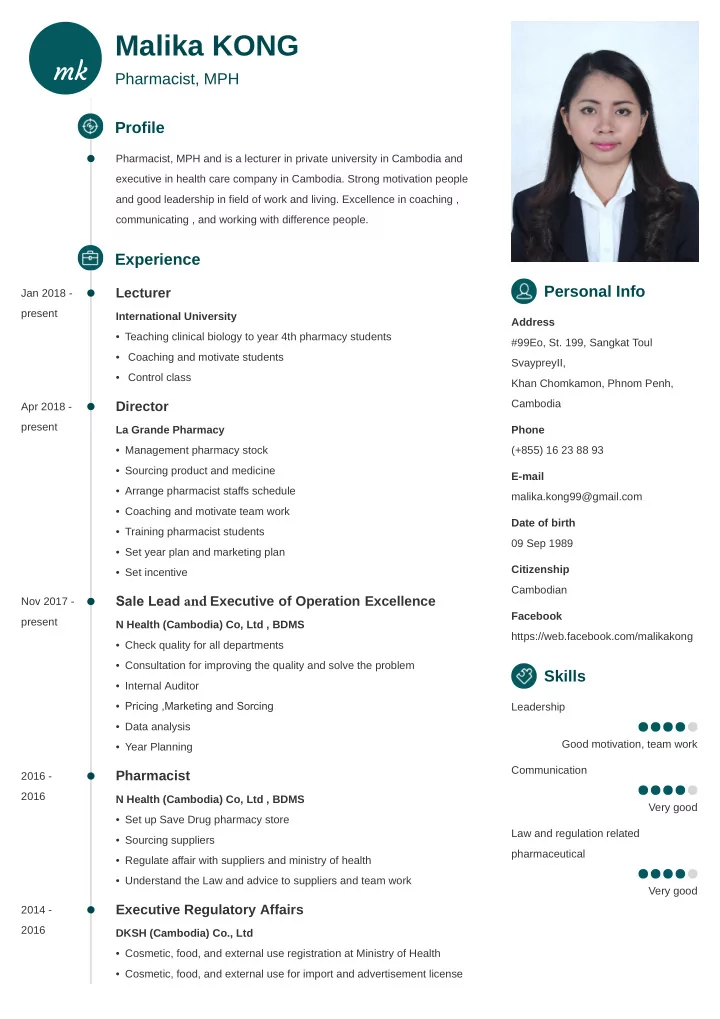
Malika KONG Pharmacist, MPH Profile Pharmacist, MPH and is a lecturer in private university in Cambodia and executive in health care company in Cambodia. Strong motivation people and good leadership in field of work and living. Excellence in


slide-1
SLIDE 1

Malika KONG

Pharmacist, MPH

Pharmacist, MPH and is a lecturer in private university in Cambodia and executive in health care company in Cambodia. Strong motivation people and good leadership in field of work and living. Excellence in coaching , communicating , and working with difference people.

Lecturer

International University Teaching clinical biology to year 4th pharmacy students

  • Coaching and motivate students
  • Control class
  • Director

La Grande Pharmacy Management pharmacy stock

  • Sourcing product and medicine
  • Arrange pharmacist staffs schedule
  • Coaching and motivate team work
  • Training pharmacist students
  • Set year plan and marketing plan
  • Set incentive
  • Sale Lead and Executive of Operation Excellence

N Health (Cambodia) Co, Ltd , BDMS Check quality for all departments

  • Consultation for improving the quality and solve the problem
  • Internal Auditor
  • Pricing ,Marketing and Sorcing
  • Data analysis
  • Year Planning
  • Pharmacist

N Health (Cambodia) Co, Ltd , BDMS Set up Save Drug pharmacy store

  • Sourcing suppliers
  • Regulate affair with suppliers and ministry of health
  • Understand the Law and advice to suppliers and team work
  • Executive Regulatory Affairs

DKSH (Cambodia) Co., Ltd Cosmetic, food, and external use registration at Ministry of Health

  • Cosmetic, food, and external use for import and advertisement license
  • Profile

Experience

Jan 2018 - present Apr 2018 - present Nov 2017 - present 2016 - 2016 2014 - 2016

Personal Info

Address #99Eo, St. 199, Sangkat Toul SvaypreyII, Khan Chomkamon, Phnom Penh, Cambodia Phone (+855) 16 23 88 93 E-mail malika.kong99@gmail.com Date of birth 09 Sep 1989 Citizenship Cambodian Facebook https://web.facebook.com/malikakong

Skills

Leadership Good motivation, team work Communication Very good Law and regulation related pharmaceutical Very good

slide-2
SLIDE 2

approval from Ministry of Health Deal the problem of suppliers, company and Ministry of Health

  • Understand the Law and advice to suppliers or team work
  • Doing daily and monthly report
  • GPA 4 & Excellence Defending Thesis in master degree of public health,

Khon Kaen University, Thailand Get full Scholarship for master degree in Public Health, Khon Kaen University, Thailand Get award of outstanding student of the year 2010, 2011, 2012, 2013, and 2014 of bachelor of pharmacy from International University, Cambodia Get an Award of full scholarship of bachelor degree of English from University of Cambodia, Cambodia

Public Health , Master degree, Khon Kaen University , Thailand Pharmacy, Bachelor degree, International University, Cambodia English, Bachelor degree, University of Cambodia, Cambodia

Thesis: of MPH on Topic “Sociocultural Determinants and Alcohol Use Disorder among Working Age Population in Cambodia” in Khon Kaen University. International presentation: Conference on Health Challenges in Sustainable Development Goals entitled “Sociocultural Determinants and Alcohol Use Disorder among Working Age Population in Cambodia” in Khon Kaen University. ISO14971:2007 Risk Management by DKSH Workshop on Tooth paste Industrial Management and Quality Control by International University Skill of Pharmacy Management by International University CISCO network for software and hardware program by Pannasastra University of Completed Intensive English Program Academic at the University of Cambodia

Awards

2017 2016 2007

Education

2016 - 2017 2009 - 2015 2007 - 2011

Research / International Presentation

2017 2017

Training / Course

2015 2014 2011 2009 2008

Software

STATA Excellence Microsoft Office, Out look Advanced Snagit Advanced SAP Very good Endnote, Internet Advanced

Languages

Cambodian- Mother tounge Proficient English- Bachelor degree Very good Thai- Diploma degree Good

slide-3
SLIDE 3

Completed Intensive English Academic Program at Pannasastra University

  • f Cambodia

National Blood Transfusion Center as volunteer during “Give Blood, Give Love” Standard Patient in National Pharmacy Exit Exam 2013 and 2014 Group pharmacy student leader in Study Tour to Thailand by International University University of Cambodia as an Exam facilitator in ‘Somdech Hun Sen’ National Scholarship Pannasastra University of Cambodia as a trainer

  • Asst. Professor Sok Vanna, Vice Dean International University

Tel: (855) 12984 166

  • Email: sok.vanna77@yahoo.com
  • 2008

Volunteer

Feb 2014 2014 Aug 2013 2010 Apr 2009

References

slide-4
SLIDE 4

International Conference on

Fibromyalgia and Chronic Pain (June 15-16, 2016 Philadelphia,

USA) Fibromyalgia 2016

June 15-16, 2016

Title: Sociocultural Determinants and Alcohol Use Disorder among Working Population in Cambodia. Authors: Kong Malika1, Wongsa Laohasiriwong2, Paricah Nippanon3, Teerasak Phajan4

1M.P.H.student, Faculty of Public Health, Khon Kaen University, Thailand.2 Faculty of Public Health,

Research and Training Center for Enhancing Quality of Life of Working Age People. Khon Kaen University, Thailand.3 Faculty of Public Health, Khon Kaen University, Thailand.4 Sirindhorn College of Public Health, Khon Kaen University, Thailand Introduction: There have been increasing trends of alcohol consumption in Cambodia. However, it effect on consumers seldom been studied and reported. Objective: To determine association between sociocultural and alcohol use disorder among working age population in Phnom Penh city, Cambodia. 323 participants in 2017 Methodology: This cross sectional study was conducted in Phnom Penh municipal city, Cambodia in 2017. Multi stage random sampling was used to select 323 working age people to response to structured

  • questionnaire. The Alcohol Use Disorders Identification Test (AUDIT) of the World Health Organization was

used to identify the alcohol use disorder status of the sample. Multiple logistic regression was used to determine the association. Result: Most of the participants were male 75.85% with the average age was 31.8 years old (SD ± 10.2). The prevalence of alcohol use disorder was 53.56% which was included hazardous drinking (8-15 scores) 34.67%, harmful drinking (16-19scores) 11.76%, and problem alcohol dependence (+20scores) 7.12%. The factors associated to alcohol use disorder were male (Adjusted OR: 5.46, 95%CI: 2.7-11.03), overweight (Adjusted OR: 1.7, 95%CI: 1.04-3.05), employed (Adjusted OR: 2.83, 95%CI: 1.42-5.65), current smoker (Adjusted OR: 4.5, 95%CI: 1.88-10.76), those had family drink alcohol (Adjusted OR: 4.28, 95%CI: 2.24-8.16), those had close friend drink alcohol (Adjusted OR: 4.43, 95%CI: 1.22-16.13), those currently take medicine (Adjusted OR: 3.56, 95%CI: 1.28-9.93), and those had chronic health problem (Adjusted OR: 2.57, 95%CI: 1.21-5.44), which statistic were significantly p value <0.05. Conclusion: The prevalence of alcohol use disorder was high; also, male, overweight, employed, current smoking, family drink alcohol, friend drink alcohol, currently take medicine, and chronic health problem were associated with alcohol use disorder in Cambodia. Keywords: Alcohol use disorder, Hazardous drinking, Working Age Population, Sociocultural Abbreviations: AUDIT: Alcohol use disorders identification test; BMI: Body mass index; WHO: World Health Organization; HD: Hazardous drinking.

slide-5
SLIDE 5

International Conference on

Fibromyalgia and Chronic Pain (June 15-16, 2016 Philadelphia,

USA) Fibromyalgia 2016

June 15-16, 2016

BACKGROUND Alcohol is the third risk factor for many death and disability worldwide (WHO, 2009). A study in 2010 indicated that 2.5 million people globally in 2004 died by the alcohol consumption which is included 32 000 people between of 15 to 29 years

  • ld. In 2004 worldwide, 3.8% of death and 45% of

disability are caused by alcohol use. (Alwan, 2010). There are more than 200 diseases and injury conditions which is caused by alcohol consumption (WHO, 2014). However, alcohol stay connected to people’s living since long time ago and provide people

  • f

relax feeling and more good communication in the social. People consume more alcohol, it will be alcohol poisoning and lead to

  • abuse. Then that person will become an alcoholic
  • person. Therefore, the global information system on

alcohol and health plays as important role to assess and control the situation of alcohol consumption, harmful of alcohol consumption, and policies in alcohol use for many countries. As the actual information has been showed that 3.3 million of people die every year by drinking alcohol, and 60 vary of diseases are caused by alcohol consumption. Also, it causes many health problems for people who consume alcohol. 6.2liters of pure alcohol was consumed by the people aged more than 15 years

  • ld, as the report of worldwide about total alcohol

consumption with 25% of total consumption is without any record. (WHO, 2017). The more people drink alcohol , the more challenge of public health as a result of much increase of prevalence of disease in region

  • f

Asia-Pacific.(Jim E. Banta, 2013) Cambodia is a low income country in Southeast Asia, with a population of 15,957,223(Factbook, 2017). The number of alcohol drink in Cambodia increased from 4.6(lite in pure alcohol) in 2003– 2005 to 5.5(lite in pure alcohol) in 2008–2010 in the general population. Also, the pure alcohol consumption per capita among drinker in Cambodia was 14.2 lite; on the other hand, alcohol use disorders and alcohol dependence in Cambodia were 4.4% and 2.7%, respectively, in 2010 that was higher than the Western Pacific region average.(Peltzer, Pengpid, & Tepirou, 2016). The prevalence of alcohol use disorder in Cambodia was high. (MaleWesley Yeung, 2015). In Cambodia, there is no law to control related to alcohol use and buy; also, no regulation about industry and local market. However, Cambodia Ministry of Health has draft the first law related to minimum the age of alcohol

  • drinking. “The law will limit people who are under

21 years of age from buying alcohol or going to drink alcohol in bars” (Henderson, 2015). A research in 2015 reported about the prevalence of alcohol use disorder and episodic drinking in rural communities in Cambodia was high. Male , younger age, and increasing income were significant risk factors.(Wesley Yeung, 2015) MATERIALS AND METHODS An observational study with cross-sectional design was conducted in August 2017 by interview after taking informed consent. Ethical approval was made by Khon Kaen University Ethics Committee in Human Research (No.HE602181). Section Multi- stage sampling was used to select the samples in this

  • study. Phnom Penh municipality was selected and 5
slide-6
SLIDE 6

International Conference on

Fibromyalgia and Chronic Pain (June 15-16, 2016 Philadelphia,

USA) Fibromyalgia 2016

June 15-16, 2016

districts were randomly selected from the total of 12 districts of Phnom Penh municipality. Then 2 communes were randomly selected from each selected district, so the total of 10 communes were

  • selected. Also, the ten communes such as Beorng

Salang,Psardepo1,Toul Svay PreyII, Bengkengkong1, Wat Phnom, Chaktomuk, Phnom Penh Tmey, Tektla, Prek Eng and Prekpra was selected from district of Khan Toul Kork, Khan Chamcarmon, Khan Doun Penh, Sen Sok, and Khan

  • Chbarampov. Then a systematic random sampling

method was applied to choose 323 households from total 125,527 households. The totals of 323 samples were randomly selected from each household if there were more than one member of included criteria in each household. The study population included the working age population (age from 18 to 59 years old) in Phnom Penh city of Cambodia, who are willing to participate in the study and have no difficulties to understand the questionnaire and express their ideas. Study tool The pre-testing of the questionnaire was conducted 30 participants in any communes and calculated for reliability of the study using Cronbach alpha coefficient >= 0.70 and Kuder–Richardson Formula 20 (KR-20)>=0.50 that was considered

  • appropriately. The questionnaire was adjusted and

corrected accordingly to ensure the validity and reliability of the tool. Finally, the questionnaires were adjusted and corrected accordingly, which were ensured the validity and reliability of the tool. During data collection real time, researcher served as mentor

  • r supervisor for data management to review all the

forms 323 of participant for completed each day, the check for the completion and other errors. BMI was measured by weight and height; also, hazardous drinking of alcohol use disorder was measured by AUDIT score ≥8 from WHO. Then knowledge, marketing, and attitude were measured by rating the scale and classified to criteria based on Bloom’s cut

  • ff point (60%-80%).

Statistical Analysis Plan The raw data of 323 responded participants had been recorded into MS Excel for database management before an in-depth analysis. After that the statistical consideration for data analysis was used by STATA (13.0) software to study and analyze the relationship between dependent variable and independent variables for this research, as well as descriptive statistic by describing the frequency and percentage as baseline of characteristic. Then the simple logistic regression was used for analyze the association between each independent variable and outcome. Finally, the multiple logistic regressions adjusted OR, 95% of Confident Interval (95%CI) with P value < 0.05 was used to determine the factor associations between sociocultural determinants with alcohol consumption disorder. Cronbrach Alpha coefficient >=0.7 and Kuder–Richardson Formula 20 (KR- 20)>=0.50 were used to test reliability. RESULTS The participants of this study was male 75.85%, and the average age was 31.82 ± 10.26 SD years old. The subject who were underweight was 11% and normal weight was 41% while those who were overweight and obesity are nearly 50%. However, those were

slide-7
SLIDE 7

International Conference on

Fibromyalgia and Chronic Pain (June 15-16, 2016 Philadelphia,

USA) Fibromyalgia 2016

June 15-16, 2016

single was comparable with married and divorced within average income was 392 USD± 410USD per month, and monthly expenditure was 286USD±282USD. Our present study, the prevalence of hazardous drinking that was defined by AUDIT score ≥ 8 was 53.56%. The result indicated that male had more chance 5.46 times than female to get HD (Adjusted OR: 5.46, 95%CI: 2.7-11.03) which statistically was significant p value< 0.001. For people who were overweight had chance 78% more than those who were normal and underweight to get HD (Adjusted OR: 1.78, 95%CI: 1.04-3.05) and it was significantly p value: 0.03. Subjects who were employed had more chance 2.83 times to get HD compared with those who were unemployed (Adjusted OR: 2.83, 95%CI: 1.42-5.65) with p value: 0.003. Those who were current smoker had more chance 4.5times to get HD compared with never/former smoker (Adjusted OR: 4.5, 95%CI: 1.88-10.76) which statistical was significant p value: 0.001. People who had family drinking alcohol were more likely to get HD 4.28 times compared to those did not have family drink alcohol (Adjusted OR: 4.28, 95%CI: 2.24-8.16) p value< 0.001 was

  • significantly. Subjects who had close friend drinking

alcohol were more likely to get HD 4.43 times compared to those did not have family drink alcohol (Adjusted OR: 4.43, 95%CI: 1.22-16.13) p value: 0.02 was significantly. People who were currently take medicine had more chance to get HD 3.56 times compared with those who never and former take medicine regularly (Adjusted OR: 3.56, 95%CI: 1.28-9.93) with statically was significant p value: 0.01. The subjects who had chronic health problem had more chance to get HD 2.57 times compared with those who were not( Adjusted OR: 2.57, 95%CI: 1.21-5.44) ; p value: 0.01 was significantly.(Table4) Table 1: Baseline characteristics of respondents Characteristics Number Percentage (%) Overall 323 Sex Male 245 75.85 Female 78 24.15 Age (years) 18-20 31 9.60 21-30 130 40.25 31-40 106 32.82 41-50 31 9.60 >50 25 7.74 Mean (SD) 31.8 ± 10.2 Median (Min: Max) 30 (18 – 59) BMI ( Kg/m2) Underweight ( <18.5) 37 11.46 Normal (18.5-22.99) 134 41.49 Overweight (23-24.99) 65 20.12 Obesity (>=25) 87 26.93 Marital status Single 167 51.70 Married 142 43.96

slide-8
SLIDE 8

International Conference on

Fibromyalgia and Chronic Pain (June 15-16, 2016 Philadelphia,

USA) Fibromyalgia 2016

June 15-16, 2016

Divorced/widowed/separated 14 4.33 Income (USD/Month) <200 84 26.01 200-300 126 39.01 >300 113 34.98 Mean (SD) 392 (± 410) Median (Min: Max) 250 (0-4,500) Expenditure (USD/Month) <200 144 44.58 200-300 95 29.41 >300 84 26.01 Mean (SD) 286 (± 282) Median (Min: Max) 200 (5-2,000) Educational attainment Uneducated 11 3.41 Primary school 57 17.65 Secondary school 49 15.17 High school 115 35.60 Bachelor degree or higher 91 28.17 Occupation Private company officer 87 26.93 Vendor 84 26.01 Student 57 17.65 Government officer 25 7.74 Worker 19 5.88 Unemployed 5 1.55 Other 46 14.24 Family member <5 133 41.18 >=5 190 58.82 People live with Relatives/ family 122 37.77 Husband/wife 118 36.53 Alone 39 12.07 Friends 28 8.67 Partner 8 2.48 Other 8 2.48 Religion Buddhist 315 97.52 Christian 5 1.55 Muslim 3 0.93 Physical activities =<1/week 192 59.44 >1/week 131 40.56 Smoking Never Smoking 226 69.97 Former Smoking 45 13.93 Current smoking 52 16.10 Family drink alcohol No 83 25.70 Yes 240 74.30

slide-9
SLIDE 9

International Conference on

Fibromyalgia and Chronic Pain (June 15-16, 2016 Philadelphia,

USA) Fibromyalgia 2016

June 15-16, 2016

Close friend drink alcohol No 26 8.05 Yes 297 91.95 Take medicine regularly Never 261 80.80 Former Take 26 8.05 Current take 36 11.15 Chronic health problem No 259 80.19 Yes 64 19.81 Table 2: Alcohol Use Disorder Identification Test Characteristics Number Percentage (%) AUDIT (1 year) Low risk drinking ( 0-7) 150 46.44 Hazardous drinking (8-15) 112 34.67 Harmful drinking (16-19) 38 11.76 Problem Alcohol dependence (20+) 23 7.12 Mean (SD) 9.19 (6.71) Median (Min: Max) 8 (0 : 30) Table 3. Odds ratios for sociocultural determinants factors on alcohol use disorder (Hazardous drinking) based on simple logistic regression. Characteristics Number %HD OR 95%CI p-value Overall 323 53.56 Sex <0.001 Female 78 28.21 1 Male 245 61.63 4.08 2.34 - 7.13 Age (years) 0.02 18-30 161 45.96 1 31-50 137 61.31 1.86 1.17-2.96 >50 25 60.00 1.76 0.74-4.15 BMI(Kg/m2) <0.001 Underweight and normal ( <23) 171 44.44 1 Overweight (>=23) 152 63.82 2.20 1.40-3.44 Marital status Single 167 52.10 1 0.36 Married 142 53.52 1.05 0.67-1.65 Divorced/widowed/separated 14 71.43 2.29 0.69-7.62 Income (USD/Month) 0.38 <200 84 48.81 1 200-300 126 52.38 1.15 0.66 - 2 >300 113 58.41 1.47 0.83 - 2.59 Expenditure (USD/Month) 0.10 <200 144 47.22 1 200-300 95 56.84 1.47 0.87 - 2.47 >300 84 60.71 1.72 0.99 - 2.98

slide-10
SLIDE 10

International Conference on

Fibromyalgia and Chronic Pain (June 15-16, 2016 Philadelphia,

USA) Fibromyalgia 2016

June 15-16, 2016

Educational attainment 0.87 Under high school 117 52.99 1 Upper high school 206 53.88 1.03 0.65-1.63 Occupation (KHR Thousand/Month) <0.001 Unemployed 62 33.87 1 Employed 261 58.24 2.72 1.52 - 4.86 Family member 0.77 <5 133 52.63 1 >=5 190 54.21 1.06 0.68 - 1.66 People live with 0.81 Alone 39 53.85 Husband/wife 118 54.24 1.01 0.49-2.1 Partner 8 75.00 2.57 0.46-14.35 Friends 28 53.57 0.98 0.37-2.61 Relatives 122 50.82 0.88 0.42-1.82 Other 8 62.50 1.42 0.29-6.82 Physical activities 0.02 =<1/week 192 48.44 1 >1/week 131 61.07 1.66 1.06-2.62 Smoking <0.001 Never/former Smoking 271 47.60 1 Current smoking 52 84.62 6.05 2.74 - 13.34 Family drink alcohol <0.001 No 83 36.14 1 Yes 240 59.58 2.60 1.55-4.36 Close friend drink alcohol <0.001 No 26 19.23 1 Yes 297 56.57 5.46 2-14.89 Take medicine regularly 0.001 Never/Former Take 287 50.52 1 Current take 36 77.78 3.42 1.51-7.77 Chronic health problem <0.001 No 259 47.10 1 Yes 64 79.69 4.40 2.28-8.48 Marketing on Alcohol 0.04 Low level 59 38.98 1 Moderate level 235 56.60 2.04 1.13-3.65 High level 29 58.62 2.21 0.89-5.48 Attitude 0.7 Neutral and Positive 273 53.11 1 Negative 50 56 1.12 0.61-2.06 Knowledge 0.24 Fair/High 305 52.79 1 Poor 18 66.67 1.78 0.65-4.88 Significant p value <0.25

slide-11
SLIDE 11

International Conference on

Fibromyalgia and Chronic Pain (June 15-16, 2016 Philadelphia,

USA) Fibromyalgia 2016

June 15-16, 2016

Table 4. Odds ratios for sociocultural determinants factors on alcohol use disorder (Hazardous drinking) based on multiple logistic regression. Characteristics Number %HD Crude OR Adjusted OR 95%CI p-value Overall 323 53.56 Sex <0.001 Female 78 28.21 1 1 Male 245 61.63 4.08 5.46 2.7-11.03 BMI(Kg/m2) 0.035 Under/ normal weight ( <23) 171 44.44 1 1 Overweight (>=23) 152 63.82 2.20 1.78 1.04-3.05 Occupation 0.003 Unemployed 62 33.87 1 1 Employed 261 58.24 2.72 2.83 1.42-5.65 Smoking 0.001 Never/former Smoking 271 47.60 1 1 Current smoking 52 84.62 6.05 4.50 1.88- 10.76 Family drink alcohol <0.001 No 83 36.14 1 1 Yes 240 59.58 2.60 4.28 2.24-8.16 Close friend drink alcohol 0.024 No 26 19.23 1 1 Yes 297 56.57 5.46 4.43 1.22- 16.13 Take medicine regularly 0.015 Never/Former Take 287 50.52 1 1 Current take 36 77.78 3.42 3.56 1.28-9.93 Chronic health problem 0.014 No 259 47.10 1 1 Yes 64 79.69 4.40 2.57 1.21-5.44 Significant p value <0.05 DISCUSSION In the study indicated that sex was associated with AUD that define by AUDIT score ≥ 8 that that male had more chance 5.46 times than female to get hazardous drinking (Adjusted OR: 5.46, 95%CI: 2.7- 11.03) which statistically was significant p value< 0.001. It was comparable to the study in Korea that women had a lower risk of high risk alcohol drinking (OR: 0.14, 95% CI: 0.13–0.16, P<0.001) than men (Hong et al., 2017). Also, it was similar to the result male versus female (45.7% versus 17.0%; OR=0.23, p<0.001) (Tynan et al., 2017) and another reported of female had chance 70% less than male to get hazardous drinking (Adjusted OR: 0.3, 95%CI: 0.17- 0.58) ; p value <0.001.(Jenkins et al., 2015). All in all, this recent result which showed male had more chance to get hazardous drinking compared to female, it could be the reason that in Cambodia female was less socialization compared to male, and Cambodia’s culture, female with alcohol drinking was not appropriate while male with alcohol is just the

slide-12
SLIDE 12

International Conference on

Fibromyalgia and Chronic Pain (June 15-16, 2016 Philadelphia,

USA) Fibromyalgia 2016

June 15-16, 2016

common thing. Regarding to occupation, this study showed that subject who were employed had more chance 2.83 times to get hazardous drinking compared with those who were unemployed (Adjusted OR: 2.83, 95%CI: 1.42-5.65) with p value : 0.003. By the same token, the study in Kenya 2015, also, showed that employed people had more chance to get hazardous drinking nearly 2 times compared to those were not employed (adjusted OR: 1.8, 95%CI: 1.04 - 2.99, p value : 0.036)(Jenkins et al., 2015). As a result, this study indicated that employed people had more chance to get hazardous drinking compared to unemployed people, it could be the result that those who were working was more socialization and they could afford more than unemployed people. Also, this study was reported that current smoking was 16% and never and former smoking was over 80%; likewise, the previous study was 13% and never and former smoking was more than 80% (Symon, Rankin, Butcher, Smith, & Cochrane, 2017). In our study indicated those who were current smoker had more chance 4.5times to get HD compared with never and former smoker (Adjusted OR: 4.5, 95%CI: 1.88- 10.76) which statistical was significant p value: 0.001. This agreed with the result of review in Slovenia was smoker had more chance nearly 2 times compared to those not smoke to get risky of drinking( adjusted OR: 1.952, 95%CI: 1.615–2.360) with p value < 0.001 significantly (Kolsek & Klemenc Ketis, 2015). The study in China was reported that the current smoker had change to get HD 3.3 times more than never/former smoker (adjusted OR: 3.3, 95% CI: 2.68–4.07); p value<0.05 was significant (Gao, Weaver, Fua, & Pan, 2014). Likewise, the previous study also indicated that smoking was associated with AUD (adjusted OR: 6, 95%CI: 3.12-11.54) with p value: 0.001 (Zenebe Y*, 2015). In conclusion, current smoker had more chance to get HD. Also, in Cambodia’s society, it could be the reason that the group of people who smoke, most of them already had experience of excessive or higher drinking

  • alcohol. In term of family drink alcohol, our analyze

showed that people who had family drinking alcohol were more likely to get hazardous drinking 4.28 times compared to those did not have family drink alcohol (Adjusted OR: 4.28, 95%CI: 2.24-8.16) p value< 0.001 was significantly. It was similar to the study in Southern Ireland that had been reported that parents who were hazardous drinking associated to the adolescent to get HD by the subjects who had father HD were more likely to get HD almost 3 times compared to those not (adjusted O.R = 2.90, 95 % CI: 1.32–6.35) with p value <0.05 (Murphy, O'Sullivan, O'Donovan, Hope, & Davoren, 2016). It could be the reason that family was the role model to their children, and some time their children are the people who consume the alcohol for their parents. Then it provided much alcohol drinking in their living style. Regarding to close friend drink alcohol, in the present study, the result showed that close friend drink alcohol was associated with HD. Our analyze showed that the subject who had close friend drinking alcohol were more likely to get hazardous drinking 4.43 times compared to those did not have family drink alcohol (Adjusted OR: 4.43, 95%CI: 1.22-16.13) ;p value: 0.02 was significantly. It was similar to the

  • ther previous study in Thailand that men who had

peer alcohol drinking occasion were more likely to

slide-13
SLIDE 13

International Conference on

Fibromyalgia and Chronic Pain (June 15-16, 2016 Philadelphia,

USA) Fibromyalgia 2016

June 15-16, 2016

get HD 5 times compared to the men had peer never drink (adjusted OR: 5.57, 95%CI: 2.02-15.31) and the men who had peer drink usual were more likely to get HD 23 times compared to those not (adjusted OR: 23.46, 95%CI: 7.29-75.43), which statistically was significant <0.01. Also in the same study that showed women who had peer drink occasion were more likely to get HD nearly 8 times compared to women who had peer never drink (adjusted OR: 7.94, 95%CI: 1.89-33.43) and those women who had peer drink usual were more likely to get HD 63 times compared with women who had peer never drink (adjusted OR: 9.24-435.31), which p value<0.01 (Zenebe Y*, 2015). It might be the reason that those who had alcohol drinking peer group, more or less they must be influent by many meeting gatherings. LIMITATION Since our study was mentioned on working age population and the location was Phnom Penh City, the most busy municipality city in Cambodia. Hence, the participants who were in this age were so busy in their work, most of them go to work outside their house during working hours in the week day; also, some of them were doing business at their home while we were asking them to join in this study. However, during working on this study, we were trying to do in weekend and the time that they are free from their work in order to minimize the selection bias as much as possible. Moreover, for the people who were doing their own business at their home, we were trying to convince them to join in this study until they were willing to participate. All the respondents were selected by systematic random sampling method in order to make the result more

  • accurate. Moreover, during our study was raining

season, so we were not able to interview more participants for the each raining day; however, we are make sure that our report was the accurate in this study. CONCLUSION Our present study, the prevalence of hazardous drinking that was defined by AUDIT score ≥ 8 was

  • ver 50% and there are 8 factors that associated with

hazardous drinking of AUD included sex, BMI,

  • ccupation, smoking, family drink alcohol, close

friend, take medicine regularly, and chronic health problem, which the statistically was significant p value<0.05. ACKNOWLEDGEMENTS I am thankful to the study participants and local administration for their kind and support. I am also thankful to my professor for always support and advice for achieving this research. REFERENCE Alwan, D. A. (2010). Global Strategy to reduce the harmful use of alcohol. Department of Mental Health and Substance Abuse20, Avenue Appia1211 Geneva 27 Switzerland. Factbook, T. W. (2017). Cambodia. Retrieved 23- March-2017, 2017, from https://www.cia.gov/library/publications/the- world-factbook/geos/cb.html

slide-14
SLIDE 14

International Conference on

Fibromyalgia and Chronic Pain (June 15-16, 2016 Philadelphia,

USA) Fibromyalgia 2016

June 15-16, 2016

Gao, J., Weaver, S. R., Fua, H., & Pan, Z. (2014). Does workplace social capital associate with hazardous drinking among Chinese rural- urban migrant workers? PLoS One, 9(12),

  • e115286. doi: 10.1371/journal.pone.0115286

Henderson, K. S. a. S. (2015, June 18, 2015). Draft Law Sets Legal Drinking Age at 21, Highest in Region, The Cambodia Dialy. Hong, J. W., Noh, J. H., & Kim, D. J. (2017). The prevalence of and factors associated with high-risk alcohol consumption in Korean adults: The 2009-2011 Korea National Health and Nutrition Examination Survey. 12(4),

  • e0175299. doi: 10.1371/journal.pone.0175299

Jenkins, R., Othieno, C., Ongeri, L., Kiima, D., Sifuna, P., Kingora, J., . . . Ogutu, B. (2015). Alcohol consumption and hazardous drinking in western Kenya--a household survey in a health and demographic surveillance site. BMC Psychiatry, 15, 230. doi: 10.1186/s12888-015-0603-x Jim E. Banta. (2013). Patterns of Alcohol and Tobacco Use in Cambodia. Asia Pac J Public

  • Health. doi: 10.1177/1010539512464649.

Kolsek, M., & Klemenc Ketis, Z. (2015). Alcohol Drinking Among the Students

  • f

the University of Maribor, Slovenia. Zdr Varst, 54(4), 259-266. doi: 10.1515/sjph-2015-0034 Murphy, E., O'Sullivan, I., O'Donovan, D., Hope, A., & Davoren, M. P. (2016). The association between parental attitudes and alcohol consumption and adolescent alcohol consumption in Southern Ireland: a cross- sectional study. BMC Public Health, 16(1),

  • 821. doi: 10.1186/s12889-016-3504-0

Peltzer, K., Pengpid, S., & Tepirou, C. (2016). Associations of alcohol use with mental health and alcohol exposure among school-going students in Cambodia. Nagoya J Med Sci, 78(4), 415-422. doi: 10.18999/nagjms.78.4.415 Symon, A., Rankin, J., Butcher, G., Smith, L., & Cochrane, L. (2017). Evaluation of a retrospective diary for peri-conceptual and mid-pregnancy drinking in Scotland: a cross- sectional study. Acta Obstet Gynecol Scand, 96(1), 53-60. doi: 10.1111/aogs.13050 Tynan, R. J., Considine, R., Wiggers, J., Lewin, T. J., James, C., Inder, K., . . . Kelly, B. J. (2017). Alcohol consumption in the Australian coal mining industry. Occupational and Environmental Medicine, 74(4), 259-267. doi: 10.1136/oemed-2016-103602 Wesley Yeung, W.-Y. L., Kimsong Khoun, Warren Ong, Sundesh Sambi, Su-Min Lim, Bill Bieber, Annelies Wilder-Smith. (2015). Alcohol Use Disorder and Heavy Episodic Drinking in Rural Communities in Cambodia. Asia Pacific Journal of Public Health, 27(8).

  • WHO. (2009). Global Health Risks: mortality and

burden of disease attributable to selected major risks. World Health Organization, 20 Avenue Appia, 1211 Geneva 27, Switzerland: World Health Organization.

  • WHO. (2014). Global status report on alcohol and

health 2014. Geneva, Switzerland: World Health Organization.

slide-15
SLIDE 15

International Conference on

Fibromyalgia and Chronic Pain (June 15-16, 2016 Philadelphia,

USA) Fibromyalgia 2016

June 15-16, 2016

  • WHO. (2017). Global Information System on

Alcohol and Health (GISAH) Retrieved 23 March 2017, from http://www.who.int/gho/alcohol/en/ Zenebe Y*, N. A., Feyissa GT and Krahl W. (2015). Alcohol Use Disorders and Its Associated Factors among Psychiatric Outpatients in Jimma University Specialized Hospital, Southwest Ethiopia.

slide-16
SLIDE 16
slide-17
SLIDE 17
slide-18
SLIDE 18
slide-19
SLIDE 19
slide-20
SLIDE 20
slide-21
SLIDE 21
slide-22
SLIDE 22
slide-23
SLIDE 23
slide-24
SLIDE 24
slide-25
SLIDE 25
slide-26
SLIDE 26
slide-27
SLIDE 27