Making the Most of a G2M Next Steps NH Series Course 2: Teaching - - PDF document

making the most of a g2m
SMART_READER_LITE
LIVE PREVIEW

Making the Most of a G2M Next Steps NH Series Course 2: Teaching - - PDF document

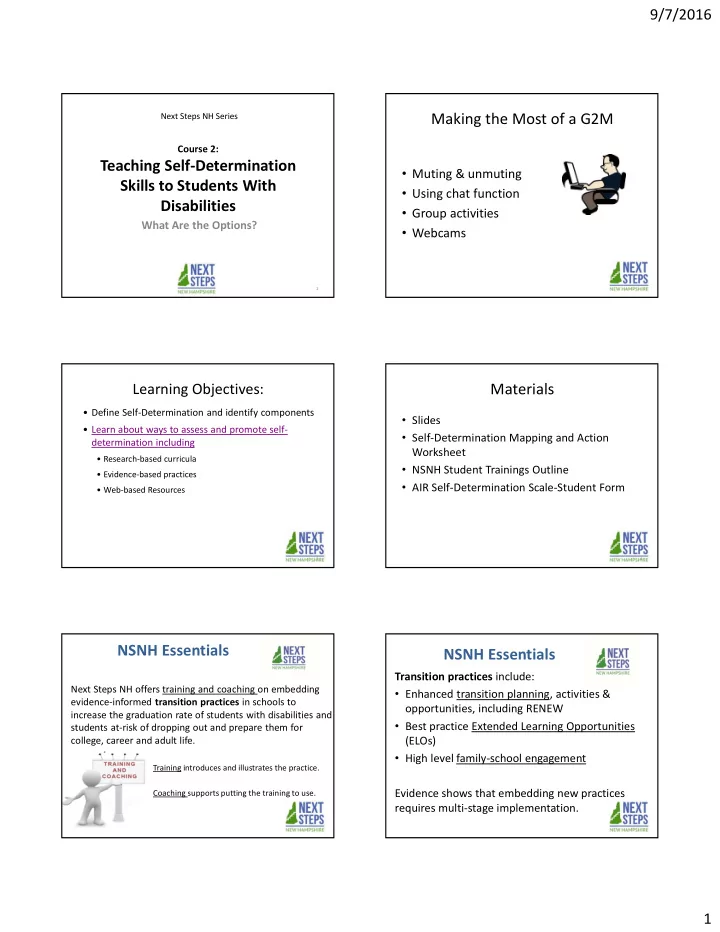
9/7/2016 Making the Most of a G2M Next Steps NH Series Course 2: Teaching Self-Determination Muting & unmuting Skills to Students With Using chat function Disabilities Group activities What Are the Options? Webcams 1


slide-1
SLIDE 1

9/7/2016 1

Course 2:

Teaching Self-Determination Skills to Students With Disabilities

What Are the Options?

1

Next Steps NH Series

Making the Most of a G2M

  • Muting & unmuting
  • Using chat function
  • Group activities
  • Webcams

Learning Objectives:

  • Define Self-Determination and identify components
  • Learn about ways to assess and promote self-

determination including

  • Research-based curricula
  • Evidence-based practices
  • Web-based Resources

3

Materials

  • Slides
  • Self-Determination Mapping and Action

Worksheet

  • NSNH Student Trainings Outline
  • AIR Self-Determination Scale-Student Form

4

NSNH Essentials

Next Steps NH offers training and coaching on embedding evidence-informed transition practices in schools to increase the graduation rate of students with disabilities and students at-risk of dropping out and prepare them for college, career and adult life.

Training introduces and illustrates the practice. Coaching supports putting the training to use.

NSNH Essentials

Transition practices include:

  • Enhanced transition planning, activities &
  • pportunities, including RENEW
  • Best practice Extended Learning Opportunities

(ELOs)

  • High level family-school engagement

Evidence shows that embedding new practices requires multi-stage implementation.

slide-2
SLIDE 2

9/7/2016 2

Family Engagement

Two-way communication Shared decision making Transition-related training

  • pportunities

Student Development

Best Practice ELOs Self-Determination RENEW

Program Structure

Leadership Teams Ongoing Strategic Planning Policy and Procedure Transition Competencies for Staff Transition Coordinator ELO Board

Student-Focused Planning

Student Led IEPs RENEW Transition Assessment

Interagency Collaboration

Community Services Colleges/Universities ELO Partners

Transition- Focused Education Framework

Adapted from Taxonomy for Transition Programming, Kohler, P.D. (1996) & NH CoP Template for Secondary Transition & NH Standards for Family /School Partnerships

NSNH Essentials

Implementing practices with fidelity is a primary focus. The use

  • f planning tools ensures fidelity.

Not In Place Partially In Place In Place

Critical Component of Practice X A4: Students are prepared to participate and do participate meaningfully in the development of their post school goals and plans to achieve those goals, and in any relevant meetings. X B6: Acquire the skills, behaviors, and attitudes through direct instruction and/or added support as necessary, that enable them to learn and grow in self-knowledge, social interactions, and physical and emotional health and self determination.

NSNH Essentials

When implemented with fidelity these practices will increase the graduation rates of students with disabilities and students at-risk

  • f dropping out and prepare them for college, career and

adult life.

Not In Place Partially In Place In Place

Critical Component of Practice X A4: Students are prepared to participate and do participate meaningfully in the development of their post school goals and plans to achieve those goals, and in any relevant meetings. X B6: Acquire the skills, behaviors, and attitudes through direct instruction and/or added support as necessary, that enable them to learn and grow in self-knowledge, social interactions, and physical and emotional health and self determination.

SUSTAINABILITY

Program Structures: Resources, Ongoing Training and Coaching, Procedures

Putting the Pieces Together

  • 1. EXPLORATION

Introductory training

  • 3. INITIAL

IMPLEMENTATION

  • Identify & address

challenges

  • Scale up
  • (Based on Dean Fixen et al & SWIFT)
  • 2. INSTALLATION
  • Develop action plan
  • Pilot self-determination practices
  • 4. FULL

IMPLEMENTATION

  • Processes &

procedures in place

  • System recalibrated to

accommodate & support new initiatives

11

The Birthday Party

Taken from Jamie L van Dycke, James E. Martin, David L. Lovett, Teaching Exceptional Children. Reston Jan/Feb 2006 Vol. 38, Iss.3 Pg. 42, 6pgs Self-Determination Constructs

Self-Determination Defined

There are many definitions

  • f SD in the literature.

The most comprehensive definition is provided by Field, Martin, Miller, Ward, and Wehmeyer (1998).

12

slide-3
SLIDE 3

9/7/2016 3 Self-Determination Defined

A combination of skills, knowledge, and beliefs that enable a person to engage in goal-directed, self-regulated, autonomous behavior. An understanding of one’s strengths and limitations together with a belief in oneself as capable and effective are essential to self-determination. When acting on the basis of these skills and attitudes, individuals have greater ability to take control of their lives and assume the role of successful adults in our society.

13

Components of Self-Determination

Choice making: appropriately choosing between a finite number of choices

Problem-solving: weigh pros & cons of potential actions, identify barriers to success

Decision making: involves choosing between unlimited options

Goal setting and attainment: ability to set appropriate goals for self and achieve the goals with actions

14

Components of Self-Determination

Self-regulation: self-monitoring, self-evaluation, self-instruction, self-management (controlling own behavior by being aware of one’s actions and providing feedback)

Self-awareness: awareness of own individuality, strengths, and areas for improvement

Self-efficacy: understanding that own actions have an impact

Self-advocacy: have knowledge of self, knowledge

  • f rights, communication skills, and leadership

ability.

15

Knowledge of Rights

Sample sub-components include  Personal rights  Community rights  Human service rights  Consumer rights  Educational rights  Steps to redress violations  Steps to advocate for change  Knowledge of resources

Self-awareness

Sample sub-components include  Strengths  Preferences  Goals  Dreams  Interests  Learning style  Support needs  Accommodation needs  Characteristics of one’s disability  Responsibilities

Leadership

Sample sub-components include

  • Knowledge of group’s rights
  • Knowledge of resources
  • Advocating for others or for causes
  • Organizational participation
  • Political action
  • Team dynamics and roles

Communication

Sample sub-components include

  • Assertiveness
  • Use of assistive technology
  • Negotiation
  • Listening
  • Articulation
  • Persuasion
  • Body Language
  • Compromise

S E L F A D V O C A C Y

16

Why the emphasis on SD?

Individuals who score higher on measures of SD have more positive adult outcomes (e.g., better employment, better living situations)

Research shows relationships between SD and positive school experiences (e.g., higher grades, attendance, fewer behavior problems).

Wehmeyer & Schwartz (1997) Let’s look at another perspective:

ACTIVITY 1

Does your Next Steps action plan have priorities related to assessing or teaching self-determination? Should it? What practices would you like to see students engaging in?

18

slide-4
SLIDE 4

9/7/2016 4

ASSESSING SELF-DETERMINATION

19

Assessing Self-Determination

Purpose: to provide information about readiness to make decisions related to future ambitions and help students in identifying relative strengths and limitations related to self-determination

Examples:

The Arc’s Self-Determination Scale

AIR Self-Determination Scale

20

The Arc Self-Determination Scale

Wehmeyer & Kelchner, 1995

T arget Population: middle and secondary students with Behavioral/Emotional Disorders, Mild ID, LD, Speech/Language Impairments, Developmental Disabilities, OHI, Orthopedic Impairments

Measures: choice-making, decision-making, problem- solving, self-awareness, self-regulation, goal setting & planning, self-efficacy

Data collection options: student self-report

Price: free http://education.ou.edu/zarrow/?p=38&z=39

21

AIR Self-Determination Assessment

(Wolman, Campeau, DuBois, Mithaug, & Stolarski, 1994)

T arget Population: all school-age students with and without disabilities

Measures: Capacity and Opportunity for choice- making, self-regulation, self-awareness, self-advocacy, goal setting & planning

Data collection options: rating scales for teacher, parent, and student

Price: free http://education.ou.edu/zarrow/?p=38&z=3

22

APPROACHES FOR PROMOTING SELF-DETERMINATION

23

Four Approaches for Promoting SD in Students

1.

Use student-driven IEP and transition planning.

  • 2. Directly teaching skills or enhancing

knowledge

  • 3. Embedding instruction into the general

curriculum

  • 4. Use Person-Centered Planning

24

slide-5
SLIDE 5

9/7/2016 5

Approaches for Promoting SD in Students

  • 1. Student-driven IEP and transition planning

Making sure the student attends and is PREPARED for participating in their IEP meetings

Important step in transferring decision- making power to students

T eaching students about the IEP and its use in guiding their future

Remember that ALL students are capable of participating

25

  • 2. Directly teaching skills or enhancing knowledge

Self-management (self-monitoring, self- recording, self-graphing, …) Choice-making Problem-solving

Approaches for Promoting SD in Students

26

  • 3. Embedding instruction into the general

curriculum

  • Examples:

a.

Literature Circles

  • b. IEP T

emplate

c.

Go 4 It…Now!

  • d. Self-Determined Learning Model of

Instruction (SDLMI)

Approaches for Promoting SD in Students

27

  • 3a. Embedding in Curriculum:

Literature Circles Description and Practice

  • In small groups, students read the same book and

prepare for the literature circle discussions by assuming different group roles and completing assignment sheets that prepare them for their role in the discussion.

  • Self-determination components addressed:

problem-solving and decision-making

  • ELA skills addressed: reading comprehension, oral

communication

Approaches for Promoting SD in Students

28

3 b. Embedding in Curriculum: IEP T emplate

  • IEP awareness, career exploration and students

interviewing parents and teachers

  • Direct instruction and modeling to complete an IEP

T emplate that includes vision statement; present level of performance; goals and objectives; measurement criteria and procedures; and services and accommodations

  • Self-determination components addressed: goal-

setting and self-awareness

  • ELA skills addressed: research skills, writing

for a variety of purposes, sentence writing

Approaches for Promoting SD in Students

29

  • 3c. Embedding in Curriculum:

GO 4 IT…NOW!

  • Uses a mnemonic device to help

students write 6-sentence goal paragraphs

  • Can be applied to other types of

paragraph writing

  • Self-determination components

addressed: goal-setting, self- awareness, and self-regulation

  • ELA skills addressed: writing for a

variety of purposes, paragraph writing

Approaches for Promoting SD in Students

Goals Objectives 4 (4 objectives) Identify Timeline Name your topic. Order your steps. Wrap it up and restate topic.

30

slide-6
SLIDE 6

9/7/2016 6

  • 3d. Embedding in Curriculum:

Self-Directed Learning Model of Instruction

  • Mithaug, Wehmeyer, Agran, Martin, & Palmer,

(1998).

  • Three phases:
  • Phase 1: Set a Goal
  • Phase 2: T

ake Action

  • Phase 3: Adjust Goal or Plan
  • Used for setting academic and behavior goals

Approaches for Promoting SD in Students

31

  • 4. Person-Centered Planning

A facilitated process designed to plan and develop supports to meet the specific desires of the focal person. First, a group (or circle) of individuals is identified by the student and family who have an interest in funding or providing supports for the student. Second, the group meets at a place convenient for all members (often a home or restaurant) to develop a plan.

Approaches for Promoting SD in Students

32

  • 4. Person Centered Planning

Some Types of PCP Whole-Life Planning (Timmons & Whitney- Thomas, 1998) Personal Futures Planning (Miner & Bates, 1997) McGill Action Planning System (Vandercook, York, & Forest, 1989).

Approaches for Promoting SD in Students

33

McGill Action Planning System (MAPS)

1. What is the individual’s history? 2. What is your dream for the future? 3. What is your nightmare? 4. Who is the individual? 5. What are the individual’s strengths, gifts, and abilities? 6. What are the individual’s needs? 7. What would the individual’s ideal day at school look like? 8. What must be done to make it happen?

Approaches for Promoting SD in Students

34

ACTIVITY 2

What self-determination teaching or assessment practices are used in your department? What practices are used schoolwide? Are the outcomes of practices being documented as transition assessment?

35

PUBLISHED RESEARCH-BASED CURRICULA IN SELF-DETERMINATION

36

slide-7
SLIDE 7

9/7/2016 7

Next S.T.E.P.

(Student Transition & Educational Planning)

  • Population:

– All levels of disability – Ages 14 through 21

  • Purpose:

– Helps students learn how to take charge of their own transition planning process – Helps students assume responsibility for important life decisions with support from teachers and parents

  • Materials:

– 16 lessons with fully developed lesson plans

37

Content:

Unit 1: Getting to Know Myself

Unit 2: Self-Evaluation

Unit 3: Setting and Achieving Goals

Unit 4: Sharing Your Goals and Accomplishments

For further information:

Available through ProEd

$215.00

Next S.T.E.P. , continued

(Student Transition & Educational Planning)

38

Whose Future Is It Anyway?

A Student-Directed Transition Planning Process

Purpose: Prepare students for their IEP meetings and

gain self-determination skills

Population: students with mild to moderate cognitive

disabilities

Materials:

Coach's Guide

  • utlines lessons

how to teach lessons

the roles of the students and teachers

expected outcomes

39

Whose Future Is It Anyway?, cont.

  • Content Sections include:

– Getting to know you; Making Decisions; How to Get What You Need; Goals, Objectives and the Future ; Communicating; Thank You, Honorable Chairperson

  • http://www.ou.edu/education/centers-and-

partnerships/zarrow.html -

  • Select “Transition Education Materials”
  • FREE!!!!

40

ME! Lessons

  • Purpose: Teaching Self-Advocacy and Self-

Awareness

  • Unit overviews, Common Core State

Standards, and lesson plans are included in

  • ne file
  • http://www.ou.edu/education/centers-and-

partnerships/zarrow.html

  • Select “Transition Education Materials”
  • FREE!!!!

41

Next Steps NH Student Training

  • Adapted from ME!

– Empowering Youth: It’s all about you! – It’s your IEP…it’s your life! – Taking it to the next step; pulling it all together.

42

slide-8
SLIDE 8

9/7/2016 8 FIND EVIDENCE-BASED PRACTICES (EBP) IN SELF-DETERMINATION

43

Where to Find ‘EBPs’ and more…

  • National Technical Assistance Center on

Transition transitionta.org/

– Effective Practices – Lesson Plans

  • Zarrow Center

– Assessments and lessons – http://www.ou.edu/education/centers-and- partnerships/zarrow.html

44

  • Youthhood

– Dynamic, curriculum- based tool that can help young adults plan for life after high school. – http://www.youthhood.

  • rg/index.asp

– Interactive and personalized – Directed to young adults

  • I am Determined!

– http://www.imdetermin ed.org/ – Direct instruction, models, and skill practice

  • Pepnet

– http://www.pepnet.org – For deaf or hard of hearing students, ages 14 through adult. – Changes coming January 1, 2017

45

Where to Find ‘EBPs’ and more…

What does teaching self-determination skills look like?

Meet Parker Bryant

46

Ideas for Implementation

  • Include discussions of self-determination

skills in IEP and other student meetings

  • Select a basic SD assessment tool and pilot

with selected group of students

  • Pilot Student Led IEPs
  • Use self-determination practices in a

specific class

47

Ideas for Implementation

  • Add self-determination transition services

and annual goals to IEPs

  • Provide the Next Steps NH Courses in a

train-the-trainer format for sustainability

  • Offer the Next Steps NH courses as:

– A mini-ELO, single or group – A mini-course – 8th grade orientation – workshops

48

slide-9
SLIDE 9

9/7/2016 9

ACTIVITY 3

Part 3: Goals and Action Plans Consider your discussions in Activities 1 & 2. What is your goal for increasing and improving self-determination practices in your school

49

Next Steps NH Transition Resource Portal

  • Today’s training and materials will be available

at: www.nextsteps-nh.org

50

Thank You!

The contents of this presentation were developed under a grant from the US Department of Education, H323A120003. However, those contents do not necessarily represent the policy of the US Department of Education, and you should not assume endorsement by the Federal Government. Project Officer, Corinne Weidenthal. This product is public domain. Authorization to reproduce it in whole or in part is granted. While permission to reprint is not necessary, the citation should be: NH State Personnel Development Grant – Next Steps NH (2012-2017). New Hampshire Department of Education, Concord.