Utility of electronic health records in improving diagnosis Bianca - - PowerPoint PPT Presentation

utility of electronic health records in improving
SMART_READER_LITE
LIVE PREVIEW

Utility of electronic health records in improving diagnosis Bianca - - PowerPoint PPT Presentation

Co-Authors Utility of electronic health records in improving diagnosis Bianca Duah 1 Kerri Sheahan 1 and treatment of opioid use Shafaq Tarar 1 Blanche Langenbach 1 Emily Forcht 1 Wyley Gates 1 disorders in HIV clinic settings David Perlman 1


slide-1
SLIDE 1

1

Utility of electronic health records in improving diagnosis and treatment of opioid use disorders in HIV clinic settings Gavriella Hecht, BS

Division of Infectious Diseases at Icahn School of Medicine at Mount Sinai Co-Authors

Bianca Duah1 Kerri Sheahan1 Shafaq Tarar1 Blanche Langenbach1 Emily Forcht1 Wyley Gates1 David Perlman1 Judith Aberg1 Ana Ventuneac1

1Icahn School of Medicine at Mount Sinai, Division of

Infectious Diseases, New York, NY, USA

2

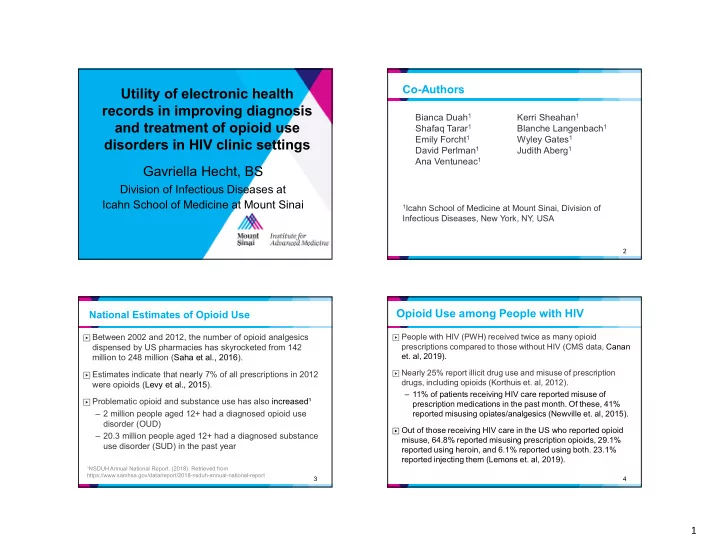
National Estimates of Opioid Use

▶ Between 2002 and 2012, the number of opioid analgesics

dispensed by US pharmacies has skyrocketed from 142 million to 248 million (Saha et al., 2016).

▶ Estimates indicate that nearly 7% of all prescriptions in 2012

were opioids (Levy et al., 2015).

▶ Problematic opioid and substance use has also increased¹

– 2 million people aged 12+ had a diagnosed opioid use disorder (OUD) – 20.3 million people aged 12+ had a diagnosed substance use disorder (SUD) in the past year

3

¹NSDUH Annual National Report. (2018). Retrieved from https://www.samhsa.gov/data/report/2018-nsduh-annual-national-report

Opioid Use among People with HIV

▶ People with HIV (PWH) received twice as many opioid

prescriptions compared to those without HIV (CMS data, Canan

  • et. al, 2019).

▶ Nearly 25% report illicit drug use and misuse of prescription

drugs, including opioids (Korthuis et. al, 2012). – 11% of patients receiving HIV care reported misuse of prescription medications in the past month. Of these, 41% reported misusing opiates/analgesics (Newville et. al, 2015).

▶ Out of those receiving HIV care in the US who reported opioid

misuse, 64.8% reported misusing prescription opioids, 29.1% reported using heroin, and 6.1% reported using both. 23.1% reported injecting them (Lemons et. al, 2019).

4

slide-2
SLIDE 2

2

Limited Research on Opioid Use among People with HIV

▶ Current data on opioid use among PWH is limited. In 2012, Önen et. al

conducted a review evaluating indications of opioid prescribing, types of

  • pioid regimens, therapeutic response, and urine drug screen usage.

▶ A retrospective cross-sectional study of a convenience sample of patients:

– ≥18 years in outpatient HIV care – Completed behavioral assessment – ≥2 clinical visits between June 2008-June 2009

▶ Major findings:

– Documentation of opioid prescribing are lacking

  • Per medication lists, 8% of patients were prescribed opioids by

multiple providers, including HIV providers. There was no mention

  • f these prescriptions in clinical notes from HIV providers.

– A lack of use in pain scales and – Limited follow up regarding therapeutic efficacy was found.

5

Study Objectives

▶Describe opioid prescriptions among patients

receiving HIV care and assess its association with substance use disorders, including opioid use disorders.

▶Discuss implications for leveraging electronic

health records to identify patients with problematic substance and opioid use

6

What is iCare?

▶Integrated Care at Mount Sinai (iCare): research

study designed to develop and test a program that integrates care between HIV primary care and substance use treatment in an effort to better meet the needs of persons with HIV (PWH) who struggle with substance misuse.

7

Institute for Advanced Medicine

Five primary care clinics with

  • ver 300 care staff members

serving over 10,000 diverse patients with HIV:

▶Race and ethnicity ▶Age ▶Gender identity ▶Sexual identity

8

slide-3
SLIDE 3

3

A Multisite Trial Utilizing a Stepped Wedge Design to test the iCare Intervention Components

9

Methods: iCare Inclusion Criteria

▶ Criteria for inclusion of patient records in the iCare

dataset for analysis consist of:

– Patients with HIV diagnosis – Patients  18 years of age – Patients with at least 1 primary care visit at a clinic within IAM from July 1, 2016 - December 31, 2017

10

Methods: Opioid Rx Validation

▶ 12,176 valid opioid Rx out of a total of 20,058 records

about opioid Rx

▶ Opioid Rx validated through 3-step chart review process

given that some Rx had a discontinuation indicator

– 1st Round: Sample of records were randomly selected for each reason for Rx discontinuation category and then chart reviewed for validation status (i.e. valid, invalid) of the records – 2nd Round: Additional sample of records were chart reviewed for all categories with valid records to determine if status was unanimous for each Rx discontinuation category – 3rd Round: Full dataset of records for categories without unanimous 2nd round results chart reviewed for Rx validation

11

Data Analysis

▶Retrospective analysis involved ICD-10 for

substance abuse/dependence, Epic Smart Forms for substance use screening, HIV labs (viral suppression), and opioid Rx

▶Binary variables:

– SUD-related ICD (yes/no) – Substance use screening (yes/no) – Outcome Variable: Opioid Rx (yes/no)

▶Logistic regression was adjusted

– demographic characteristics: gender, age, ethnic and racial differences – years since diagnosed with HIV

12

slide-4
SLIDE 4

4 Results: Patient Demographics

▶9,772 patients total

– 76% male – 34% Black/African American, 24% Hispanic, 22% White, and 20% multiracial or “other” – 53% ≥50 years of age – 81% virally suppressed (<50 copies/mL) at last viral load test.

▶1,239 (12.7%) patients received ≥1 opioid Rx

13

Sociodemographic characteristics and HIV outcomes (n = 9,772)

14

Substance Use Documentation in Epic

▶Substance use screening – 7,716 Smart Form screeners were administered in 15% of primary care visits among 2,972 (30%) patients – substance use was endorsed in 760 of the screeners (10%) ▶ICD-10 for SUDs: 1,816 (19%) patients

had a documented SUD, and of them

– 30% had an alcohol use disorder, – 31% cocaine disorder, – 24% opioid disorder, – 22% cannabis disorder, – 16% amphetamine disorder, and – 24% other disorder or not specified.

15

Documented SUDs (n= 1,816; 19%)

16

slide-5
SLIDE 5

5 Documented Opioid Rx (n = 1,239; 12.7%)

5 10 15 20 25 Codeine Oxycodone Tramadol Other

Percent

Prevalence of ≥1 Opioid Rx by Gender

Male (n = 7470)1 Cisgender Female (n = 2232) Transgender Female (n = 70)

χ2 = 6.15* χ2 = 103.00*** χ2 = 37.37*** χ2 = 49.37***

1Includes 7467 cisgender and 3 transgender males.

17

Any Opioid Rx by Patient Characteristics

1Includes 7467 cisgender and 3 transgender males.*p < .05; **p < .01

***p < .001

18

Logistic Regression Predicting ≥1 Opioid Rx

19

Summary

▶A larger percentage of older patients, cis-gender

and transgender women, and Hispanic patients received ≥ 1 opioid Rx compared to their counterparts

▶Significantly higher odds of having received an

  • pioid Rx among patients with OUDs and those

with SUDs compared to those without OUDs or SUDs, after adjusting for differences by demographic characteristics

20

slide-6
SLIDE 6

6 Limitations

▶ EHR data were validated using a 3-step chart review

process; however, there is still room for systematic error due to issues with provider documentation regarding OUD and SUD

▶ No self-reported data from patients or providers on

prescribing practices or use

▶ No data on comorbidities, a potential confounder that

might highlight conditions with an indication for opioid Rx

▶ Conclusions are not necessarily generalizable to the

  • verall population of HIV-positive persons as this study is

limited to a population of HIV primary care patients receiving services in an urban setting

21

Conclusions

▶Feasible to use EHR data to identify patients with

problematic substance use including opioid use

▶Use of EHRs could help identify patients who

could benefit from initiation of OUD treatment

▶Use of EHRs could help in the development of

strategies to improve prescribing practices among patients receiving HIV care

22

Thank you! For additional information, please email:

Gavriella Hecht at

gavriella.hecht@icahn.mssm.edu

Grant Number: R01DA041072 Program Officer: Dr. Minnjuan W. Flournoy Floyd

References

Canan, C., Alexander, G. C., Moore, R., Murimi, I., Chander, G., & Lau, B. (2019). Medicaid Trends in Prescription Opioid and Non- Opioid Use by HIV Status. Drug and Alcohol Dependence, 197, 141–148.Lemons 2019

Lemons, A., Degroote, N., Peréz, A., Craw, J., Nyaku, M., Broz, D., … Beer, L. (2019). Opioid Misuse Among HIV-Positive Adults in Medical Care. JAIDS Journal of Acquired Immune Deficiency Syndromes, 80(2), 127–134.

Levy, B., Paulozzi, L., Mack, K. A., & Jones, C. M. (2015). Trends in Opioid Analgesic–Prescribing Rates by Specialty, U.S., 2007–

  • 2012. American Journal of Preventive Medicine, 49(3), 409–413.

Newville, H., Roley, J., & Sorensen, J. L. (2015). Prescription Medication Misuse Among HIV-infected Individuals taking Antiretroviral

  • Therapy. Journal of Substance Abuse Treatment, 48(1), 56–61.

Önen, N. F., Barrette, E.-P., Shacham, E., Taniguchi, T., Donovan, M., & Overton, E. T. (2011). A Review of Opioid Prescribing Practices and Associations with Repeat Opioid Prescriptions in a Contemporary Outpatient HIV Clinic. Pain Practice, 12(6), 440–448.

Saha, T. D., Kerridge, B. T., Goldstein, R. B., Chou, S. P., Zhang, H., Jung, J., … Grant, B. F. (2016). Nonmedical Prescription Opioid Use and DSM-5 Nonmedical Prescription Opioid Use Disorder in the United States. The Journal of Clinical Psychiatry, 77(06), 772–780.

¹Substance Abuse and Mental Health Services Administration. (2019). Key substance use and mental health indicators in the United States: Results from the 2018 National Survey on Drug Use and Health (HHS Publication No. PEP19-5068, NSDUH Series H-54). Rockville, MD: Center for Behavioral Health Statistics and Quality, Substance Abuse and Mental Health Services Administration. Retrieved from https://www.samhsa.gov/data/

Korthuis, P. T., Fiellin, D. A., Mcginnis, K. A., Skanderson, M., Justice, A. C., Gordon, A. J., … Kraemer, K. L. (2012). Unhealthy Alcohol and Illicit Drug Use Are Associated With Decreased Quality of HIV Care. JAIDS Journal of Acquired Immune Deficiency Syndromes, 61(2), 171–178.

24