MAKING THE CASE Ecosystem Valuation to Inform Decision Making - - PowerPoint PPT Presentation

making the case
SMART_READER_LITE
LIVE PREVIEW

MAKING THE CASE Ecosystem Valuation to Inform Decision Making - - PowerPoint PPT Presentation

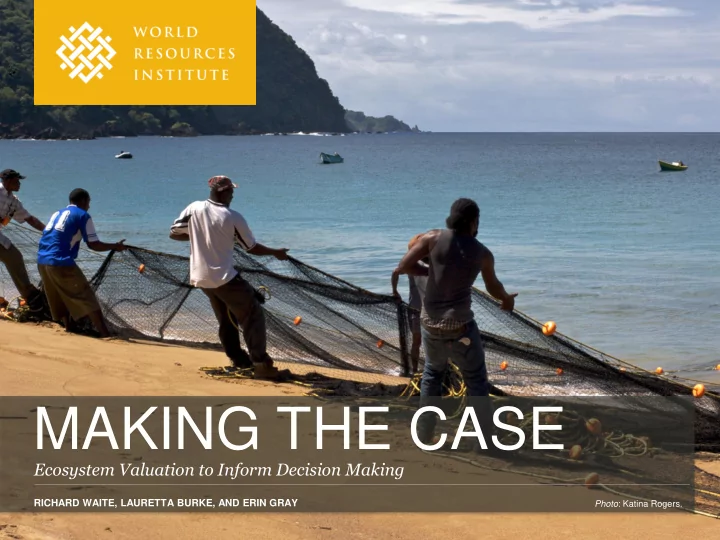
MAKING THE CASE Ecosystem Valuation to Inform Decision Making RICHARD WAITE, LAURETTA BURKE, AND ERIN GRAY Photo : Katina Rogers. Why value ecosystem services? Photos: Richie Deisterheft (forest and river), Mark Lehigh (farmland), Kenny Mitchell


slide-1
SLIDE 1

Ecosystem Valuation to Inform Decision Making

RICHARD WAITE, LAURETTA BURKE, AND ERIN GRAY

MAKING THE CASE

Photo: Katina Rogers.
slide-2
SLIDE 2

Why value ecosystem services?

Photos: Richie Deisterheft (forest and river), Mark Lehigh (farmland), Kenny Mitchell (beach).

slide-3
SLIDE 3

Coastal Capital – Studies 2005-11

slide-4
SLIDE 4

Photos: Crispin Zeenam (fisherman), Steve Linfield (wave break), K. Tkachenko (diving).

High $ High $

Coastal Capital – Studies 2005-11

Lower $, but important for food/jobs

slide-5
SLIDE 5

Coastal Capital – Impacts?

slide-6
SLIDE 6

Main research questions

  • Which coastal valuation studies have informed decision

making in the Caribbean?

  • What made those studies successful in informing

decision making?

slide-7
SLIDE 7

Use of coastal ecosystem valuation in decision making in the Caribbean

  • Low observed use so far
  • But, 20+ case studies
  • ffer lots of lessons
slide-8
SLIDE 8

Photo: Tadzio Bervoets.

Valuation supports protected area establishment

  • St. Maarten, Haiti, Cuba, Bahamas, USA
slide-9
SLIDE 9

Valuation supports damage claims

Belize, Jamaica, St. Eustatius, St. Maarten, USA

Source: U.S. Coast Guard.

slide-10
SLIDE 10

Valuation informs spatial planning

Belize

Source: Clarke et al. (2013).

slide-11
SLIDE 11

Valuation informs spatial planning

  • St. Eustatius

Source: TEEB Caribbean Netherlands (2014).

slide-12
SLIDE 12

Image: STINAPA.

Valuation unlocks new finance streams

Bonaire, Dominican Republic, Mexico, Belize, St. Eustatius, Honduras

slide-13
SLIDE 13

Photo: Lauretta Burke.

How else have valuation results been used?

  • Justify investment in

management/conservation/ enforcement

  • Justify other policy changes

(e.g., fishing regulations,

  • ffshore oil drilling ban)
  • Raise awareness/highlight

economic importance

slide-14
SLIDE 14

Valuation results have informed decision making across the Caribbean

Note: Not exhaustive.

slide-15
SLIDE 15

WHAT YOU CAN DO  Conduct a sound analysis  Link to a clear policy question (use appropriate methods)  Engage stakeholders and decision makers  Value relevant ecosystem services  Be transparent  Communicate strategically

Why were these 20+ studies influential?

…enabling conditions for use in decision making WHAT YOU CAN LOOK FOR  Highly threatened ecosystems  High economic dependence on natural resources  Good governance

  • Transparency in decision

making

  • Legal framework, enforcement

ability

  • Local control over resource

management / revenue

slide-16
SLIDE 16

New Guidebook:

Replicating the enabling conditions

…adapts / updates / builds on our co- authors’ 2007 toolkit…

  • The CARIBSAVE Partnership
  • Centre for Resource Management

and Environmental Studies (CERMES), University of the West Indies (UWI), Cave Hill, Barbados

  • Conservation International
  • Conservation Strategy Fund
  • Coral Reef Alliance
  • Marine Ecosystem Services

Partnership (MESP)

  • Natural Capital Project
  • The Nature Conservancy
  • Nicholas Institute for Environmental

Policy Solutions, Duke University

  • Organization of American States
  • United Nations Environment

Programme – Caribbean Environment Program (UNEP-CEP)

  • University of North Carolina

Wilmington

  • WWF Conservation Science Network
slide-17
SLIDE 17

New Guidebook:

Replicating the enabling conditions Financial support:

  • Margaret A. Cargill Foundation
  • Chino Cienega Foundation
  • Family Alliance Foundation
  • Netherlands Ministry of Foreign Affairs
  • United Nations Environment

Programme – Caribbean Environment Programme (UNEP-CEP)

slide-18
SLIDE 18
  • 1. Scoping
  • 2. Analysis
  • 3. Outreach

/ Use of Results

New Guidebook:

Replicating the enabling conditions

slide-19
SLIDE 19

Phase 1: Scoping

  • 1.1 Identify policy question
  • 1.2 Consider the context
  • 1.3 Review previous valuation studies
  • 1.4 Identify and begin to engage stakeholders
  • 1.5 Identify decision makers and other target audiences

and draft communications strategy

slide-20
SLIDE 20

Phase 2: Analysis

  • 2.1 Develop scenarios
  • 2.2 Analyze changes in ecosystem services
  • 2.3 Choose valuation method(s)
  • 2.4 Collect and analyze data
  • 2.5 Account for risk and uncertainty
  • 2.6 Apply decision support tools
  • 2.7 Report all valuation results clearly
slide-21
SLIDE 21

Phase 3: Outreach and Use of Results

  • 3.1 Develop non-technical products for decision

makers

  • 3.2 Communicate results to decision makers
  • 3.3 Share study and results with valuation community
  • 3.4 Monitor and assess impact
slide-22
SLIDE 22

Steps in conducting ecosystem valuation to inform decision making

  • Identify policy question
  • Consider the context
  • Review previous valuation

studies

  • Identify and engage

stakeholders

  • Identify decision makers and
  • ther target audiences and

draft communications strategy

  • Develop scenarios
  • Analyze changes in

ecosystem services

  • Choose valuation method(s)
  • Collect and analyze data
  • Account for risk and

uncertainty

  • Develop and apply decision

support tools

  • Report all valuation results

clearly

  • Develop synthesis

products for decision makers

  • Communicate results to

decision makers

  • Share study and results

with valuation community

  • Monitor and assess impact

Scoping Analysis Outreach / Use of Results

Stakeholder Engagement

slide-23
SLIDE 23

Steps in conducting ecosystem valuation to inform decision making

  • Identify policy question
  • Consider the context
  • Review previous valuation

studies

  • Identify and engage

stakeholders

  • Identify decision makers and
  • ther target audiences and

draft communications strategy

  • Develop scenarios
  • Analyze changes in

ecosystem services

  • Choose valuation method(s)
  • Collect and analyze data
  • Account for risk and

uncertainty

  • Develop and apply decision

support tools

  • Report all valuation results

clearly

  • Develop synthesis

products for decision makers

  • Communicate results to

decision makers

  • Share study and results

with valuation community

  • Monitor and assess impact

Scoping Analysis Outreach / Use of Results

Stakeholder Engagement

slide-24
SLIDE 24

Next steps at WRI…

  • Outreach and capacity building
  • Pilot applications
  • Other opportunities for collaboration…
slide-25
SLIDE 25

Thank you!

wri.org/coastal-capital rwaite@wri.org

Photo: Olivier Langrand.