Major Outcomes 1) Joint reconnaissance efforts of building damage by - - PowerPoint PPT Presentation
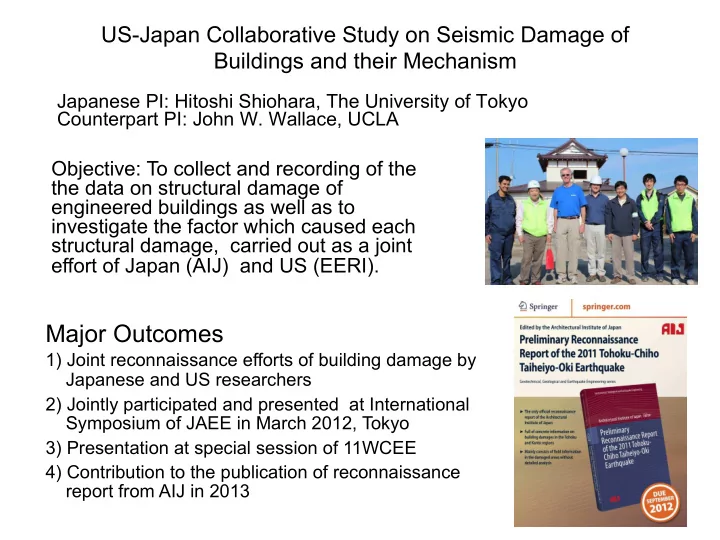
US-Japan Collaborative Study on Seismic Damage of Buildings and their Mechanism Japanese PI: Hitoshi Shiohara, The University of Tokyo Counterpart PI: John W. Wallace, UCLA Objective: To collect and recording of the the data on structural
Preliminary Reconnaissance Report of the 2011 Tohoku-Chiho Taiheiyo-Oki Earthquake
Edited by the Architectural Institute of Japan
Geotechnical, Geological and Earthquake Engineering series
7 The only official reconnaissance
report of the Architectural Institute of Japan
7 Full of concrete information on
building damages in the Tohoku and Kanto regions
7 Mainly consists of field information
in the damaged areas without detailed analysis
D U E
S E P T E M B E R
2012
springer.com
PREFACE
Devastating damage in the Tohoku region of Japan occurred during and after the earthquake off the Pacific coast of Tohoku earthquake on March 11, 2011. The report summarizes damage associated with ground failures including landslide and liquefaction as well as non-structural damages such as to equipment and facilities, partitioning walls and ceilings, and functional failures in skyscrapers. Also brief description of the Japanese Seismic Design Code will be provided in the
- Appendix. A proposed scheme of anti-
tsunami design for buildings is also included.
Publication: Reconnaissance Report (by AIJ)
Second Phase: 2010~
A B C D
A B C D
B A C D B A C D
Beam-column joint: Full Scale Shaking Table Test at E-Defense in 2010
E-Defense test on RC Building in December 2010
15 m 20 m
X Y
E-Defense 3D Shaking Table Four Storied Wall-Frame RC Structure
10-D22 10-D22 500 x 500 500 x 500 3,4-D10@100 3,4-D10@100 2,2-D10@140 2,2-D10@140 B x D Rebar Hoop Joint Bottom Section 8-D22 500 x 500 2,3-D10@100 2,2-D10@140 B x D Hoop Rebar Joint Top Section 8-D22 10-D22 500 x 500 500 x 500 2,3-D10@100 2,4-D10@100 2,2-D10@140 2,2-D10@140 2Fl. Hoop B x D Rebar Joint Section 8-D22 500 x 500 2,2-D10@100 2,2-D10@100 10-D22 500 x 500 2,2-D10@140 2,2-D10@140 4Fl. 3Fl. Hoop B x D Rebar Joint Section C2 C1 List of Column 1Fl. RFl. 4Fl. Top Bottom Stirrup Section B x D Web Location 3Fl. Top Bottom Stirrup Section B x D Web 2Fl. Top Bottom Stirrup Section B x D Web G1 4-D22 3-D22 4-D22 3-D22 3-D22 3-D22 4-D10 300 x 600 2-D10@200 Center End End 5-D22 3-D22 5-D22 3-D22 3-D22 3-D22 4-D10 300 x 600 2-D10@200 6-D22 3-D22 6-D22 3-D22 3-D22 3-D22 4-D10 300 x 600 2-D10@200 List of Girder
Joint shear / Nominal joint shear capacity
Margin of joint shear capacity
Column-to-beam strength ratios
Column-to-beam strength ratio
JMA Kobe 50%
JMA Kobe 50%
JMA Kobe 100%
JMA Kobe 100%
3D Full Scale RC Frame Structure Shaking Table Test at E-Defense in 2010
- Four-story full scale RC frame structures were tested,
- The building structure was designed and constructed such that it conforms to
current seismic provisions in Japan and the US.
- Shear failure of lightly reinforced beam-column joints were
confirmed,
- BC joints with column-to-beam strength ratio between 1.0 showed joint shear
failure.
- Vulnerabilities of frame structure with lightly BC joint has been demonstrated.
17
SEISMIC DAMAGE OF A NINE-STORY RC RESIDENTIAL BUILDING IN SENDAI DESIGNED BY OLD SEISMIC CODES
Nagamachi - Dwelling Complex
1 9 6 8 1 9 7 1 1 9 7 8 1 9 8 1 1 9 9 5 2 2 1 1 1968 Tokachi-oki Earthquake Amendment of BSL Enforcement Order 1978 Miyagiken-oki Earthquake Amendment of BSL Enforcement Order
Brief History of RC buildings and Seismic Codes in Japan
1995 Hyogo-ken Nambu Earthquake Act on Promotion of Seismic Retrofitting of Existing Buildings Amendment of BSL Enforcement Order 2011 Tohoku-chiho Taiheiyo-oki Earthqukae I ~ 1971 II ~ 1981 III 1981 ~
*BSL : Building Standard Law ( Prevention of column shear failure ) ( The “shin-taishin”, new standard ) ( Effectiveness of the 1981 revision was confirmed ) ( Performance based criteria introduced ) ( To urge building owners to retrofit existing vulnerable buildings )
Nagamachi - Dwelling Complex
- RC/SRC 9 floors.
- Completed in 1969
- No seismic retrofit
- Survived major earthquakes in
1978, 2003 and 2005.
- Fc 210 & 180
- Grade SD35 rebars
Taihaku ward, Sendai City
Izumi ward Miyagino ward Wakabayashi ward Taihaku ward Aoba ward JR Sendai Station Port of Sendai Pacific Ocean Site of the building City of Sendai
1st floor plan and damage rate
X1 X2 X3 X4 X5 X6 X7 X8 X0 Y1 Y2 Y3 Y4 Y0 Y5
V V V IV IV IVs III III IVs V Vs IIIs III IIIs IIIs III III IIIs IIIs IIIs III IIs II IIs IIs IIs IIs II II II II IIs IIs II Is Is Is Is I I Is Is Is Is I I O O O O O O O O O O O O O O
see Fig. 7 Entrance
west east south north
Municipal offices Medical Service
2nd floor plan and damage rate
Y1 Y2 Y3 Y4 Y0 Y5 X1 X2 X3 X4 X5 X6 X7 X8 X0
III III IIIs III II II II IIs IIs IIs I I I Is Is Vs I I Is I I Is I I Is I I I Is Is Is Is Is Is Is I I I I I O O O O O O O O O O O O O O O O O O O O O O west east south north
Municipal offices
3rd floor plan and damage rate
Y1 Y2 Y3 Y4 Y0 Y5 X1 X2 X3 X4 X5 X6 X7 X8 X0
III III IIIs III II II II IIs IIs IIs I I I Is Is Vs I I Is I I Is I I Is I I I Is Is Is Is Is Is Is I I I I I O O O O O O O O O O O O O O O O O O O O O O
Y1 X1 X2 X3 X4 X5 X6 X7 X8 Y2 Y3 Y4
Is Is IIs IIs IIIs IVs IVs IVs IVs Is Is Is Is Is west east south north
Apartment units Corridor RC non-structural partition
Damage Grading Criteria of RC Members
Damage grade Damage grade Criteria No damage No damage I Slight Structural concrete cracking of width less than 0.2mm II Minor Structural concrete cracking of width larger than 0.2mm and less than 1.0mm. III Moderate Structural concrete cracking of width larger than 1.0mm and less than 2.0mm. IV Major Structural concrete cracking of width larger than 2.0mm, with cover concrete spalling and visible reinforcement V Severe Cover concrete spalling off, with some concrete crushes and longitudinal reinforcement buckling
Residual Lateral Capacity of RC Structural Member
Load Carrying Capacity Deteriorated Damage Class Lateral Load
- Vertical Load
Deflection
Remained Lost Remained Lost
(a) Ductile member
Yielding of tensile rebars Cracking Buckling of rebars and falling of covering concrete Compression failure
- f concrete starts
Elevation of Y4 frame in longitudinal direction
X8 X7 X6 X5 X4 X3 X0 X2 X1
1FL GL 2FL 3FL 4FL 5FL 6FL 7FL 8FL 9FL RFL PHRFL 36,150 4,100 7,400 10,150 12,850 15,550 18,150 20,750 23,350 26,150 500 5 400 8 = 43 200 IVs IVs IVs IVs IVs IVs shear crack on beam-column joint Is O O O O O O O IIs Is Is I I I I IIs II II III Is II
Unit in mm
see Fig. 10 Shear failure of columns Latice steel
Failure of Beam-column Joints
Elevation of X1 frame in longitudinal direction
steel shape in concrete O IIIs
Y0 Y1 Y2 Y3 Y4 Y5
4 500 4 500 6 000 6 000 6 000 O III II O I Is Is Is IIs III III III O III IV V V
unit in mm
see Fig. 7
shear cracks on coupling beams
Elevation of X1 frame in longitudinal direction
steel shape in concrete O IIIs
Y0 Y1 Y2 Y3 Y4 Y5
4 500 4 500 6 000 6 000 6 000 O III II O I Is Is Is IIs III III III O III IV V V
unit in mm
see Fig. 7
flexural failure and buckling of rebars at the bottom of column
Values of Seismic Index Is
Story Longitudinal direction Transverse direction 9 0.37 1.49 8 0.27 1.04 7 0.23 0.82 6 0.20 0.70 5 0.21 0.62 4 0.19 0.51 3 0.20 0.71 2 0.44 0.44 1 0.62 0.39
Seismic Evaluation Standards by JBDPA
no good correlation good correlation
Beam-column Joints in Y4 frame
(a) Beam-column joint at 7F (X5-Y4)
10-D19 hoop φ9@250 750 450 450 220 220 1150 horizontal section
- f column
vertical section
- f beam
4-D19 3-D19
(b) Beam-column joint at 5F (X5-Y4)
4-D22+6-D19 hoop φ9@250 750 600 600 220 220 1250 unit in mm horizontal section
- f column
vertical section
- f beam
4-D22 4-D22
Shear failur Shear failure in kN Shear failure Flexural hinge in kN Flexural hinge in kN Flexural hinge Column-to-beam strength ratio Column-to-beam ength ratio Joint shear strength column beam joint column case 1* column case 2* beam case 1 case 2 strength margin*
9FL 544.4 858.7 863.4 522.5 396.7 231.7 2.25 1.71 3.73 8FL 555.0 929.1 984.0 650.8 454.0 320.2 2.03 1.42 3.07 7FL 589.2 1043.2 1112.3 751.5 496.7 335.0 2.24 1.48 3.32 6FL 799.7 1148.5 1150.1 906.6 574.8 432.2 2.10 1.33 2.66 5FL 907.8 1162.5 1624.0 1082.9 664.0 528.3 2.05 1.26 3.07
Tributary area of gravity load Column Wall floor plan
Calculated story shear
Concluding Remarks
- Nagamachi Dwelling Complex Building
- Flexural failure of the first story SRC column
- deficiency of steel lattice not embedded into the foundation which just
ends at the first floor level.
- abrupt change of section caused the damage.
- Shear failure of lightly reinforced beam-column joints.
- calculated margin of joint shear strength is 2.0 or more.
- column-to-beam strength ratio is in the range of 1.26 to 1.48.
- vulnerablity of column-to-beam strength ratio between 1.0 and 1.5 are to
joint shear failure.
- problem in failure mode prediction
New beam-column joint macro element and nonlinear dynamic analysis on 4 story frame RC structure
37
- Members; beams or columns framing into the joints
- Full flexural capacity of the members to be achieved
Life Safety Requirements to Beam-Column Joint
Not easy to meet in practice
Δ P V
Collapse mechanism by Joint hinging Subsequent repetition due to Cyclic loading
columns.
Collapsed Structure : Wencheuan Earthquake (2008)
P
Skeleton curve P-delta Effect Slip
- Control Joint hinging in seismic Design
- Performance to prevent collapse and instability of lateral resisting frame due to
subsequent repetitions of earthquake loading needs to be evaluated.
- Joint hinging
38
- No suitable model has been developed before.
New Macro Element for Interior BC Joint
39
rigid panel rigid panel steel element bond link bond link steel element concrete spring concrete element concrete element steel element steel element axial stiffness is factored considering pull-out of bars from member end diagonal concrete horizontal reinforcing bars vertical reinforcing bars vertical & horizontal concrete A A' {A'}={A} macro element of beam-column joint force-based beam-column element node
superimpose
Frame Structure
P-Delta effect is incorporated to stiffness matrix
Uniaxial Constitutive Models for Elements
- Kfc
- KfcZm
- 0.2Kfc
ft
- ft
0.25ft
- t2
t1
- Kc
- u
- concrete
Tension Compression Modified Kent & Park
- y
1.5y y
- y
- y
Es Es Es/4
steel
Tension Compression Modified Bi-linear
s s1s2s3 s4 s5
- 1
2 3
bond-slip
Modified Eligehausen
40
Validation of the Macro Element by the Tests
- 100
- 50
50 100
- 4
- 2
2 4 -4
- 2
2 4
Db/Dc=1 Mcu/Mbu=1.0 Vju/Vu=1.03
B02
- 100
- 50
50 100
- 4
- 2
2 4 -4
- 2
2 4
Db/Dc=1 Mcu/Mbu=1.35 Vju/Vu=1.03
B05
Db/Dc=0.5 Mcu/Mbu=1.03 Vju/Vu=1.06
D05
Db/Dc=1 Mcu/Mbu=2.06 Vju/Vu=1.63
H01
story shear in kN story drift in kN
Test Analysis
- The new model is
suitable to simulates strength and hysteresis behavior of sub structure with BC joints
41
Input Ground Acceleration Record
1 2 3 4 5 500 1000 1500 2000 2500 3000 Sa (cm/sec 2) JMA Kobe 1995 JR Takatori 1995 SCT1 1985 T1 =0.46 sec T2 =0.15 sec Period in second Spectra of Max. Response Acc. Damping = 5%
- Four input ground motions are selected for dynamic analysis
42
Four Story Building Collapse Simulation
with non-linear BC Joint model with elastic BC Joint model
43
Unstable Limit ; beyond Ultimate Limit
Mcu/Mbu=1.0 Mcu/Mbu=1.5 Mcu/Mbu=1.5 Mcu/Mbu=1.0 0.05 0.1 0.1 0.2 0.3 0.4 0.05 0.1 0.05 0.1 0.5 1.0 1.5 2.0 2.5 3.0 Sa(T1=0.46s,5%), g
EQ 1.0
0.05 0.1 1.0 2.0 3.0 4.0 5.0 6.0 Sa(T1=0.46s,5%), g 0.05 0.1 0.1 0.2 0.3 0.4 0.5 0.6 0.7 Sa(T1=0.46s,5%), g 0.5 1.0 1.5 2.0 2.5 Sa(T1=0.46s,5%), g
EQ 1.0 EQ 1.0 EQ 1.0
JMA Kobe JR Takatori SCT1 story drift in rad
- 44
= collapse limit
Column-to-beam Strength Ratio and Unstable Limit
0.05 0.1 0.15 0.5 1.0 1.5 2.0 2.5 3.0 Sa(T1=0.46s,5%), g
EQ 1.0
0.05 0.1 0.15
Mcu/Mbu=1.0 Mcu/Mbu=1.1 Mcu/Mbu=1.2 Mcu/Mbu=1.3 Mcu/Mbu=1.4 Mcu/Mbu=1.5 Mcu/Mbu=1.0 Mcu/Mbu=1.1 Mcu/Mbu=1.2 Mcu/Mbu=1.3 Mcu/Mbu=1.4 Mcu/Mbu=1.5 Mcu/Mbu=1.0 Mcu/Mbu=1.1 Mcu/Mbu=1.2 Mcu/Mbu=1.3 Mcu/Mbu=1.4 Mcu/Mbu=1.5
0.05 0.1 0.15 1.0 2.0 3.0 4.0 5.0 6.0 Sa(T1=0.46s,5%), g 0.05 0.1 0.15 0.05 0.1 0.15 0.1 0.2 0.3 0.4 0.5 0.6 0.7 Sa(T1=0.46s,5%), g 0.05 0.1 0.15 0.05 0.1 0.15 0.5 1.0 1.5 2.0 2.5 Sa(T1=0.46s,5%), g
EQ 1.0 EQ 1.0 EQ 1.0 Mcu/Mbu=1.0 Mcu/Mbu=1.1 Mcu/Mbu=1.2 Mcu/Mbu=1.3 Mcu/Mbu=1.4 Mcu/Mbu=1.5
- Frame with beam-column joint of C-to-B ratio of 1.0 become unstable at
smaller ground motion amplification factor
- The difference is due to concentration of story drift at particular story
45
New beam-column joint macro model and nonlinear dynamic analysis on RC frames
- Instability of moment resisting frame occurs at extremely large excitation
- Inappropriateness of non-linear frame model without consideration of non-linear
beam-column joint is demonstrated,
- Performance of beam-column joint is essential to attain stable seismic response
at large displacement response level of ductility factor of 5 or more,
- Joint hinging causes local concentration of story drift at particular story,
- Then the frame becomes vulnerable to collapse due to P-Delta effect.
- Large column-to-beam strength ratio is necessary to to avoid collapse due to
instability
- Safety margin for extremely large earthquake is smaller if small column-to-beam
strength ratio is used for seismic design
46