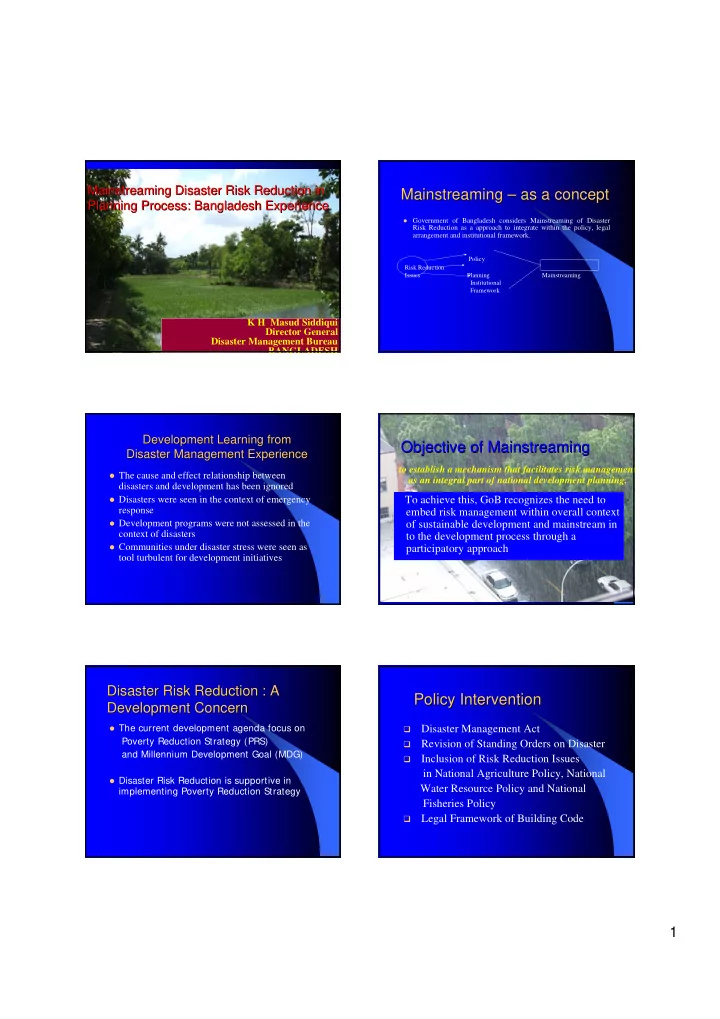
SLIDE 2 2
PRSP Core Principles PRSP Core Principles
country-driven, promoting national ownership of strategies
through broad-based participation of civil society;
result-oriented and focused on outcomes that will benefit the
poor;
comprehensive in recognizing the multidimensional nature of
poverty;
partnership-oriented, involving coordinated participation of
development partners (government, domestic stakeholders, and external donors); and
based on a long-term perspective for poverty reduction.
Status of Disaster Risk Reduction in PRS Status of Disaster Risk Reduction in PRS
Policy Matrix 07: Comprehensive Disaster Mgt. Towards Poverty Reduction and Growth Policy Matrix – 08: Food Security Policy Matrix - 12: Promote use of ICT in Dis. Mgt. Policy Matrix – 15: Ensure social protection for women against vulnerability and risks
PRSP Policy Matrix 7: Comprehensive disaster PRSP Policy Matrix 7: Comprehensive disaster management towards poverty reduction and growth management towards poverty reduction and growth
Mainstreaming disaster management and risk reduction into
national policies, institutions and development processes (introduction of Disaster Impact and Risk Assessment (DIRA)
Strengthening disaster management and risk reduction
capacity
Ensuring knowledge management (acquiring, storing, sharing
and applying) on disaster risk reduction
Enhancing community level capacity for disaster risk
reduction (community level preparedness, response, recovery and rehabilitation)
Ensuring social protection of women, children, elderly, people
with disability and other vulnerable groups against vulnerability and risk
Mainstreaming of Risk Reduction Framework Bangladesh Mainstreaming Risk Reduction Framework Bangladesh Mainstreaming Risk Reduction Framework
Local Govt. Local Govt. departments departments Different Different sectoral sectoral departments, departments, bureau, wing, bureau, wing, professional professional groups groups Stakeholders Stakeholders NGOs NGOs CBOs CBOs NGO Affairs NGO Affairs Bureau Bureau Stakeholders Stakeholders NGOs NGOs Capacity building Capacity building training training Practice of Practice of Community Risk Community Risk Assessment Assessment Mechanism (CRA) Mechanism (CRA) Development and Development and implementation of implementation of risk reduction action risk reduction action plans plans Inclusion of Disaster Inclusion of Disaster Risk Reduction Risk Reduction Mechanism in FD Mechanism in FD-
6 Form Form Activities Activities Practice of Practice of Community Risk Community Risk Assessment Assessment Mechanism Mechanism (CRA) (CRA) Inclusion of Inclusion of Disaster Risk Disaster Risk Reduction in the Reduction in the core business core business plan plan Activities Activities Sectors Sectors PRSP PRSP Sectoral Sectoral Policy Policy (Education, (Education, Housing, Housing, Agriculture, Agriculture, Fisheries Fisheries etc.) etc.) Policy Policy Activities Activities Stakeholders Stakeholders Local Local Government Government Planning Planning Commission, Commission, ERD, ERD, Planning Cell Planning Cell
Ministries/ Ministries/ Divisions Divisions GOB GOB Capacity building Capacity building training training Practice of Practice of Community Risk Community Risk Assessment Assessment Mechanism (CRA) Mechanism (CRA) Development and Development and implementation of implementation of risk reduction action risk reduction action plans plans Inclusion of Disaster Inclusion of Disaster Risk Reduction Risk Reduction Mechanism in Mechanism in Development Development Project Proposal Project Proposal (DPP), TAPP and (DPP), TAPP and PCP PCP Local Local National National Key Key Stakehold Stakehold ers ers
Mainstreaming Target Group Mainstreaming Target Group
CDMP identified the following stakeholders for Mainstreaming
Disaster Risk Reduction
Ensure Risk Reduction Agenda is properly addressed in all the proposal submitted
(FD-6 and FD-7 )
NGO Affairs Bureau Inclusion of Disaster Risk Reduction Mechanism in Concern department (DIRA, EIA, DPP, TPP) Economic Relation Department GOB Ministries and Departments Planning Commission Policy Reforms and Legal Arrangement Cabinet Members The Law Makers