
SLIDE 1
Principal Investigator: Principal Investigator: Miroslav Kotrla Theoretical Department, IPASCR kotrla (at) fzu.cz
MagDot MagDot Participant No.6 Participant No.6
MagDot Participant No.6 MagDot Participant No.6 Institute of - - PowerPoint PPT Presentation
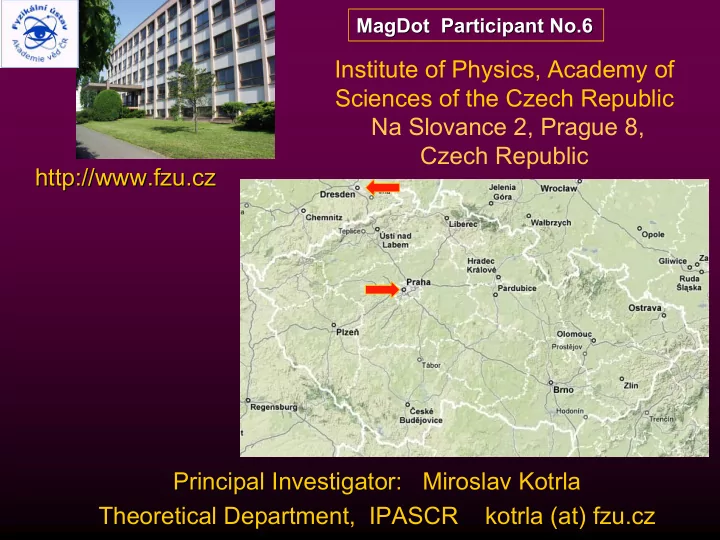
MagDot Participant No.6 MagDot Participant No.6 Institute of Physics, Academy of Sciences of the Czech Republic Na Slovance 2, Prague 8, Czech Republic http://www.fzu.cz www.fzu.cz http:// Principal Investigator: Miroslav Kotrla
MagDot MagDot Participant No.6 Participant No.6
12.5.2009 Third MagDot Workshop - Napa 2
Miroslav Kotrla – – Principal Investigator Principal Investigator
Martin Ma Maší šín n
researcher
postdoc (D. (D. Goykolov Goykolov) since ) since Oc Oct to
ber 2007 2007
Ondř řej ej Mar Maršá šálek lek
graduate student
Mathematical & Physical Faculty of Charles University, Prague Faculty of Charles University, Prague
Sebastian Weber - University of Wuezburg
growth of strained alloys
info on SimNANO Wiki http://simnano.fzu.cz/
Project MetHet
Third MagDot Workshop Third MagDot Workshop -
Napa 5 5
Third MagDot Workshop Third MagDot Workshop -
Napa 6 6
H.Brune H.Brune et al. PRL et al. PRL 73 73, (1994) 1955 , (1994) 1955 a) a) 0.0024 ML 0.0024 ML b) b) 0.006 ML 0.006 ML c) c) 0.03 ML 0.03 ML d) d) 0.06 ML 0.06 ML
Third MagDot Workshop Third MagDot Workshop -
Napa 7 7
H.
Brune et al. PRB. et al. PRB. 52 52 (1995) R 14380 (1995) R 14380.
S D B
N exp -E /k T
D
can be estimated from can be estimated from an experimental data an experimental data
12.5.2009 Third MagDot Workshop - Napa 8
some references on PLD: some references on PLD:
MBE – Molecular beam epitaxy PLD – Pulsed laser deposition
et al. PRL. 87 (2001) 135701.
MBE MBE -
extensively studied in the past
P.O Jubert, O. Fruchart, and C. Meyer Surface Science 522 (2003) 8.
MagDot MagDot
Unusual Scaling for PLD Unusual Scaling for PLD
PLD PLD – – new additional parameters new additional parameters pulse repetition rate pulse repetition rate f
f, etc. , etc.
nucleation density nucleation density in PLD depends on in PLD depends on intensity I of pulses intensity I of pulses
12.5.2009 Third MagDot Workshop - Napa 9
nucleation density N nucleation density Nx
x
vs vs. . temperature temperature
P.O Jubert, O. Fruchart, and C. Meyer Surface Science 522 (2003) 8.
experiment experiment
12.5.2009 Third MagDot Workshop - Napa 10
et al. et al. PRB PRB 73 73 ( (2006 2006) ) 014428 014428. M
. Bod
e et al. PR PRL L 9 92 2 ( (2004 2004) ) 067201 067201.
Third MagDot Workshop Third MagDot Workshop -
Napa 11 11
b d D B D
b d
Third MagDot Workshop Third MagDot Workshop -
Napa 12 12
b d D B D
b d
Third MagDot Workshop Third MagDot Workshop -
Napa 13 13
P.O Jubert, O. Fruchart, and C. Meyer Surface Science 522 (2003) 8.
kinetic analysis of experiment performed but special character
deposition (PLD) considered DFT calculation
Third MagDot Workshop Third MagDot Workshop -
Napa 14 14
Y b X b
? k ? E ? E ? E
Y b X b d
11 d
12
b d
12.5.2009 Third MagDot Workshop - Napa 15
T = 200 K T = 200 K T = 300 K T = 300 K T = 400 K T = 400 K
12.5.2009 Third MagDot Workshop - Napa 16
T = 200 K T = 200 K T = 300 K T = 300 K T = 400 K T = 400 K
12.5.2009 Third MagDot Workshop - Napa 17
(θ θ = 0.1 = 0.1) )
T = 400 K T = 400 K T = 500 K T = 500 K T = 400 K T = 400 K
, E E
b b
= 0.60 = 0.60 eV eV
, E E
b b
= 0.60 = 0.60 eV eV
, E E
b b
= 0. = 0.33 33 eV eV
T = 400 K T = 400 K T = 500 K T = 500 K T = 500 K T = 500 K
12.5.2009 Third MagDot Workshop - Napa 18
P.-O. Jubert, O. Fruchart, and C. Meyer Surface Sci. 522 (2003), 8
12.5.2009 Third MagDot Workshop - Napa 19
P.-O. Jubert, O. Fruchart, and C. Meyer Surface Sci. 522 (2003), 8
12.5.2009 Third MagDot Workshop - Napa 20
12.5.2009 Third MagDot Workshop - Napa 21
MBEvsPLD.png
12.5.2009 Third MagDot Workshop - Napa 22
Third MagDot Workshop Third MagDot Workshop -
Napa 23 23
ad i) ad i) Mark Mark Asta Asta group group calculated calculated binding binding energy energy for for Fe Fe-
Fe dimer on dimer on Mo Mo(110) (110) up up to to sixth sixth neighbor neighbor
b
neighbor : nearest second third fouth fifth sixth : 0.3389 0.0717 0.07885 0.01005 0.004125 0.007475
E eV
12
k 4 10 Hz
d b
E 0.41 , E 0.33 eV eV
12.5.2009 Third MagDot Workshop - Napa 24
Regular square lattice Representation of the bcc(110) lattice by square array - adding two next-nearest neighbors and allow jumps to their location. a a
1 2
b2 b1 To produce picture of the regular triangular lattice one need to perform coordinate system transformation: tilt the lattice. Coordinates transformation:
y' x'+b b = x
2x 1x
y' x'+b b = y
2y 1y
b , b , b , b - correspondent projections of the unit vectors in the bcc(110) coordinate system to the
x', y' – coordinates in the bcc(110) lattice coordinate system
1x 2x 1y 2y
12.5.2009 25
b2 b1 Square lattice before the transformation bcc(110) lattice after the transformation a a
1 2
Coordinate system before the transformation Coordinate system after the transformation Due to this kind of transformation boundary islands are getting distorted. In the following simulation pictures they are deleted. For Molibdenium tilting angle is α=19.47º. α Coordinates transformation (for molibdenum):
' + x' = x 0.5774y 0.8165 ' = y 0.8165y
12.5.2009 Third MagDot Workshop - Napa 26
Lattice geometry Adatom Nearest neighbors that interact with adatom (I – first, II – second, III – third nearest neighbors Arrows – allowed directions of adatom hop En - with the first nearest neighbor (0.14 .. 0.329 eV) E2n - with the second nearest neighbor (0 .. 0.15 eV) E3n - with the third nearest neighbor (0 .. 0.1 eV) Interaction energies: Es - with the substrate (0.2 .. 0.4 eV) Other model parameters: Fvib – vibrational frequency (2x10¹² .. 4x10¹² Hz) ( Lattice size in the range 300x300 .. 1000x1000
12.5.2009 Third MagDot Workshop - Napa 27
T=350K T=360K T=370K T=400K T=390K T=380K
Shown are fragments of the 300x300 lattices: En=0.329 eV, Enn=0.072 eV, Flux=0.01 ML/s, Θ=0.05 ML, ν=4x10 Hz
12
12.5.2009 Third MagDot Workshop - Napa 28
En=0.33 eV En=0.36 eV En=0.4 eV En=0.55 eV En=0.5 eV En=0.45 eV
Shown are fragments of the 300x300 lattices: Enn=0 eV, T=400K, Flux=0.01 ML/s, Θ=0.1 ML, ν=4x10 Hz
12
12.5.2009 29
Change of Island Shape with Temperature
T=325K T=350K T=400K T=500K T=450K T=425K Conditions of simulations: 300x300 lattice (T=325..450K) 1000x1000 lattice (T=500K) Flux = 0.01 ML/s θ = 0.05 ML Fvib = 4x10¹² Hz Es = 0.4 eV En = 0.329 eV E2n = 0.072 eV E3n = 0.079 eV Shape evolution with coverage Scale: θ=0.01 ML θ=0.05 ML Coverage step = 0.01 ML
12.5.2009 Third MagDot Workshop - Napa 30
Island Shape for Scaled Energies and Higher Temperature
We have used scaled energies and temperature to reduce computation time. Since simultaneous scaling does not change the hopping rates, we may claim, that the results for scaling factor 0.5 are the same as for the factor equal to 1. Scale: θ=0.01 ML θ=0.05 ML Coverage step = 0.01 ML Conditions of simulations: 300x300 lattice Flux = 0.01 ML/s θ = 0.05 ML T = 350K Fvib = 4x10¹² Hz Es = 0.2 eV En = 0.1645 eV E2n = 0.036 eV E3n = 0.0395 eV scaling factor = 0.5 The same result may be obtained for calculated energies and T=700K, which is observed in
12.5.2009 Third MagDot Workshop - Napa 31
Change of Island Shape with Temperature
Insets: examples of the island shape at the particular temperatures
Quantitative parameter to study island shape: average aspect ratio. Average aspect ratio is defined as average ratio of transversal and longitudinal dimensions of the islands. Conditions of simulations: 300x300 lattice (T=180..200K) 600x600 lattice (T=210..230K) 1000x1000 lattice (T=240K) Flux = 0.01 ML/s θ = 0.1 ML Fvib = 2x10¹² Hz Es = 0.2 eV En = 0.14 eV E2n = 0 E3n = 0.06 eV Data points for 300x300 lattice are averaged over 10 runs. Data points for 600x600 and 1000x1000 lattice are averaged
12.5.2009 Third MagDot Workshop - Napa 32
Average Aspect Ratio vs E2n
(E2n = 0.14 eV) Insets: examples of the island shape at the particular values of E2n
Conditions of simulations: 300x300 lattice Flux = 0.01 ML/s θ = 0.1 ML T = 230K Fvib = 2x10¹² Hz Es = 0.2 eV En = 0.14 eV E3n = 0.03 eV Data points are averagd
12.5.2009 Third MagDot Workshop - Napa 33
Average Aspect Ratio vs E3n
Insets: examples of the island shape at the particular values of E3n
Conditions of simulations: 300x300 lattice Flux = 0.01 ML/s θ=0.1 ML T=250K Fvib = 2x10¹² Hz Es = 0.2 eV En =0.14 eV E2n =0.04 eV Data points are averagd
12.5.2009 Third MagDot Workshop - Napa 34
Special Case: Islands with Extra Facet
We get the shape that resemble hexagons under the special condition: when interaction energies with the first and second nearest neighbors are approximately the same. Conditions of simulations: 300x300 lattice Flux = 0.01 ML/s θ=0.1 ML; T=400K Fvib = 4x10¹² Hz Es = 0.4 eV; En =0.15 eV E2n =0.13 eV; E3n =0 Conditions of simulations: 300x300 lattice Flux = 0.01 ML/s θ=0.1 ML; T=480K Fvib = 4x10¹² Hz Es = 0.4 eV; En =0.15 eV E2n =0.15 eV; E3n =0 Scale: θ=0.01 ML θ=0.05 ML Coverage step = 0.01 ML
12.5.2009 Third MagDot Workshop - Napa 35
12.5.2009 Third MagDot Workshop - Napa 36
17th Int. Vacuum Congress (IVC-17), 13th Int. Conference on Surface Science (ICSS-13), Int. Conference on Nanoscience and Technology (ICN+T 2007) Stockholm, Sweden (July 2-6, 2007) Nano-pattern formation in strained 2D metallic alloys: comparison of simple cubic(100) and fcc(111) surfaces by M. Kotrla, S. Weber, M. Biehl (talk)
CCP2007 - International Conference
Physics, Brussels (Sep. 5-8, 2007) Pulsed depositions vs. continuous growth: Monte-Carlo study of sub-- monolayer regime by M. Masin, and M. Kotrla (poster)
Brno, October, 8-10, 2007 Self-assembled nano-patterns in strained 2D metalic alloys: stripes vs. islands by M. Kotrla, S. Weber, F. Much, M. Biehl, W. Kinzel (talk)
12.5.2009 Third MagDot Workshop - Napa 37
in strained 2D alloys on fcc(111) surface: equilibrium Monte Carlo simulation
17th Int. Vacuum Congress (IVC-17), 13th Int. Conference on Surface Science (ICSS- 13), Int. Conference on Nanoscience and Technology (ICN+T 2007) Stockholm, Sweden (July 2-6, 2007) Nano-pattern formation in strained 2D metallic alloys: comparison of simple cubic(100) and fcc(111) surfaces by M. Kotrla, S. Weber, M. Biehl (talk)
CCP2007 - International Conference
Physics, Brussels (Sep. 5-8, 2007) Pulsed depositions vs. continuous growth: Monte-Carlo study of sub--monolayer regime by M. Masin, and M. Kotrla (poster)
Brno, October, 8-10, 2007 Self-assembled nano-patterns in strained 2D metalic alloys: stripes vs. islands by M. Kotrla, S. Weber, F. Much, M. Biehl, W. Kinzel (talk)
Work in Progress
The modified model:
Atoms involved in one hopping event I, II and III – first, second and third nearest neighbors. Indexes i, f labels neighbors at the initial and final positions of the hopping atom.
Eif = Es + (Nn – μMn )En + (N2n – μM2n )E2n + (N3n – μM3n )E3n
Energy barrier is now calculated as follows:
Eif – diffusion barrier for jump from initial to final position Es – diffusion barrier of the free adatom Nn , N2n , N3n – number of first, second and third nearest neighbors before the jump Mn , M2n , M3n
neighbors after the jump En , E2n , E3n – interaction energies of the adatom with first, second and third nearest neighbors μ – influence of the atomic configuration after the jump
some special jumps (edge diffusion, detachment, etc.)
Results of the new code Comparison of the lattice configurations obtained under the same conditions: Conditions: 300x300 lattice Flux = 0.01 ML/s θ = 0.1 ML T = 300 K Fvib = 4x10¹² Hz Es = 0.4 eV En = 0.329 eV E2n = 0.072 E3n = 0.079 eV Old code New code. μ = 0.05
Shape of the compact islands Old code conditions: 1000x1000 lattice Flux = 0.01 ML/s θ = 0.05 ML T = 500 K Fvib = 4x10¹² Hz Es = 0.4 eV En = 0.329 eV E2n = 0.072 E3n = 0.079 eV New code conditions: 300x300 lattice Flux = 0.01 ML/s θ = 0.1 ML T = 300 K Fvib = 4x10¹² Hz Es = 0.4 eV En = 0.329 eV E2n = 0.072 E3n = 0.079 eV μ = 0.05