Nonregular language I We are interested in the limit of finite - - PowerPoint PPT Presentation

nonregular language i
SMART_READER_LITE
LIVE PREVIEW

Nonregular language I We are interested in the limit of finite - - PowerPoint PPT Presentation

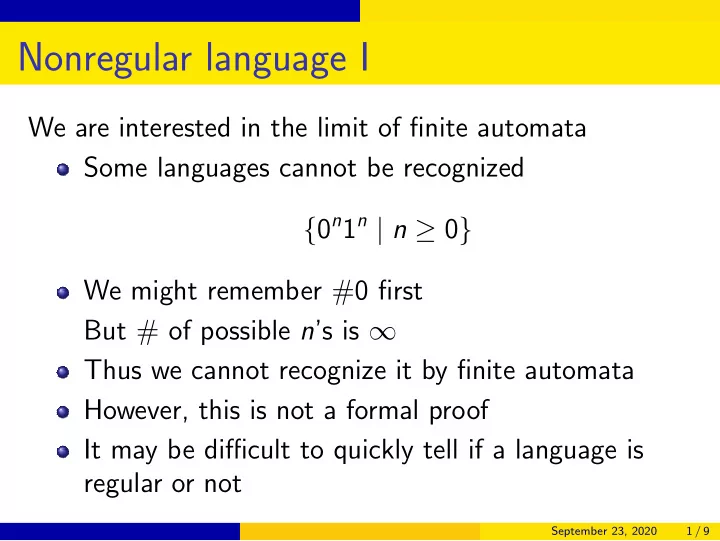
Nonregular language I We are interested in the limit of finite automata Some languages cannot be recognized { 0 n 1 n | n 0 } We might remember #0 first But # of possible n s is Thus we cannot recognize it by finite automata However,


slide-1
SLIDE 1

Nonregular language I

We are interested in the limit of finite automata Some languages cannot be recognized {0n1n | n ≥ 0} We might remember #0 first But # of possible n’s is ∞ Thus we cannot recognize it by finite automata However, this is not a formal proof It may be difficult to quickly tell if a language is regular or not

September 23, 2020 1 / 9

slide-2
SLIDE 2

Nonregular language II

Consider two languages C = {w | #0 = #1} D = {w | #01 = #10} It seems that both are not regular Indeed, C is not regular but D is This is an exercise in the book, so we don’t give details To formally prove a language is not regular, we will introduce the pumping lemma

September 23, 2020 2 / 9

slide-3
SLIDE 3

Pumping lemma I

Strategy: by contradiction We prove regular ⇒ some properties If “some properties” cannot hold, then the language is not regular

September 23, 2020 3 / 9

slide-4
SLIDE 4

Theorem 1.70 I

If A regular ⇒ ∃p (pumping length) such that ∀s ∈ A, |s| ≥ p, ∃x, y, z such that s = xyz and

1

∀i ≥ 0, xy iz ∈ A

2

|y| > 0

3

|xy| ≤ p Note that for y i, we have y 0 = ǫ

September 23, 2020 4 / 9

slide-5
SLIDE 5

Proof of pumping lemma I

Because A is regular, ∃ a DFA to recognize A Let p = # states of this DFA If no string s such that |s| ≥ p, then the theorem statement is satisfied Now consider any s with |s| ≥ p s = s1 · · · sn

September 23, 2020 5 / 9

slide-6
SLIDE 6

Proof of pumping lemma II

To process this string, assume the state sequence is q1 · · · qn+1 Because |s| ≥ p, we have n + 1 > p In 1 . . . p + 1 two states must be the same (pigeonhole principle) Fig 1.72

September 23, 2020 6 / 9

slide-7
SLIDE 7

Proof of pumping lemma III

q1 qj, ql qa x z y

September 23, 2020 7 / 9

slide-8
SLIDE 8

Proof of pumping lemma IV

Assume qj and ql with j ≤ p + 1, l ≤ p + 1 are two same states. Then let x = s1 · · · sj−1, y = sj, · · · sl−1, z = sl · · · sn We then have ∀i ≥ 0, xy iz ∈ A

September 23, 2020 8 / 9

slide-9
SLIDE 9

Proof of pumping lemma V

Because j = l, |y| > 0 From l ≤ p + 1, we have |xy| ≤ p Thus all conditions are satisfied

September 23, 2020 9 / 9