
SLIDE 1
Macro and Close up Photography What does Macro mean? Extreme - - PowerPoint PPT Presentation
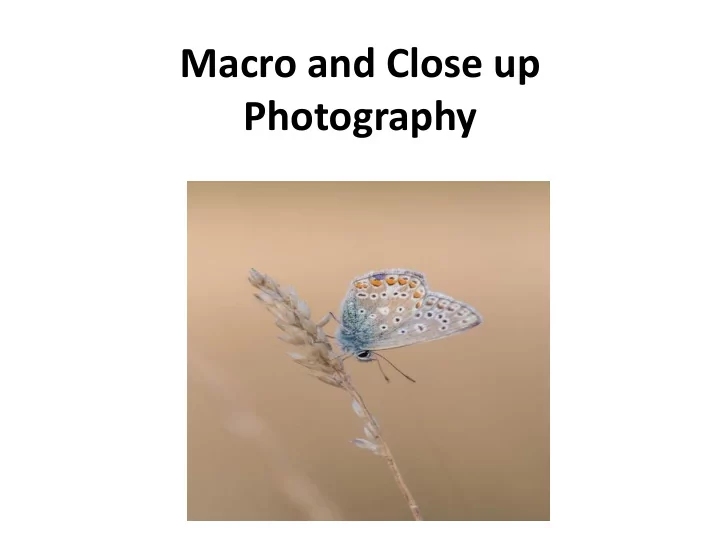
Macro and Close up Photography What does Macro mean? Extreme close-up photography, usually of very small subjects and living organisms like insects, flowers and good for abstracts, in which the size of the subject in the photograph is
Is a measure of the range of sharpness in the photograph. The distance between the nearest and the furthest objects giving a focused image. 3 Factors for controlling D of F Using the Aperture – f stop Small Apertures– large f numbers f11 – 22 – giving the greatest D of F Large Apertures – small f numbers f2.8 – f8 – giving shallowest D of F The distance from the subject to the camera Focal length of the lens
Always important in photography. Natural Light – golden hour – sunrise and sunset
Dull overcast days can give brilliant results
Tripods
Flashguns
Ring Flash
Other light sources – torch on your iPhones – LED lights Reflectors
Most popular macro models come in focal lengths between 90 – 105 with 1:1 magnification. Meaning – The image on the sensor is at least as large as the subject being photographed. Don’t have a macro lens Can work fine – less that 35mm – 24 105often has short minimum focus and can give reasonable magnification. Close up lens
Extension tubes
Sharp droplets / background gradually goes out of focus Longer DOF Sharp leaf and drop – background completely out of focus – shorter DOF
Flatness of object makes DOF irrelevant Soft gradation of DOF gives a more interesting composition
Short DOF deliberately creates the abstract element of this image Long DOF keep flowers in focus but background visible but blurry – great composition
Everyone Welcome – need to let Peter know – 21 so far At Dancers End Nature Reserve – 1.30pm to 5pm Cream Tea served at 4.30pm ish £6 per head – all goes to the Charity responsible for the Nature Reserve Groups of 7 - each with a ‘advisor’ – who will help you with settings / lenses etc. All kinds of bugs and much fauna around