Machine Protection Rdiger Schmidt 517. WE-Heraeus-Seminar - - PowerPoint PPT Presentation

machine protection
SMART_READER_LITE
LIVE PREVIEW

Machine Protection Rdiger Schmidt 517. WE-Heraeus-Seminar - - PowerPoint PPT Presentation

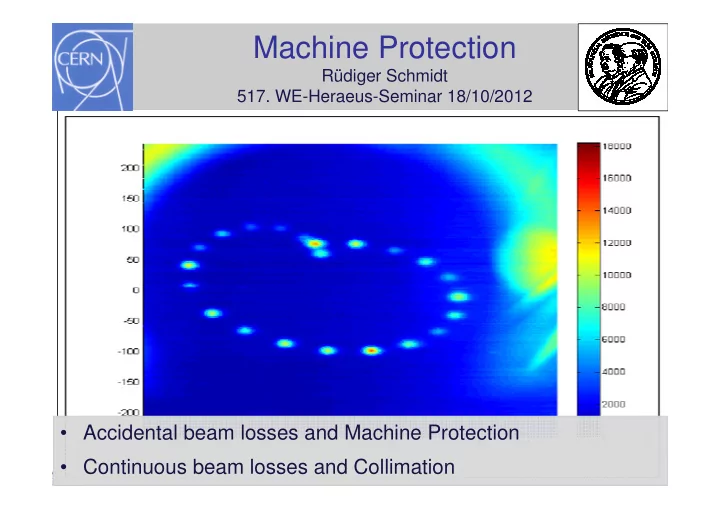
Machine Protection Rdiger Schmidt 517. WE-Heraeus-Seminar 18/10/2012 Accidental beam losses and Machine Protection Continuous beam losses and Collimation HERAEUS Seminar October 2012 R.Schmidt 1 1 r6 Proton bunches at the end


slide-1
SLIDE 1

HERAEUS Seminar October 2012 R.Schmidt 1

Machine Protection

Rüdiger Schmidt

  • 517. WE-Heraeus-Seminar 18/10/2012

1

  • Accidental beam losses and Machine Protection
  • Continuous beam losses and Collimation
slide-2
SLIDE 2

HERAEUS Seminar October 2012 R.Schmidt

Proton bunches at the end of their life in LHC: screen in front of the beam dump block

r6

slide-3
SLIDE 3

Folie 2 r6 Illustrations and examples mostly from CERN

rudi; 23.05.2008

slide-4
SLIDE 4

HERAEUS Seminar October 2012 R.Schmidt 3

Proton bunches at the end of their life during an SPS test: damage to metal structure

r7

slide-5
SLIDE 5

Folie 3 r7 Illustrations and examples mostly from CERN

rudi; 23.05.2008

slide-6
SLIDE 6

HERAEUS Seminar October 2012 R.Schmidt 4

Content

  • Overview: Energy and Power in accelerators
  • Beam losses and damage potential
  • Beam losses, collimation and machine protection
  • Some examples of failures from LHC
  • Collimators, beam absorbers and beam cleaning
  • Wrap up on Machine Protection

Most examples from LHC …. apologies to other accelerators…. LHC allows illustration of many principles

slide-7
SLIDE 7

HERAEUS Seminar October 2012 R.Schmidt 5

Overview: Energy and Power in accelerators

slide-8
SLIDE 8

HERAEUS Seminar October 2012 R.Schmidt 6

Protection from Energy and Power

  • Risks come from Energy stored in a system (Joule), and

Power when operating a system (Watt)

– “very powerful accelerator” … the power flow needs to be controlled – !!! watch out: energy (e.g. 7 TeV) and stored energy (e.g. 362 MJ) !!!

  • An uncontrolled release of the energy or an uncontrolled

power flow can lead to unwanted consequences

– Loss of time for operation or damage of equipment

  • This is true for all systems, in particular for complex systems

such as accelerators

– For the RF system, power converters, magnet system (e.g. magnet protection for superconducting magnets), …. – For the beams

  • The 2008 accident during LHC operation happened during

test runs without beam

slide-9
SLIDE 9

HERAEUS Seminar October 2012 R.Schmidt

Damage of LHC during the 2008 accident

Accidental release of an energy of 600 MJoule stored in the magnet system - No Beam

slide-10
SLIDE 10

HERAEUS Seminar October 2012 R.Schmidt 8

Machine Protection for Particle Beams

Many accelerators operate with high beam intensity and/or large stored energy:

  • For synchrotrons and storage rings, the energy stored in the

beam is increased during the years (from ISR to LHC)

  • For linear accelerators and fast cycling machines, in particular

high intensity proton and ion accelerators, the beam power increases The emittance becomes smaller (resulting in a beam size down to nanometer:

  • Increasingly important for future projects, with increased beam

power / energy density (W/mm2 or J/mm2 ) for ILC, CLIC and XFEL) - less relevant for hadron accelerators

  • Beam induced heating due to high beam current via EM fields:

see G.Arduinis presentation – not discussed here

slide-11
SLIDE 11

HERAEUS Seminar October 2012 R.Schmidt

Livingston type plot: Energy stored magnets and beam

slide-12
SLIDE 12

HERAEUS Seminar October 2012 R.Schmidt

license operation with 2.2mA given: 1.3MW 4 new Cu Resonators in Ring

beam current is limited by beam losses and resulting activation; upgrade measures kept absolute losses constant

aperture limitation removed; new ECR source; 50Hz ripple problem solved: 1.4MW

n e w r e c

  • r

d : 1 . 4 M W

Power in the PSI cyclotron accelerator

M.Seidel, HB2012

slide-13
SLIDE 13

HERAEUS Seminar October 2012 R.Schmidt 11

High power accelerators …

  • Operate with beam power of 1 MW and more
  • SNS – 1 MW, PSI cyclotron – 1.3 MW, ESS – planned for

5 MW, FRIB (ions)– planned for 0.4 MW

  • In case of an uncontrolled beam loss during 1 ms, the

deposited energy is 1 kJ to 5 kJ, for 100 ms 100 kJ to 500 kJ

  • It is required to switch off the source a.s.a.p. after detecting

uncontrolled beam loss

  • The delay between detection and “beam off” to be

considered

source

dT = dT_detect failure + dT_transmit signal + dT_stop source + dT_stop impact stop beam interlock signal

slide-14
SLIDE 14

HERAEUS Seminar October 2012 R.Schmidt 12

Beam losses

In accelerators, particles are lost due to a variety of reasons: beam gas interaction, losses from collisions, losses of the beam halo, …

  • Continuous beam losses are inherent to the operation of

accelerators

– Taken into account during the design of the accelerator

  • Accidental beam losses are due to a multitude of failures

mechanisms

  • The number of possible failures leading to accidental beam

losses is (nearly) infinite

slide-15
SLIDE 15

HERAEUS Seminar October 2012 R.Schmidt 13

Beam losses, machine protection and collimation

Continuous beam losses: Collimation prevents too high beam losses around the accelerator (beam cleaning) A collimation system is a (very complex) system with (massive) material blocks installed in an accelerator to capture halo particles Such system is also called (beam) Cleaning System Accidental beam losses: “Machine Protection” protects equipment from damage, activation and downtime Machine protection includes a large variety of systems, including collimators (or beam absorbers) to capture mis- steered beam

slide-16
SLIDE 16

HERAEUS Seminar October 2012 R.Schmidt 14

Regular and irregular operation Failures during

  • peration

Beam losses due to failures,

timescale from nanoseconds to seconds

Machine protection systems Collimators Beam absorbers

Regular operation

Many accelerator systems Continuous beam losses Collimators for beam cleaning Collimators for halo scraping Collimators to prevent ion- induced desorption

slide-17
SLIDE 17

HERAEUS Seminar October 2012 R.Schmidt 15

Beam losses and damage

slide-18
SLIDE 18

HERAEUS Seminar October 2012 R.Schmidt 16

Beam losses and consequences

  • Particle losses lead to ionisation and particle cascades in

materials that deposit energy in the material

– the maximum energy deposition can be deep in the material at the maximum of the hadron / electromagnetic shower

  • The energy deposition leads to a temperature increase

– material can vaporise, melt, deform or lose its mechanical properties – risk to damage sensitive equipment for some kJ …10 kJ, risk for damage of any structure for some MJoule (depends on beam size) – superconducting magnets could quench (beam loss of ~mJ to J)

  • Activation of equipment due to beam losses (acceptable is

~1 W/m for high energy protons, should be “As Low As Reasonably Achievable” - ALARA)

– very serious limitation of the performance of high power accelerators (PSI cyclotron, SNS, …..)

slide-19
SLIDE 19

HERAEUS Seminar October 2012 R.Schmidt 17

Energy deposition and temperature increase

  • There is no straightforward expression for the energy

deposition of particles in matter

  • The energy deposition is a function of the particle type, its

momentum, and the parameters of the material (atomic number, density, specific heat)

  • Programs such as FLUKA, MARS, GEANT and similar

codes are being used for the calculation of energy deposition and activation

  • Other programs are used to calculate the response of the

material (deformation, melting, …) to beam impact (mechanical codes such as ANSYS, hydrodynamic codes such as BIG2, AUTODYN and others) Question: what is dangerous (stored beam energy, beam power)? When do we need to worry about protection?

slide-20
SLIDE 20

HERAEUS Seminar October 2012 R.Schmidt 18

What parameters are relevant?

  • Energy stored in the beam

– one MJoule can heat and melt 1.5 kg

  • f copper

– one MJoule corresponds to the energy stored in 0.25 kg of TNT

  • Beam power

– one MW during one second corresponds to a MJ

  • Particle type

– activation is mainly an issue for hadron accelerators

  • Momentum of the particle
  • Time structure of beam
  • Beam size
  • Beam power / energy density

(MJoule/mm2, MWatt/mm2)

The energy of an 200 m long fast train at 155 km/hour corresponds to the energy of 360 MJoule stored in one LHC beam Machine protection to be considered for an energy stored in the beam > 1 kJ … 10 kJ Very important if beam > 1 MJ

slide-21
SLIDE 21

HERAEUS Seminar October 2012 R.Schmidt 19

Controlled SPS experiment

  • 8⋅1012 protons clear damage
  • beam size σx/y = 1.1mm/0.6mm

above damage limit for copper stainless steel no damage

  • 2⋅1012 protons

below damage limit for copper 6 cm 25 cm

  • Damage limit ~200 kJoule
  • 0.1 % of the full LHC 7 TeV beams
  • factor of ~10 below the energy in a

bunch train injected into LHC

V.Kain et al

A B D C

SPS experiment: Beam damage with 450 GeV proton beam

slide-22
SLIDE 22

HERAEUS Seminar October 2012 R.Schmidt

Protons versus Ions - LHC parameters

  • In the worst case, the proton beam could damage the accelerator

beyond repair, one bunch can drill a hole into the vacuum chamber

  • The ion beam can damage the accelerator, the worst case damage

potential is much less

  • For one ion bunch with 6.44 kJ stored energy, is there any risk?

20

Protons Ions (Pb)

  • Max. dipole field

8.33 T 8.33 T Energy per nucleon 7 TeV 2.759 TeV Number of bunches 2808 592 Particles per bunch 1.15 * 1011 7 * 107 Energy per bunch 129 kJ 6.44 kJ Energy in one beam 362 MJ 3.81 MJ

slide-23
SLIDE 23

HERAEUS Seminar October 2012 R.Schmidt

Concept of set-up (safe) beam

21

slide-24
SLIDE 24

HERAEUS Seminar October 2012 R.Schmidt

Energy deposition in target: protons and ions

  • The interaction of protons and ions with matter has

similarities, but also differences aspects

  • Ionisation energy loss
  • Creates many soft electrons, which makes the final energy deposition

close to the point of creation => very localized energy deposition

  • Scales with Z2, approximately described by Bethe-Bloch formula for

relativistic particles:

slide-25
SLIDE 25

HERAEUS Seminar October 2012 R.Schmidt

Energy deposition in target: protons and ions

  • Nuclear inelastic interactions (hadronic

shower)

  • Causes electromagnetic shower through decays of

pions

  • Exponential increase in number of created particles
  • Final energy deposition to large fraction done by

large number of electromagnetic particles

  • Scales roughly with total energy of incident particles
  • Ions can be approximated as independent nucleons
  • Ions nuclei can break up in the high-

intensity electromagnetic field for ultra peripheral collisions without direct overlap

  • In ion-ion collisions, the nucleus can

change the charge/mass ratio, e.g.

http://williamson-labs.com/ltoc/cbr-tech.htm

slide-26
SLIDE 26

HERAEUS Seminar October 2012 R.Schmidt 24

Maximum energy deposition in the proton cascade (one proton) : Emax_C 2.0 10 6

⋅ J kg := Specific heat of graphite is cC_spec 710.6000 1 kg J K = To heat 1 kg graphite by, say, by ∆T 1500K := , one needs: cC_spec ∆T ⋅ 1 ⋅ kg 1.07 106 × J = Number of protons to deposit this energy is: cC_spec ∆T ⋅ Emax_C 5.33 1011 × = Maximum energy deposition in the proton cascade (one proton): Emax_Cu 1.5 10 5

⋅ J kg := Specific heat of copper is cCu_spec 384.5600 1 kg J K = To heat 1 kg copper by, say, by ∆T 500K := , one needs: cCu_spec ∆T ⋅ 1 ⋅ kg 1.92 105 × J = Number of protons to deposit this energy is: cCu_spec ∆T ⋅ Emax_Cu 1.28 1010 × =

Copper graphite

Damage of a pencil 7 TeV proton beam (LHC)

copper graphite

slide-27
SLIDE 27

HERAEUS Seminar October 2012 R.Schmidt 25

Target length [cm] vaporisation melting

N.Tahir (GSI) et al.

Copper target 2 m Energy density [GeV/cm3]

  • n target axis

2808 bunches 7 TeV 350 MJoule

Full LHC beam deflected into copper target

FLUKA and hydrodynamic codes: the LHC beam will tunnel about 30 m into solid copper for full beam impact

Impact of high energy high intensity proton beams

  • n targets, N.A.Tahir et al, PRSTAB IPAC 2011

Conference Edition

slide-28
SLIDE 28

HERAEUS Seminar October 2012 R.Schmidt

Energy deposition in target: Ions

  • Relevant ion-matter interactions implemented in programs such as FLUKA
  • Simple case: beams of Pb ions and protons hitting homogenous copper

target at straight angle

  • Gaussian beam with σ = 40 µ

sigma hitting Cu target

  • Three different particle species

simulated: Pb82+, Ge32+ and p+, all at 2.76 TeV/nucleon

  • Sharp peak for ions near to

entry point

  • Second peak after some 20 cm
  • Energy deposition from Pb

roughly factor 4 higher than energy deposition from protons

R.Bruce

slide-29
SLIDE 29

HERAEUS Seminar October 2012 R.Schmidt 27

Beam losses, collimation and protection

slide-30
SLIDE 30

HERAEUS Seminar October 2012 R.Schmidt 28

Continuous beam losses: Collimation

Limitation of beam losses is in order of 1 W/m (high energy protons) to avoid activation and allow hands-on maintenance

– avoid beam losses around the accelerator – define the aperture by collimators – capture continuous particle losses with collimators at specific locations

Continuous beam with a power ~1 MW (SNS, JPARC, ESS)

– a loss of 1% corresponds to 10 kW – not to be lost along the beam line to avoid activation of material, heating, quenching, … – assume a length of 200 m: 50 W/m, not acceptable – ideas for accelerators of 5 MW, 10 MW and more….

LHC stored beam with an energy of 360 MJ for 7 TeV operation

– assume lifetime of 10 minutes corresponds to beam loss of 500 kW, not to be lost in superconducting magnets – reduce losses by four orders of magnitude

….but also: capture fast accidental beam losses
slide-31
SLIDE 31

HERAEUS Seminar October 2012 R.Schmidt 29

Accidental beam losses: Machine Protection

Single-passage beam loss in the accelerator complex (ns - µs)

– transfer lines between accelerators or from an accelerator to a target station (target for secondary particle production, beam dump block) – failures of kicker magnets (injection, extraction, special kicker magnets, for example for diagnostics) – failures in linear accelerators – too small beam size at a target station

Very fast beam loss (ms)

– in circular accelerators (multiturn) and in linacs – due to a large number of possible failures, mostly in the magnet powering system, with a typical time constant of ~1 ms to many seconds

Fast beam loss (some 10 ms to seconds) Slow beam loss (many seconds)

slide-32
SLIDE 32

HERAEUS Seminar October 2012 R.Schmidt 30

Classification of failures

  • Type of the failure

– hardware failure (power converter trip, magnet quench, AC distribution failure such as thunderstorm, object in vacuum chamber, vacuum leak, RF trip, kicker magnet misfires, .…) – controls failure (wrong data, wrong magnet current function, trigger problem, timing system, feedback failure, ..) – operational failure (chromaticity / tune / orbit wrong values, …) – beam instability (due to too high beam / bunch current / e-clouds)

  • Parameters for the failure

– time constant for beam loss – probability for the failure – damage potential

  • Machine state when failure occurs

– beam transfer, injection and extraction (single pass) – acceleration – stored beam defined as risk

slide-33
SLIDE 33

HERAEUS Seminar October 2012 R.Schmidt 31

Example for Active Protection - Traffic

  • A monitor detects a

dangerous situation

  • An action is triggered
  • The energy stored in

the system is safely dissipated

slide-34
SLIDE 34

HERAEUS Seminar October 2012 R.Schmidt 32

Example for Passive Protection

  • The monitor fails to

detect a dangerous situation

  • The reaction time is

too short

  • Active protection not

possible – passive protection by bumper, air bag, safety belts

slide-35
SLIDE 35

HERAEUS Seminar October 2012 R.Schmidt 33

Strategy for protection: Protection Systems

  • Avoid that a specific failure can happen
  • Detect failure at hardware level and stop beam operation
  • Detect initial consequences of failure with beam

instrumentation ….before it is too late…

  • Stop beam operation

– stop injection – extract beam into beam dump block – stop beam by beam absorber / collimator

  • Elements in the protection systems

– hardware monitoring and beam monitoring – beam dump (fast kicker magnet and absorber block) – collimators and beam absorbers – beam interlock systems linking different systems

slide-36
SLIDE 36

34

LHC Layout eight arcs (sectors) eight long straight section (about 700 m long) IR6: Beam dumping system IR4: RF + Beam instrumentation IR5:CMS IR1: ATLAS IR8: LHC-B IR2: ALICE

Injection Injection

IR3: Moment Beam Clearing (warm) IR7: Betatron Beam Cleaning (warm)

Beam dump blocks

Detection of beam losses with >3600 monitors around LHC

Signal to kicker magnet Beams from SPS

slide-37
SLIDE 37

35 RF contacts for guiding image currents Beam spot 2 mm

View of a two sided collimator for LHC about 100 collimators are installed

Ralph Assmann, CERN length about 120 cm

slide-38
SLIDE 38

36

  • Ionization chambers to detect beam losses:
  • Reaction time ~ ½ turn (40 µs)
  • Very large dynamic range (> 106)
  • There are ~3600 chambers distributed over the ring to

detect abnormal beam losses and if necessary trigger a beam abort !

Beam Loss Monitors

slide-39
SLIDE 39

37

Schematic layout of LHC beam dumping system

Q5R Q4R Q4L Q5L Beam 2 Beam 1

Beam Dump Block Septum magnet deflecting the extracted beam Accurate energy tracking between LHC and extraction elements required

about 700 m about 500 m

Fast kicker magnet for

  • ne turn

extraction H-V kicker for painting the beam

slide-40
SLIDE 40

LHC beam dumping system

slide-41
SLIDE 41

Beam dump

  • Screen in front of

the beam dump block

  • Each light dot

shows the passage

  • f one proton bunch

traversing the screen

  • Each proton bunch

has a different trajectory, to better distribute the energy across a large volume

50 cm

slide-42
SLIDE 42

40

Some examples for failure from LHC

slide-43
SLIDE 43

HERAEUS Seminar October 2012 R.Schmidt 41

Failures: examples for LHC

Assume that two 100 MJoule beams (= 2*25 kg TNT) are circulating with the speed of light through the 56 mm diameter vacuum chamber and 2 mm wide collimators

  • 1. Suddenly the AC distribution for CERN fails – no power!
  • 2. An object falls into the beam

Assume we injection beams for the next fill…..

  • 3. Serious failure during injection – the injection kicker fails
slide-44
SLIDE 44

HERAEUS Seminar October 2012 R.Schmidt

LHC from injection to collisions

42

4.0 TeV / 135 MJoule 0.45 TeV / 13 MJoule Energy ramp Luminosity: start collisions Injection of 1380 bunches per beam About 2 hours

slide-45
SLIDE 45

HERAEUS Seminar October 2012 R.Schmidt 43

  • 1. Suddenly the AC distribution for

CERN fails – no power for LHC!

slide-46
SLIDE 46

HERAEUS Seminar October 2012 R.Schmidt

Total power cut at LHC - 18 August 2011, 11:45

44

Monitors detect a change of magnet current in less than

  • ne ms and trigger a beam

dump before the beam is affected (FMCM, development with DESY)

slide-47
SLIDE 47

HERAEUS Seminar October 2012 R.Schmidt

Orbit for last 1000 turns before power cut

45

10 micrometer

slide-48
SLIDE 48

HERAEUS Seminar October 2012 R.Schmidt 46

  • 2. An object falls

into the beam

slide-49
SLIDE 49

HERAEUS Seminar October 2012 R.Schmidt

Continuous beam losses during collisions

47 47 CMS Experiment ATLAS Experiment LHCb Experiment ALICE Experiment Momentum Cleaning RF and BI Beam dump Betatron Cleaning

slide-50
SLIDE 50

HERAEUS Seminar October 2012 R.Schmidt

Accidental beam losses during collisions

48 48 CMS Experiment ATLAS Experiment LHCb Experiment ALICE Experiment Momentum Cleaning RF and BI Beam dump Betatron Cleaning

slide-51
SLIDE 51

HERAEUS Seminar October 2012 R.Schmidt

Zoom one monitor: beam loss as a function of time

49

1 ms Totally unexpected: UFOs at LHC (unidentified falling

  • bject)
slide-52
SLIDE 52

HERAEUS Seminar October 2012 R.Schmidt 50

  • 3. Serious failure during injection – the injection kicker fails
slide-53
SLIDE 53

HERAEUS Seminar October 2012 R.Schmidt 51

SPS, transfer line and LHC

1 km

Beam is accelerated in SPS to 450 GeV (stored energy

  • f 3 MJ)

Beam is transferred from SPS to LHC Beam is accelerated in LHC to 4.0 TeV (stored energy of 135 MJ) Scraping of beam in SPS before transfer to LHC

Transfer line 3km

LHC SPS

6911 m 450 GeV / 400 GeV 3 MJ Acceleration cycle of ~10 s

CNGS Target

IR8

Switching magnet Fast extraction kicker Injection kicker

Transfer line

Injection kicker

IR2

Fast extraction kicker

slide-54
SLIDE 54

HERAEUS Seminar October 2012 R.Schmidt 52

Protection at injection

LHC circulating beam

Circulating beam in LHC

LHC vacuum chamber Transfer line vacuum chamber

slide-55
SLIDE 55

HERAEUS Seminar October 2012 R.Schmidt 53

LHC circulating beam

Beam injected from SPS and transfer line

Protection at injection

Beam from SPS Injection Kicker LHC injected beam

slide-56
SLIDE 56

HERAEUS Seminar October 2012 R.Schmidt 54

LHC circulating beam

Kicker failure (no kick)

Protection at injection

Beam from SPS Injection Kicker

slide-57
SLIDE 57

HERAEUS Seminar October 2012 R.Schmidt 55

LHC circulating beam

Beam absorbers take beam in case of kicker misfiring Transfer line collimators ensure that incoming beam trajectory is ok

Protection at injection

Beam from SPS Injection Kicker Set of transfer line collimators (TCDI) ~5σ Injection absorber (TDI) ~7σ

phase advance 900

slide-58
SLIDE 58

HERAEUS Seminar October 2012 R.Schmidt 56

LHC circulating beam

Beam absorbers take beam in case of kicker misfiring on circulating beam

Protection at injection

Injection Kicker Injection absorber (TDI) ~7σ Circulating beam – kicked out

phase advance 900

LHC circulating beam Set of transfer line collimators (TCDI) ~5σ

slide-59
SLIDE 59

HERAEUS Seminar October 2012 R.Schmidt

173 bunches grazing incident on injection absorber

Upstream of IP2

Beam 1

Downstream of IP2

Beam 1

Insertion losses: 3 magnets quenched (D1.L2, MQX.L2, D2.R2)

TDI

Losses starting at TDI, no injection loss signature  only circulating beam kicked by MKI

In comparison to flashover event of April 18th in P8 (LMC 20/04/11), cleaner in arc less magnet quenches (3), ALICE SDD permanent effect, open MCSOX.3L2 circuit

C.Bracco

slide-60
SLIDE 60

HERAEUS Seminar October 2012 R.Schmidt 58

Collimators, beam absorber and beam cleaning

slide-61
SLIDE 61

HERAEUS Seminar October 2012 R.Schmidt 59

Collimator material

  • Full beam impact at injection: metal absorbers would be

destroyed

  • Other materials for injection absorber preferred, graphite or

boron nitride for the injection absorber

  • In case of a partial kick (can happen), the beam travels to

collimators further down

P.Sievers / A.Ferrari /

  • V. Vlachoudis

7 TeV, 2⋅1012 protons

  • For collimators close to

the beam, metal jaws would be destroyed

  • Other materials for

collimators close to the beam are preferred (carbon – carbon)

slide-62
SLIDE 62

HERAEUS Seminar October 2012 R.Schmidt 60

Collimation: why so many?

Answer A:

  • For a transfer line or a linear accelerator, many collimators are

required to remove particles at all phases Answer B:

  • Cite: “It is not possible to stop a high energy particle, it is only

possible to make them mad”

  • Collimators cannot stop a high energy particle
  • The particle impact on a collimator jaw is very small, in the
  • rder of microns or even less
slide-63
SLIDE 63

HERAEUS Seminar October 2012 R.Schmidt 61

Collimation: why so many?

  • rbit

Impact parameter

betatron oscillation jaw jaw

slide-64
SLIDE 64

HERAEUS Seminar October 2012 R.Schmidt 62

Collimation: why so many?

Answer A:

  • For a transfer line or a linear accelerator, many collimators are

required to remove particles at all phases Answer B:

  • Cite: “It is not possible to stop a high energy particle, it is only

possible to make them mad”

  • Collimators cannot stop a high energy particle
  • The particle impact on a collimator jaw is very small, in the
  • rder of microns or even less
  • Particles scatter….. depends on particle type, energy and

impact on collimator jaw

  • Staged collimation system in a ring and in a transfer line
slide-65
SLIDE 65

HERAEUS Seminar October 2012 R.Schmidt

Betatron beam cleaning

Cold aperture Cleaning insertion Arc(s) IP

Circulating beam Illustration drawing

Arc(s)

Primary collimator Secondary collimators

Tertiary beam halo + hadronic showers

Shower absorbers Tertiary collimators SC Triplet

Collimation team

slide-66
SLIDE 66

Measurement: 500 kJ proton losses at primary collimators (loss rate: 9.1e11 p/s) – IR7

64

TCP: ~505 kJ Q8L7: ~335 J Q11L7: ~35 J Q19L7: ~4.7 J Q8L7: η~ 6.7e-4 Lower limit: RqLdil ~ 1.22e9 p/s (with cresp= 2 ) Lost energy over 1 s

Collimation team

slide-67
SLIDE 67

HERAEUS Seminar October 2012 R.Schmidt

Losses during Pb-Pb Collisions in 2011

J.M. Jowett Bound-free pair production secondary beams from IPs IBS & Electromagnetic dissociation at IPs, taken up by momentum collimators

??

Limits efficiency of ion collimation, to about 100 times worse than protons

slide-68
SLIDE 68

HERAEUS Seminar October 2012 R.Schmidt 66

Wrap up on Machine Protection

slide-69
SLIDE 69

HERAEUS Seminar October 2012 R.Schmidt 67

LHC strategy for machine protection

  • Definition of aperture by collimators.

Beam Cleaning System Beam Loss Monitors Other Beam Monitors Beam Interlock System Powering Interlocks Fast Magnet Current change Monitor Beam Dumping System Collimator and Beam Absorbers

  • Early detection of failures for equipment acting
  • n beams generates dump request, possibly

before the beam is affected.

  • Active monitoring of the beams detects

abnormal beam conditions and generates beam dump requests down to a single machine turn.

  • Reliable transmission of beam dump requests

to beam dumping system. Active signal required for operation, absence of signal is considered as beam dump request and injection inhibit.

  • Reliable operation of beam dumping system for

dump requests or internal faults, safely extract the beams onto the external dump blocks.

  • Passive protection by beam absorbers and

collimators for specific failure cases.

slide-70
SLIDE 70

HERAEUS Seminar October 2012 R.Schmidt 68

Accidental beam losses: Risks and protection

  • Protection is required since there is some risk
  • Risk = probability of an accident (in number of accidents per year)
  • consequences (in Euro, downtime, radiation dose to people)
  • Probability of an accidental beam loss

– What are the failure modes the lead to beam loss into equipment (there is an practical infinite number of mechanisms to lose the beam)? – What is the probability for the most likely failures?

  • Consequences of an accidental beam loss

– Damage to equipment – Downtime of the accelerator for repair (spare parts available?) – Activation of material, might limit operation and lead to downtime since access to equipment is delayed

  • The higher the risk, the more protection becomes important
slide-71
SLIDE 71

HERAEUS Seminar October 2012 R.Schmidt 69

Some design principles for protection systems

  • Failsafe design

– detect internal faults – possibility for remote testing, for example between two runs – if the protection system does not work, better stop operation rather than damage equipment

  • Critical equipment should be redundant (possibly diverse)
  • Critical processes not by software (no operating system)

– no remote changes of most critical parameters

  • Demonstrate safety / availability / reliability

– use established methods to analyse critical systems and to predict failure rate

  • Managing interlocks

– disabling of interlocks is common practice (keep track !) – LHC: masking of some interlocks possible for low intensity / low energy beams

slide-72
SLIDE 72

HERAEUS Seminar October 2012 R.Schmidt 70

Beam instrumentation for machine protection

  • Beam Loss Monitors

– stop beam operation in case of too high beam losses – monitor beam losses around the accelerator (full coverage?) – could be fast and/or slow (LHC down to 40 µs)

  • Beam Position Monitors

– ensuring that the beam has the correct position – in general, the beam should be centred in the aperture – for extraction: monitor extraction bump using BPMs (redundant to magnet current)

  • Beam Current Transformers

– if the transmission between two locations of the accelerator is too low (=beam lost somewhere): stop beam operation – if the beam lifetime is too short: dump beam

  • Beam Size Monitors

– if beam size is too small could be dangerous for windows, targets, …

slide-73
SLIDE 73

HERAEUS Seminar October 2012 R.Schmidt 71

Summary

Machine protection

  • is not equal to equipment protection
  • requires the understanding of many different type of failures

that could lead to beam loss

  • requires comprehensive understanding of all aspects of the

accelerator (accelerator physics, operation, equipment, instrumentation, functional safety)

  • touches many aspects of accelerator construction and
  • peration
  • includes many systems
  • is becoming increasingly important for future projects, with

increased beam power / energy density (W/mm2 or J/mm2 ) and increasingly complex machines ....is a fascinating subject…at least as long as nothing breaks

slide-74
SLIDE 74

HERAEUS Seminar October 2012 R.Schmidt

Acknowledgement

  • Acknowledgements to many colleagues involved in LHC

protection and operation

– Beam instruments – Collimator and beam absorbers – Injection and beam dump – Interlocks – Operation

  • Some colleagues concentrate on aspects of LHC as ion-ion

and ion-proton collider

– Ion operation in LHC is different from proton operation – Therefore particular thanks to Roderik Bruce and John Jowett

72

slide-75
SLIDE 75

HERAEUS Seminar October 2012 R.Schmidt

References

  • R.B.Appleby et. al., Beam-related machine protection for the CERN Large Hadron Collider

experiments, Phys. Rev. ST Accel. Beams 13, 061002 (2010)

  • R.Schmidt et al., Protection of the CERN Large Hadron Collider, New Journal of Physics 8

(2006) 290

  • Machine Protection, R.Schmidt, CERN CAS 2008 Dourdan on Beam Diagnostics
  • N.Tahir et al., Simulations of the Full Impact of the LHC Beam on Solid Copper and Graphite

Targets, IPAC 2010, Kyoto, Japan, 23 - 28 May 2010

  • LHC Machine Protection System: Method for Balancing Machine Safety and Beam

Availability / Wagner, Sigrid, CERN-THESIS-2010-215

  • Redundancy of the LHC machine protection systems in case of magnet failures / Gomez

Alonso, CERN-THESIS-2009-023

  • A Beam Interlock System for CERN High Energy Accelerators / Todd, Benjamin, CERN-

THESIS-2007-019

  • Machine Protection and Beam Quality during the LHC Injection Process / Verena Kain, V K,

CERN-THESIS-2005-047

  • Reliability of the Beam Loss Monitors System for the Large Hadron Collider at CERN /

Guaglio, G, CERN-THESIS-2006-012 PCCF-T-0509

  • Lars Fröhlich, Dissertation, Department Physik der Universität Hamburg, 2009, "Machine

Protection for FLASH and the European XFEL"

  • Conference reports in JACOW, keywords: machine protection, beam loss

73

slide-76
SLIDE 76

HERAEUS Seminar October 2012 R.Schmidt 74