
SLIDE 1
1
Machine learning at LHC
- Dr. Leonid Serkin (ICTP/Udine/CERN)
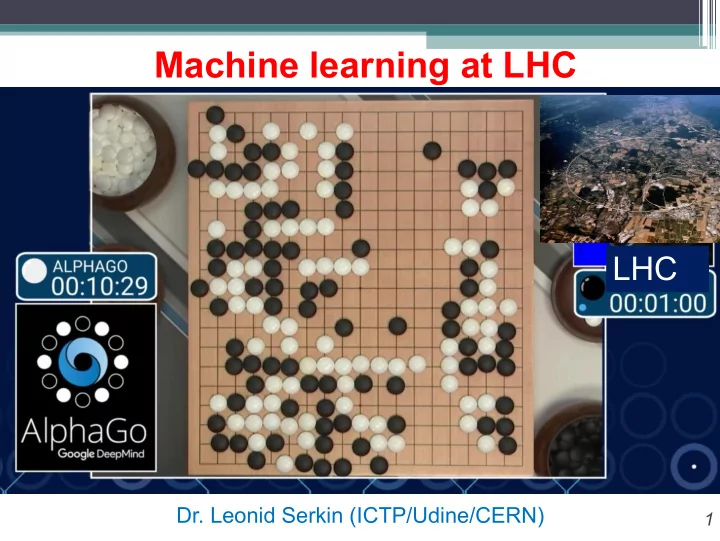
Machine learning at LHC LHC Dr. Leonid Serkin (ICTP/Udine/CERN) 1 - - PowerPoint PPT Presentation
Machine learning at LHC LHC Dr. Leonid Serkin (ICTP/Udine/CERN) 1 Introduction 2 Event classification problem (applied to HEP) The question: what decision boundary should we use to accept/reject events as belonging to event types H1, H2
The question: what ‘decision boundary’ should we use to accept/reject events as belonging to event types H1, H2 or H3? Methods available (up to 2015): Rectangular cut optimization, Projective likelihood estimation, Multidimensional probability density estimation, Multidimensional k-nearest neighbor classifier, Linear discriminant analysis (H-Matrix and Fisher discriminants), Function discriminant analysis, Predictive learning via rule ensembles, Support Vector Machines, Artificial neural networks, Boosted/Bagged decision trees (BDT)…
https://www.kaggle.com/c/higgs-boson https://higgsml.lal.in2p3.fr/ The Higgs Boson Machine Learning Challenge was
collaboration between high energy physicists and data
experiment at CERN provided simulated data that has been used by physicists in a search for the Higgs boson.
Artificial neuron An ANN mimics the behaviour of the biological neuronal networks and consists of an interconnected group of processing elements (referred to as neurons or nodes) arranged in layers. The first layer, known as the input layer, receives the input variables (x1; x2; …xd). Each connection to the neuron is characterised by a weight (w1; w2; … wd) which can be excitatory (positive weight) or inhibitory (negative weight). Moreover, each layer may have a bias (x0 = 1), which can provide a constant shift to the total neuronal input net activation (A), in this case a sigmoid function:
Artificial neuron The last layer represents the final response of the ANN, which in the case of d input variables and nH nodes in the hidden layer can be expressed as: The weights and thresholds are the network parameters, whose values are learned during the training phase by looping through the training data several hundreds of times. These parameters are determined by minimising an empirical loss function over all the events N in the training sample and adjusting the weights iteratively in the multidimensional space, such that the deviation E of the actual network output o from the desired (target) output y is minimal
ANN architecture: heuristic selection based on complexity adjustment and parameter estimation Theoretical basis: Arnold - Kolmogorov (1957): if f is a multivariate continuous function, then f can be written as a finite composition of continuous functions
Gorban (1998): it is possible to
any continuous function of several variables using operations of summation and multiplication by number, superposition of functions, linear functions and one arbitrary continuous nonlinear function of one variable.
ANN architecture: heuristic selection based on complexity adjustment and parameter estimation An example of a two and three-layer networks with two input nodes. Given an adequate number of hidden units, arbitrary nonlinear decision boundaries between regions R1 and R2 can be achieved Theoretical basis: Arnold - Kolmogorov (1957): if f is a multivariate continuous function, then f can be written as a finite composition of continuous functions
Gorban (1998): it is possible to
any continuous function of several variables using operations of summation and multiplication by number, superposition of functions, linear functions and one arbitrary continuous nonlinear function of one variable. Neural Network is an universal approximator for any continuous function
DNN architecture: Structure of the networks, and the node connectivity can be adapted for problem at hand Convolutions: shared weights of neurons, but each neuron only takes subset of inputs Difficult to train, only recently possible with large datasets, fast computing (GPU) and new training procedures / network structures http://www.asimovinstitute.org/neural-network-zoo/
https://playground.tensorflow.org
https://arxiv.org/pdf/1807.02876.pdf
https://arxiv.org/pdf/1807.02876.pdf http://www-group.slac.stanford.edu/sluo/Lectures/Stat2006_Lectures.html https://indico.cern.ch/event/77830/ http://www.pp.rhul.ac.uk/~cowan/stat/cowan_weizmann10.pdf https://web.stanford.edu/~hastie/ElemStatLearn/ https://cds.cern.ch/record/2651122 http://cds.cern.ch/record/2634678 http://cds.cern.ch/record/2267879/