Machine-Dependent Optimization Machine-Dependent Optimization CS - - PowerPoint PPT Presentation

machine dependent optimization machine dependent
SMART_READER_LITE
LIVE PREVIEW

Machine-Dependent Optimization Machine-Dependent Optimization CS - - PowerPoint PPT Presentation


slide-1
SLIDE 1

Machine-Dependent Optimization Machine-Dependent Optimization CS 105

“Tour of the Black Holes of Computing”

– 2 – CS 105

Machine-Dependent Optimization Machine-Dependent Optimization

Need to understand the architecture Not portable Not often needed …but critically important when it is Also helps in understanding modern machines

– 3 – CS 105

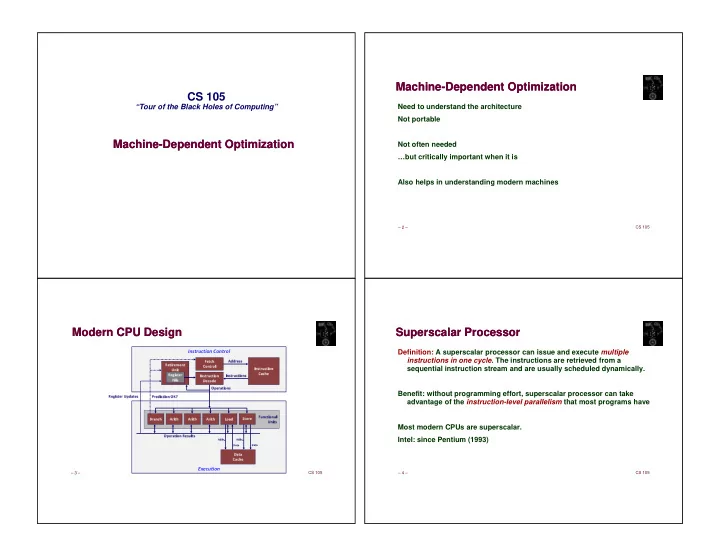
Modern CPU Design Modern CPU Design

✂ ✄ ☎ ✆ ✝ ✞ ✄ ✟ ✠ ✡ ✄ ✝ ✆ ☛
✌ ✟ ✄ ☎ ✍ ✎ ✌ ✝ ✆ ✍ ✎ ✌ ✝ ✆ ✍ ✏ ✞ ✟ ✑ ✒ ✆ ✞ ✌ ✓ ✔ ✄ ☛ ✆ ✌ ✂ ☎ ✆ ✝ ✞ ✄ ✕ ✟ ☎ ✍ ✓ ✖ ✟ ✆ ✟ ✕ ✟ ☎ ✍ ✓ ✁ ✓ ✆ ☎ ✍ ✕ ✞ ✄ ✆ ✌ ✞ ✠ ✔ ✄ ☛ ✆ ✌ ✂ ☎ ✆ ✝ ✞ ✄ ✖ ✓ ☎ ✞ ✑ ✓ ✎ ✑ ✑ ✌ ✓ ☛ ☛ ✔ ✄ ☛ ✆ ✌ ✂ ☎ ✆ ✝ ✞ ✄ ☛ ✗ ✘ ✓ ✌ ✟ ✆ ✝ ✞ ✄ ☛ ✙ ✌ ✓ ✑ ✝ ☎ ✆ ✝ ✞ ✄ ✗ ✛ ✜
✢ ✚
✢ ✚ ✣ ✤ ✤ ✥ ✦ ✣ ✤ ✤ ✥ ✦ ✎ ✌ ✝ ✆ ✍ ✗ ✘ ✓ ✌ ✟ ✆ ✝ ✞ ✄ ✧ ✓ ☛ ✂ ✠ ✆ ☛ ✧ ✓ ✆ ✝ ✌ ✓ ★ ✓ ✄ ✆ ✡ ✄ ✝ ✆ ✧ ✓ ✩ ✝ ☛ ✆ ✓ ✌ ✁ ✝ ✠ ✓ ✧ ✓ ✩ ✝ ☛ ✆ ✓ ✌ ✡ ✘ ✑ ✟ ✆ ✓ ☛

– 4 – CS 105

Superscalar Processor Superscalar Processor

Definition: A superscalar processor can issue and execute multiple instructions in one cycle. The instructions are retrieved from a sequential instruction stream and are usually scheduled dynamically. Benefit: without programming effort, superscalar processor can take advantage of the instruction-level parallelism that most programs have Most modern CPUs are superscalar. Intel: since Pentium (1993)

slide-2
SLIDE 2

– 5 – CS 105

What Is a Pipeline? What Is a Pipeline?

Mul Mul Mul Mul Mul Mul Mul Mul Mul Mul Mul Result Bucket

– 6 – CS 105

Pipelined Functional Units Pipelined Functional Units

Divide computation into stages

Pass partial computations from stage to stage

Stage i can start new computation once values passed to i+1

E.g., complete 3 multiplications in 7 cycles, even though each requires 3 cycles

  • long mult_eg(long a, long b, long c) {

long p1 = a*b; long p2 = a*c; long p3 = p1 * p2; return p3; }

  • a*b

a*c p1*p2

  • a*b

a*c p1*p2

  • a*b

a*c p1*p2 – 7 – CS 105

Haswell CPU Haswell CPU

8 Total Functional Units

Multiple instructions can execute in parallel

2 load, with address computation 1 store, with address computation 4 integer 2 FP multiply 1 FP add 1 FP divide

Some instructions take > 1 cycle, but can be pipelined

Instruction Latency Cycles/Issue Load / Store 4 1 Integer Multiply 3 1 Integer/Long Divide 3-30 3-30 Single/Double FP Multiply 5 1 Single/Double FP Add 3 1 Single/Double FP Divide 3-15 3-15

– 8 – CS 105

x86-64 Compilation of Combine4 x86-64 Compilation of Combine4

Inner Loop (Case: Integer Multiply)

.L519: # Loop: imull (%rax,%rdx,4), %ecx # t = t * d[i] addq $1, %rdx # i++ cmpq %rdx, %rbp # Compare length:i jg .L519 # If >, goto Loop

Method Integer Double FP Operation Add Mult Add Mult Combine4 1.27 3.01 3.01 5.01 Latency Bound 1.00 3.00 3.00 5.00

slide-3
SLIDE 3

– 9 – CS 105

Combine4 = Serial Computation (OP = *) Combine4 = Serial Computation (OP = *)

Computation (length=8)

((((((((1 * d[0]) * d[1]) * d[2]) * d[3]) * d[4]) * d[5]) * d[6]) * d[7])

Sequential dependence

Performance: determined by latency of OP

* * 1 d0 d1 * d2 * d3 * d4 * d5 * d6 * d7

– 10 – CS 105

Loop Unrolling (2x1) Loop Unrolling (2x1)

Perform 2x more useful work per iteration

void unroll2a_combine(vec_ptr v, data_t *dest) { long length = vec_length(v); long limit = length-1; data_t *d = get_vec_start(v); data_t x = IDENT; long i; /* Combine 2 elements at a time */ for (i = 0; i < limit; i+=2) { x = (x OP d[i]) OP d[i+1]; } /* Finish any remaining elements */ for (; i < length; i++) { x = x OP d[i]; } *dest = x; }

– 11 – CS 105

Effect of Loop Unrolling Effect of Loop Unrolling

Helps integer add by reducing number of overhead instructions

(Almost) achieves latency bound

Others don’t improve. Why?

Still sequential dependency

x = (x OP d[i]) OP d[i+1]; Method Integer Double FP Operation Add Mult Add Mult Combine4 1.27 3.01 3.01 5.01 Unroll 2x1 1.01 3.01 3.01 5.01 Latency Bound 1.00 3.00 3.00 5.00

– 12 – CS 105

Loop Unrolling with Reassociation (2x1a) Loop Unrolling with Reassociation (2x1a)

Can this change result of computation? Yes, for multiply and floating point. Why?

void unroll2aa_combine(vec_ptr v, data_t *dest) { long length = vec_length(v); long limit = length-1; data_t *d = get_vec_start(v); data_t x = IDENT; long i; /* Combine 2 elements at a time */ for (i = 0; i < limit; i+=2) { x = x OP (d[i] OP d[i+1]); } /* Finish any remaining elements */ for (; i < length; i++) { x = x OP d[i]; } *dest = x; }

x = (x OP d[i]) OP d[i+1];

slide-4
SLIDE 4

– 13 – CS 105

Effect of Reassociation Effect of Reassociation

Nearly 2x speedup for Int *, FP +, FP *

Reason: Breaks sequential dependency

Why is that? (next slide)

x = x OP (d[i] OP d[i+1]); Method Integer Double FP Operation Add Mult Add Mult Combine4 1.27 3.01 3.01 5.01 Unroll 2x1 1.01 3.01 3.01 5.01 Unroll 2x1a 1.01 1.51 1.51 2.51 Latency Bound 1.00 3.00 3.00 5.00 Throughput Bound 0.50 1.00 1.00 0.50

  • – 14 –

CS 105

Reassociated Computation Reassociated Computation

What changed:

Operations in the next iteration can be started early (no dependency)

Overall Performance

N elements, D cycles latency/op

(N/2+1)*D cycles: CPE = D/2 * * 1 * * * d1 d0 * d3 d2 * d5 d4 * d7 d6 x = x OP (d[i] OP d[i+1]);

– 15 – CS 105

Loop Unrolling with Separate Accumulators (2x2) Loop Unrolling with Separate Accumulators (2x2)

Different form of reassociation

void unroll2a_combine(vec_ptr v, data_t *dest) { long length = vec_length(v); long limit = length-1; data_t *d = get_vec_start(v); data_t x0 = IDENT; data_t x1 = IDENT; long i; /* Combine 2 elements at a time */ for (i = 0; i < limit; i+=2) { x0 = x0 OP d[i]; x1 = x1 OP d[i+1]; } /* Finish any remaining elements */ for (; i < length; i++) { x0 = x0 OP d[i]; } *dest = x0 OP x1; }

– 16 – CS 105

Effect of Separate Accumulators Effect of Separate Accumulators

Int + makes use of two load units 2x speedup (over unroll2) for Int *, FP +, FP *

x0 = x0 OP d[i]; x1 = x1 OP d[i+1]; Method Integer Double FP Operation Add Mult Add Mult Combine4 1.27 3.01 3.01 5.01 Unroll 2x1 1.01 3.01 3.01 5.01 Unroll 2x1a 1.01 1.51 1.51 2.51 Unroll 2x2 0.81 1.51 1.51 2.51 Latency Bound 1.00 3.00 3.00 5.00 Throughput Bound 0.50 1.00 1.00 0.50

slide-5
SLIDE 5

– 17 – CS 105

Separate Accumulators Separate Accumulators

* * 1 d1 d3 * d5 * d7 * * * 1 d0 d2 * d4 * d6 x0 = x0 OP d[i]; x1 = x1 OP d[i+1];

  • – 18 –

CS 105

Unrolling & Accumulating Unrolling & Accumulating

Idea

Can unroll to any degree L

Can accumulate K results in parallel

L must be multiple of K

Limitations

Diminishing returns

Cannot go beyond throughput limitations of execution units

May run out of registers for accumulators

Large overhead for short lengths

Finish off iterations sequentially

– 19 – CS 105

Unrolling & Accumulating: Double * Unrolling & Accumulating: Double *

Case

Intel Haswell

Double FP Multiplication

Latency bound: 5.00. Throughput bound: 0.50

  • – 20 –

CS 105

Unrolling & Accumulating: Int + Unrolling & Accumulating: Int +

Case

Intel Haswell

Integer addition

Latency bound: 1.00. Throughput bound: 1.00

slide-6
SLIDE 6

– 21 – CS 105

Achievable Performance Achievable Performance

Limited only by throughput of functional units Up to 42X improvement over original, unoptimized code

Method Integer Double FP Operation Add Mult Add Mult Best 0.54 1.01 1.01 0.52 Latency Bound 1.00 3.00 3.00 5.00 Throughput Bound 0.50 1.00 1.00 0.50

– 22 – CS 105

What About Branches? What About Branches?

Challenge

Instruction Control Unit must work well ahead of Execution Unit to generate enough operations to keep EU busy

When encounters conditional branch, cannot reliably determine where to continue fetching

404663: mov $0x0,%eax 404668: cmp (%rdi),%rsi 40466b: jge 404685 40466d: mov 0x8(%rdi),%rax . . . 404685: repz retq

  • – 23 –

CS 105

Modern CPU Design Modern CPU Design

✂ ✄ ☎ ✆ ✝ ✞ ✄ ✟ ✠ ✡ ✄ ✝ ✆ ☛
✌ ✟ ✄ ☎ ✍ ✎ ✌ ✝ ✆ ✍ ✎ ✌ ✝ ✆ ✍ ✏ ✞ ✟ ✑ ✒ ✆ ✞ ✌ ✓ ✔ ✄ ☛ ✆ ✌ ✂ ☎ ✆ ✝ ✞ ✄ ✕ ✟ ☎ ✍ ✓ ✖ ✟ ✆ ✟ ✕ ✟ ☎ ✍ ✓ ✁ ✓ ✆ ☎ ✍ ✕ ✞ ✄ ✆ ✌ ✞ ✠ ✔ ✄ ☛ ✆ ✌ ✂ ☎ ✆ ✝ ✞ ✄ ✖ ✓ ☎ ✞ ✑ ✓ ✎ ✑ ✑ ✌ ✓ ☛ ☛ ✔ ✄ ☛ ✆ ✌ ✂ ☎ ✆ ✝ ✞ ✄ ☛ ✗ ✘ ✓ ✌ ✟ ✆ ✝ ✞ ✄ ☛ ✙ ✌ ✓ ✑ ✝ ☎ ✆ ✝ ✞ ✄ ✗ ✛ ✜
✢ ✚
✢ ✚ ✣ ✤ ✤ ✥ ✦ ✣ ✤ ✤ ✥ ✦ ✎ ✌ ✝ ✆ ✍ ✗ ✘ ✓ ✌ ✟ ✆ ✝ ✞ ✄ ✧ ✓ ☛ ✂ ✠ ✆ ☛ ✧ ✓ ✆ ✝ ✌ ✓ ★ ✓ ✄ ✆ ✡ ✄ ✝ ✆ ✧ ✓ ✩ ✝ ☛ ✆ ✓ ✌ ✁ ✝ ✠ ✓ ✧ ✓ ✩ ✝ ☛ ✆ ✓ ✌ ✡ ✘ ✑ ✟ ✆ ✓ ☛

– 24 – CS 105

Branch Outcomes Branch Outcomes

When encounter conditional branch, cannot determine where to continue fetching

Branch Taken: Transfer control to branch target Branch Not-Taken: Continue with next instruction in sequence

Cannot resolve until outcome determined by branch/integer unit

  • 404663: mov

$0x0,%eax 404668: cmp (%rdi),%rsi 40466b: jge 404685 40466d: mov 0x8(%rdi),%rax . . . 404685: repz retq

slide-7
SLIDE 7

– 25 – CS 105

Branch Prediction Branch Prediction

Idea

Guess which way branch will go

Begin executing instructions at predicted position

But don’t actually modify register or memory data

  • 404663: mov

$0x0,%eax 404668: cmp (%rdi),%rsi 40466b: jge 404685 40466d: mov 0x8(%rdi),%rax . . . 404685: repz retq

– 26 – CS 105

401029: vmulsd (%rdx),%xmm0,%xmm0 40102d: add $0x8,%rdx 401031: cmp %rax,%rdx 401034: jne 401029 401029: vmulsd (%rdx),%xmm0,%xmm0 40102d: add $0x8,%rdx 401031: cmp %rax,%rdx 401034: jne 401029 401029: vmulsd (%rdx),%xmm0,%xmm0 40102d: add $0x8,%rdx 401031: cmp %rax,%rdx 401034: jne 401029

Branch Prediction Through Loop Branch Prediction Through Loop

401029: vmulsd (%rdx),%xmm0,%xmm0 40102d: add $0x8,%rdx 401031: cmp %rax,%rdx 401034: jne 401029

  • – 27 –

CS 105

401029: vmulsd (%rdx),%xmm0,%xmm0 40102d: add $0x8,%rdx 401031: cmp %rax,%rdx 401034: jne 401029 401029: vmulsd (%rdx),%xmm0,%xmm0 40102d: add $0x8,%rdx 401031: cmp %rax,%rdx 401034: jne 401029 401029: vmulsd (%rdx),%xmm0,%xmm0 40102d: add $0x8,%rdx 401031: cmp %rax,%rdx 401034: jne 401029 401029: vmulsd (%rdx),%xmm0,%xmm0 40102d: add $0x8,%rdx 401031: cmp %rax,%rdx 401034: jne 401029

  • Branch Misprediction Invalidation

Branch Misprediction Invalidation

  • – 28 –

CS 105

Branch Misprediction Recovery Branch Misprediction Recovery

Performance Cost

Multiple clock cycles on modern processor

Can be a major performance limiter

Current CPUs (2019) speculate 150 or more instructions ahead!

401029: vmulsd (%rdx),%xmm0,%xmm0 40102d: add $0x8,%rdx 401031: cmp %rax,%rdx 401034: jne 401029 401036: jmp 401040 . . . 401040: vmovsd %xmm0,(%r12)

slide-8
SLIDE 8

– 29 – CS 105

Getting High Performance Getting High Performance

Use a good compiler and appropriate flags Don’t do anything stupid

Watch out for hidden algorithmic inefficiencies

Write compiler-friendly code

Watch out for optimization blockers:

procedure calls & memory references

Look carefully at innermost loops (where most work is done)

Tune code for machine

Exploit instruction-level parallelism

Avoid unpredictable branches

Make code cache-friendly

But DON’T OPTIMIZE UNTIL IT’S DEBUGGED!!!

– 30 – CS 105

Visualizing Operations Visualizing Operations

Operations

Vertical position denotes time at which executed

Cannot begin operation until operands

available

Height denotes latency

Operands

Arcs shown only for operands that are passed within execution unit

cc.1 t.1

load

%ecx.1

incl cmpl jl

%rdx.0 %rdx.1 %ecx.0

imull

load (%rax,%rdx.0,4) t.1 imull t.1, %ecx.0 %ecx.1 incl %rdx.0 %rdx.1 cmpl %rsi, %rdx.1 cc.1 jl-taken cc.1 Time

– 31 – CS 105

3 Iterations of Combining Product 3 Iterations of Combining Product

Unlimited-Resource Analysis

Assume operation can start as soon as

  • perands available

Operations for multiple iterations overlap in time

Performance

Limiting factor becomes latency of integer multiplier

Gives CPE of 4.0

load imull load load imull incl incl incl cmpl jll cmpl jll cmpl jll

%rax.0 %rax.1 %rax.2 %rax.3 %rcx.1 %rcx.2 %rcx.3 t.1 cc.1 t.2 t.3 cc.2 cc.3

Iteration 1 Iteration 2 Iteration 3 Cycle

i=0 i=1 i=2 1 2 3 4 5 6 7 8 9 10 11 12 13 14 15

imull

%rcx.0

– 32 – CS 105

4 Iterations of Combining Sum 4 Iterations of Combining Sum

Unlimited-Resource Analysis Performance

Can begin a new iteration on each clock cycle

Should give CPE of 1.0

Would require executing 4 integer operations in parallel

%edx.0 t.1 %ecx.i +1

incl cmpl jl addl

%ecx.1

i=0 load

cc.1 %edx.0 t.1 %ecx.i +1

incl cmpl jl addl

%ecx.1

i=0 load

cc.1 %edx.1 t.2 %ecx.i +1

incl cmpl jl addl

%ecx.2

i=1 load

cc.2 %edx.1 t.2 %ecx.i +1

incl cmpl jl addl

%ecx.2

i=1 load

cc.2 %edx.2 t.3 %ecx.i +1

incl cmpl jl addl

%ecx.3

i=2 load

cc.3 %edx.2 t.3 %ecx.i +1

incl cmpl jl addl

%ecx.3

i=2 load

cc.3 %edx.3 t.4 %ecx.i +1

incl cmpl jl addl

%ecx.4

i=3 load

cc.4 %edx.3 t.4 %ecx.i +1

incl cmpl jl addl

%ecx.4

i=3 load

cc.4 %ecx.0 %edx.4

Cycle 1 2 3 4 5 6 7 Cycle 1 2 3 4 5 6 7 Iteration 1 Iteration 2 Iteration 3 Iteration 4

4 integer ops

slide-9
SLIDE 9

– 33 – CS 105

Combining Sum: Resource Constraints Combining Sum: Resource Constraints

Iteration 4 Iteration 5 Iteration 6 Iteration 7 Iteration 8

%ecx.3 %edx.8 %edx.3 t.4 %ecx.i +1

incl cmpl jl addl

%ecx.4

i=3 load

cc.4 %edx.3 t.4 %ecx.i +1

incl cmpl jl addl

%ecx.4

i=3 load

cc.4 %edx.4 t.5 %ecx.i +1

incl cmpl jl addl

%ecx.5

i=4 load

cc.5 %edx.4 t.5 %ecx.i +1

incl cmpl jl addl

%ecx.5

i=4 load

cc.5 cc.6 %edx.7 t.8 %ecx.i +1

incl cmpl jl addl

%ecx.8

i=7 load

cc.8 %edx.7 t.8 %ecx.i +1

incl cmpl jl addl

%ecx.8

i=7 load

cc.8 %edx.5 t.6

incl cmpl jl addl

%ecx.6

load i=5

%edx.5 t.6

incl cmpl jl addl

%ecx.6

load i=5 6 7 8 9 10 11 12 Cycle 13 14 15 16 17 6 7 8 9 10 11 12 Cycle 13 14 15 16 17 18

cc.6 %edx.6 t.7

cmpl jl addl

%ecx.7

load

cc.7

i=6 incl

%edx.6 t.7

cmpl jl addl

%ecx.7

load

cc.7

i=6 incl

Suppose only have two integer functional units

Some operations delayed even though operands available

Set priority based on program order

Performance

Sustains CPE of 2.0

– 34 – CS 105

Visualizing Parallel Loop Visualizing Parallel Loop

Two multiplies within loop no longer have data dependency

Allows them to pipeline

load (%eax,%edx.0,4) t.1a imull t.1a, %ecx.0 %ecx.1 load 4(%eax,%edx.0,4) t.1b imull t.1b, %ebx.0 %ebx.1 iaddl $2,%edx.0 %edx.1 cmpl %esi, %edx.1 cc.1 jl-taken cc.1 Time

%edx.1 %ecx.0 %ebx.0 cc.1 t.1a

imull

%ecx.1

addl cmpl jl

%edx.0

imull

%ebx.1 t.1b

load load

– 35 – CS 105

Executing with Parallel Loop Executing with Parallel Loop

%edx.3 %ecx.0 %ebx.0

i=0 i=2

cc.1 t.1a

imull

%ecx.1

addl cmpl jl

%edx.0

imull

%ebx.1 t.1b

load load

cc.1 t.1a

imull

%ecx.1

addl cmpl jl

%edx.0

imull

%ebx.1 t.1b

load load

cc.2 t.2a

imull

%ecx.2

addl cmpl jl

%edx.1

imull

%ebx.2 t.2b

load load

cc.2 t.2a

imull

%ecx.2

addl cmpl jl

%edx.1

imull

%ebx.2 t.2b

load load i=4

cc.3 t.3a

imull

%ecx.3

addl cmpl jl

%edx.2

imull

%ebx.3 t.3b

load load 14 Cycle 1 2 3 4 5 6 7 8 9 10 11 12 13 14 15 16 Cycle 1 2 3 4 5 6 7 8 9 10 11 12 13 14 15 16 Iteration 1 Iteration 2 Iteration 3 Note: actually delayed 1 clock from what diagram

  • shows. (Why?)

Predicted Performance

Can keep 4-cycle multiplier busy performing two simultaneous multiplications

Gives CPE of 2.0

– 36 – CS 105

Meltdown and Spectre Meltdown and Spectre

Consider a few things

Access to cached things is much faster than to non-cached ones

Programs have access to detailed timing information

Intel offers free-running cycle counter to all programs Thus, can tell whether something was cached

OS has access to everything

Carefully checks whether you have access before giving stuff to you

CPU speculates many instructions ahead

Must guess about branch directions

User programs can either flush cache (clflush instruction) or clobber with loop

slide-10
SLIDE 10

– 37 – CS 105

Meltdown and Spectre Meltdown and Spectre

Trick OS into doing these steps:

Check whether you have access to arbitrary location x (you don’t)

Mispredict that branch

Read location x and use its contents as follows:

Extract bit b Multiply (shift left) bit b by, e.g., 1024 Access array y[b*1024] that you do have access to

Hardware will eventually discover mispredicted branch and cancel all those instructions

…but cache now contains y[b*1024]

Scan cache to see whether y[0] or y[1024] is fast (i.e., in cache)

You now know bit b of location x

Lather, rinse, repeat until you know all bits of x

Lather, rinse, repeat for all locations you want to read

– 38 – CS 105

So What? So What?

Can read arbitrary memory at about 2K bits/second

No biggie on your laptop

Huge issue in the cloud

Physical machines often shared Supposedly isolated by virtual-machine technology

Grab people’s encryption keys, passwords, all sorts of stuff

Next stop: Putin

What to do?

Disabling speculation kills performance

Only certain branches are vulnerable

Can do special things for those branches But hard to find (millions of lines in kernel)

Compiler can try to identify risky branches

But will be conservative OS will slow down