
1
MACAW : A Media Access Protocol for Wireless LAN’s
Abdel-Karim Al Tamimi
Introduction
Based on MACA, a Multiple Access Collision
Avoidance protocol.
Initial attempt to deal with WLAN challenges. Four key main observations:
The relevant contention is at the receiver not the
sender.
Congestion is location dependent. Learning about the contention level must be a collective
enterprise.
The media access protocol should propagate congestion
information explicitly.
Background
Developed in Palo Alto Research Center-
Xerox Corporation.
All experiments have been done in noise-
free testing environment.
Multiple access approach is chosen
It is more robust, than token based approach. The high mobility of WLAN nodes, will initiate
frequent token hand-offs or recovery in token- based systems.
Hidden Terminal
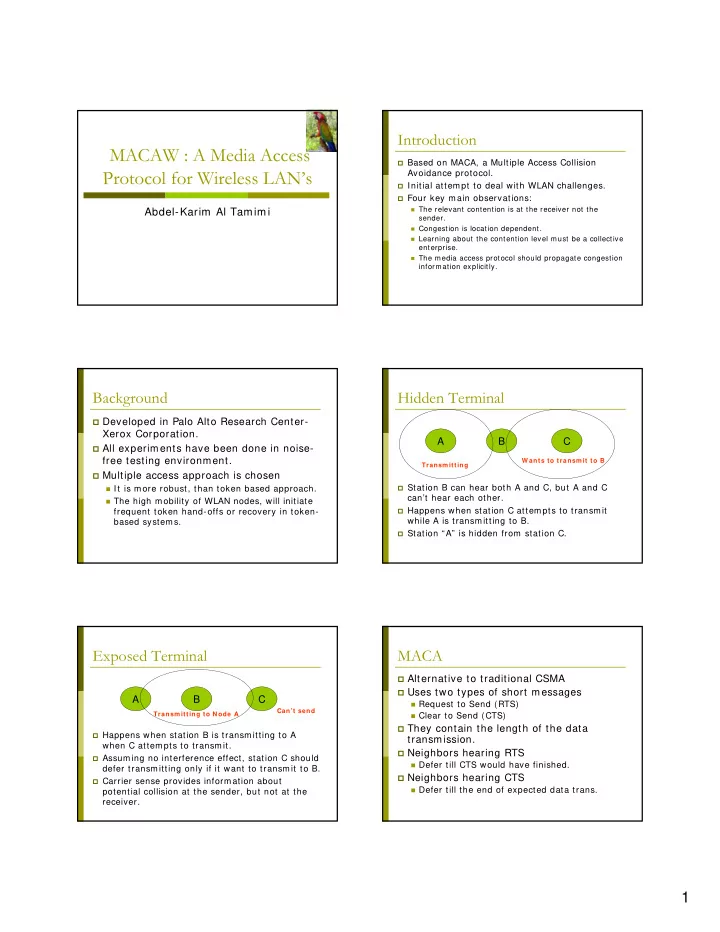
Station B can hear both A and C, but A and C
can’t hear each other.
Happens when station C attempts to transm it
while A is transmitting to B.
Station “A” is hidden from station C.
A B C
Transm itting W ants to transm it to B
Exposed Terminal
Happens when station B is transmitting to A
when C attempts to transm it.
Assum ing no interference effect, station C should
defer transm itting only if it want to transm it to B.
Carrier sense provides information about
potential collision at the sender, but not at the receiver.
A B C
Transm itting to Node A Can’t send
MACA
Alternative to traditional CSMA Uses two types of short messages
Request to Send (RTS) Clear to Send (CTS)
They contain the length of the data
transmission.
Neighbors hearing RTS
Defer till CTS would have finished.
Neighbors hearing CTS
Defer till the end of expected data trans.