Mac Lacy, Senior Attorney Oregon Natural Desert Association OSB, - - PowerPoint PPT Presentation

mac lacy senior attorney oregon natural desert
SMART_READER_LITE
LIVE PREVIEW

Mac Lacy, Senior Attorney Oregon Natural Desert Association OSB, - - PowerPoint PPT Presentation

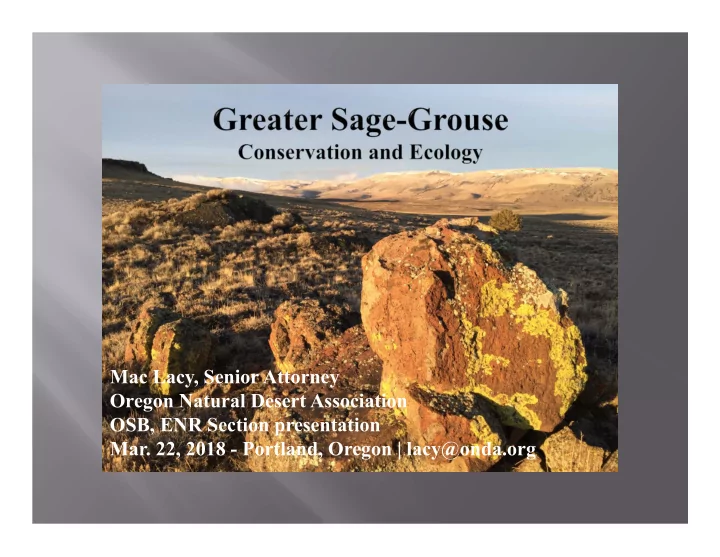
Mac Lacy, Senior Attorney Oregon Natural Desert Association OSB, ENR Section presentation Mar. 22, 2018 - Portland, Oregon | lacy@onda.org Perhaps only 50,000 birds left, from as many as 16 million pre-European settlement. ODFW

slide-1
SLIDE 1

Mac Lacy, Senior Attorney Oregon Natural Desert Association OSB, ENR Section presentation

  • Mar. 22, 2018 - Portland, Oregon | lacy@onda.org
slide-2
SLIDE 2
  • Perhaps only 50,000 birds

left, from as many as 16 million pre-European settlement.

  • ODFW estimates 2017

population in Oregon was 20,510 individuals, a 7.7% decline from 2016, and 30% below 2003 baseline estimate of 29,237.

  • ESA listing history –

from “not warranted” to “warranted” and back again. Listing criteria at 16 U.S.C. § 1533(a)(1).

slide-3
SLIDE 3

U.S. Fish and Wildlife Service. 2013. Greater Sage-grouse (Centrocercus urophasianus) Conservation Objectives: Final

  • Report. U.S. Fish and Wildlife Service, Denver, CO. February 2013.

Sage-Grouse Range

IIIIi

CLflTen.1 Range

c=1 H

iscric Range,

Created By: US FWS, Wyoming E S Map Date: 21512013 Source: Schro«er - WADFW (2002) I WAFWAI FWS

slide-4
SLIDE 4
  • Sagebrush obligate &

landscape-scale species.

  • Life cycle revolves

around the seasons: breeding, nesting, brood- rearing, over-wintering.

  • Two remaining habitat

strongholds: one anchored around southeastern Oregon, and a second centered

  • n southern Wyoming.
slide-5
SLIDE 5
  • Fragmentation and loss of

sagebrush habitat, including increasing isolation of populations.

  • Human activities including

livestock grazing and rangeland infrastructure, energy development and transmission, expanding road networks.

  • Habitat conversion, e.g. as

weeds spread and replace sagebrush, via grazing, roads, wildfire, etc.

slide-6
SLIDE 6

1990 2013

Photographs courtesy Dr. Robert Beschta, Emeritus Professor, Department of Forest Ecosystems and Society, Oregon State University

slide-7
SLIDE 7
  • Complexity and vast scale of

habitat requires two-fold approach: core areas + connectivity corridors.

  • BLM/USFS amend 98 land

use plans across 10 states in 2015, adding important measures like Sagebrush Focal Areas, disturbance caps, adaptive management triggers.

  • 11 lawsuits (ten by industry

groups and state and local governments, one by conservation groups).

slide-8
SLIDE 8
  • In 2017, at Secretary Zinke’s

direction, BLM proposes amending plans to weaken

  • r remove protections and

processes.

  • Some rollbacks already

accomplished (cancellation

  • f proposed 10 million acre

mineral withdrawal; rescission of mitigation policies).

  • All lawsuits currently stayed.
slide-9
SLIDE 9
  • How dramatically will

Dep’t of the Interior revise the federal plans?

  • Will BLM field offices

continue to implement?

  • PEISs to review things like

fuel breaks and hazardous fuels reduction projects at a landscape scale.

  • On track for a 2020 listing?
slide-10
SLIDE 10