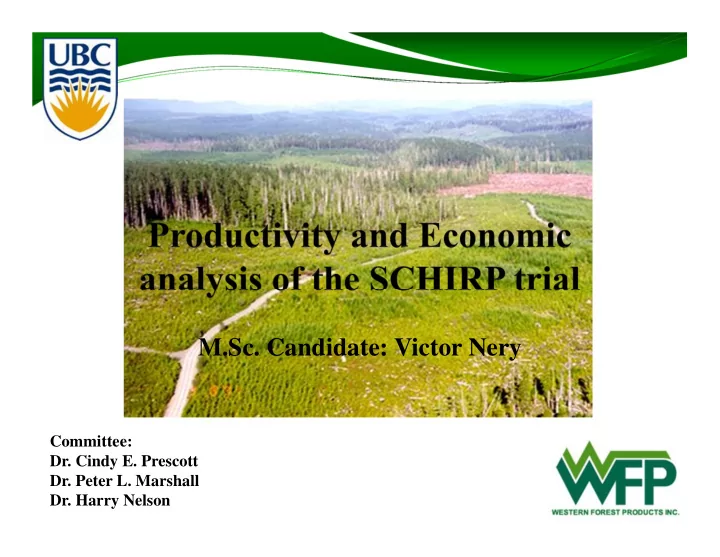
M.Sc. Candidate: Victor Nery Committee: Dr. Cindy E. Prescott Dr. - - PowerPoint PPT Presentation

m sc candidate victor nery
SMART_READER_LITE
LIVE PREVIEW

M.Sc. Candidate: Victor Nery Committee: Dr. Cindy E. Prescott Dr. - - PowerPoint PPT Presentation

M.Sc. Candidate: Victor Nery Committee: Dr. Cindy E. Prescott Dr. Peter L. Marshall Dr. Harry Nelson SCHIRP SCHIRP Salal Cedar Hemlock Integrated Research Program Established in the winter 1987/88 Objectives: to


slide-1
SLIDE 1

M.Sc. Candidate: Victor Nery

Committee:

  • Dr. Cindy E. Prescott
  • Dr. Peter L. Marshall
  • Dr. Harry Nelson
slide-2
SLIDE 2

“SCHIRP”

slide-3
SLIDE 3

Salal Cedar Hemlock Integrated Research Program Established in the winter 1987/88 Objectives:

  • to determine the underlying causes of poor growth of

regenerating Western red cedar (Thuja plicata), Western hemlock (Tsuga heterophylla), Amabilis fir (Abies amabilis) and Sitka spruce (Picea sitchensis) on cedar-hemlock cutovers invaded by Salal (Gaultheria shallon) on the west coast of North America

  • to establish the best operational means for improving

productivity on these sites

Website: http://www.forestry.ubc.ca/schirp/homepage.html

“SCHIRP”

slide-4
SLIDE 4

Research sites

128 plots - 64 CH and 64 HA 8 blocks (4 CH and 4 HA) 2 species (Western Hemlock

and Western Red cedar)

3 types of density (500, 1500,

2500 stems/ha)

Fertilized at the time of

planting (17-10-10, slow release)

Re-fertilized in 1993 -

broadcast application (225kg

  • f N and 75Kg of P)

Re-fertilized in 2004 -

broadcast application (225kg

  • f N)
slide-5
SLIDE 5

CH HA

  • Salal should be controlled
  • The conifer should be planted

immediately after harvest and if possible at high densities

  • Fertilizing with N and P is

strongly recommended at the time of planting

  • In case of no fertilization,

Western red cedar would be the species of choice

  • Western

hemlock is

  • nly

feasible accompanied by multiple fertilizations

  • “HA” sites showed a much

greater growth rate

  • In some cases, fertilized “HA”

had double increment

  • f

volume and Periodic annual increment compared to “CH”

  • “HA” sites should carry most
  • f

the investment in silvicultural treatments because of its higher growth rate

Latest reports

Blevins and Niejenhuis (2003) Negrave et al. (2007)

slide-6
SLIDE 6

Field Work

slide-7
SLIDE 7

CH – Cedar not fertilized

slide-8
SLIDE 8

CH – Cedar fertilized

slide-9
SLIDE 9

CH – Hemlock not fertilized

slide-10
SLIDE 10

HA – Hemlock fertilized

slide-11
SLIDE 11

CH HA

  • Significant interaction between

Species, Fertilization and Density for height, basal area and volume

  • Significant interaction between

Species and Fertilization

  • Significant interaction between

Species and Fertilization for height, basal area and volume

  • No significant difference in height

between different densities

  • No significant interaction between

species and fertilization

  • Significant interaction between

fertilization and density

Statistical Analysis

Mixed-effects model (Proc Mixed in SAS) P < 0.05

slide-12
SLIDE 12

Cumulative effect (21 years)

CH - 1500 st/ha

1 2 3 4 5 6 7 8 9 10 11 12 CEDAR HEMLOCK m

Height

Fertilized Control 20 40 60 80 100 120 140 CEDAR HEMLOCK m³

Volume

Fertilized Control

slide-13
SLIDE 13

Annual Growth

CH - 1500 st/ha

slide-14
SLIDE 14

Comparison with Tipsy Projection

Volume - CH - Cedar - 1500 st/ha

20 40 60 80 100 120 140 160 1 2 3 4 5 6 7 8 9 10 11 12 13 14 15 16 17 18 19 20 21 Volume (m3/ha) AGE (yr) Cw-Control Projected Cw-Control Cw-Fert. Projected Cw-Fert.

Site Indexes Non-fertilized (19.88) Fertilized (27.95) Projected Gain = +72.00 Real Gain = +99.85

slide-15
SLIDE 15

Comparison with Tipsy Projection

Volume - CH - Hemlock - 1500 st/ha

10 20 30 40 50 60 70 80 90 100 1 2 3 4 5 6 7 8 9 10 11 12 13 14 15 16 17 18 19 20 21 Volume (m3/ha) AGE (yr) Hw-Control Projected Hw-Control Hw-Fert. Projected Hw-Fert.

Site Indexes Non-fertilized (17.12) Fertilized (28.83) Projected Gain = +75.00 Real Gain = +69.47

slide-16
SLIDE 16

Fertilization significantly increased both height and

total volume

Height increased 60% in Cedar and 118% in

Hemlock

Volume increased 352% in Cedar and 810% in

Hemlock

Cedar seems to be having better basal area growth

than expected

Conclusions at 21 years (CH)

slide-17
SLIDE 17

Projected productivity

451 523 585 635 880 100 200 300 400 500 600 700 800 900 1000 10 12 14 16 18 20 22 24 26 28 30 32 34 36 38 40 42 44 46 48 50 52 54 56 58 60 Projected Volume (m3/ha) AGE (yr) Non-fertilized 6 years after last treatment 11 years after last treatment 16 years after last treatment Continuous effect Real gain projected

Real Gain Projected

= 550.85 (+99.85)

Site Indexes Non-fertilized (19.88) Continuous effect (27.95)

CH - Cedar - 1500 st/ha

Volume at 60 years

slide-18
SLIDE 18

Projected productivity

295 370 461 540 895 100 200 300 400 500 600 700 800 900 1000 10 12 14 16 18 20 22 24 26 28 30 32 34 36 38 40 42 44 46 48 50 52 54 56 58 60 Projected Volume (m3/ha) AGE (yr) Non-fertilized 6 years after last treatment 11 years after last treatment 16 years after last treatment Continuous effect Real gain projected

Real Gain Projected

= 364.47 (+69.47)

Site Indexes Non-fertilized (17.12) Continuous effect (28.83)

CH - Hemlock - 1500 st/ha

Volume at 60 years

slide-19
SLIDE 19

Cumulative effect (21 years)

HA - 1500 st/ha

1 2 3 4 5 6 7 8 9 10 11 12 13 14 15 16 17 18 CEDAR HEMLOCK m

Height

Fertilized Control 50 100 150 200 250 300 350 CEDAR HEMLOCK m³

Volume

Fertilized Control

slide-20
SLIDE 20

Annual Growth (HA)

HA - 1500 st/ha

slide-21
SLIDE 21

Comparison with Tipsy Projection

Volume - HA - Cedar - 1500 st/ha

50 100 150 200 250 1 2 3 4 5 6 7 8 9 10 11 12 13 14 15 16 17 18 19 20 21 Volume (m3/ha) AGE (yr) Cw-Control Projected Cw-Control Cw-Fert. Projected Cw-Fert.

Site Indexes Non-fertilized (23.03) Fertilized (30.02) Projected Gain = +80.00 Real Gain = +136.00

slide-22
SLIDE 22

Comparison with Tipsy Projection

Volume - HA - Hemlock - 1500 st/ha

50 100 150 200 250 300 350 400 1 2 3 4 5 6 7 8 9 10 11 12 13 14 15 16 17 18 19 20 21 Volume (m3/ha) AGE (yr) Hw-Control Projected Hw-Control Hw-Fert. Projected Hw-Fert.

Site Indexes Non-fertilized (30.26) Fertilized (38.97) Projected Gain = +201.00 Real Gain = +230.37

slide-23
SLIDE 23

Fertilization significantly increased both height and

total volume

Height increased 56% in Cedar and 65% in Hemlock Volume increased 309% in Cedar and 243% in

Hemlock

Cedar seems to be having better basal area growth

than expected

Conclusions at 21 years (HA)

slide-24
SLIDE 24

Projected productivity

HA - Cedar - 1500 st/ha

588 668 723 766 988 100 200 300 400 500 600 700 800 900 1000 1100 10 12 14 16 18 20 22 24 26 28 30 32 34 36 38 40 42 44 46 48 50 52 54 56 58 60 Projected Volume (m3/ha) AGE (yr) Non-fertilized 6 years after last treatment 11 years after last treatment 16 years after last treatment Continuous effect Real gain projected

Real Gain Projected

= 724.00 (+136.00)

Site Indexes Non-fertilized (23.03) Continuous effect (30.02)

Volume at 60 years

slide-25
SLIDE 25

Projected productivity

HA - Hemlock - 1500 st/ha

984 1185 1240 1313 1606 100 200 300 400 500 600 700 800 900 1000 1100 1200 1300 1400 1500 1600 1700 10 12 14 16 18 20 22 24 26 28 30 32 34 36 38 40 42 44 46 48 50 52 54 56 58 60 Projected Volume (m3/ha) AGE (yr) Non-fertilized 6 years after last treatment 11 years after last treatment 16 years after last treatment Continuous effect Real gain projected

Real Gain Projected

= 1214.37 (+230.37)

Site Indexes Non-fertilized (30.26) Continuous effect (38.97)

Volume at 60 years

slide-26
SLIDE 26

Focus on planting costs ($/ha) Includes: Seedlings, tree planters, fertilizer, fertilizer app

helicopter broadcast, surveys and brushing (5%)

Compound interests used for planting costs were 2%, 4%

and 8%

Total Average of treated plots = $3336.00 Total Average of untreated plots = $1545.00 Projected planting costs were calculated based on expected

volume by Tipsy

Economic Analysis

slide-27
SLIDE 27

Economic Analysis

CH – Cedar - 1500

$- $10 $20 $30 $40 $50 $60 $70 $80 16 18 20 22 24 26 28 30 32 34 36 38 40 42 44 46 48 50 52 54 56 58 60 PPC/PV ($/m3) AGE (yr) Non-fertilized 6 years after last treatment 11 years after last treatment 16 years after last treatment

Lowest PPC/PV

= $11.02 (60 yr) = $16.05 (57 yr) = $17.48 (58 yr) = $19.60 (59 yr)

slide-28
SLIDE 28

Economic Analysis

CH – Hemlock - 1500

$- $10 $20 $30 $40 $50 $60 $70 $80 16 18 20 22 24 26 28 30 32 34 36 38 40 42 44 46 48 50 52 54 56 58 60 PPC/PV ($/m3) AGE (yr) Non-fertilized 6 years after last treatment 11 years after last treatment 16 years after last treatment

Lowest PPC/PV

= $16.85 (60 yr) = $18.70 (51 yr) = $22.24 (59 yr) = $27.72 (60 yr)

slide-29
SLIDE 29

Even though Hemlock responds very well with fertilizer,

the total growth is the lowest of all treatments.

Regardless of treatment, the costs of Hemlock in CH are

quite prohibitive.

The results suggests that Cedar is the more suitable species

for CH sites.

Cedar if fertilized should have extra fertilizations to

maintain increasing annual growth and therefore mitigate compound interest.

Conclusions (CH)

slide-30
SLIDE 30

Economic Analysis

HA – Cedar - 1500

$- $5 $10 $15 $20 $25 $30 $35 $40 $45 $50 16 18 20 22 24 26 28 30 32 34 36 38 40 42 44 46 48 50 52 54 56 58 60 PPC/PV ($/m3) AGE (yr) Non-fertilized 6 years after last treatment 11 years after last treatment 16 years after last treatment

Lowest PPC/PV

= $8.46 (60 yr) = $13.20 (51 yr) = $14.10 (53 yr) = $15.35 (60 yr)

slide-31
SLIDE 31

Economic Analysis

HA – Hemlock - 1500

$- $5 $10 $15 $20 $25 $30 16 18 20 22 24 26 28 30 32 34 36 38 40 42 44 46 48 50 52 54 56 58 60 PPC/PV ($/m3) AGE (yr) Non-fertilized 6 years after last treatment 11 years after last treatment 16 years after last treatment

Lowest PPC/PV

= $5.05 (60 yr) = $7.72 (49 yr) = $8.23 (56 yr) = $8.64 (57 yr)

slide-32
SLIDE 32

Hemlock with or without fertilization has incredible growth

rates, which reflects low planting cost at very early ages

Cedar has excellent growth rates in HA; but, not as good as

  • hemlock. Therefore planting Cedar on HA would mostly

depend on the difference between species selling price.

If fertilized, both species are better suited for very short

rotations (mid 30’s – 40’s)

If not fertilized, hemlock and cedar plantations should be

harvested at older ages (>60 years) and have minimum extra investments as a way to mitigate compound interest

Conclusions (HA)

slide-33
SLIDE 33

General points:

Fertilizer is mostly interesting for shorter rotations or to enhance

productivity in stagnated areas

For longer rotations (> 50 years); minimum investment is

recommended or multiple fertilization; up to 10 years prior to harvest, could potentially mitigate compound interest by adding extra volume Opportunities:

Potential reduction of logging costs Opportunity to increase profit by reducing logging age Opportunity to mitigate compound interest by adding carbon credits

Economic Analysis

slide-34
SLIDE 34

Compound interests for planting costs by 2% $0.92/seedling + planting $0.20/ 4 teabag per seedling + application $730/tonne applied 740 kg (225 N 75kg P 46-0-0) $0.35 per Kg applied $600/tonne applied 490 kg (225 N urea 30.5-23-0)

Economic Analysis