M is for Linked-List Code and APTs Markov, Maps Assignment you - - PowerPoint PPT Presentation

m is for
SMART_READER_LITE
LIVE PREVIEW

M is for Linked-List Code and APTs Markov, Maps Assignment you - - PowerPoint PPT Presentation

Compsci 201 M is for Linked-List Code and APTs Markov, Maps Assignment you are working on Method A function by any other name Memory New Node, New ArrayList, Susan Rodger February 26, 2020 2/26/2020 CompSci 201,


slide-1
SLIDE 1

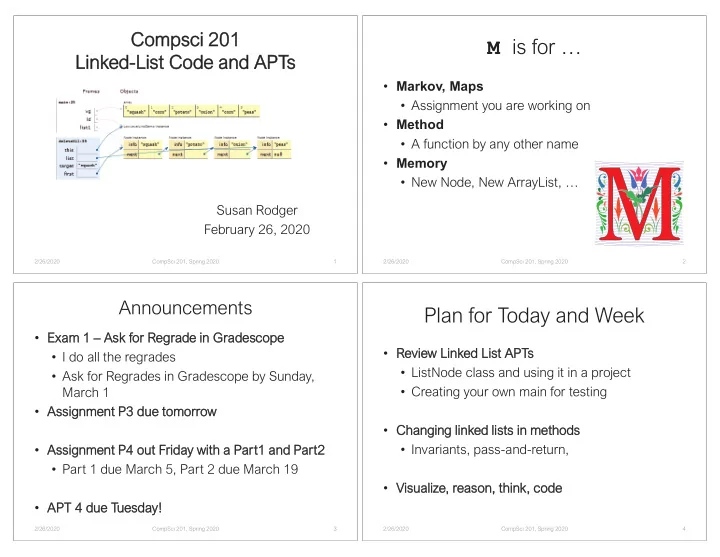
Compsci 201 Linked-List Code and APTs

2/26/2020 CompSci 201, Spring 2020 1

Susan Rodger February 26, 2020

M is for …

  • Markov, Maps
  • Assignment you are working on
  • Method
  • A function by any other name
  • Memory
  • New Node, New ArrayList, …

2/26/2020 CompSci 201, Spring 2020 2

Announcements

  • Exam 1 – Ask for Regrade in Gradescope
  • I do all the regrades
  • Ask for Regrades in Gradescope by Sunday,

March 1

  • Assignment P3 due tomorrow
  • Assignment P4 out Friday with a Part1 and Part2
  • Part 1 due March 5, Part 2 due March 19
  • APT 4 due Tuesday!

2/26/2020 CompSci 201, Spring 2020 3

Plan for Today and Week

  • Review Linked List APTs
  • ListNode class and using it in a project
  • Creating your own main for testing
  • Changing linked lists in methods
  • Invariants, pass-and-return,
  • Visualize, reason, think, code

2/26/2020 CompSci 201, Spring 2020 4

slide-2
SLIDE 2

Markov 2: Efficiency

  • Idea related to machine learning
  • Given a training text, use it to create a model
  • Using the model, generate random text
  • Infinite Monkey Theorem?
  • Don't type at random
  • Use letter frequencies!!

2/26/2020 CompSci 201, Spring 2020 5

Naïve, Brute Force Idea

  • Given training text "the theatre through that helps"
  • Generate random text based on frequencies
  • For a model-2 Markov process: start with "th"
  • Characters after "th": {"e","e","r","a"}
  • Choose one at random, say "e": generate!
  • Now use with "he", since "th" + "e" = "he"
  • Following "he": {" ", "a", "l"}
  • Why naïve? Re-scan text every time for follows

2/26/2020 CompSci 201, Spring 2020 6

Finding Follow Characters

  • Scan entire text looking for key
  • https://coursework.cs.duke.edu/201spring20/p3-markovpart2-sp20
  • Loop O(T) for myText with T characters
  • Again?

2/26/2020 CompSci 201, Spring 2020 7 2/2 2/ 2/ 2/ 2/ 2/ 2/ 2/ 2/ 2/ 2/ 2/ 2/ 2/ 2/ / 2/ / 2/ 2/ / 2/ 2/ 2/ 6/2020 CompSci 201, Spring 2020 7

Don't Scan N times, Scan Once

  • We generate N random characters
  • Get follows N times, each O(T), total is O(NT)
  • Suppose we find all N-grams, e.g., 2-grams
  • "th" -> {"e", "e", "r", "a"}
  • "he" -> {" ", "a", "l"}
  • Map of 2-gram to ArrayList of following chars
  • Create in O(T) time. Get follows is O(1)
  • So total is O(N + T)

2/21/2020 CompSci 201, Spring 2020 8

slide-3
SLIDE 3

Markov Big Picture

  • Use BaseMarkov as a start, create EfficientMarkov
  • Make constructors work, create map
  • @Override getFollows to be O(1) not O(T)
  • Benchmark these programs
  • Use WordGram rather than String
  • Generate word-based random text, not char
  • String is collection of characters, WordGram is

collection of Strings

  • Use same idea for map, but use WordGram

2/26/2020 CompSci 201, Spring 2020 9

From Last Time WOTO (go over)

http://bit.ly/201spring20-0221-2

2/26/2020 CompSci 201, Spring 2020 10

What’s in a Node?

  • Some information
  • Place to snap another node
  • In Java we’ll see
  • String reference: info
  • Node reference: next

2/26/2020 CompSci 201, Spring 2020 11

Linked list with one Node

2/26/2020 CompSci 201, Spring 2020 12

Bo

Bo First

slide-4
SLIDE 4

1) Add a Node to the front

2/26/2020 CompSci 201, Spring 2020 13

Bo

Bo First

1) Add a Node to the front

2/26/2020 CompSci 201, Spring 2020 16

Bo

Bo First

Bo

Fa N nodes in linked list Running time to add one Node to front?

2) Add a Node to the end

2/26/2020 CompSci 201, Spring 2020 18

Bo

Bo First

Bo

Fa

Bo

4) Again - Add a Node to the end

2/26/2020 CompSci 201, Spring 2020 23

Bo

Bo First

Bo

Fa Me

slide-5
SLIDE 5

Bo

4) Again - Add a Node to the end

2/26/2020 CompSci 201, Spring 2020 29

Bo

Bo First

Bo

Fa Me Temp

Bo

So N nodes in linked list Running time to add one node to end?

Bo

5) First and Last Add a Node to the end

2/26/2020 CompSci 201, Spring 2020 31

Bo

Bo First

Bo

Fa Me Last

Bo

So

Bo

5) First and Last Add a Node to the end

2/26/2020 CompSci 201, Spring 2020 35

Bo

Bo First

Bo

Fa Me Last

Bo Bo

So

Bo

La N nodes in linked list Running time to add

  • ne node to end?

Where does Node go for APT?

  • Where does the class Node live? Use ListNode
  • In same package/folder as class, e.g., APT

2/26/2020 CompSci 201, Spring 2020 37

slide-6
SLIDE 6

Where does Node go for P4: next assignment

  • Where does the class Node live?
  • Nested/inner class, e.g., in LinkedStrand.java

2/26/2020 CompSci 201, Spring 2020 38

Visualizing Running Code – Java Tutor

  • Simple node demo:
  • New nodes added at front: 3->2->1->0

2/26/2020 CompSci 201, Spring 2020 39

Code - create and main

2/26/2020 CompSci 201, Spring 2020 40

ListDemo Class - Node and Count

2/26/2020 CompSci 201, Spring 2020 41

slide-7
SLIDE 7

Alternatives to “plain” linked lists

  • Doubly-linked lists, node has .prev and .next
  • Facilitates iterating from front and back
  • Some code easier don’t need “peek ahead”

2/26/2020 CompSci 201, Spring 2020 42

Bo Bo Bo Bo

Bo Ti Re La First R

B

Last

Alternatives to “plain” linked lists

  • Lists with “header nodes”
  • Create “dummy” node, not part of list
  • First now always points to a “dummy” node
  • Last always points to a node
  • Google "dummy header node" for details

2/26/2020 CompSci 201, Spring 2020 43

Bo

First

Here is a list with 0 nodes

Last

Alternatives to “plain” linked lists

  • Lists with “header nodes”
  • Create “dummy” node, not part of list
  • First now always points to a “dummy” node
  • Last always points to a node
  • Google "dummy header node" for details

2/26/2020 CompSci 201, Spring 2020 44

Bo

First

Here is a list with 1 node

Last

Bo

Fa

Source code in the wild

  • http://bit.ly/java8-linked
  • OpenJDK Java 8
  • LinkedList<String> means Node<String>
  • LinkedList<Integer> means Node<Integer>

2/26/2020 CompSci 201, Spring 2020 45

slide-8
SLIDE 8

Class Invariant

  • Invariant: always true after each method executes
  • Maintain first and last as pointers to the first and

last nodes. What does this mean?

  • Note ||

2/26/2020 CompSci 201, Spring 2020 46 /2020 020 020 20 020 020 020 20 020 020 020 2 02 20 02 20 20 020 02 20 20 2

  • m

Com C m Com Com Com Com Com Com C m

  • m

Com m Com Com

  • m
  • m
  • m

mpSc pSc ci 2 i 2 i 2 i 2 2 i 2 2 i 2 i 2 2 i 2 i 2 i 2 i 2 201 01 01 01, 01 01 01 01 01 01 01 1 01 01 01 01 01 01 01 01 Sp Sp Sp Sp Sp Sp S ring 2020 46

Maintaining Invariant

  • How do we remove

the first node?

  • If there is a node,

re-assign first, notice assert!

  • What is GC?
  • Lines 177-178 …
  • What is first?
  • Line 182?

2/26/2020 CompSci 201, Spring 2020 47

first

Same code, larger

2/26/2020 CompSci 201, Spring 2020 48

, g

20 20 Com CompSc pSci 2 i 201 01, Sp Sprin ring 2 g 2020 020

ListCount - ListNode APT

  • Must use the ListNode class in same package
  • Not an inner class, used by all APT programs
  • Create project, create class, copy from APT
  • https://www2.cs.duke.edu/csed/newapt/listcount.html

2/26/2020 CompSci 201, Spring 2020 49

slide-9
SLIDE 9

Similarities and Summary

  • Code typically uses while(list != null)
  • Move list = list.next in body of loop
  • If you want to stop on last node rather than after?
  • Must make sure that list cannot be initially null

2/26/2020 CompSci 201, Spring 2020 50

WOTO

http://bit.ly/201spring20-0226-1

2/26/2020 CompSci 201, Spring 2020 51

Josh Bloch

  • Led design of Java Collections

Framework

  • Formerly Java Chief Architect

at Google

  • Professor of the Practice CMU

2/26/2020 CompSci 201, Spring 2020 52

APIs should be easy to use and hard to misuse. It should be easy to do simple things; possible to do complex things; and impossible, or at least difficult, to do wrong things.

Josh Bloch

  • Led design of Java Collections

Framework

  • Formerly Java Chief Architect

at Google

  • Professor of the Practice CMU

2/26/2020 CompSci 201, Spring 2020 53

APIs should be easy to use and hard to misuse. It should be easy to do simple things; possible to do complex things; and impossible, or at least difficult, to do wrong things.

slide-10
SLIDE 10

Katherine Johnson

  • Died Monday, Feb 24
  • “Hidden Figures” – book/movie
  • NASA Mathematician – “computer”
  • Calculated by hand, trajectories for space flights.
  • One of first African-American women to work as NASA

Scientist

  • “In the early days of NASA women were not allowed to put their

names on the reports – no woman in my division had had her name

  • n a report. I was working with Ted Skopinski and he wanted to

leave and go to Houston ... but Henry Pearson, our supervisor – he was not a fan of women – kept pushing him to finish the report we were working on. Finally, Ted told him, "Katherine should finish the report, she's done most of the work anyway." So Ted left Pearson with no choice; I finished the report and my name went on it, and that was the first time a woman in our division had her name on something”

2/26/2020 CompSci 201, Spring 2020 54

Modify and Return linked list

  • If we pass a pointer to first node and ..
  • Want to "remove first"
  • We must return a pointer to modified list
  • void change(ListNode first)
  • Call change(list)
  • first = first.next
  • list not changed after call

2/26/2020 CompSci 201, Spring 2020 55

first

Removing first node?

  • We’d have to re-assign to first
  • Straight-forward with instance variables
  • Alternative: one method that changes list
  • Idiom: pass and return
  • cannot “change” a parameter via assignment
  • In Java parameters are copies, pass-by-value
  • Assigning to parameter with = has no effect!

2/26/2020 CompSci 201, Spring 2020 56

Example: remove all X’s from list

  • Singly linked list, we need to link around
  • Check list.next.info remove deadNode
  • Remove: list.next = list.next.next
  • Should we write deadNode.next = null too?

2/26/2020 CompSci 201, Spring 2020 57

slide-11
SLIDE 11

deleteAll(list,target)

  • Reason about invariant and special cases
  • First node, Last Node, No Nodes, All Nodes
  • See LowLevelLinkDemo.java
  • https://coursework.cs.duke.edu/classcode/

2/26/2020 CompSci 201, Spring 2020 58 2/26/2020 CompSci 201, Spring 2020 59

What does pass-by-value mean?

  • Pass a copy of the variable

2/26/2020 CompSci 201, Spring 2020 60

RemoveMin APT

  • https://www2.cs.duke.edu/csed/newapt/removemin.html
  • This method cannot be void
  • Can the first node be minimal node?
  • Usage: list = removeMin(list)
  • Pass-and-return: call, modify, return, assign
  • Works when list = 5->8->6->9 and 5 removed

2/26/2020 CompSci 201, Spring 2020 61

slide-12
SLIDE 12

Idiom: pass-and-return

  • Change the list passed in, return the list.
  • Assign in the call, e.g. x = changeUp(x)

2/26/2020 CompSci 201, Spring 2020 62

Thing xx = new Thing(); change(xx); // can xx be different after call? // can write xx.mutate() // cannot assign to xx in change xx = changeUp(xx);

Invariants

  • Class level: true before each method executes
  • Established at construction
  • Re-established by each method
  • Loop level: true before each loop guard evaluation
  • Established before first iteration of loop
  • Re-established after each loop iteration
  • Reason formally and informally about code

2/26/2020 CompSci 201, Spring 2020 63

WOTO

http://bit.ly/201spring20-0226-2

2/26/2020 CompSci 201, Spring 2020 64