M ETABOLIC P ETRI N ETS M ONIKA H EINER , properties properties - - PowerPoint PPT Presentation

m etabolic
SMART_READER_LITE
LIVE PREVIEW

M ETABOLIC P ETRI N ETS M ONIKA H EINER , properties properties - - PowerPoint PPT Presentation

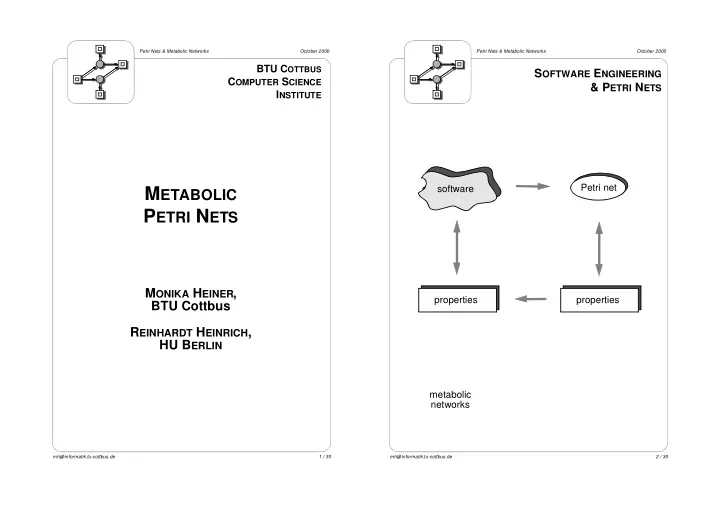
Petri Nets & Metabolic Networks October 2000 Petri Nets & Metabolic Networks October 2000 BTU C OTTBUS S OFTWARE E NGINEERING C OMPUTER S CIENCE & P ETRI N ETS I NSTITUTE Problem Petrinetz Petri net software M ETABOLIC P ETRI N


slide-1
SLIDE 1

Petri Nets & Metabolic Networks October 2000 mh@informatik.tu-cottbus.de 1 / 30

BTU COTTBUS COMPUTER SCIENCE INSTITUTE

METABOLIC PETRI NETS

MONIKA HEINER, BTU Cottbus REINHARDT HEINRICH, HU BERLIN

Petri Nets & Metabolic Networks October 2000 mh@informatik.tu-cottbus.de 2 / 30

SOFTWARE ENGINEERING & PETRI NETS

Petrinetz Petri net properties properties Problem metabolic networks software

slide-2
SLIDE 2

Petri Nets & Metabolic Networks October 2000 mh@informatik.tu-cottbus.de 3 / 30

feed belt (belt 1) deposit belt (belt 2) elevating rotary table robot arm 1 arm 2 press travelling crane

Production Cell:

Petri Nets & Metabolic Networks October 2000 mh@informatik.tu-cottbus.de 4 / 30

TOOL OVERVIEW

analysis protocols qualitative

PED

qualitative Petri net analyzers

PROD INA

quantitative Petri net analyzers

analysis protocols quantitative motion

execution tool

FUNLite

protocols execution lib

hierarchy browser

(distributed) animation tool

protocols functional testing informal specification safety requirements performance requirements

INA

(non-stochastic)

TimeNet

(stochastic)

hierarchical Petri Net Editor with output filters

PEP

functional requirements (rapid prototyping)

PEDVisor SMV

slide-3
SLIDE 3

Petri Nets & Metabolic Networks October 2000 mh@informatik.tu-cottbus.de 5 / 30

[Reddy 96] Reddy, V. N.; Liebman, M. N.; Mavrovouniotis, M. L.: Qualitative Analysis of Biochemical Reaction Systems; Computers in Biology and Medicine 26(96), 9-24.

Ru5P 4 5 Xu5P R5P 6 S7P GAP 7 E4P F6P 8 GAP 15 NAD+ + Pi NADH G6P F6P 10 ATP ADP FBP 11 12 DHAP 13 14 ATP ADP 9 Gluc 1,3-BPG ATP ADP 16 ATP ADP 19 NAD+ NADH 20 3PG 17 2PG PEP 18 Pyr Lac 2 NADP+ 2 NADPH 4 GSH 2 3 1 2 GSSG

EXAMPLE [REDDY 96]

Petri Nets & Metabolic Networks October 2000 mh@informatik.tu-cottbus.de 6 / 30

EXAMPLE PENTOSE PHOSPHATE CYCLE

glucose 6-phosphate ribulose 5-phosphate ribose 5-phosphate

  • 2. possibility

2 NADP+ 2 NADPH CO2 glucose 6-phosphate fructose 6-phosphate fructose 1,6-bisphosphate dihydroxyacetone phosphate glycerinaldehyde 3-phosphate

  • 1. possibility

ribose 5-phosphate ribulose 5-phosphate ribose 5-phosphate 2 NADP+ 2 NADPH CO2 glucose 6-phosphate fructose 6-phosphate fructose 1,6-bisphosphate dihydroxyacetone phosphate glycerinaldehyde 3-phosphate

  • 3. possibility

ribulose 5-phosphate ribose 5-phosphate 2 NADP+ 2 NADPH CO2 glucose 6-phosphate fructose 6-phosphate fructose 1,6-biphosphate dihydroxyacetone phosphate glycerinaldehyde 3-phosphate

  • 4. possibility

2 ATP pyruvate Stryer, L.: Biochemistry; Freeman, New York, NY, 1995, p. 450.
slide-4
SLIDE 4

Petri Nets & Metabolic Networks October 2000 mh@informatik.tu-cottbus.de 7 / 30

PETRI NETS, BASICS 1 (1) NODES places transitions “passive elements” “active elements” conditions events states actions “chem. compounds” “chem. reactions” (2) ARCS preconditions postconditions event 3 5

Petri Nets & Metabolic Networks October 2000 mh@informatik.tu-cottbus.de 8 / 30

PETRI NETS, BASICS 2 (3) TOKENS (moving objects, vehicles, work pieces, dates, control flow pointer, ..., units of substances (e. g. Mol), ...) (4) MARKING (system state, substance distribution) How many tokens are on each place?

  • > initial marking

condition is not fulfilled condition is (one times) fulfilled condition is n times fulfilled n

slide-5
SLIDE 5

Petri Nets & Metabolic Networks October 2000 mh@informatik.tu-cottbus.de 9 / 30

PETRI NETS, BASICS 3 (5) FLOW OF TOKENS ❑ an event may happen, if

  • > all preconditions

are fulfilled (corresponding to the arc weights); ❑ if an event happens, then

  • > tokens are removed

from all preconditions (corresponding to the arc weights), and

  • > tokens are added

to all postconditions (corresponding to the arc weights); ❑ an event happens (firing of a transition)

  • > atomic
  • > time-less

Petri Nets & Metabolic Networks October 2000 mh@informatik.tu-cottbus.de 10 / 30

EXAMPLES, REACTION EQUATIONS ❑

FOR LIGHT-INDUCED PHOSPHORYLATION

FROM THE PHOTOSYNTHESIS

2 2 2 2 2 2 2 r1 r2 H2SO4 CH2O H2O H2S CO2 O2 H+ NADH H2O NAD+

2 CO2 + H2S + 2 H2O -> 2 (CH2O) + H2SO4 2 NAD+ + 2 H2O -> 2 NADH + 2 H+ + O2

slide-6
SLIDE 6

Petri Nets & Metabolic Networks October 2000 mh@informatik.tu-cottbus.de 11 / 30

TYPICAL BASIC STRUCTURES

r2 r1 MB1 MB2 MB3 MB3 MB2 MB1 r1 r2 r2 r1 MB3 MB2 MB1

CHAIN OF REACTIONS

❑ (FREE-CHOICE)

BRANCHING

BRANCHING WITH SIDE CONDITION

Petri Nets & Metabolic Networks October 2000 mh@informatik.tu-cottbus.de 12 / 30

METABOLIC PETRI NETS (1) PLACES

  • > involved substances / chem. compounds

❑ substrates (boundary places),

  • e. g. glucose, lactate;

❑ metabolites,

  • e. g. glucose 6-phosphate

❑ side conditions for reactions,

  • e. g.

electron carrier, phosphate carrier; ❑ enzymes, if any input substrat

  • utput substrat

r2 r1 OutSub InSub

slide-7
SLIDE 7

Petri Nets & Metabolic Networks October 2000 mh@informatik.tu-cottbus.de 13 / 30

METABOLIC PETRI NETS 2 (2) TRANSITIONS ❑ spontaneous reactions ❑ enzyme-catalyzed reactions, two ways of modelling: ❑ transport steps, if any

  • > inhomogeneous substance distribution;

Enzym MB2 MB1

without the enzyme concentration with the enzyme concentration x

x - amount of units of substances required by the reaction enzyme MB2 MB1 enzym-catalyzed reaction x x

Petri Nets & Metabolic Networks October 2000 mh@informatik.tu-cottbus.de 14 / 30

METABOLIC PETRI NETS 3 (3) ARC INSCRIPTIONS

  • > amount of the units of substances

involved in the reaction (4) AMOUNT OF TOKENS

  • > amount of available units of substances

(5) INITIAL MARKING

  • > initial substance distribution

Σ METABOLIC PETRI NET (MPN):

set of all paths from the input to the output substrates taking into consideration the stoichiometric relations;

slide-8
SLIDE 8

Petri Nets & Metabolic Networks October 2000 mh@informatik.tu-cottbus.de 15 / 30

EXAMPLE [REDDY 96]

AS PETRI NET,

VERSION 1

2 2 2 2 F6P GAP ATP ADP ADP ATP NADH NAD+ ATP ADP Lac Pyr PEP 2PG 3PG 1,3-BPG DHAP FBP G6P Gluc F6P E4P GAP S7P R5P Xu5P Ru5P GSH GSSG NADPH NADP+ NAD+ ADP ATP Pi

glukose1.ped

NADH Petri Nets & Metabolic Networks October 2000 mh@informatik.tu-cottbus.de 16 / 30

EXAMPLE [REDDY 96]

AS PETRI NET,

VERSION 2

2 2 2 2 F6P GAP ATP ADP ADP ATP NADH NAD+ ATP ADP Lac Pyr PEP 2PG 3PG 1,3-BPG DHAP FBP G6P Gluc F6P E4P GAP S7P R5P Xu5P Ru5P GSH GSSG NADPH NADP+ NADH NAD+ ADP ATP Pi

glukose2.ped

slide-9
SLIDE 9

Petri Nets & Metabolic Networks October 2000 mh@informatik.tu-cottbus.de 17 / 30

EXAMPLE [REDDY 96]

AS PETRI NET,

VERSION 3

2 2 2 2 F6P GAP ATP ADP ADP ATP NADH NAD+ ADP Lac 1,3-BPG DHAP FBP G6P Gluc F6P E4P GAP S7P R5P Xu5P Ru5P GSH GSSG NADPH NADP+ NADH NAD+ ATP Pi

glukose3.ped

Pyr PEP 2PG 3PG NADH NAD+ ADP ADP Lac 1,3-BPG ATP ATP

two-layered representation

Petri Nets & Metabolic Networks October 2000 mh@informatik.tu-cottbus.de 18 / 30

EXAMPLE [REDDY 96]

AS PETRI NET,

VERSION 4

2 2 2 2 F6P GAP ATP ADP ADP ATP NADH NAD+ ADP Lac 1,3-BPG DHAP FBP G6P Gluc F6P E4P GAP S7P R5P Xu5P Ru5P GSH GSSG NADPH NADP+ NADH NAD+ ATP Pi

glukose4.ped

Pyr PEP 2PG 3PG NADH NAD+ ADP ADP Lac 1,3-BPG ATP ATP 2 2

reduced to

slide-10
SLIDE 10

Petri Nets & Metabolic Networks October 2000 mh@informatik.tu-cottbus.de 19 / 30

TYPICAL PETRI NET QUESTIONS (1) How many tokens may reside at most in a given place? ❑ (0, 1, k, oo)

  • > BOUNDEDNESS

(2) How often may a transition fire? ❑ (0-times, n-times, oo-times)

  • > LIVENESS

(3) Is a given system state ❑ always reachable again?

  • > PROGRESS PROPERTIES

❑ never reachable?

  • > SAFETY PROPERTIES

Petri Nets & Metabolic Networks October 2000 mh@informatik.tu-cottbus.de 20 / 30

EXAMPLE [REDDY 96]

AS PETRI NET,

VERSION 5

3 3 2 2 7 7 4 7 7 2 2 2 2 b1 b2 a1 a2 b2 b1 a2 a1 ATP ADP start Gluc Pi Lac F6P GAP ATP ADP ADP ATP NADH NAD+ ADP Lac 1,3-BPG DHAP FBP G6P Gluc F6P E4P GAP S7P R5P Xu5P Ru5P GSH GSSG NADPH NADP+ NADH NAD+ ATP Pi

glukose4_zyk.ped

2 2

slide-11
SLIDE 11

Petri Nets & Metabolic Networks October 2000 mh@informatik.tu-cottbus.de 21 / 30

ASSUMPTIONS

IN VERSION 5

❑ the two appearances of GAP can be separated (no logical / fusion nodes) ❑ the branching probabilities at the conflicts of G6P and Ru5P are known and may be characterized by the relations G6P

  • 3 : 1

Ru5P

  • 2 : 1
  • > STEADY STATE:

all intermediates have to be balanced with respect to inputs and outputs

Petri Nets & Metabolic Networks October 2000 mh@informatik.tu-cottbus.de 22 / 30

TYPICAL ANALYSIS TECHNIQUES 1 (1) TOKEN GAME (?) (2) REACHABILITY GRAPH nodes: system states arcs: the firing transition (3) REDUCED REACHABILITY GRAPH (4) STRUCTURAL ANALYSES

  • e. g.: conservative -> bounded

z1 z2 z3 z4 t1 t2 t3 t4

slide-12
SLIDE 12

Petri Nets & Metabolic Networks October 2000 mh@informatik.tu-cottbus.de 23 / 30

TYPICAL ANALYSIS TECHNIQUES 2 (5) NET INVARIANTS ❑ P-INVARIANTS

  • > set of places with (weighted)

constant token sum; mPn: meta substance preservation rules, all electron carriers Ex: P-Invariant (Pi ,..., Lac); i.e. their can be produced only as much lactate as Pi is provided; ❑ T-INVARIANTS

  • > set of transitions,

reproducing a given marking; mPn: reaction chains, reproducing a substance distribution; BND, LIVE mPn: elementary modes [Schuster 9x] Ex: forward / backward reaction of the triose phosphate isomerase

Petri Nets & Metabolic Networks October 2000 mh@informatik.tu-cottbus.de 24 / 30

QUALITATIVE ANALYSIS

TECHNIQUES REACHABILITY ANALYSIS (complete) reachability graph reduced state spaces coverability graph symmetry stubborn / sleep sets NET REDUCTION STRUCTURAL PROPERTIES LINEAR PROGRAMMING place / transition invariants state / trap equation static dynamic analysis analysis compressed state spaces OBDDs, ONDDS Kronecker products branching processes (model checking) concurrent automaton

slide-13
SLIDE 13

Petri Nets & Metabolic Networks October 2000 mh@informatik.tu-cottbus.de 25 / 30

INTEGRATION OF QUALITATIVE AND QUANTITATIVE ANALYSES ❑

TIME CONSUMPTION

BRANCHING PROBABILITIES

time p1 p2 p1 + p2 = 1

Petri Nets & Metabolic Networks October 2000 mh@informatik.tu-cottbus.de 26 / 30

MODEL CLASSES

context checking by Petri net theory verification by temporal logics worst-case evaluation performance prediction reliability prediction

PETRI NETS

PLACE/TRANSITION

(COLOURED PN)

TIME-DEPENDENT PN NON-STOCHASTIC STOCHASTIC

PETRI NET PETRI NET PETRI NET

slide-14
SLIDE 14

Petri Nets & Metabolic Networks October 2000 mh@informatik.tu-cottbus.de 27 / 30

APPLICATIONS

OF METABOLIC PETRI NETS

(1) step-wise construction

  • f graphical (=visual) models

for metabolic networks (2) graphical model animation (simulation) with / without disturbances (3) validation of metabolic models

  • >

model integrity (4) qualitative analyses

  • f biological / bio-technological questions

(5) quantitative analyses

  • f biological / bio-technological questions

Petri Nets & Metabolic Networks October 2000 mh@informatik.tu-cottbus.de 28 / 30

DERIVED BASIC QUESTIONS ❑ relation between ❑ relation between

  • > pros / cons ?
  • > strength / weaknesses ?

metabolic network properties Petri net properties metabolic control theory Petri net theory (Heinrich) (Heiner)

slide-15
SLIDE 15

Petri Nets & Metabolic Networks October 2000 mh@informatik.tu-cottbus.de 29 / 30

WORK PACKAGES 1 (A) MAPPING THE TERMINOLOGIES A-1 selection of case studies A-2 initial comparison of modelling principles A-3 initial comparison concerning typical analysis questions (B) INVESTIGATION OF THE A-1 CASE STUDIES B-1 by means of control theory B-2 by means of Petri net theory (C) CASE STUDIES’ RESULT COMPARISON C-1 modelling power C-2 qualitative analysis

  • > power / efficiency

C-3 quantitative analysis

  • > power /efficiency

Petri Nets & Metabolic Networks October 2000 mh@informatik.tu-cottbus.de 30 / 30

WORK PACKAGES 2 (D) INTEGRATION D-1 definition of selection criteria D-2 proposal of a combined methodology (E) PETRI NET BASED ANALYSES E-1 supplementing model validation E-2 realization with available pn techniques E-3 dedicated tool kit (F) CASE STUDIES

  • >

more sophisticated case studies (G)TUTORIAL & DEMO VERSION (H) FINAL REPORT