Euro- -Mditerranean Mditerranean Symposium Symposium - - Working - - PowerPoint PPT Presentation

euro m diterranean m diterranean symposium symposium
SMART_READER_LITE
LIVE PREVIEW

Euro- -Mditerranean Mditerranean Symposium Symposium - - Working - - PowerPoint PPT Presentation

Euro- -Mditerranean Mditerranean Symposium Symposium - - Working Group 2 Working Group 2 Euro Geohazards : earthquakes, slope : earthquakes, slope unstabilities unstabilities, tsunamis, coastal erosion , tsunamis, coastal erosion


slide-1
SLIDE 1

Euro Euro-

  • Méditerranean

Méditerranean Symposium Symposium -

  • Working Group 2

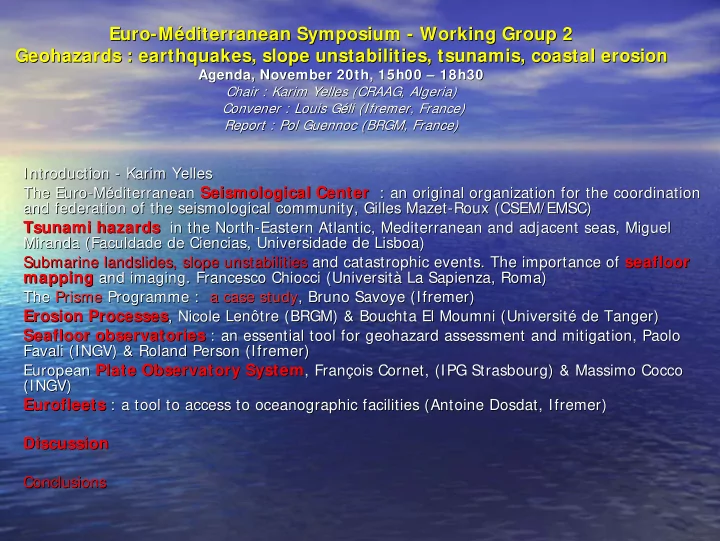
Working Group 2 Geohazards Geohazards : earthquakes, slope : earthquakes, slope unstabilities unstabilities, tsunamis, coastal erosion , tsunamis, coastal erosion

Agenda, November 20th, 15h00 Agenda, November 20th, 15h00 – – 18h30 18h30

Chair Chair : : Karim Karim Yelles Yelles (CRAAG, Algeria) (CRAAG, Algeria) Convener Convener : Louis : Louis Géli Géli (Ifremer, France) (Ifremer, France) Report : Pol Guennoc (BRGM, France) Report : Pol Guennoc (BRGM, France)

Introduction Introduction -

  • Karim

Karim Yelles Yelles The Euro The Euro-

  • Méditerranean

Méditerranean Seismological

Seismological Center Center : an original organization for the coordination

: an original organization for the coordination and federation of the seismological community, Gilles and federation of the seismological community, Gilles Mazet Mazet-

  • Roux (CSEM/EMSC)

Roux (CSEM/EMSC)

Tsunami hazards Tsunami hazards in the North

in the North-

  • Eastern Atlantic, Mediterranean and adjacent seas, Miguel

Eastern Atlantic, Mediterranean and adjacent seas, Miguel Miranda ( Miranda (Faculdade Faculdade de de Ciencias Ciencias, , Universidade Universidade de de Lisboa Lisboa) ) Submarine landslides, slope Submarine landslides, slope unstabilities unstabilities and catastrophic events. The importance of and catastrophic events. The importance of seafloor

seafloor mapping mapping and imaging. Francesco

and imaging. Francesco Chiocci Chiocci ( (Università Università La La Sapienza Sapienza, Roma) , Roma) The The Prisme Prisme Programme Programme : : a case study a case study, Bruno , Bruno Savoye Savoye ( (Ifremer Ifremer) )

Erosion Erosion Processes Processes, Nicole

, Nicole Lenôtre Lenôtre (BRGM) & (BRGM) & Bouchta Bouchta El El Moumni Moumni (Université de Tanger) (Université de Tanger)

Seafloor observatories Seafloor observatories : an essential tool for

: an essential tool for geohazard geohazard assessment and mitigation, Paolo assessment and mitigation, Paolo Favali Favali (INGV) & Roland Person ( (INGV) & Roland Person (Ifremer Ifremer) ) European European Plate Observatory System

Plate Observatory System, François Cornet, (IPG Strasbourg) & Massimo

, François Cornet, (IPG Strasbourg) & Massimo Cocco Cocco (INGV) (INGV)

Eurofleets Eurofleets : a tool to access to oceanographic facilities (Antoine

: a tool to access to oceanographic facilities (Antoine Dosdat Dosdat, , Ifremer Ifremer) )

Discussion Discussion

Conclusions Conclusions

slide-2
SLIDE 2

The The Mediterranean Mediterranean area: area: geodynamically geodynamically active active

Slowly favoring the North –South convergence but generating numerous geological hazards

slide-3
SLIDE 3

www.emsc-csem.org

Permanent funding only from institutional quotas and CoE subvention Soft money represents 90% of the 2007 budget!

EMSC/ CSEM created by the scientific community (ESC) in 1975 to rapidly locate earthquakes 77 institutes in 50 countries Data exchange with a hundred of institutes in more than 60 countries 1300 stations (on land) Production of bulletin at Mediterranean scale

Seismic monitoring: networking of databases and dissemination

slide-4
SLIDE 4

Modelling impact of tsunamis on the coast are ongoing in various countries

  • Models are able to reproduce well the measurements and the observation
  • In critical areas there is a need for vulnerability studies
  • Early warning system : ICG/NEAMTWS an intergovernmental subsidiary body of the

IOC, established in June 2005 (Resolution XXIII-14)

No emergency plans for tsunamis (excepted in Japan, USA…) before the giant Indian Ocean tsunami on December 26, 2004 Large European Mediteranean tsunamis: Lisbon 1755, Alexandria, Messine

Geological hazards are facing the medium/long term recurrence problem

Tsunami hazards in the Mediterranean

slide-5
SLIDE 5

Importance of submarine edifices vs subaerial, Strong slopes, various geomorphic processes Numerous instabilities revealed by detailed mapping

Stromboli edifice Etna edifice

slide-6
SLIDE 6

2002 2002

Stromboli Italy Stromboli Italy

Stromboli houses Road

« Relatively « small » landslides may cause severe damages in near crowded areas

slide-7
SLIDE 7

Production of Geohazard Maps (A0 format, 1:50.000) covering the seafloor in the depth interval 50- 500m

Objective To detect and map all the Italian seafloor geohazard features in the more instable continental margins

slide-8
SLIDE 8

PRISME Cruise: 7 oct – 7 nov 2007 A federative cruise: parners from France, Italy, Spain, Algeria A tour of 4 target areas previously studied by other « conventionnal means »: Gulf of Lions, Ibiza Channel, Algerian margin, Nice slope With 2 initiative tools : Penfeld penetrometer and piezometers

  • Objectives
  • internal architecture of recent gravity

deposition events in the W Mediterranean

  • spatial variability of associated turbidity

deposits

  • triggering mechanisms of the process for

each studied area

  • evaluation of future potential risk of

submarine slope failure

  • solutions capable of reducing the danger
  • f submarine

Detailed studies of geohazards: slope instabilities

slide-9
SLIDE 9

Coastal erosion

Costal erosion is a non linear/ non continuous processes Studies need continuous multifrequency monitoring at local to regional scales various and detailed studies (mrophology, sedimentoly, hydrodynamics Status of European costal erosion: : EUROSION project

  • 20% of EU coastline are eroded or protected
  • 15 KM² of coastal zone are « lost » per year
  • 3.2 milliard € are spent for coastal defence per year !
slide-10
SLIDE 10
  • Costal evolution (erosion, stability, prograding) is a non linear processes,

not constant in time

  • Extreme events – storms- may be highly damaged for years
  • Studies need
  • continuous monitoring at local to regional scales (networks)
  • various and detailed data (morphology, sedimentoly,

hydrodynamics…) at sea and on land

  • for modelling the geomorphologic evolution trough coupled

multiscale and multitools approach

  • and proposing scenarii
  • evaluation of possible refurnishment from offshore fossil deposits
  • and fundamental research on processes + more derailed basic

knowledge of coastal zones

  • Coastal erosion will increase severely with
  • increased human occupation
  • climatic changes: sealevel elevation (> = 60cm in this century) ,

higher impact of storms

slide-11
SLIDE 11

Seafloor Observatories: essential tools for Geo Seafloor Observatories: essential tools for Geo-

  • Hazard

Hazard assessment and mitigation assessment and mitigation

  • Geo-hazards distribution calls for a Regional approach for monitoring, warning and

study

  • Important sources of Geo-hazards are located in marine areas and effective

monitoring needs network extension to the seafloor

  • Geo-hazard prone marine areas have been well identified (e.g., ESONET, MOMAR,

NEAREST), scientific and technological activities already started

GEOSTAR GEOSTAR

85 km offshore 85 km offshore 3200 m w.d. 3200 m w.d. ( ( Sagres Sagres Plateau) Plateau)

1 1-

  • year monitoring:

year monitoring: Deployment August 2007 Deployment August 2007

NEAREST

slide-12
SLIDE 12

EMSO European Mutidisciplinary deep Seafloor observatories Preparatory phase (P Favali coord) start early 2008 (4 years)

To be deployed on specific sites around European waters, according to a list of key sites identified by ESONET NoE and forming a widely distributed pan-European infrastructure

slide-13
SLIDE 13

EUROFLEETS next call

European call opened end nov 07: Research Infratstructure ~ 5 – 7 M€, 4 years program, for vessels L> 35m, submarine or embarked tools Networking activities: European harmonizationof slection procedures, fast operation (in case of emergency), inetroperability, regional coordination, shared strategic, ecoresponsability, traing periods (technician, young scientists), data management, extra Europe cooperation Transnational access: cruises, transits, at distance access Joint Research activities: acquisition softwares, acoustic systems harmonization, mobile sensors, environemnt protection during research at sea, technical priorities

slide-14
SLIDE 14

Build integrated land-sea projects (incl. detailed swath bathymetric surveys, HR seismics…) fro the evaluation of geological hazards Study the potential slides on slopes and their impacts on coastal zones Complement the seismic networks with marine stations Install permanent systems for monitoring the coastal erosion Install / reinforce Tsunami Alert Systems Integrate fundamental researches inlc. Observatories, boreholes, numerical modelling for sediment transport, tsunami impacts…

WG2 Preparatory note Actions

slide-15
SLIDE 15

Question submitted : which strategy for linking the main expectations

  • f the geosciences community ?
  • Elaborate a multi-disciplinary research program on geological hazards,

integrating land and marine aspects and involving the countries from the northern and southern Mediterranean

  • Develop training and mobility of students and researchers
  • Structurate marine sciences research at the Euro-Mediterranean level

(development of the access to marine research infrastructures)

  • Implement a pluri-annual programmation of trans-national cruises involving

countries from both shores of the Mediterranean (connexion with Eurofleets).

Working Group discussion

slide-16
SLIDE 16

Discussion : Discussion : some some of the

  • f the matters

matters discussed discussed

  • Strong

Strong need need for more for more detailed detailed knowledge knowledge of

  • f seabed

seabed and sub and sub-

  • seabed

seabed and and fundamental fundamental research research on

  • n processes

processes at at all all levels levels (local, (local, regional regional, , , ,deep deep crust crust / / surficial surficial) (+ ) (+ integrated integrated land / land / sea sea) )

  • Develop

Develop links links with with industry industry ( (existing existing in N and S countries) for the in N and S countries) for the access access to unique to unique sets of data ( sets of data (eg eg very very deep deep and good and good resolution resolution seismic seismic, drill , drill holes holes), ),

  • Various

Various public public means means exist exist but are not but are not enough enough structured structured

  • Develop

Develop multidisciplinarity multidisciplinarity of

  • f projects

projects

  • Tsunami

Tsunami hazard hazard : : need need for for detailed detailed knowledge knowledge in the in the coastal coastal areas areas

  • Strong

Strong needs needs expressed expressed from from Southern Southern countries countries

– – Access to Access to oceanographioc

  • ceanographioc vessels

vessels and and tools tools – – Sharing Sharing experience experience on

  • n scientific

scientific concepts, concepts, – – Full Full cooperation cooperation project project building ( building (from from the the beginning beginning) ) – – Developing Developing local marine local marine research research facilities facilities

  • Launching

Launching a a Mediterranean Mediterranean workfield workfield (INSU) (INSU)

  • Reinforce

Reinforce exchange about exchange about scientific scientific questions & questions & results results / / answers answers with with decision decision makers makers, local , local authorities authorities

slide-17
SLIDE 17
  • A better structuration of
  • projects
  • tools
  • data : networking and further integration of databases
  • New data acquisition including seabed and subseabed surveys
  • at various scales,
  • from land to coastal zone to the deep sea
  • from the surface to the deep crust
  • Monitoring in designated sensitive / evolutive areas
  • In the coastal zone
  • On the slopes & in the deep basins
  • Establishing a real & full North-South partnership: from defining the

scientific programmes, to the data acquisition, processing, interpretation incl. strong training

An improved assessment of geological hazards and their impacts needs

slide-18
SLIDE 18

Working Group propositions

  • Create North – South Mediterranean coordination structures at all levels

associating :

  • policy makers, funding agencies and scientific organizations
  • scientists / project managers and regional authorities in charge of spatial

management, socio- economic aspects,

  • scientists from various disciplines for building multidsicplinary projects
  • towards a permanent Mediterranean « structure »
  • Reinforce or structure networks (ex. EMOD call)
  • Facilitate access of Southern countries to oceanographic vessels / tools (ex

trough Eurofleet)

  • Develop common integrated scientific projects on the Mediterranean in a full /

complete partnership scheme incl. installation of means in Southern countries + training