M ATHEMATICAL M ODELLING OF B IOCHEMICAL N ETWORKS WITH P ETRI N ETS - - PDF document

m athematical m odelling of b iochemical n etworks
SMART_READER_LITE
LIVE PREVIEW

M ATHEMATICAL M ODELLING OF B IOCHEMICAL N ETWORKS WITH P ETRI N ETS - - PDF document

FMP B ERLIN , F EBRUARY 2007 PN & Systems Biology M ATHEMATICAL M ODELLING OF B IOCHEMICAL N ETWORKS WITH P ETRI N ETS Monika Heiner Brandenburg University of Technology Cottbus Dept. of CS monika.heiner@informatik.tu-cottbus.de February


slide-1
SLIDE 1

PN & Systems Biology monika.heiner@informatik.tu-cottbus.de February 2007

FMP BERLIN, FEBRUARY 2007

MATHEMATICAL MODELLING OF BIOCHEMICAL NETWORKS

WITH PETRI NETS

Monika Heiner Brandenburg University of Technology Cottbus

  • Dept. of CS

PN & Systems Biology monika.heiner@informatik.tu-cottbus.de February 2007

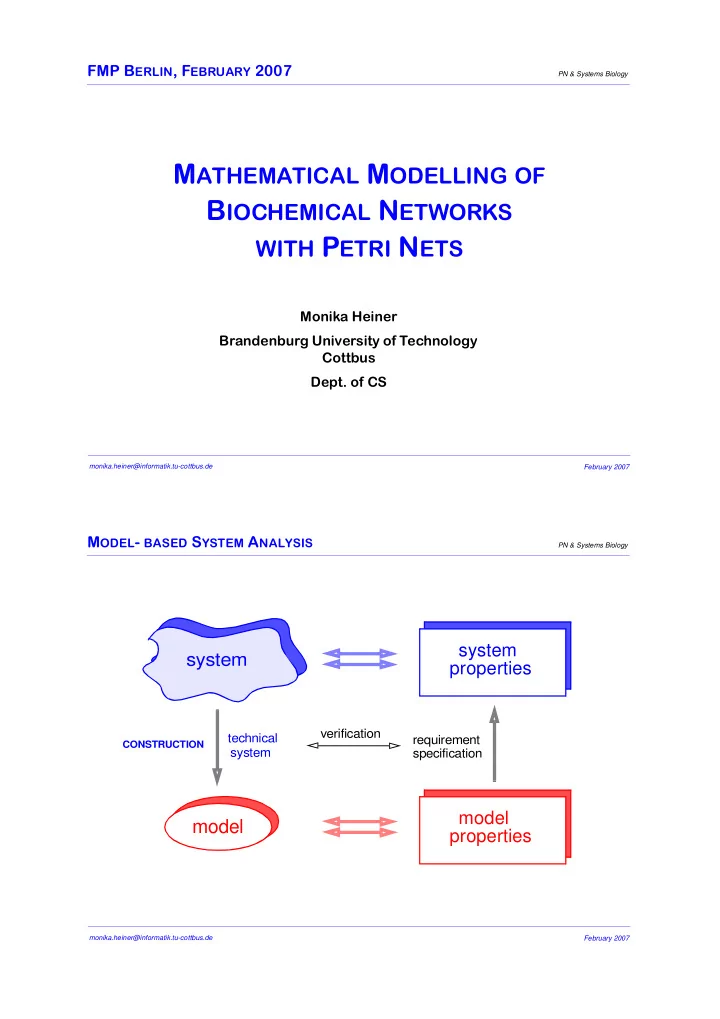
MODEL- BASED SYSTEM ANALYSIS

Petrinetz model Problem system

system properties model properties

technical system requirement specification verification

CONSTRUCTION

slide-2
SLIDE 2

PN & Systems Biology monika.heiner@informatik.tu-cottbus.de February 2007

MODEL- BASED SYSTEM ANALYSIS

Petrinetz model Problem system

system properties model properties

biological system known unknown properties properties validation behaviour prediction

UNDERSTANDING

PN & Systems Biology monika.heiner@informatik.tu-cottbus.de February 2007

WHAT KIND OF MODEL

SHOULD BE USED?

slide-3
SLIDE 3

PN & Systems Biology monika.heiner@informatik.tu-cottbus.de February 2007

NETWORK REPRESENTATIONS, EX1

R af-1 M EK ERK1,2 M EK1,2 ERK1,2 B-Raf R ap1

cAM P GEF

Akt Receptor

e.g . 7-TM R

α β γ

tyrosine kinase

β γ SO S shc grb2 R as PAK Rac PI-3 K Ras

cA M P

PKA

cAM P

PDE

cAM P A M P

α AdC yc

cA M P ATP

PKA

cA M P

M KP transcription factors

nucleus

cell m em brane cytosol

heterotrim eric G
  • protein

R af-1 R af-1 M EK M EK ERK1,2 ERK1,2 M EK1,2 M EK1,2 ERK1,2 ERK1,2 B-Raf B-Raf R ap1 R ap1

cAM P GEF cAM P GEF

Akt Akt Receptor

e.g . 7-TM R

α β γ α β γ α β γ β β γ

tyrosine kinase

β β γ SO S SO S shc shc grb2 grb2 R as R as PAK PAK Rac Rac PI-3 K PI-3 K Ras Ras

cA M P cA M P

PKA

cAM P

PKA PKA

cAM P cAM P

PDE

cAM P A M P

PDE PDE

cAM P A M P cAM P cAM P A M P

α AdC yc

cA M P ATP

α AdC yc AdC yc

cA M P ATP cA M P cA M P ATP

PKA

cA M P

PKA PKA

cA M P cA M P

M KP M KP transcription factors transcription factors

nucleus

cell m em brane cytosol

heterotrim eric G
  • protein
  • >

F O R M A L S E M A N T I C S

?

PN & Systems Biology monika.heiner@informatik.tu-cottbus.de February 2007

NETWORK REPRESENTATIONS, EX2

  • > READABILITY ?
slide-4
SLIDE 4

PN & Systems Biology monika.heiner@informatik.tu-cottbus.de February 2007

BIO NETWORKS, SOME PROBLEMS

❑ knowledge

  • > PROBLEM 1
  • > uncertain
  • > growing, changing
  • > distributed over independent data bases, papers, journals, . . .

❑ various, mostly ambiguous representations

  • > PROBLEM 2
  • > verbose descriptions
  • > diverse graphical representations
  • > contradictory and / or fuzzy statements

❑ network structure

  • > PROBLEM 3
  • > tend to grow fast
  • > dense, apparently unstructured
  • > hard to read
  • models are full of assumptions -

PN & Systems Biology monika.heiner@informatik.tu-cottbus.de February 2007

BIO NETWORKS, SOME PROBLEMS

slide-5
SLIDE 5

PN & Systems Biology monika.heiner@informatik.tu-cottbus.de February 2007

FRAMEWORK

quantitative parameters bionetworks knowledge qualitative modelling qualitative models quantitative modelling quantitative models animation / analysis animation / analysis /simulation understanding model validation qualitative behaviour prediction understanding model validation quantitative behaviour prediction (invariants) model checking Petri net theory Markov chains

ODEs

PN & Systems Biology monika.heiner@informatik.tu-cottbus.de February 2007

PETRI NETS -

AN INFORMAL CRASH COURSE

slide-6
SLIDE 6

PN & Systems Biology monika.heiner@informatik.tu-cottbus.de February 2007

PETRI NETS, BASICS

2 2 2 2 r1 O2 H+ NADH H2O NAD+

2 NAD+ + 2 H2O -> 2 NADH + 2 H+ + O2

O2 H+ NADH H2O NAD+

hyper-arcs

2 2 2 2

PN & Systems Biology monika.heiner@informatik.tu-cottbus.de February 2007

PETRI NETS, BASICS - THE STRUCTURE

❑ atomic actions

  • > transitions
  • > chemical reactions

❑ local conditions

  • > places
  • > chemical compounds

❑ multiplicities

  • > arc weights
  • > stoichiometric relations

❑ condition’s state

  • > token(s)
  • > available amount (e.g. mol)

❑ system state

  • > marking
  • > compounds distribution

❑ PN = (P, T, F, m0), F: (P x T) U (T x P) -> N0, m0: P -> N0 input compounds

  • utput

compounds

2 2 2 2 r1 O2 H+ NADH H2O NAD+

2 NAD+ + 2 H2O -> 2 NADH + 2 H+ + O2

slide-7
SLIDE 7

PN & Systems Biology monika.heiner@informatik.tu-cottbus.de February 2007

PETRI NETS, BASICS - THE FIRING RULE

❑ an action can happen, if

  • > prerequisite
  • > all preconditions are fulfilled

(corresponding to the arc weights); ❑ if an action happens, then

  • > firing behaviour
  • > tokens are removed from all preconditions

(corresponding to the arc weights), and

  • > tokens are added to all postconditions

(corresponding to the arc weights); ❑ action happens (firing of a transition)

  • > model assumptions
  • > atomic
  • > time-less

PN & Systems Biology monika.heiner@informatik.tu-cottbus.de February 2007

PETRI NETS, BASICS - THE BEHAVIOUR

❑ atomic actions

  • > transitions
  • > chemical reactions

input compounds

  • utput

compounds

2 2 2 2 r1 O2 H+ NADH H2O NAD+

2 NAD+ + 2 H2O -> 2 NADH + 2 H+ + O2

2 2 2 2 r1 O2 H+ NADH H2O NAD+

FIRING TOKEN GAME DYNAMIC BEHAVIOUR

(substance flow)

STATE SPACE

slide-8
SLIDE 8

PN & Systems Biology monika.heiner@informatik.tu-cottbus.de February 2007

TYPICAL BASIC STRUCTURES

❑ metabolic networks

  • > substance flows

❑ signal transduction networks

  • > signal flows

r3 r2 r1 e3 e2 e1 r3 r2 r1

PN & Systems Biology monika.heiner@informatik.tu-cottbus.de February 2007

PETRI NET ELEMENTS, INTERPRETATIONS

METABOLIC NETWORKS SIGNAL TRANSDUCTION NETWORKS GENE REGULATORY NETWORKS

❑ transitions

  • > (reversible, stoichiometric) chemical reactions,
  • > enzyme-catalyzed conversions of metabolites, proteins, . . .
  • > complexations/decomplexations, de-/phosphorylations, . . .

❑ places

  • > (primary, seocndary) chemical compounds,
  • > (various states of) proteins, protein complex, genes, . . .

❑ tokens

  • > molecules, moles,
  • > concentration levels, gene expression levels, . . .

(e.g., high/low = present/not present)

slide-9
SLIDE 9

PN & Systems Biology monika.heiner@informatik.tu-cottbus.de February 2007

BIOCHEMICAL PETRI NETS, SUMMARY

❑ biochemical networks

  • > networks of (abstract) chemical reactions

❑ biochemically interpreted Petri net

  • > partial order sequences of chemical reactions (= elementary actions)

transforming input into output compounds / signals [ respecting the given stoichiometric relations, if any ]

  • > set of all pathways

from the input to the output compounds / signals [ respecting the stoichiometric relations, if any ] ❑ pathway

  • > self-contained partial order sequence of elementary (re-) actions

PN & Systems Biology monika.heiner@informatik.tu-cottbus.de February 2007

BIO PETRI NETS - SOME EXAMPLES

slide-10
SLIDE 10

PN & Systems Biology monika.heiner@informatik.tu-cottbus.de February 2007

EX1 - Glycolysis and Pentose Phosphate Pathway

Ru5P 4 5 Xu5P R5P 6 S7P GAP 7 E4P F6P 8 GAP 15 NAD+ + Pi G6P F6P 10 ATP ADP FBP 11 12 DHAP 13 14 ATP ADP 9 Gluc 1,3-BPG ATP ADP 16 ATP ADP 19 NAD+ NADH 20 3PG 17 2PG PEP 18 Pyr Lac 2 NADP+ 2 NADPH 4 GSH 2 3 1 2 GSSG NADH

[Reddy 1993]

PN & Systems Biology monika.heiner@informatik.tu-cottbus.de February 2007

EX1 - Glycolysis and Pentose Phosphate Pathway

[Reddy 1993]

Pi Pi NADP+ NADPH GSSG GSH Ru5P Xu5P R5P S7P GAP GAP E4P F6P F6P Gluc G6P FBP DHAP 1,3−BPG 3PG 2PG PEP Pyr Lac ATP ATP ATP ATP ATP ADP ADP ADP ADP ADP NAD NAD+ NAD NADH 15 16 17 18 19 20 13 14 12 11 10 9 2 1 3 4 5 6 7 8 2 2 2 2

slide-11
SLIDE 11

PN & Systems Biology monika.heiner@informatik.tu-cottbus.de February 2007

EX2 - Carbon Metabolism in Potato Tuber

Suc eSuc Glc Frc UDPglc G6P F6P G1P UDP UDP UTP ATP ATP ATP ATP ATP ATP ADP 29 ADP 29 ADP 29 ADP 29 ADP 29 ADP 29 S6P Pi 28 Pi 28 Pi 28 Pi 28 PP PP starch AMP SucTrans Inv HK FK SPP StaSy(b) Glyc(b) ATPcons(b) PPase rstarch geSuc SuSy SPS PGI PGM NDPkin UGPase AdK 29 29 28 2 2 2

[KOCH; JUNKER; HEINER 2005]

PN & Systems Biology monika.heiner@informatik.tu-cottbus.de February 2007

EX3: APOPTOSIS IN MAMMALIAN CELLS

Fas−Ligand FADD Procaspase−8 Caspase−8 Bid BidC−Terminal Bax_Bad_Bim Apoptotic_Stimuli Bcl−2_Bcl−xL CytochromeC dATP/ATP Apaf−1 (m20) (m22) Procaspase−9 Caspase−9 Procaspase−3 Caspase−3 DFF CleavedDFF45 DFF40−Oligomer DNA DNA−Fragment Mitochondrion s1 s7 s9 s8 s5 s10 s11 s2 s12 s13 s3 s4 s6

[HEINER; KOCH; WILL 2004] [GON 2003]

slide-12
SLIDE 12

PN & Systems Biology monika.heiner@informatik.tu-cottbus.de February 2007

EX4 - SWITCH CYCLE HALOBACTERIUM SALINARUM

[Marwan; Oesterhelt 1999]

PN & Systems Biology monika.heiner@informatik.tu-cottbus.de February 2007

EX4 - SWITCH CYCLE HALOBACTERIUM SALINARUM

CheB−P _p0_ CheB _p1_ SR_II360_520 _p2_ SR_II360_520Me _p3_ SR_II480 _p4_ SR_II480Me _p5_ CheR _p6_ CheY−P _p7_ CheY−P _p7_ CheY _p8_ hv487 _p9_ no_hv487 _p10_ Conf2 _p11_ Conf1 _p12_ 44 CheYPbound _p13_ co_CheYP _p14_ 44 co_CheYP _p14_ 44 co_CheYP _p14_ 44 Rccw _p15_ Cccw _p16_ Accw _p17_ Sccw _p18_ Scw _p19_ Acw _p20_ Ccw _p21_ Rcw _p22_ hv373 _p23_ no_hv373 _p24_ SR_I_510Me _p25_ SR_I_510 _p26_ no_hv580 _p27_ hv580 _p28_ CheA−P _p29_ CheA−P _p29_ CheA _p30_ CheA _p30_ CheR _p31_ SR_I_587Me _p32_ SR_I_587 _p33_ SR_I_373Me _p34_ SR_I_373 _p35_ CheB _p36_ CheB−P _p37_
  • ff
  • n
t22 t12 kd4 kd3 kd2 ka3 ka2 ka4 t21 t11 kd1 ka1 Tstop_ccw k2_ccw k1_ccw k0_ccw Tstop_cw k2_cw k1_cw k0_cw
  • ff
  • n
  • n
  • ff
44 44 44 44
slide-13
SLIDE 13

PN & Systems Biology monika.heiner@informatik.tu-cottbus.de February 2007

QUALITATIVE ANALYSES

PN & Systems Biology monika.heiner@informatik.tu-cottbus.de February 2007

TYPICAL PETRI NET QUESTIONS

❑ How many tokens can reside at most in a given place ?

  • > (0, 1, k, oo)
  • >

BOUNDEDNESS

❑ How often can a transition fire ?

  • > (0-times, n-times, oo-times)
  • >

LIVENESS

❑ How often can a system state be reached ?

  • > never
  • >

UNREACHABLE -> SAFETY PROPERTIES

  • > n-times
  • >

REPRODUCIBLE

  • > always reachable again
  • > REVERSIBLE (HOME STATE)
  • > reversible initial state
  • >

REVERSIBILITY

❑ Are there behavourally invariant net structures ?

  • > token conservation
  • > P - INVARIANTS
  • > token distribution reproduction
  • > T - INVARIANTS

❑ . . . and many more -> temporal logics

slide-14
SLIDE 14

PN & Systems Biology monika.heiner@informatik.tu-cottbus.de February 2007

ANALYSIS TECHNIQUES

❑ static analyses

  • > no state space construction
  • > structural properties (graph theory)
  • > P / T - invariants

(linear algebra) ❑ dynamic analyses

  • > total/ partial state space construction
  • > analysis of general behavioural system properties,

e.g. boundedness, liveness, reversibility, . . .

  • > model checking of special behavioural system properties,

e.g. reachability of a given (sub-) system state (with constaints), reproducability of a given (sub-) system state (with constraints) expressed in temporal logics (CTL / LTL), very flexible, powerful querry language

PN & Systems Biology monika.heiner@informatik.tu-cottbus.de February 2007

CASE STUDIES

  • > CREDITS

❑ gene regulatory networks bacteriophage lambda

  • > C. Chaouiya, D. Thieffry / Univ. Marseille

❑ signal-transduction networks RKIP/MEK-ERK signalling pathway

  • > David Gilbert / Univ. Glasgow

yeast pheromone pathway

  • > Andrea Sackmann, Ina Koch / TFH Berlin

G1/S - phase in mammalian cells

  • > Thomas Kaunath, Ina Koch / TFH Berlin
  • E. coli pathway
  • > Nina Kramer, Ina Koch / TFH Berlin

lipoprotein metabolism (liver)

  • > Daniel Schrödter / BTU Cottbus

apoptosis in mammalian cells

  • > Jürgen Will / BTU Cottbus

blood coagulation, hemostasis

  • > Gerry Neumann / BTU Cottbus

switch cycle halobacterium salinarum -> Wolfgang Marwan / MPI Magdeburg ❑ metabolic networks glycolysis in humans

  • > Thomas Runge / BTU Cottbus

carbon metabolism in potato tuber

  • > Björn Junker / IPK Gatersleben
slide-15
SLIDE 15

PN & Systems Biology monika.heiner@informatik.tu-cottbus.de February 2007

SUMMARY

❑ representation of bionetworks by Petri nets

  • > partial order representation
  • > better comprehension
  • > formal semantics
  • > sound analysis techniques
  • > unifying view

❑ purposes

  • > animation
  • > to experience the model
  • > model validation against consistency criteria
  • > to increase confidence
  • > qualitative / quantitative behaviour prediction
  • > experiment design,

new insights ❑ step-wise model development

  • > qualitative model
  • > discrete Petri nets
  • > discrete quantitative model
  • > stochastic Petri nets
  • > continuous quantitative model
  • > continuous Petri nets = ODEs

PN & Systems Biology monika.heiner@informatik.tu-cottbus.de February 2007

OUTLOOK

THANKS !

HHTP://WWW-DSSZ.INFORMATIK.TU-COTTBUS.DE