LTEC 690 Final Project Policies Governing the Use of Body Cams on - - PowerPoint PPT Presentation

ltec 690 final project
SMART_READER_LITE
LIVE PREVIEW

LTEC 690 Final Project Policies Governing the Use of Body Cams on - - PowerPoint PPT Presentation

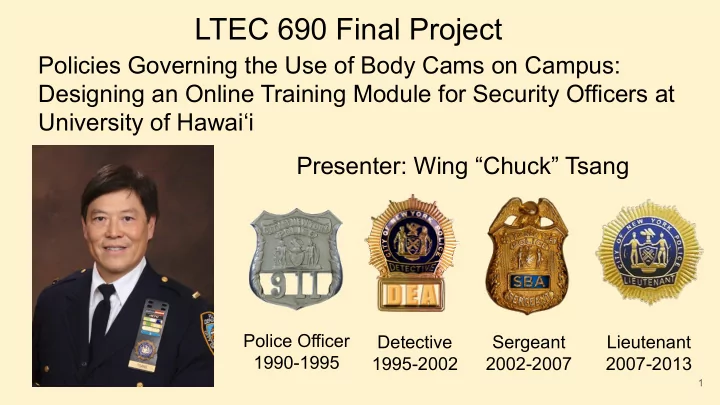
LTEC 690 Final Project Policies Governing the Use of Body Cams on Campus: Designing an Online Training Module for Security Officers at University of Hawaii Presenter: Wing Chuck Tsang Police Officer Detective Sergeant Lieutenant


slide-1
SLIDE 1

Presenter: Wing “Chuck” Tsang

LTEC 690 Final Project

Policies Governing the Use of Body Cams on Campus: Designing an Online Training Module for Security Officers at University of Hawai‘i

Police Officer 1990-1995 Detective 1995-2002 Sergeant 2002-2007 Lieutenant 2007-2013

1

slide-2
SLIDE 2

After retiring

  • Moved to Hawaii
  • Started second career
  • Security Chief at UH Maui College

2013-2018

2

slide-3
SLIDE 3

Joined 2015 Cohort M.Ed. Learning Design and Technology

Gee-whiz! What did I get myself into now?

3

slide-4
SLIDE 4

Current job at UH West Oahu

  • Chief of Public Safety & Security

Emergency Management Coordinator 2018 - Present

4

slide-5
SLIDE 5
  • Miniature camera capable of recording HD video and

audio What is a body-worn camera or body cam?

5

slide-6
SLIDE 6

6

= Agree = Disagree

  • Brief survey to assess your opinions toward the use of body

cams on campus

  • Same questions posed to the participants of my research

project

slide-7
SLIDE 7

Body cams protect users against false accusations

7

= Agree = Disagree

slide-8
SLIDE 8

Officer interactions with public should be recorded with body cams

8

= Agree = Disagree

slide-9
SLIDE 9

Confrontations are less likely to occur if both officers and the public know they are being recorded

9

= Agree = Disagree

slide-10
SLIDE 10

Officers should be required to inform individuals that they are being recorded on a body cam

10

= Agree = Disagree

slide-11
SLIDE 11

Using body cams on college campuses is a step in the right direction

11

= Agree = Disagree

slide-12
SLIDE 12

There are security officers working 24/7 on all ten UH campuses.

Why I chose to conduct this research?

12

slide-13
SLIDE 13
  • Some received complaints of

discourtesy or misconduct

  • Usually difficult to prove or

disprove ○ Lack of evidence or witnesses

  • Complaints could have been

resolved differently if video recordings were available

13

slide-14
SLIDE 14
  • “Chicken Lady” at UH

Maui College

  • Violated campus’ policy

against feeding of feral animals

  • Complained that officers

were rude and used

  • bscene language

14

slide-15
SLIDE 15
  • Another incident at UH

Maui College

  • Student alleged he was

speared by security

  • fficer
  • Damaged guitar and

injured knees

15

slide-16
SLIDE 16

Benefits of using body cams

Officers act more professional Less apt to use force Reports are more accurate Public is less confrontational Protect officers against false allegations

16

slide-17
SLIDE 17

The purpose of this instructional design project was to develop and evaluate the effectiveness of a video-based website to teach security officers at UH about the policies governing the use of body-worn cameras on campus. LTEC 690 Final Project

17

slide-18
SLIDE 18
  • 1. How effective is the module in

teaching the learners to understand the policies governing the use of body cams on campus?

  • 2. In what way has the learners’

attitudes toward the use of body cams been impacted after taking this course?

Research Questions

18

slide-19
SLIDE 19

Literature Review

  • Obasi (2018) - Officers’

attitudes toward body cams have direct correlation with how often they get used

19

slide-20
SLIDE 20

Literature Review

  • Parachini (2018) - studied Kaua‘i PD and found similar

findings

20

slide-21
SLIDE 21

Literature Review

  • Stanley (2015) - body

cams can be a win-win for everyone, but only if the correct policy was in place

  • Ensure effectiveness and

prevent abuse

  • Against at-will activation of

body cams

21

slide-22
SLIDE 22
  • Currently, none of the UH

campuses use body cams

  • Policies taught in this

course are based on the policy of the Kaua‘i Police Department

  • First PD in Hawaiʻi to

implement body cams

22

slide-23
SLIDE 23
  • UH security officers from West Oʻahu
  • Minimum 18 years of age, no maximum age limit
  • Male & female
  • Various ethnicities
  • H.S. diploma or General Education Development (GED)

Intended target audience

23

slide-24
SLIDE 24

24

slide-25
SLIDE 25

Design implications based on learners’ demographics:

  • Very little reading
  • Brief and engaging

YouTube videos

  • Selected based on

relevance

  • No more than 3 - 4

minutes in length

25

slide-26
SLIDE 26
  • Online videos are

an effective teaching method

  • Ideal for teaching
  • verwhelming

amount of information

  • View content on

demand until skills mastered

26

slide-27
SLIDE 27

Design implications based on learners’ demographics:

  • Case-based learning
  • Real life scenarios
  • Applicable to own

experience

27

slide-28
SLIDE 28

Learning domains most in line with our learners are affective and cognitive

28

slide-29
SLIDE 29

Methods

  • Instrumentation

○ Site builder - Google Sites ○ Content delivery - YouTube ○ Pre & post tests - Testmoz ○ Surveys - Google Forms

29

slide-30
SLIDE 30

Methods

  • Familiarity with G Suite

products

  • Easier to integrate

Google Forms and YouTube videos

30

slide-31
SLIDE 31
  • Pretests to determine

pre-existing knowledge and to establish baseline.

  • Posttests to assess what

was learned

  • Tests were created using

TestMoz

Pretests & Posttests

31

slide-32
SLIDE 32
  • Conducted using Google Forms
  • Assess Changes in the learners’

perceptions of their knowledge and thoughts regarding body cam usage before and after the instruction.

Post-instruction survey

32

slide-33
SLIDE 33

33

slide-34
SLIDE 34

Comparison of pretest and posttest scores

Data showed that on average, participants scored 13% higher in the posttests than the pretests

34

74% => 87% = 13%

slide-35
SLIDE 35

Participants’ rating of module’s effectiveness

Data showed that on average, the participants rated the module 90% effective

35

1(7) + 4(8) + 2(9) + 6(10) = 117 117 ÷ 13 = 9 9/10 = .9 = 90% effective

slide-36
SLIDE 36

Findings

  • Effective way to teach body cam policies on campus
  • Effective in shaping participants’ attitudes towards the

use of body cams on campus

36

slide-37
SLIDE 37

Participants’ self-perceptions of knowledgeability

  • Before taking course: not

knowledgeable

  • After taking course:

knowledgeable

37

slide-38
SLIDE 38
  • Before taking course: 1

disagree, 3 agree, 9 strongly agree

  • After taking course: 1

neutral, 1 agree, 11 strongly agree

Participants’ perceptions that body cams can protect

  • fficers against false accusations

38

slide-39
SLIDE 39
  • Before taking course: 1

disagree, 5 neutral, 4 agree, 3 strongly agree

  • After taking course: 1

disagree, 4 neutral, 4 agree, 4 strongly agree

Participants’ perceptions that the use of body cams

  • n college campuses is a step in the right direction

39

slide-40
SLIDE 40
  • Unreliability of data:

module based on fictitious UH body cam policy

  • Unavailability of relevant

videos for some topics

Limitations

40

slide-41
SLIDE 41
  • UH Mānoa to receive

CALEA (Commission on Accreditation for Law Enforcement Agencies) accreditation

  • Next step: move security

force towards “sworn

  • fficer” status

Suggestions for further research

41

slide-42
SLIDE 42
  • An online instructional

module is an effective training tool

  • Allows on-demand training

at officers own convenience

  • Videos are an effective way

to deliver engaging instructional content

Conclusion

42

slide-43
SLIDE 43

Demo of Instructional Module

43

slide-44
SLIDE 44

Questions?

44