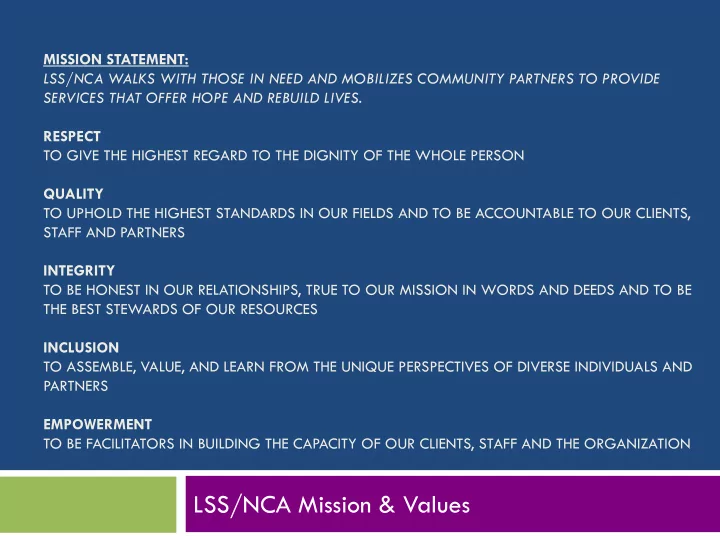
MISSION STATEMENT: LSS/NCA WALKS WITH THOSE IN NEED AND MOBILIZES COMMUNITY PARTNERS TO PROVIDE SERVICES THAT OFFER HOPE AND REBUILD LIVES. RESPECT TO GIVE THE HIGHEST REGARD TO THE DIGNITY OF THE WHOLE PERSON QUALITY TO UPHOLD THE HIGHEST STANDARDS IN OUR FIELDS AND TO BE ACCOUNTABLE TO OUR CLIENTS, STAFF AND PARTNERS INTEGRITY TO BE HONEST IN OUR RELATIONSHIPS, TRUE TO OUR MISSION IN WORDS AND DEEDS AND TO BE THE BEST STEWARDS OF OUR RESOURCES INCLUSION TO ASSEMBLE, VALUE, AND LEARN FROM THE UNIQUE PERSPECTIVES OF DIVERSE INDIVIDUALS AND PARTNERS EMPOWERMENT TO BE FACILITATORS IN BUILDING THE CAPACITY OF OUR CLIENTS, STAFF AND THE ORGANIZATION
LSS/NCA Mission & Values SERVING AS A GOOD NEIGHBOR WHO IS A - - PowerPoint PPT Presentation
MISSION STATEMENT: LSS/NCA WALKS WITH THOSE IN NEED AND MOBILIZES COMMUNITY PARTNERS TO PROVIDE SERVICES THAT OFFER HOPE AND REBUILD LIVES. RESPECT TO GIVE THE HIGHEST REGARD TO THE DIGNITY OF THE WHOLE PERSON QUALITY TO UPHOLD THE HIGHEST
SERVING AS A GOOD NEIGHBOR
WHO IS A REFUGEE?
REFUGEE & IMMIGRANT SERVICES Lutheran Social Services of the National Capital Area
- is outside of his or her country of
nationality or habitual residence;
- has a well-founded fear of persecution
because of his or her race, religion, nationality, membership of a particular social group or political opinion;
- is unable or unwilling to avail himself or
herself of the protection of that country or to return there for fear of persecution.
A refugee is someone who…
Where are refugees coming from?
Text or graphic
What challenges do refugees face?
Waiting
in refugee camps set up by UNHCR
Voluntary Repatriation
to country of origin
Refugee Status in 2nd country
within geographic area
Resettlement
in 3rd country
less than 1%
Refugee Resettlement Process
Local Refugee Statistics
On average, the US accepts 70,000 refugees for permanent resettlement annually. In FY16, the U.S. will welcome 85,000 refugees, Refugees make up about 10% of the immigration to the US in a year Refugees versus Asylees, SIVs – local numbers. (Refer to FAQs and glossary in the co-sponsorship packet.)
Jessica Cuellar, Volunteer Coordinator and Resource Developer cuellarj@lssnca.org
For more information
Page 1
Good Neighbor Description & Responsibilities
A LSS/NCA Refugee Good Neighbor is a group of volunteers who closely works together to help a newly arrived refugee family rebuild their lives in America. The Good Neighbor serves as a personal guide through a culture and community that is new and often strange to refugees. Most importantly, Good Neighbors are trustworthy and caring friends to families who frequently have endured terrifying persecution and turbulent journeys to reach newfound opportunity in the Washington, DC Metro Area. As a friend to refugee families, it is imperative that Good Neighbors do not provide contrary or competing advice to refugee families, and, instead, support the expertise and guidance provided by LSS/NCA staff. While the ultimate responsibility for the provision of core services remains with LSS/NCA, Good Neighbors are vital to helping refugees become self-sufficient and feel effectively part of their new
- community. All Good Neighbor responsibilities will be discussed prior to a family being assigned. Please
share any expertise with LSS/NCA regarding Social Security, Medicaid, or other core services so the newly arrived family receives the best service and care we can all provide together.
Objective:
In partnership with faith communities, foundations, government partners, and hosts of volunteers, LSS/NCA is proud to welcome hundreds of refugees from around the world to our community every
- year. LSS/NCA supports refugees during an important transition in their lives by mobilizing community
partners to offer hope and a comprehensive range of services, including resettlement assistance and employment training throughout the Greater Washington DC Region. Many refugee families are starting over often with limited or no belongings. Each year LSS/NCA resettles more than 600 refugees—each individual with their own set of particular needs ranging from employment to healthcare requirements. LSS/NCA staff are limited in the time they are able to dedicate to each refugee. Good Neighbors ensure that each family and individual receives the extra care and guidance they need to reach self-sufficiency.
LSS/NCA Key Goals:
Core needs (and areas
- f service) will be met
for each refugee. Refugee will be economically stable by gaining and maintaining employment. Refugee will learn practical, social, and cultural life skills. Refugee will gain SELF-SUFFICIENCY
Page 2
How We Will Work Together:
In all cases, LSS/NCA will be responsible for working with the family to secure available government benefits including Medicaid, Medicare, TANF, food stamps, WIC, child care subsidies, and Social Security. In addition, LSS/NCA staff will work with the refugee family to enroll all children in public school and placement exams. Finally, LSS/NCA caseworker will work closely with the Good Neighbor team and general coordinator to ensure that all family needs are met and Good Neighbor is confident and successful in fulfilling all partner responsibilities. See general outline of services divided between Good Neighbor and LSS/NCA below. Good Neighbor Agrees to: LSS/NCA Assists with: Service To complete by arrival date X X Assist with apartment set up * X Meet the family at the airport and transport to new home. * X Provide a culturally appropriate meal ready to eat upon arrival * X Provide safe and affordable housing X X Provide basic furnishings for housing. * X Provide initial seasonal clothing and other necessities. * X Provide food allowance for approximately 2 weeks To complete in first 10 days X X Enroll in English as a Second Language Class (ESL) X X Provide orientation of community and public transportation X X Assess for employment services job/training * X Assist in applying for government assistance programs (i.e. Social Security Cards, food stamps) To complete in first 30 days * X Assist with transportation to initial health screening * X Register children for school X X Help prepare adults to obtain and retain employment. X X Assist with financial literacy X X Commit to spending a minimum of 1-2 hours per week teaching self-sufficiency skills to refugee X X Transporting refugees to appointments, interviews, and necessary daily appointments * X Assist men 18-26 in registering for selective services
Page 3
Outline of Good Neighbor Opportunities:
Good Neighbor levels have been developed to allow congregations and community groups to assist a refugee family in congruence with their group’s financial and volunteer capacity. The varying levels of partnership offer different levels of responsibility, engagement, and relationship building.
Home Raiser
Time commitment: 1 year Volunteer group Size: 6-10+ Requirements: Assist in finding housing that meets refugee family needs prior to arrival Collect and provide all furnishings and household supplies required for resettlement, including linens, toiletries, cleaning supplies, kitchen cookware, etc. Furnish and set-up apartment home prior to family’s arrival Provide Rental Assistance* Provide 3 additional core areas of support (see page 8) *Rental Assistance: Ensure that the family can maintain housing by financially contributing rental assistance directly to LSS/NCA. Work with LSS/NCA to secure safe and affordable housing for the family before their arrival. (LSS/NCA does not co-sign any leasing agreement at any point in time. Arrangements should be made with landlord to sign agreement upon family’s arrival.) LSS/NCA will work with each Good Neighbor to Ongoing services X * Submit volunteer time and mileage online X * Continue mentoring, transportation assistance, and employment training * Give money, medicine, or medical advice directly to refugee Transporting refugees without attending volunteer orientations and being cleared by LSS/NCA Proselyting * Sharing family information with public media, congregation publications, or individual social media sites without family’s legal consent and approval from LSS/NCA. (LSS/NCA may ask refugee families to participate in media interviews to further the mission. LSS/NCA will ensure the family’s requests during participation are met. Good neighbors should support these efforts but are not required to participate.) X = Required, * = Optional Prohibited
Page 4
determine the extent of their ability to provide financial assistance. 1) Work with leasing company to secure an affordable rental rate OR provide accommodations within a home (or otherwise unoccupied space) of a Good Neighbor member/connection at little
- r no cost(example: In-law unit, vicar house). Housing must meet state and federal guidelines. If
providing accommodations in an in-law unit, vicar house, etc, the family must be able to freely move in and out of the housing and make their own meals. 2) Provide full rental assistance for 3 months. Rental Assistance will depend on location and size of the family. (Please see budget below for sample cost.) OR provide full rental assistance for an agreed upon length of time and then provide half the total expense for the remaining time of the Good Neighbor commitment.
Fixed Expenses (Same each month) Family Expenses Expected Assistance from Good Neighbor (per month) MD VA MD VA
Rent/Mortgage $575-$1150 $850-$1700 $575-$1150 $850-$1700 Child Care IOM Loan/Credit Payments $35 $35 Savings (if possible) Other
Flexible Expenses (Change each month)
Utilities (gas, electric, water) $150 $150 $150 $150 Transportation $420 $420 Food $400 $450 Medical $420 $420 Telephone $50 $50 Clothing *In-Kind Donations may be needed *In-Kind Donations may be needed Education Household items (soap, cleaning supplies, etc $200-$300 (not included in total) $200-$300 (not included in total) * In Kind Donations (May cost $300— see list page 8) *In Kind Donations (May cost $300–see list page 8) Furniture $1000-$1300 (not included in total) $1000-$1300 (not included in total) * In Kind Donations (May cost $1300-- see list page 8) *In Kind Donations (May cost $1300– see list page 8) Personal Expenses Insurance Support to other relatives Other Total Monthly Expenses $2050-$2625 $2375-$3325 *$725-$2900 *$1000--$3450
Page 5
Monthly Budget--Home Raiser (Sample Budget based on a family of four) *Financial Assistance depends on the Good Neighbors’ abilities to collect in-kind donations Home raiser: Financial Case Studies Scenario 1: The Alan family has been resettled in the state of Maryland. The Good Neighbor assigned to their case worked directly with LSS/NCA to provide rent in full for the first three months after they
- arrived. Once funds were collected or budgeted for, the Financial Team leader provided a check directly
to LSS/NCA. LSS/NCA ensured the gift was designated for the Alan family. For the final 9 months of the partnership year, the Good Neighbor began a decreasing financial scale plan* which ensured the Alan family was able to provide for their needs yet encourage the family’s financial independence with ultimate goal of self-sufficiency. *Decreasing Financial Scale Plan is designed to gradually decrease Good Neighbors’ financial assistance to a refugee family over the final 9 months of their relationship. For instance: 100% financial assistance for the first three months, 50% of rent cost for next 6 months, and 25% of rent for the final 3 months. Scenario 2: The Mataw family has been resettled in the state of Virginia. Since the family was a larger size (5 individuals) they had fewer options for affordable housing. The Good Neighbor decided that they would provide rent in full for a total of 6 months and then half of the cost of rent for the last six months. The Good Neighbor worked directly with the LSS/NCA case manager to provide rent payments directly to LSS/NCA. This was coordinated through the Financial Team leader. After the first six months the Mataw family was able to provide half the rent as both adults had found work thanks to the Good Neighbor employment team. Scenario 3: Before a family was assigned, a Good Neighbor identified an unoccupied vicar house that could provide free housing for a refugee family. Members of the partnership team worked diligently with LSS/NCA staff to ensure that the house was furnished with all of the items on the supply list (see page 7). Once the family arrived, the Good Neighbor helped maintain the house for the family’s use, teaching them about homeownership and repairs. Since the family did not have to pay rent for the first year, they were able to save money for the years to come and afford their other daily expenses.
Page 6 Foundation Layer Time commitment: 6 months
Volunteer group size: 4-10 Requirements: Collect and provide all furnishings and household supplies required for resettlement, including linens, toiletries, cleaning supplies, kitchen cookware, etc. Furnish and set up apartment home prior to family’s arrival
Provide 3 additional core areas of support (see page 8) Budget—Foundation Layer (Sample Budget based on a family of four) *Financial Assistance depends on the Good Neighbors’ ability to collect in-kind donations
Fixed Expenses (Same each month) Family Expenses Expected Assistance from Good Neighbor MD VA MD VA
Rent/Mortgage $575-$1150 $850-$1700 Child Care IOM Loan/Credit Payments $35 $35 Savings (if possible) Other
Flexible Expenses (Change each month)
Utilities (gas, electric, water) $150 $150 Transportation $420 $420 Food $400 $450 Medical $420 $420 Telephone $50 $50 Clothing *In-Kind Donations *In-Kind Donations Education Household items (soap, cleaning supplies, linens, etc) $200-$300 (not included in total) $200-$300 (not included in total) * In Kind Donations (May cost $300-- see list page 8) *In Kind Donations (May cost $300–see list page 8) Furniture $1000-$1300 (not included in total) $1000-$1300 (not included in total) * In Kind Donations (May cost $1300-- see list page 8) *In Kind Donations (May cost $1300–see list page 8) Personal Expenses Insurance Support to other relatives Other Total Monthly Expenses $2050-$2625 $2375-$3325 *1600 *1600
Page 7 Architect
Time commitment: 6 months Volunteer group Size: 4-10 Requirements: Offer mentoring to help refugee adapt to a new community. Mentoring may include educational tutoring, professional development, English tutoring, and community guidance. Educational Tutoring: Refugee adult may be taking certification classes, job training courses, or trying to secure their GED. Tutors are essential in not only explaining certain concepts, but also motivating the individual to stay on track and meet deadlines. Likewise, refugee school-aged children will be placed in public school upon
- arrival. Tutoring may also be needed in grade school courses such as math, science, history, and
language. Professional Development: Help prepare refugee for American workforce and secure employment. Professional development may include helping draft a resume, practice for interviews, navigate the job market, and network with professionals in refugee’s career of interest, etc. English Tutoring: Focus on developing English skills for all family members. Frequent visits and conversations can help an individual utilize his new language in a friendly and patient environment. Community Guidance: Use creativity and knowledge of the Washington DC Area to help refugee family learn more about their new community including but not limited to navigation of the public transportation system, fun and cheap ideas for family outings, explanation of local and national history, and conversation regarding interest points such as grocery stores, banks and doctor offices.
Carpenter
Time Commitment: 3 months Group Size: Unlimited Requirements:
Plan donation drive(s) before the family’s arrival. Donation drives should focus on collecting the required housing items listed on page 5. Good Neighbor assists in setting up apartment home prior to family’s arrival. Group must be willing and able to retrieve apartment keys from the leasing office and return them LSS/NCA or the leasing office the following day.
Page 8
Additional Core Areas of Support
Home Raiser & Foundation Layer Good Neighbors must provide at least 3 core areas of support, one from each category. When choosing your core areas of support, keep in mind the refugee family’s needs as well as the talents and abilities of your team. THE BASICS (Choose one): Stock the Pantry: Purchase culturally appropriate groceries for the family. Arrival: Pick up the individual or family from the airport and welcome them to their new home and community. Welcome Meal: Prepare a culturally appropriate meal, ready for the individual or family to enjoy immediately upon arrival at their new home. EDUCATION (Choose One): Health: Accompany the individual or family to medical appointments and assist as an advocate for the individual or family’s healthcare access. Conversation: Focus on developing English skills with the individual or family. Financial Education: Facilitate financial education for the individual or family. Job Development: Help the individual or family with employment preparation and/or securing employment in order to work towards self-sufficiency. FRIENDSHIP (Choose One): Transportation Assistance: In partnership with LSS/NCA staff and case managers, arrange for transportation of individual or family in situations where public transportation is not practical. Community Guide: Use your creativity to help the refugee family to learn more about their new community.
Page 9
Required Home Supply List
(Sample Quantities based on a 4-person family)
Family Name: Refugee Name Case #: 555 List Completed by: Co-sponsor name Case Size: 4 DOA: Arrival Date # of Occupants: 4 Date Completed: Date of completion Address: Virginia/Maryland address of residence Temporary (T) or Permanent (P) Housing: P Furniture Quantity Kitchen Items Quantity Mattress and box spring (only married couples or small children of same gender may be expected to share beds) 3 One place setting of tableware (fork, knife, spoon) per person 4 Bed frame 3 One place setting of dishes (plate, bowl and cup) per person 4 One set of drawers, shelves or other unit appropriate for storage of clothing per family 1 Pots and pans: at least one sauce pan, frying pan, and baking dish 3 One couch or equivalent seating per family (in addition to kitchen chairs) 1 Mixing/serving bowls 2 One lamp per room, unless installed lighting is present and adequate, and light bulbs as needed 3 One set of kitchen utensils (such as a spatula, wooden spoon, knife, serving utensils, etc.) 1 set Kitchen table (per case) and chair (per person) 1 table, 4 chairs Can opener 1 Linens and Other Household Supplies Toiletries (new) One bath towel per person 4 Toilet paper (list number of rolls) 4 One set of sheets for each bed 3 Shampoo 1 Blanket(s) for each bed as seasonally appropriate 3 Soap 3 One pillow and pillowcase for each person 4 One toothbrush per person 4 Alarm clock 1 Toothpaste 2 Paper, pens and/or pencils (one set per case recommended) 1 Personal hygiene items as appropriate (such as deodorant, feminine hygiene products, and razors) 5 Cleaning Supplies Dish soap 1 Two waste baskets 2 Bathroom/kitchen cleanser 1 Trash bags (list number of boxes) 1 box Laundry detergent 1 Mop or broom 1 mop Sponges or cleaning rags and/or paper towels 2
Page 10
Other Items and Food Description Appropriate seasonal clothing for work, school and everyday use: Clean clothing, in good condition, for all members of the family (including proper footwear) 4 winter coats Baby items as needed: baby food, clothing, diapers, infant and children car seats, and cribs Diapers, clothes, car seat, etc. for household with baby Food available on arrival: Culturally appropriate, ready-to-eat food, plus
- ne day’s worth of additional food supplies and staples (including baby
food as needed) Meal from culturally appropriate restaurant. Food staples familiar and adequate for family. Food within one day of arrival: Food or food allowance at least equivalent to the food stamp allocation for that family unit and continued food assistance until receipt of food stamps or until individual/ family is able to provide food for himself, herself or themselves
Page 1
Good Neighbor FAQs and Glossary Frequently Asked Questions
Who is a refugee?
A refugee is a person who fled their country of origin to escape persecution, war, violence, or natural
- disaster. Today we see worldwide refugee levels at the highest ever recorded. One in every 122
individuals is either a refugee, internally displaced, or seeking asylum, according to the United Nations High Commissioner for Refugees (UNHCR). In Fiscal Year (FY) 2015, the U.S. government admitted 69,933 refugees to the United States, just shy of meeting the goal of 70,000 admissions for the fiscal year, and 7,200 Special Immigrant Visas (SIVs) were admitted, surpassing the goal of 7,000 projected for the year. Each year, LSS/NCA welcomes more than 600 refugees to the Washington-DC Metro Area.
Where are refugees coming from?
Currently, the majority of LSS/NCA refugee arrivals are coming from Afghanistan, Iraq, Iran, Russia, Bhutan, Burma, Ethiopia, Eritrea, and the Democratic Republic of Congo. There are an ever-increasing number of Syrian refugees that has now reached 4 million, confirming it as the world’s single largest refugee crisis in the past 25 years. LSS/NCA expects to welcome and resettle Syrian refugees beginning in FY2017.
Where are they resettled? Which towns?
Families in Virginia, resettle as close to the District as Falls Church and as far away as Loudoun or Fauquier Counties. We are currently seeing more families move to and resettle in Alexandria. In Maryland, we resettle predominantly in Prince George’s County given the cost of living and proximity to possible job opportunities in Washington DC.
Page 2
Do we resettle in the District of Columbia?
Our organization does not resettle within the District due to high cost of living, limited financial assistance programs, and state-funded job employment programs. Upon arrival, refugees go through two important phases in their first 6 months. In the first phase, Reception and Placement, a refugee works closely with a case manager to secure housing and address any immediate needs, such as obtaining groceries, enrolling children in school, applying for a social security card, and receiving required health care. In the second phase, a refugee works with a job developer to craft resumes, conduct mock interviews, and acquire a job within the first three months of arrival. This program is strictly funded by state agencies. Since we do not have any funding for job development within the District, we do not resettle refugees within DC to ensure that each refugee is eligible to receive the breadth of LSS/NCA services. However, if free or low-rent housing options are available through a co-sponsor, LSS/NCA directors will weigh the financial benefits for the family in this housing option is available.
As a congregation, what should be our financial goal as a Good Neighbor?
Depending on the varying levels of partnership, the budget will fluctuate. In addition, a Good Neighbor’s budget will also vary depending on the family they are assigned. Refugee family size and history can affect housing needs, medical treatments, and special provisions such as cribs or car seats. For example, a Level 1 partnership (Home Raiser) will need to budget around $3,000/mo for a family of 4 in Maryland or $5,000/mo for a family of 4 in Virginia, accounting for rental assistance and other varying needs. Additionally, Good Neighbors will also need to consider miscellaneous costs, such as volunteer background checks, apartment items that were not donated through in-kind drives, and any additional assistance the Good Neighbor intends to provide for the family (gas, pre-paid phone, etc.). For further information, please refer to our Sample Refugee Family Budget Sheet on pgs. 4-5 of the Good Neighbor description document.
How do you contact a family when they arrive and throughout the partnership?
The main point of contact throughout the partnership will be the family’s LSS/NCA case manager. At any point, you may also contact: Kiersten Rossetto, Outreach and Engagement Coordinator (RossettoK@lssnca.org; 202-723-3000 x. 284).
Page 3
Can furnishings be donated or do they have to be new?
Furnishings may be new or gently loved. Certain items must meet rolling government regulations for safety and health. These items include cribs, car seats, etc. If you have questions about a certain item, please contact the case manager for proper instructions. A full list of required home supplies is on p. 8 in the Good Neighbor description documents.
What are average family sizes?
Families range from a family of 3 to 7.
Which faith traditions do the refugee families have?
LSS/NCA has a proud tradition of serving people of all faiths and working to create a society where the most vulnerable among us find wholeness, justice, and self-sufficiency. Currently most refugee families resettled by LSS/NCA are from the Muslim faith. We also welcome families who are of Christian, Ba’hai, Buddhist, Jewish, and Orthodox traditions.
How can we ensure that we respect the refugee’s confidentiality?
Names, addresses, phone numbers, or personal circumstances must never be shared without consent. Do not share family information or photographs in public media such as newsletters, Face book, or congregation bulletins without their consent. Even “little” stories shared with friends could mean repeating personal information that your refugee family may not wish to be shared. Ask the family what information you may tell others and what they consider private. Health care professionals cannot share a person’s medical information unless approved by a patient in writing.
Page 4
Glossary of Terms
Asylee: An asylee, like a refugee, is someone who cannot return to his home country because of past
persecution or a well-founded fear of future persecution based on race, religion, nationality, political
- pinion, or membership in a particular social group, and his government is unwilling or unable to protect
- him. The term “asylee” refers to those who have had their statuses approved in the U.S., by either an
asylum officer at United States Citizenship and Immigration Services (USCIS) or an Immigration Judge in
- court. In contrast, refugees have been resettled after having their statuses approved abroad.
Family Self-Sufficiency Plan (FSSP): The self-sufficiency plan (budget) exists to outline clear
expectations of the family expenses and all possible sources of income. When completed, the FSSP should provide concrete solutions to assist the family or individual in overcoming barriers to self- sufficiency.
International Office of Migration (IOM): IOM works to help ensure the orderly and humane
management of migration, to promote international cooperation on migration issues, to assist in the search for practical solutions to migration problems and to provide humanitarian assistance to migrants in need whether they are refugees, displaced persons or other uprooted people.
Internally Displaced Person: Internally displaced persons, or IDPs, are among the world’s most
vulnerable people. Unlike refugees, IDPs have not crossed an international border to find sanctuary but have remained inside their home countries. Even if they have fled their homes for similar reasons as refugees (armed conflict, generalized violence, human rights violations), IDPs legally remain under the protection of their own government – even though that government might be the cause of their flight. As citizens, they retain all of their rights and protection under both human rights and international humanitarian law.
Lutheran Immigrant and Refugee Services (LIRS): LIRS is one of 9 regional Resettlement
Agencies in the United States. Once a refugee is granted permission to resettle in America and has passed a myriad of security clearances, tests, and health screenings, he/she are assigned to one of these 9 regional agencies for placement. Once LIRS is given a case, they assign that case to one of their local
Page 5
partners (such as LSS/NCA) to receive resettlement and employment services.
Lutheran Social Services of the National Capital Area (LSS/NCA): Washington-DC
based non-profit that was founded in 1917 when a number of local Lutheran congregations joined together to provide food, clothing, and shelter to families in need and to protect our most vulnerable
- neighbors. LSS/NCA is a local partner of LIRS. LSS/NCA provides direct services to our refugee neighbors.
Matching Grant Program: The Resettlement Agencies Matching Grant Program is an alternative
to public cash assistance providing services to enable ORR-eligible populations (refugees, asylees, Cuban and Haitian entrants, certain Amerasians from Vietnam, Victims of Severe Forms of Trafficking, and Special Immigrant Visa Holders (SIVs)) to become economically self-sufficient within 120 to 180 days of program eligibility. Services required under this program include, but are not limited to, case management, employment services, maintenance assistance and cash allowance, and administration. Self-sufficiency must be achieved without accessing public cash assistance. Enrollment is available to all ORR-eligible populations meeting the minimum employability requirements as defined under the Program Guidelines; however, enrollment must occur within 31 days of becoming eligible to ensure adequate services are provided and self-sufficiency is achieved and maintained within the period of eligibility.
Office of Refugee Resettlement (ORR): A U.S. government office under the Administration
for Children and Families that manages programs to provide economic, health, and social service assistance to the following groups: refugees, asylees, trafficking victims, survivors of torture, Unaccompanied Alien Children, SIV-holders from Iraq and Afghanistan, Cuban/ Haitian entrants, and Amerasians.
Special Immigrant Visa: Special Immigrant Visa is a status given to eligible Iraqis and Afghanis
who supported the U.S. military effort in their countries and thus they have been targeted by extremists in their countries. They are eligible for the same benefits as refugees and asylees.
Page 6
Temporary Assistance for Needy Families (TANF): A U.S. government program that
provides financial assistance varying state by state for low-income families. In Virginia, a family of four can get up to $451 per month and in Maryland, the same family of four could get up to $762 per month. Note: This usually differs within states and family sizes.
United Nations High Commissioner for Refugees (UNHCR): The Office of the United
Nations High Commissioner for Refugees (UNHCR), also known as the UN Refugee Agency, is the world’s leading organization aiding and protecting people forced to flee their homes due to violence, conflict and persecution. UNHCR provides shelter, food, water, medical care, and other life-saving assistance to refugees around the world.
United States Citizenship and Immigration Services (USCIS): U.S. Citizenship and
Immigration Services (USCIS) is the government agency that oversees lawful immigration to the United States.
LSS/NCA Building Lives LSS/NCA Building Lives LSS/NCA Building Lives Through Good Neighbors Through Good Neighbors Through Good Neighbors
(See Good Neighbor Descriptjon Packet for more informatjon) Questjons? Contact Kiersten Rossetuo Nassar at 202-723-3000 ext. 284 or RossetuoK@LssNca.org
HOME RAISER FOUNDATION LAYER CARPENTER ARCHITECT
LEVEL 1
(1yr commitment) Welcome Home: Assist in settjng up apartment for arriving refugee family. Provide all furnishings and household supplies needed and required for resetulement. Rental Assistance: Ensure that family can maintain housing by fjnancially supportjng LSS/NCA’s rental assistance program. Financial commitment must ensure 3 months of family’s FULL rental payments and at least 6 months of partjal rental assistance. Additjonal Support: Provide 3 additjonal core areas of support. (Choose from optjons on
- pposite side.)
LEVEL 2
(6mo commitment) Welcome Home: Assist in settjng up apartment for arriving refugee family. Provide all furnishings and household supplies needed and required for resetulement. Additjonal Support: Provide 3 additjonal core areas of support. (Choose from optjons on opposite side.)
LEVEL 4
(3mo commitment) Building Team: Plan multjple donatjon drives in home, community, or church. Drives will collect furnishings and supplies for newly arriving families. (See additjonal fmyer illustratjng donatjon drive supply list and needs.)
LEVEL 3
(6mo commitment) Mentor Team: Ofger mentoring to help refugees adapt to new
- community. Mentoring
may include: educatjonal tutoring, professional development, English tutoring, and ofgering transportatjon or other assistance in navigatjng the community.
LSS/NCA Building Lives LSS/NCA Building Lives LSS/NCA Building Lives Through Good Neighbors Through Good Neighbors Through Good Neighbors
(See Good Neighbor Descriptjon Packet for more informatjon) Questjons? Contact Kiersten Rossetuo Nassar at 202-723-3000 ext. 284 or RossetuoK@LssNca.org
HOME RAISER FOUNDATION LAYER CARPENTER ARCHITECT
LEVEL 1
(1yr commitment) Welcome Home: Assist in settjng up apartment for arriving refugee family. Provide all furnishings and household supplies needed and required for resetulement. Rental Assistance: Ensure that family can maintain housing by fjnancially supportjng LSS/NCA’s rental assistance program. Financial commitment must ensure 3 months of family’s FULL rental payments and at least 6 months of partjal rental assistance. Additjonal Support: Provide 3 additjonal core areas of support. (Choose from optjons on
- pposite side.)
LEVEL 2
(6mo commitment) Welcome Home: Assist in settjng up apartment for arriving refugee family. Provide all furnishings and household supplies needed and required for resetulement. Additjonal Support: Provide 3 additjonal core areas of support. (Choose from optjons on opposite side.)
LEVEL 4
(3mo commitment) Building Team: Plan multjple donatjon drives in home, community, or church. Drives will collect furnishings and supplies for newly arriving families. (See additjonal fmyer illustratjng donatjon drive supply list and needs.)
LEVEL 3
(6mo commitment) Mentor Team: Ofger mentoring to help refugees adapt to new
- community. Mentoring
may include: educatjonal tutoring, professional development, English tutoring, and ofgering transportatjon or other assistance in navigatjng the community.
THE B THE BASIC ICS: : (Ch (Choose se o
- ne
ne)
Stock the Pantry: Purchase culturally appropriate groceries for the family . Arrival: Pick up the individual or family from the airport and welcome them to
their new home and community.
Welcome Meal: Prepare a culturally appropriate meal, ready for the
individual or family to enjoy immediately upon arrival at their new home.
Additional Additional Additional CORE AREAS CORE AREAS CORE AREAS of Support
- f Support
- f Support
EDU DUCATI TION: : (C (Choose se One One)
Health: Accompany the individual or family to medical appointments and
assist as an advocate for the individual or family’s healthcare access.
Conversatjon: Focus on developing English skills with the individual or family. Financial Educatjon: Facilitate fjnancial educatjon for the individual or family. Job Development: Help the individual or family with employment
preparatjon and/or securing employment in order to work towards self-suffjciency .
FRI FRIEN ENDSHIP: HIP: (C (Choose One)
Transportatjon Assistance: In partnership with LSS/NCA stafg
and case managers, arrange for transportatjon of individual or family in situatjons where public transportatjon is not practjcal.
Community Guide: Use your creatjvity to help the refugee
family to learn more about their new community.
THE B THE BASIC ICS: : (Ch (Choose se o
- ne
ne)
Stock the Pantry: Purchase culturally appropriate groceries for the family . Arrival: Pick up the individual or family from the airport and welcome them to
their new home and community.
Welcome Meal: Prepare a culturally appropriate meal, ready for the
individual or family to enjoy immediately upon arrival at their new home.
Additional Additional Additional CORE AREAS CORE AREAS CORE AREAS of Support
- f Support
- f Support
EDU DUCATI TION: : (C (Choose se One One)
Health: Accompany the individual or family to medical appointments and
assist as an advocate for the individual or family’s healthcare access.
Conversatjon: Focus on developing English skills with the individual or family. Financial Educatjon: Facilitate fjnancial educatjon for the individual or family. Job Development: Help the individual or family with employment
preparatjon and/or securing employment in order to work towards self-suffjciency .
FRI FRIEN ENDSHIP: HIP: (C (Choose One)
Transportatjon Assistance: In partnership with LSS/NCA stafg
and case managers, arrange for transportatjon of individual or family in situatjons where public transportatjon is not practjcal.
Community Guide: Use your creatjvity to help the refugee
family to learn more about their new community.
LSS/NCA Role Good Neighbor Role
- 1. Invite partner to Good Neighbor presentatjon
- 1. Initjal Contact with LSS/NCA
- 1. Good Neighbor leaders atuend Good
Neighbor presentatjon.
- 2. Leaders share materials and
informatjon with other team members.
- 3. Good Neighbor decides on partnership
- level. Interest form must be completed
and returned to LSS/NCA.
- 4. Optjonal: Good Neighbor hosts a
Compassion in Actjon tour or a LSS/NCA presentatjon to rally support among team members and group/ congregatjon.
- 5. All persons involved with partnership
(who will have direct contact with family) will undergo a background check and volunteer orientatjon.
- 1. Stafg coordinates with Good Neighbor,
return of interest form and next steps.
- 2. Afuer Good Neighbor volunteers have
completed background checks and volunteer trainings, approved Good Neighbor is referred to Resetulement Manager to match with a family
Preparation 1-3 Months Good Neighbor Assigned A Family
(Wait tjme for approval & assignment will vary but could take up to 90 days)
GOOD
OOD NEI EIGHB HBOR OR TIM IMELINE ELINE
WEL ELCOMIN OMING REFUGEE G REFUGEES
LSS/NCA Role Good Neighbor Role
- 1. Stafg communicates family
informatjon/background to Good Neighbor and ensures team is prepared for family’s arrival.
2-6 weeks before arrival
- 1. 1-3 months afuer arrival: Role of Good
Neighbor afuer arrival will depend on level of partnership. Responsibilitjes may include: providing fjnancial rental assistance, securing employment,
- fgering mentoring, and providing
food, clothing, and food. See “Good Neighbor Commituee Assignments” document for more informatjon.
- 2. 3-9 months afuer arrival: Good
Neighbor contjnues to provide core services to refugee family (per partnership level) and ensures open communicatjon with LSS/NCA stafg.
- 3. Prepares to withdraw support from
refugee family. Family should be self- suffjcient.
1-9 months after arrival
- 1. Stafg communicates with Good
Neighbor general coordinator regarding concerns and questjons. Stafg receives weekly updates regarding family’s progress and needs.
- 1. Good Neighbor signs offjcial
commitment form outlining family needs and partner’s respectjve responsibilitjes/fjnancial commitments.
- 2. Role of Good Neighbor prior to arrival
will depend on level of partnership. Preparatjons may include: fjnding afgordable housing, collectjng in-kind donatjons, and exploring employment
- pportunitjes. See “Good Neighbor
Commituee Assignments” document for more informatjon.
- 1. Good Neighbor evaluates challenges
and successes, providing feedback to LSS/NCA stafg.
- 2. Good Neighbor and LSS/NCA plan fjnal
celebratjon dinner for refugee family and partnership team.
- 1. LSS/NCA receives evaluatjon from both
refugee family and Good Neighbor team.
- 2. Stafg help plan celebratjon dinner and
- pen conversatjon for contjnued
partnership with group/congregatjon.
Exit REFUGEE FAMILY ARRIVES