LOWER MERAMEC MULTI-JURISDICTIONAL FLOODPLAIN MANAGEMENT PLAN (FMP) - - PowerPoint PPT Presentation

lower meramec multi jurisdictional floodplain management
SMART_READER_LITE
LIVE PREVIEW

LOWER MERAMEC MULTI-JURISDICTIONAL FLOODPLAIN MANAGEMENT PLAN (FMP) - - PowerPoint PPT Presentation

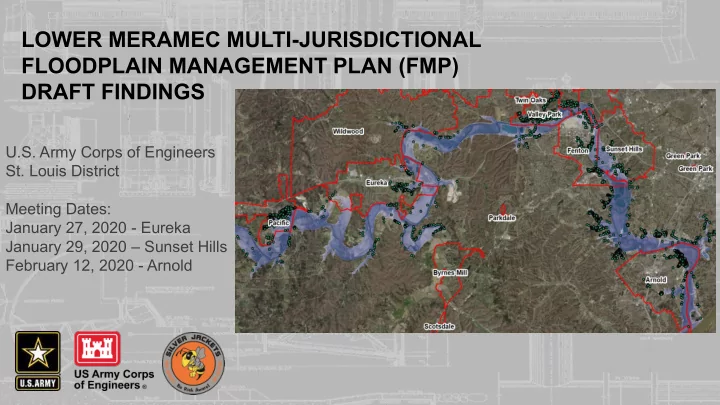
LOWER MERAMEC MULTI-JURISDICTIONAL FLOODPLAIN MANAGEMENT PLAN (FMP) DRAFT FINDINGS U.S. Army Corps of Engineers St. Louis District Meeting Dates: January 27, 2020 - Eureka January 29, 2020 Sunset Hills February 12, 2020 - Arnold 2


slide-1
SLIDE 1

LOWER MERAMEC MULTI-JURISDICTIONAL FLOODPLAIN MANAGEMENT PLAN (FMP) DRAFT FINDINGS

U.S. Army Corps of Engineers

  • St. Louis District

Meeting Dates: January 27, 2020 - Eureka January 29, 2020 – Sunset Hills February 12, 2020 - Arnold

slide-2
SLIDE 2

2

  • 1. Meramec Basin History
  • 2. Introduction of partners
  • 3. Background and coordination of Floodplain Management Plan
  • 4. Report contents
  • 5. Summary of Findings
  • 6. Highlights of significant measures to reduce flood risk
  • 7. Action Plan
  • 8. Potential Funding Sources
  • 9. Next Steps

10.The Nature Conservancy Floodplain Prioritization Tool 11.Q&A 12.End of formal meeting / opportunity to meet with partners

AGENDA

slide-3
SLIDE 3

3

Meramec Basin Plan (1964)

  • Authorized reservoirs in the Meramec River Basin
  • Significant public opposition during referendum
  • De-authorized by Congress in 1990

Lower Meramec Flood Damage Reduction Study (1987)

  • Specifically prohibited reservoir alternative
  • Considered array of structural alternatives throughout the Basin
  • Resulted in Valley Park Levee construction

PREVIOUS MERAMEC BASIN STUDIES

slide-4
SLIDE 4

4

PARTNERS

slide-5
SLIDE 5

5

FLOODPLAIN MANAGEMENT PLANNING

Follows a 10-step planning process: Step 1. Organize Step 2. Involve the public Step 3. Coordinate Step 4. Assess the hazard Step 5. Assess the problem Step 6. Set goals Step 7. Review possible activities Step 8. Draft an action plan Step 9. Adopt the plan Step 10. Implement, evaluate, revise.

Steps included in FMP Schedule Step performed by communities

slide-6
SLIDE 6

6

PARTNER & PUBLIC COORDINATION

Partner

  • Planning Committee, Advisory Group, NGO’s,

Legislative/Congressional Staff

  • 5 In-person scheduled Partner Meetings
  • 5 Partner Update Webinars

Public

  • 3 Public Workshops (Arnold, Pacific, Sunset Hills) to Gather

Information

  • Public comment period
  • USACE National Nonstructural Committee Assessment of 17 structures

in the Lower Meramec Basin

  • 3 Public Meeting to Share Findings
slide-7
SLIDE 7

7

REPORT CONTENTS

Executive Summary List of Figures List of Tables List of Appendices 1. Introduction 2. Floodplain Management Plan Development 3. Future Conditions 4. Floodplain Hazard Assessment 5. Consequences Assessment 6. Goals and Objectives 7. Strategies and Tools 8. Action Plan 9. References Appendix A – Public Involvement Results Appendix B – Floodplain Ordinances for Communities* Appendix C – FMP Participation Resolutions Appendix D – USACE National Nonstructural Committee Assessment Appendix E – USACE Analysis of National Nonstructural Committee Assessment Appendix F – Healthy Watershed Funding Options Appendix G – Flood Insurance Rates Maps Appendix H – Model FEMA CRS Checklist

* Appendix B only has 3 communities’ ordinances (Arnold, Eureka, St. Louis County)

slide-8
SLIDE 8

8

FEMA FLOODPLAIN MAPS (FIRMS)

County Initial Countywide Effective Date Revised Countywide Effective Date(s) Anticipated Countywide Updates Franklin October 18, 2011 2021-2022 Jefferson April 5, 2006 June, 2019

  • St. Louis

August 2, 1995 August 23, 2000 February 4, 2015 2021

FEMA conducted a Flood Insurance Study for Jefferson County June, 2019 Revisions are anticipated for:

  • St. Louis County in 2021
  • Franklin County in 2021-2022

The data acquired from the Flood Insurance Study (FIS) and Flood Insurance Rate Maps (FIRMs) informed this Floodplain Management Plan (FMP). FIRMs can be found on SEMA’s website.

slide-9
SLIDE 9

9

Example: Effective vs. Preliminary FIRMs

slide-10
SLIDE 10

10

LIST OF POTENTIAL TOOLS

TOOLS EVALUATION

Land Use Policies and Regulations EFFECTIVE RECOMMENDED Public Alert Flood Warning System EFFECTIVE RECOMMENDED Warning Dissemination, Multi-Media EFFECTIVE RECOMMENDED Flood Emergency Preparedness Plans (or EAPs) EFFECTIVE RECOMMENDED Development Policies - Moratorium EFFECTIVE NOT RECOMMENDED Structure Elevations EFFECTIVE RECOMMENDED Buyouts (Structure and Land Acquisition) EFFECTIVE RECOMMENDED Flood proofing (Wet & Dry) EFFECTIVE RECOMMENDED Community Education and Advocacy EFFECTIVE RECOMMENDED Temporary Flood Risk Adaptive Measures EFFECTIVE RECOMMENDED Information and Education EFFECTIVE RECOMMENDED Flood Insurance EFFECTIVE RECOMMENDED Community Rating System (CRS) EFFECTIVE RECOMMENDED Local Drainage and Utility Protection EFFECTIVE FURTHER EVALUATION NEEDED Tax Adjustments EFFECTIVE FURTHER EVALUATION NEEDED Post-Flood Recovery Processes EFFECTIVE RECOMMENDED Wetlands, Stream, and Riparian Protection and Restoration EFFECTIVE RECOMMENDED Enhancement of Recreation and Education Opportunities EFFECTIVE RECOMMENDED Detention/Retention Basins EFFECTIVE FURTHER EVALUATION NEEDED Levees and Floodwalls EFFECTIVE FURTHER EVALUATION NEEDED

slide-11
SLIDE 11

11

LIST OF MEASURES WE CONSIDERED

Physical Nonstructural Measures Nonphysical Nonstructural Measures Elevation Flood Warning Systems Relocation Flood Insurance Buyout/Acquisition Floodplain Mapping (FIRM) Dry Floodproofing Flood Emergency Preparedness Plans Wet Floodproofing Land Use Regulations Evacuation Plans (EAPs) Risk Communication

slide-12
SLIDE 12

12

CONSEQUENCES / STATISTICS

  • The 1-percent AEP flood event recommendations identify the cost and approach

to mitigating all 942 structures that are expected to be damaged during such a potential flood event.

  • Of the structures located within the 1% floodplain in the Lower Meramec Basin,
  • 162 (17%) are recommended to be elevated,
  • 122 (13%) are recommended to be acquired,
  • 357 (38%) are recommended to be flood proofed,
  • 254 (27%) are recommended to be relocated, and
  • 47 (5%) had inundation below the first floor, and therefore only required either

a sewer check valve or relocation of utilities.

slide-13
SLIDE 13

13

COMMUNITY RATING SYSTEM (CRS)

EFFECTIVE RECOMMENDED

  • The CRS is a national program through

FEMA and the National Flood Insurance Program (NFIP) that evaluates a community’s floodplain management efforts;

  • Can result in National Flood Insurance

premium reductions;

  • FEMA is currently reviewing the draft

Floodplain Management Plan and will assign preliminary CRS points

slide-14
SLIDE 14

14

LAND USE POLICIES AND REGULATIONS

EFFECTIVE RECOMMENDED

Potential Land Use Policies and Regulations

  • Building restrictions in the floodplain
  • Bringing in fill
  • Freeboard requirements (Number of Feet Above Base Flood Elevation)

Jefferson County

  • Floodplain ordinance adopted in March 2006 and recently revised on June 20, 2019.
  • Regulation aimed at restricting new development in the floodplain
  • Includes requirements for building in Special Flood Hazard Areas (SFHA)
  • Includes requirement that residential and non-residential construction in SFHA shall be

elevated to BFE +3 ft.

  • Model ordinances available through SEMA
slide-15
SLIDE 15

15

ORDINANCE TABLE

Community Name Free board (Feet) Repetitive Loss Definition Non Conforming Use Mandatory Disclosure Critical Development Protection Additional Floodway Requirement Hazardous Materials Cumulative Substantial Damage/ Improvement Setbacks Stream Buffer Enforcement (min 100.00) Eureka 1 X X 500 Pacific 2 X X X X 100 Union 2 1000 Valley Park 1 X X 500 Sunset Hills 1 X X 500 Arnold 3 X X 500 Franklin Co. 2 X X X X X X 100

  • St. Louis Co.

1 X X X Jefferson Co. 3 X X X X 1000 Wildwood 2 X X X Fenton 2 X X X X 500

slide-16
SLIDE 16

16

COMMUNITY EDUCATION AND ADVOCACY

EFFECTIVE RECOMMENDED

  • Communication between a unit of government and its constituents,

at any and all levels, creates trust and a sense of shared responsibility for the citizens

  • There must be a balance between community activism and governance
  • It is recommended for the cities and counties in the Lower Meramec Basin to form an official

committee or group that has representatives from the city government, private citizens, and any other county or municipal representatives deemed beneficial to the committee.

  • The mission of this committee will be to openly communicate the risk of living in or near a

floodplain and to host public meetings, both formal and informal, to help citizen and business

  • wners prepare for and respond to all types of natural disasters (including flooding).
slide-17
SLIDE 17

17

PUBLIC ALERT AND WARNING SYSTEM

EFFECTIVE RECOMMENDED

  • Many communities participate in and promote

the CodeRED Alert system.

  • Recommended to install flood warning lights

near intersections and roads that are flood prone.

  • Recommended to continue using Meramec

River gages as well as National Weather Service predictions to help plan for potential evacuations and emergency situations.

  • USGS Flood Inundation Mapper

https://wimcloud.usgs.gov/apps/FIM/FloodInundationMapper.html

slide-18
SLIDE 18

18

EMERGENCY ACTION PLAN

EFFECTIVE RECOMMENDED

Inter-related to the flood warning system is an emergency preparedness plan for flooding. Generally speaking, emergency preparedness plans include several topics related to identifying the risk:

  • Emergency operation plans based on

indicators or stages of the magnitude of the risk;

  • Emergency communication plans;
  • Emergency evacuation plans;
  • After action plans.
slide-19
SLIDE 19

19

DEVELOPMENT POLICIES - MORATORIUM

EFFECTIVE NOT RECOMMENDED

  • A moratorium on development in the floodplain would prohibit any building in the floodplain by

law until a specified time when solutions could be created to reduce the flooding impacts from the Meramec River.

  • In researching the moratorium, it was determined that such a measure would only impact a

very small number of vacant properties in the Lower Meramec communities and might be considered a “taking” if implemented. These factors do not lend to this tool being considered moving forward.

44 CFR 60.3(d)(3): In the regulatory floodway, communities must prohibit encroachments, including fill, new construction, substantial improvements, and other development within the adopted regulatory floodway unless it has been demonstrated through hydrologic and hydraulic analyses performed in accordance with standard engineering practice that the proposed encroachment would not result in any increase in flood levels within the community during the

  • ccurrence of the base flood discharge. (FEMA Regulation)
slide-20
SLIDE 20

20

TEMPORARY FLOOD RISK MEASURES

EFFECTIVE RECOMMENDED

Common temporary measures: 1) polyethylene sheeting attached or hung onto the structure exterior in combination with door and window closures; 2) clear liquid sealant applied to the structure exterior in combination with caulking of large cracks in the exterior and placement of door and window closures; 3) sandbag berms located around all or a portion of the structure; 4) any of the barriers certified through the National Flood Barrier Testing and Certification Program https://nationalfloodbarrier.org/

slide-21
SLIDE 21

21

FLOOD RISK ADAPTIVE MEASURES

EFFECTIVE RECOMMENDED

USACE National Non-Structural Committee results documented in Appendix D

  • Elevation
  • Wet floodproofing

  • Dry floodproofing
  • Sewer check valves
  • Relocate utilities

Appendix E

  • Further environmental and economic

analysis determined the final recommendations

  • Full structure list with recommendations
slide-22
SLIDE 22

22

STRUCTURE ELEVATIONS

EFFECTIVE RECOMMENDED

  • Elevating structures involves raising the

structure in place to reduce frequency and/or depth of flooding during high-water events.

  • Elevation can be completed on fill, foundation

walls, piers, piles, posts or columns. Selection of proper elevation method depends on flood characteristics such as flood depth or velocity and condition of the structure and site.

slide-23
SLIDE 23

23

ACQUISITION (STRUCTURE AND LAND BUYOUT)

EFFECTIVE RECOMMENDED

The rationale for acquisition was based

  • n

identification

  • f

acquisition as the least cost mitigation approach, except when:

  • Total cost is within 25% of other nonstructural

measures It was assumed that since acquisition completely removes the flood hazard into perpetuity, that the property

  • wner

and city would elect to pay marginally more to acquire the structure rather than select a mitigation measure that does not fully remove the risk of damage.

Environmental Hubs

slide-24
SLIDE 24

24

WETLAND RESTORATION, OPEN SPACE, & RECREATION

EFFECTIVE RECOMMENDED

Reducing flood risk through open space preservation and habitat restoration is a large scale proposition based on watershed size, topography and rainfall intensity. In general, an effectively applied tool requires: 1. identification or mapping of available open space, 2. prioritization of parcels, 3. acquisition of property or educate/inform landowners about available incentivized conservation programs and 4. restoration of habitat types that attenuate or reduce the floodwater velocities.

  • City & County parks and recreation systems

include park sites, including general parkland, sports fields and courts, picnic facilities, natural resource areas and related support facilities.

  • Open space along a stream provides for an

area that is free and clear of man-made structures to allow stormwater runoff and flood waters to flow unobstructed, as nature intended.
slide-25
SLIDE 25

25

ACTION PLAN

Lower Meramec Multi-Jurisdictional Floodplain Management Plan Action Plan: 1) Adopt the Lower Meramec Multi-Jurisdictional FMP 2) Implement Nonstructural Recommendations in Appendix E ** 3) Develop/Update a Comprehensive Public Outreach Plan 4) Develop/Update a Flood Emergency Preparedness Plan (and Evacuation Plan) 5) Adopt/Update Higher Regulatory Floodplain Management Standards 6) Maintain and Expand the Existing Flood Warning Systems 7) Join the CRS **See Table outside with Maps/Property List Tables

slide-26
SLIDE 26

26

Grants

  • FEMA
  • HUD
  • EPA
  • USFWS
  • State (DNR, DOC, DOT)
  • Mo NRCS
  • Mo Conservation Heritage Foundation
  • National Fish and Wildlife Foundation
  • Other NGO’s

Loans

  • MoDNR
  • EPA
  • USDA
  • HUD

Capital Improvement Plans Bonds

  • General Obligation, Revenue, Green

Taxes

  • Sales Tax
  • Watershed Improvement District
  • Community Improvement District
  • Neighborhood Improvement District
  • TIF District
  • Soil and Water Conservation Sub-district

Fees

  • Stormwater Fees
  • Development Impact Fee
  • Fee In-Lieu of Stormwater Management Practices
  • On-Bill Donations

Incentive Programs

  • Environmental Incentives or Pay-for-Performance
  • Stormwater Credits

APPENDIX F: POTENTIAL FUNDING SOURCES

slide-27
SLIDE 27

27

  • USACE CAP Eureka 205 - ongoing
  • USACE CAP Projects in Pacific and Arnold
  • have been requested to USACE HQ
  • FEMA – Updating FIRMS
  • USGS/USACE – Flood inundation mapping study

https://wimcloud.usgs.gov/apps/FIM/FloodInundationMapper.html

  • TNC’s Floodplain Prioritization Tool using Lower Meramec as pilot project

ONGOING INITIATIVES

slide-28
SLIDE 28

28

Tentative Timeline:

  • February, 2020 – FEMA Preliminary CRS Review Complete (estimated)
  • March, 2020 – Final FMP Transmitted to Partners

City and County governments may then formally adopt the final FMP. It is also recommended that the FMP is reviewed and updated regularly.

NEXT STEPS

slide-29
SLIDE 29

29

Lower Meramec Floodplain Prioritization Tool

slide-30
SLIDE 30

30

Multiple Benefits of Floodplains

slide-31
SLIDE 31

31

The Lower Meramec Floodplain Prioritization Tool allows the user to identify opportunities for floodplain conservation and restoration. The tool is designed to help decision-makers optimize their investments and minimize the impacts of development.

Link to the FP Tool: https://maps.freshwaternetwork.org/meramec- floodplain/ Note: The Tool is not compatible with Internet Explorer

slide-32
SLIDE 32

32

  • Buyouts in floodplains
  • Restoring floodplains & wetlands
  • Open space conservation
  • Protecting & restoring habitat along

rivers

  • Flood-friendly culverts
  • Green Stormwater Infrastructure

Nature-based Solutions

NRCSOLUTIONS.ORG/

Naturally Resilient Communities Website:

slide-33
SLIDE 33

33

Flood frequency Spatial scale Action type

slide-34
SLIDE 34

34

Environmental, Economic and Social Data

slide-35
SLIDE 35

35

Prioritization Example

Restorable area Restoration Rank

slide-36
SLIDE 36

36

Topographic or Imagery

slide-37
SLIDE 37

37

Floodplain Management Plan Environmental Hub Analysis

slide-38
SLIDE 38

38

Structures in the 1% Annual Exceedance Probability Floodplain

slide-39
SLIDE 39

39

Barbara Charry Strategy Manager: Floodplains & Nature-Based Solutions Barbara.Charry@tnc.org Link to the Lower Meramec Floodplain Prioritization Tool: https://maps.freshwaternetwork.org/meramec-floodplain/

slide-40
SLIDE 40

40

Ground rules:

  • 1. No questions pertaining to pending litigation.
  • 2. Ask questions pertaining to the whole community;

individual property questions can be addressed one-

  • n-one with the Partners after the Q&A portion of the

meeting.

  • 3. Q&A will end in 25 minutes so that there is time to

speak with the Partners individually.

QUESTION AND ANSWER PERIOD

slide-41
SLIDE 41

41

END OF PRESENTATION

Additional Public Engagement

  • Partners in the Room
  • Summary of Findings Sheet
  • FAQ Sheet

https://www.mvs.usace.army.mil/missions/programs-project-management/lower-meramec-basin/