
SLIDE 1
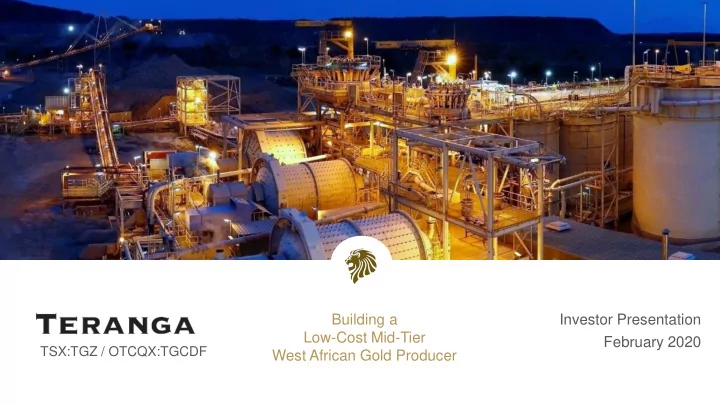
Low-Cost Mid-Tier February 2020 TSX:TGZ / OTCQX:TGCDF West African - - PowerPoint PPT Presentation
Building a Investor Presentation Low-Cost Mid-Tier February 2020 TSX:TGZ / OTCQX:TGCDF West African Gold Producer Forward-Looking Statements All information included in this presentation, including any information as to the future financial or
2
All information included in this presentation, including any information as to the future financial or operating performance and other statements of Teranga Gold Corporation (“Teranga”) that express management’s expectations or estimates of future performance, other than statements of historical fact, constitute forward-looking information or forward-looking statements within the meaning of applicable securities laws and are based on expectations, estimates and projections as of the date hereof. Forward-looking statements are included for the purpose of providing information about management’s current expectations and plans relating to the future. Wherever possible, words such as “plans”, “expects”, “scheduled”, “trends”, “indications”, “potential”, “estimates”, “predicts”, “anticipate”, “to establish”, “believe”, “intend”, “ability to”, or statements that certain actions, events or results “may”, “could”, “would”, “might”, “will”, or are "likely" to be taken, occur or be achieved, or the negative of these words or other variations thereof, have been used to identify such forward-looking information. Specific forward-looking statements include, without limitation, all disclosure regarding future results of operations, economic conditions and anticipated courses of action. Although the forward-looking statements contained herein reflect management's current beliefs and reasonable assumptions based upon information available to management as of the date hereof, Teranga cannot be certain that actual results will be consistent with such forward-looking information. Such assumptions include, among others, the ability to obtain any requisite governmental approvals, the accuracy of mineral reserve and mineral resource estimates, gold price, exchange rates, fuel and energy costs, future economic conditions, anticipated future estimates of free cash flow, courses of action, the anticipated impact of combining the two assets, including anticipated synergies, and the potential for the combined Sabodala-Massawa complex to become a top tier gold asset. Teranga cautions you not to place undue reliance upon any such forward-looking statements. The economic analysis presented in the Massawa Technical Report was prepared by Barrick in respect of its feasibility study for a standalone development plan and proposed mining operation at
by Barrick. However, readers are cautioned that as Teranga proposes to process the Massawa deposits at its existing Sabodala Project, the economic analysis presented in the Massawa Technical Report should not be considered as representing the economic outcome stemming from an integrated Sabodala-Massawa mining complex. The risks and uncertainties that may affect forward-looking statements include, among others, the inherent risks involved in exploration and development of mineral properties, including government approvals and permitting, changes in economic conditions, changes in the worldwide price of gold and other key inputs, changes in mine plans and other factors, such as project execution delays, many
Teranga to be materially different from estimated future results, performance or achievements expressed or implied by forward-looking information or forward-looking statements, please refer to Teranga’s latest Annual Information Form filed with Canadian securities regulatory authorities at www.sedar.com or on Teranga’s website at www.terangagold.com. The risks described in the Annual Information Form (filed and viewable on www.sedar.com and on Teranga’s website at www.terangagold.com) are hereby incorporated by reference herein. Teranga disclaims any intention or obligation to update or revise any forward-looking statements whether as a result of new information, future events or otherwise, except as required by applicable law. Nothing herein should be construed as either an offer to sell or a solicitation to buy or sell Teranga securities. This presentation is dated as of February 21, 2020. All references to Teranga include its subsidiaries unless the context requires otherwise. This presentation contains references to Teranga using the words “we”, “us”, “our” and similar words and the reader is referred to using the words “you”, “your” and similar words.
ALL DOLLAR AMOUNTS ARE DENOMINATED IN U.S. DOLLARS UNLESS SPECIFIED OTHERWISE
3 Massawa was discovered by Randgold Resources Limited, which merged with Barrick effective January 1, 2019. On July 23, 2019, Barrick voluntarily filed a technical report under National Instrument 43-101 – Standards of Disclosure for Mineral Projects (“NI 43-101”) on the Feasibility Study of the Massawa Gold Project, Senegal (the “Massawa Feasibility Study”). The Massawa Feasibility Study disclosed mineral resource statements as well as mineral reserve estimates as of December 31, 2018, which remain current for Barrick as of the date hereof. As the mineral resource and mineral reserve estimates pre-date Teranga’s agreement to acquire Massawa, Teranga is treating them as “historical estimates” under NI 43-101, but they remain relevant as the most recent mineral resource and reserves estimates for Massawa. Further drilling and resource modelling would be required to upgrade or verify these historical estimates as current mineral resources
agreement to acquire Massawa. A Teranga “Qualified Person” under 43-101 has not done sufficient work to classify the historical estimate as current mineral resources or mineral reserves for the combined Sabodala-Massawa Complex and Teranga is not treating the historical estimate as current mineral resources or mineral reserves.
This presentation includes market and industry data which was obtained from various publicly available sources and other sources believed by Teranga to be true. Although Teranga believes this information to be reliable, Teranga has not independently verified any of the data from third-party sources referred to in this presentation, or analyzed or verified the underlying reports relied upon or referred to by such sources, or ascertained the underlying assumptions relied upon by such sources. Teranga does not make any representation as to the accuracy of such information.
ALL DOLLAR AMOUNTS ARE DENOMINATED IN U.S. DOLLARS UNLESS SPECIFIED OTHERWISE.
4
Stage Achieved commercial production November 1, 2019 2019 Production† 47,492 oz Au(7) 2019 AISC/oz*(10) $938/oz Au 2P Reserves 1.6Moz @ 1.59 g/t Au(8)
Stage Exploration/PFS Indicated Resource 415koz @ 2.02 g/t Au(9) Inferred Resource 644koz @ 1.68 g/t Au(9)
Stage Early Exploration
Stage Production 2019 Production 241,276 oz Au(2) 2019 AISC/oz* $807/oz Au 2P Reserves 2.2Moz @ 1.33 g/t Au(3)
Mali Guinea Sierra Leone Liberia Ghana Benin Niger Togo West African Birimian Greenstone Belt
Stage Development Years 1-10 Average Production 203koz Au/year Historical 2P Reserves 2.6Moz @ 3.94 g/t Au(5)
*Refer to Non-IFRS Performance Measures in the Appendix. †Life of mine initial 5-year average of 132koz Au per year. Refer to Endnotes (1), (2), (3), (4), (5), (7), (8), (9) and (10) in the Appendix.
5
5
*Refer to Non-IFRS Performance Measures in the Appendix.
6
6
Top 20 Institutional Shareholders % of o/s Shares
1 Tablo Corporation (David Mimran) 22.1 2 Ruffer LLP 5.9 3 Van Eck Associates 5.6 4 Dimensional Fund Advisors, L.P. 4.4 5 Konwave AG 1.7 6 Franklin Advisers, Inc. 1.7 7 Invesco Advisers 1.6 8 Heartland Advisors, Inc. 1.4 9 SSI Wealth Management 1.1 10 Stabilitas GmbH 0.9 11 IPConcept 0.9 12 Mackenzie Financial 0.9 13 AgaNola AG 0.8 14 British Columbia Investment Management 0.8 15 Earth Resource Investment Group 0.8 16 DWS Investment Management America 0.8 17 azValor Asset Management 0.7 18 AMG Fondsverwaltung AG 0.6 19 LSV Asset Management 0.5 20 Ethenea Independent Investors S.A. 0.5
Total shares held by top 20 shareholders 53%
7
Source: Nasdaq IR Insight as at February 21, 2020
Analyst Coverage Rating Target Price
(C$)
Canaccord Genuity Buy $11.50 Cormark Securities Top Pick $13.00 Eight Capital Buy $11.50 RBC Capital Markets Outperform $8.50 Average $11.13
The research firms listed above provide research on Teranga and its securities. The information, estimates, and recommendations of these analysts regarding Teranga’s performance are theirs alone and do not represent that of Teranga and its management. Teranga does not by its reference above imply endorsement of or agree with such information.
Following the closing of the Massawa acquisition expected in Q1 2020, Barrick Gold is expected to become Teranga’s second largest investor with a pro forma ownership of 11.5%. 74% 41% 18%
Dec '18 Dec '19
TSX:TGZ GDXJ Index Gold Price
2019 Share Price Performance
8
9
Masato Mamasato Kouroundi Kerekounda Kourouloulou Golouma South Koulouqwinde Koutoniokollo Kinemba East Kobokoto Goumbati West Maki Medina Golouma West Golouma North Soukhoto Niakafiri East Niakafiri West Diadiako Gora
Permitted mining license: 291 km2 *Refer to Non-IFRS Performance Measures in the Appendix Refer to Endnotes (1),(2),(3),(10),(11) and (12) in the Appendix
2P Reserves at 1.33 g/t Au(3)
M&I Resources at 1.52 g/t Au(3) Mine Life(1)
Sabodala
2018-2022
Refer to Endnotes (1), (2), (3), (11), (12), and (13) in the Appendix.
(Koz Au)
10
17 131 214 207 212 182 217 233 245 241 2010 2011 2012 2013 2014 2015 2016 2017 2018 2019
*Refer to Non-IFRS Performance Measures in the Appendix
$/oz Au sold
2019 Actual Guidance Cost of sales $1,015 $1,050 - $1,125 T
$690 $725 - $775 All-in sustaining costs* $857 $900 - $975 Cash/(non-cash) inventory movements and amortized advanced royalty costs ($50) ($75) All-in sustaining costs (excluding cash/(non-cash) inventory movements and amortized advanced royalty costs)* $807 $825 - $900
11
Refer to Endnotes (14), (15) and (16) in the Appendix.
12
Massawa Gold Project
Sofia Tina Delya
Sabodala +4Mtpa CIL Plant
Massawa (CZ & NZ) Senegal Map View
Bambaraya
30km
FROM THE PLANT Map not drawn to scale.
13
– Reduces phase 1 and phase 2 capex for standalone mill and infrastructure – Minimal infrastructure development anticipated to initiate mining at Massawa project and process free-milling ore at Sabodala
argeting near-term higher production and lower costs at pro forma Sabodala-Massawa complex with an optimized mine schedule to be defined in technical studies
eranga anticipated to transition to a low-cost, mid-tier gold producer – as a result, cash margins and free cash flows* are expected to increase commensurate with the increased production
eranga will continue to progress its attractive organic pipeline, including Golden Hill – an advanced exploration project
eranga’s repositioning as a low-cost mid-tier West African gold producer
current mineral reserves base of 2.4Moz from 55.7Mt at 1.35 g/t(3)
*Refer to Non-IFRS Performance Measures in the Appendix. Refer to Endnotes (3), (4), (5), (14), (15) and (16) in the Appendix.
14
eranga has entered into a definitive agreement pursuant to which it will acquire a 90% interest in the Massawa Gold Project from a wholly-owned subsidiary of Barrick Gold Corporation (“Barrick”) and Compagnie Sénégalaise de Transports Transatlantiques Afrique de l’Ouest SA (“CSTTAO”) (collectively, the “ Vendors”)
‒ $225 million will be funded by existing lender Taurus Funds Management, including $25 million to be provided by Barrick ‒ Balance to be funded through a private placement to the Vendors and a public offering
following completion of Transaction or January 31, 2023(17)
ablo, controlled by T eranga director David Mimran, expected to invest $45 million to retain 21.2% ownership on a pro forma basis
eranga (pro forma basis) and is entitled to nominate one member to the Company’s board of directors so long as it retains 10% equity ownership
financing, each of which are also inter-conditional
Refer to Endnote (17) in the Appendix.
221 227 201 245 237 206 245 115 162 175 25 50 100 150 200 250 300
Year 1 Year 2 Year 3 Year 4 Year 5 Year 6 Year 7 Year 8 Year 9 Year 10 Year 11
15
Standalone Life of Mine Production(100% basis)(4) $1,200/oz Pit Shell Gold Price Pit Shell Gold Price $1,200/oz Economics(4)
After-Tax NPV5%
$M
421 After-Tax IRR
%
28
Operational Summary(4)
Total Ore Mined
Mt
21 Average Grade
g/t Au
3.94* Contained Gold
Moz
2.6 Total Tonnes Mined
Mt
166 Average Strip Ratio
w:o
6.9 Average Production
Koz
201 Total Production
Moz
2.1 Mine Life
Years
10+
Cost Summary(4)
Mining Cost
$/t mined
3.55 Haulage Cost
$/t milled
1.25 Plant Cost
$/t milled
18.02 G&A Cost
$/t milled
8.60
Capex Summary(4)
Construction incl. of BIOX
$M
413 BIOX Capital
$M
80 Sustaining
$M
16 Rehabilitation Cost
$M
23
$421 $550 $677 $805
$1,200/oz $1,300/oz $1,400/oz $1,500/oz
Standalone Net Present Value (5%) Gold Price Sensitivity (100% basis)(4) $1,200/oz Pit Shell Gold Price ($M)
*Ore reserve grade Refer to Endnote (4) in the Appendix.
16
(July 2019 Massawa Feasibility Study)
(Year-to-date as at September 30, 2019*)
$333 million for all phase 1 and phase 2 infrastructure +4Mtpa mill & TSF within ~30 km from Massawa
$3.55/t mined (contractor; LOM) + $1.25/t ore haul to standalone mill $2.86/t mined*
$18.02/t milled (LOM), including BIOX $11.39/t milled*
$8.60/t milled or ~$17 million/year $4.71/t milled*
2-year build; 10+ year mine life 13-year mine life
(relative to July 2019 Massawa Feasibility Study)
*Year-to-date as at September 30, 2019. Refer to Endnotes (4) and (15) in the Appendix.
17
(Mtpa)
2020E 2021E 2022E 2023E 2024E 2025E
Sabodala Ore 2P Reserves Contained Metal
(Moz Au)
Annual Production
(koz Au)
+4Mtpa Sabodala Current Mill Capacity
*Refer to Endnotes (2), (3), (4) and (5) in the Appendix. Subject to integrated technical studies. **Refer to Non-IFRS Performance Measures in the Appendix.
2P Reserve Grade
(g/t Au)
1.35(3) 3.94(5)
0.5 1 1.5 2 2.5 3 3.5 4 4.5Sabodala Massawa
Massawa Project Ore Prioritize high-grade ore for maximum free cash flow**
2.4(3) 2.6(5)
2.3 2.35 2.4 2.45 2.5 2.55 2.6 2.65Sabodala Massawa
241(2) 203(4)
Sabodala 2019 Massawa LOM Average (First 10 Years)
18
SOURCE: OUTOTEC.COM Refer to Endnote (4) in the Appendix
19
Massawa Gold Project
Tina Bambaraya Delya
Sabodala +4Mtpa CIL Plant
Sofia
Sabodala-Sofia Shear Zone Main Transcurrent Shear Zone
Massawa (CZ & NZ)
30km
FROM THE PLANT
Map not drawn to scale.
Not included in initial 2020 exploration guidance
20
including $25 million to be provided by Barrick as a part of the lending syndicate
right); (ii) 4 million Teranga call rights*
– $75 million in cash to be paid as part of the Massawa acquisition – $80 million in Teranga common shares to the Vendors – $76 million to be retained for deal costs, reserve development, exploration of Teranga’s existing portfolio and working capital purposes
Completion of the acquisition facility, equity offering, and private placement are all inter-conditional upon completion of the transaction. *Strike price equal to 120% of the 5-day volume weighted average price of Teranga on the date of the announcement of the Transaction. Refer to Endnote (17) in the Appendix
21
Source: Company materials, Capital IQ, equity research. *Based on consensus equity research estimates. As at December 6, 2019 1.26x 1.19x 1.00x 0.96x 0.83x 0.72x 0.69x 0.66x 0.60x 0.49x
B2Gold Centamin Perseus Endeavour Golden Star Resolute Roxgold Semafo Teranga Asanko
6.2x 6.1x 5.8x 4.6x 4.4x 3.6x 3.6x 3.0x 2.8x 2.7x
Centamin Perseus B2Gold Endeavour Golden Star Resolute Asanko Roxgold Semafo Teranga
$981 $949 $943* $916 $871 $821 $800 $789 $779 $702
Perseus Asanko Teranga Resolute Centamin Golden Star Semafo Endeavour B2Gold Roxgold
8.24 3.94(5) 3.36 2.86 1.70 1.57 1.50 1.47 1.44 1.32 1.16
Roxgold Massawa SEMAFO Golden Star Endeavour Asanko Resolute Perseus Teranga B2Gold Centamin
22
*Not to be interpreted as Teranga’s production and cost guidance for 2020. **Net of 50% JV with Gold Fields. Refer to Endnotes (4) and (5) in the Appendix. Source: Company materials, Capital IQ, equity research.
1,020 751 511 492 424 334* 315 228 203(4) 134 119
200 400 600 800 1,000 1,200 1,400 1,600B2Gold Endeavour Centamin Resolute Semafo Teranga Perseus Golden Star Massawa Life of Mine Average Years 1-10 Roxgold Asanko
8.7 7.3 6.7 6.4 4.0 3.3 2.9 2.6(5) 2.6 1.8 0.7
Endeavour Centamin Resolute B2Gold Teranga Perseus SEMAFO Massawa Asanko Golden Star Roxgold ** Project Project
67% 21% 11% 1%
23
*The Company used the February 20, 2020 closing share price of C$8.48 and US$/CDN exchange rate of 1.3209. **Before transaction related costs
Capital Structure
(millions, except per share amount) As at February 20, 2020
Transaction Adjustment Pro Forma Basic shares outstanding 107.6 59.8 167.4 T eranga share price* C$8.48 C$8.48 Basic market capitalization* $691 $1,074 Cash & Debt (millions)
As at December 31, 2019
Transaction Adjustment Pro Forma Cash & cash equivalents $30 $76** $106 Cash from in-the-money securities* $26 $26 T
$202 $225 $427
24
25
*Refer to Non-IFRS Performance Measures in the Appendix. **Pre-production capital costs of $240 million excludes $16 million in construction readiness activities spent prior to major construction Refer to Endnotes (6), (7), (8), (10), (11) and (18) in the Appendix
Mine Life(6)
2P Reserves at 1.61 g/t Au(8)
M&I Resources at 1.59 g/t Au(8)
Raul
2020-2024
26
Raul
Plant Reserve Deposits Exploration T argets
Permitted mining license: 89 km2
Kafina West Hillside Bagu Sud Korindougou Ouahiri
Sud
Raul Kondandougoug Konatvogo Bazogo Bassongoro Samavogo North
Muddhi Petit Colline
27
Sources ¹ Press Release, SEMAFO (March 5, 2019) ² Press Release, Roxgold (July 11, 2019) ³ Annual Information Form, Endeavour Mining (March 26, 2019) ⁴ Press Release, Sarama Resources (September 4, 2019) ⁵ MD&A, Sarama Resources (August 27, 2019)
6 MD&A, Sarama Resources (August 27, 2019)
M&I Resources are inclusive of P&P Reserves
Mana & Siou M&I: 4.2Moz ¹ Houndé M&I: 3.1 Moz ³ Yaramoko M&I: 1.3Moz ² Acacia JVs South Houndé JV Inferred: 2.1Moz ⁴
Interpreted Geology
Andesite Basalt Basin Batholith Chert Granitoid Tarkwaian
Burkina Faso, West Africa
Mineral Resource: (9) Indicated: 415koz @ 2.02 g/t Au Inferred: 644koz @ 1.68 g/t Au
ACC Holdings Permits Teranga/ACC Holdings JV
(Dossi Permit)
ThreeBee Project M&I: 0.3Moz 6 Karankasso JV M&I: 0.7Moz ⁵
28
(9) Indicated
(9) Inferred
For full details on Golden Hill, please visit www.terangagold.com Refer to Endnote (9) in the Appendix
29
Geology
Tarkwaian Type Sediments Volcano Sediments Mixed Volcano Sediments & Volcanics Basalt Grantoid Batholith
Ma North
Exploration licenses:468 km2 Ma Main Ma East Nahiri Gogoba West Nahiri Plateau Jackhammer Hill Peksou North Peksou C-Zone B-Zone A-Zone Ma Far North Ma South Gogoba North Sebe Nahiri South Intie Copper MAIN SHEAR ZONE
Included in mineral resource estimate
Ma Jonction Jackhammer Hill Offset
Considerable expansion of the Ma Structural Complex
30
31
Agbaou Ity Yaouré T
Bonikro
Côte d’Ivoire represents more than one-third of the West African Birimian Greenstone Belt
Operating Gold Mine/ Development Project
(100% earning, 3% NSR; JV formed June 2016)
(51%, earning 70%; JV formed December 2017)
Miminvest Permits
Afema Permits
Côte d'Ivoire 35% Burkina Faso 21% Ghana 19% Guinea 11% Mali 10% Other 4%
Sissingué
T
Operating Gold Mine/Development Project
Guitry
Sissingué Agbaou Ity Yaouré Bonikro
32
Afema Geophysical Survey: Reduced-to-Pole Magnetic Intensity 33 Ahafo 17 Moz Newmont
3 Afema Exploration Permits Afema Mining Permit
Bibiani 7 Moz Resolute Chirano 5 Moz Kinross Edikan 6.6 Moz Perseus Bogoso/Prestea 18 Moz Golden Star Konogo 1.4 Moz Signature Metals Akyem Newmont Esaase 5.19 Moz Obotan 5.5 Moz Asanko Obuasi 41 Moz Anglo Gold Ashanti Kubi 0.9 Moz Asaute Gold Corporation Damang 7.1 Moz Goldfields Tarkwa 24 Moz Iduapriem 8.2 Moz AngloGold Ashanti Kumasi Cape Coast
Sefwi-Bibiani Gold Belt Asankrangwa Gold Belt Ashanti Gold Belt Winneba-Kibi Gold Belt
Mali Guinea Sierra Leone Liberia
metallurgical drilling at both the Massawa CZ and NZ deposits to
processing refractory ore for a definitive feasibility study
Ghana Benin Niger West African Birimian Greenstone Belt
Massawa adds a further $10M to budget
materials
the mine license with the intent of replacing resources
34
215,000 ounces of gold(12) before addition of ore from Massawa’s Sofia deposit
acquisition, expected Q1 2020
Massawa’s high-grade Sofia deposit
feasibility study within six months of the transaction close
additional refractory and
35
program to expand the resource base
environmental, and social work to support the preliminary economic assessment required for a mine license application Q3 2020
budget to $6M-$8M for the Afema and Miminvest exploration properties
Refer to Endnotes (12) and (15) in the Appendix
130,000-140,000 ounces
program on mince license
37 Refer to Endnotes (19), (20), (21), (22), and (23) in the Appendix
Sabodala Wahgnion Consolidated Operating Results Total mined (‘000t) 35,000 18,000-20,000
(‘000t) 5,000-6,000 2,500-3,000
(g/t) 1.40-1.60 1.70-1.80
waste/ore 5.0-6.0 6.0-7.0
(‘000t) 4,000-4,2000 2,500-2,700
(g/t) 1.75-1.85 1.80-2.00
% 88-90 91-93
(oz) 215,000 130,000 – 140,000 345,000-355,000 Cost of sales per ounce sold $/oz sold 1,050-1,150 1,025-1,150 1,075-1,200 Total cash costs per ounce sold* $/oz sold 750-800 775-850
$/oz sold 875-950 900-1,000 975–1,100 Non-cash inventory movements and amortized advanced royalty costs(20) $/oz sold 25 (50) (25) All-in sustaining costs (excluding non-cash inventory movements and amortized advanced royalty costs)(20) $/oz sold 900-975 850-950 950–1,075 Mine Production Costs $ millions 160-170 90-100
Sustaining Capital (21) $ millions 15-20 15-20
$ millions 10-15 10-15
Corporate Administration Expense $ millions
Share-Based Compensation Expense(22) $ millions
Regional Administration Costs $ millions
Community Social Responsibility $ millions
Exploration and Evaluation (23) $ millions
*Refer to Non-IFRS Performance Measures in the Appendix
38
Richard Young, CPA President & CEO 25+ years’ experience in gold mining including 13 years at Barrick Gold including finance and corporate development Paul Chawrun, P.Eng, MBA Chief Operating Officer 25+ years’ experience in mining including operations and development projects for Fording Coal, Suncor, and Detour Gold Navin Dyal, CPA SVP & Chief Financial Officer 13 years’ experience in mining including 7 years at Barrick Gold as Head of Finance in copper business unit David Savarie, LL.B SVP, General Counsel, Corporate Affairs & People 11 years’ corporate counsel experience in mining including Deputy General Counsel and Corporate Secretary of Gabriel Resources Aziz Sy, P.Eng, M.Sc., MBA Regional Manager, West Africa 17+ years’ experience in managing gold exploration projects, including his work as Vice President Senegal Operations for the Oromin Joint Venture Group until its acquisition in 2014 by Teranga Gold David Mallo, B.Sc. Geology VP, Exploration 35+ years’ mineral exploration in project evaluation and program management, playing an integral role in acquisition, discovery, and exploration of world-class deposits including Eskay Creek and Cobre Panama Leily Omoumi, MBA VP, Corporate Development 15+ years’ experience in the mining and financial services industries, including buy-side and sell-side analyst at two major Canadian banks and at Hatch in a technical capacity Nancy Lee, MA VP, Human Resources 20 years’ experience in human resources with a focus on talent development across industries in Canada, US and Asia, including Director, Global Talent Management at Manulife Financial Chantal Da Silva, J.D., LL.L., BA VP, Legal Affairs 15 years’ experience as a solicitor and corporate counsel advising on global finance transactions, M&A and commercial matters in natural resources and financial services Gwennael Guillen VP, Corporate Social Responsibility 25 years’ experience in health, safety, environment and community relations, including 12 years on mining projects in South America and West Africa Trish Moran, BBM , PPA VP, Investor Relations & Corporate Communications 25+ years’ experience in investor relations and communications, including the mining and financial services industries
39
Alan Hill, M.Eng Chairman 35+ years experience in mining including 20 years at Barrick Gold in project evaluation and development Christopher Lattanzi, B.Eng Director 30 years experience in mining property valuation, scoping, feasibility studies and project monitoring on a global basis. Founder of Micon International Richard Young, CPA President & CEO 25+ years experience in gold mining including 13 years at Barrick Gold in finance and corporate development Jendayi Frazer, Ph.D. Director 17 years experience in key roles supporting initiatives and policies to build Africa’s equity and commodity
to South Africa William Biggar, MA, CPA Director 25+ years experience in senior executive positions in investment, mining and real estate including Barrick Gold and Merrill Lynch Edward Goldenberg, MA, BCl Director Distinguished career in policy including 10 years as Senior Policy Advisor to the Prime Minister of Canada and the Prime Minister's Chief of Staff in 2003. Honourary Doctorate of Laws from McGill University David Mimran Director & Teranga’s Largest Shareholder CEO of Grands Moulins d’Abidjan and Grands Moulins de Dakar, among the largest producers of agri-food in West
Alan Thomas, CPA Director 30+ years mining and energy industry experience in senior financial and director roles including 6 years as VP and CFO of ShawCor and 11 years as CFO of Noranda Frank Wheatley, LL.B Director 30+ years mining industry experience as director, senior officer and legal counsel. Extensive experience in public financing, project debt financing, permitting of large- scale mining projects and strategic M&A
Pending close of Massawa transaction and Barrick’s retained
40
The Company provides some non-IFRS financial measures as supplementary information that management believes may be useful to investors to explain the Company’s financial results. Beginning in the second quarter of 2013, we adopted an “all-in sustaining costs” measure consistent with the guidance issued by the World Gold Council (“WGC”) on June 27, 2013, of which Teranga became a member on November 27, 2018. The Company believes that the use
in assessing its operating performance, its ability to generate free cash flow from current
in understanding the economics of gold mining. The “all-in sustaining costs” is an extension of existing “cash cost” metrics and incorporate costs related to sustaining production. “Total cash cost per ounce sold” is a common financial performance measure in the gold mining industry but has no standard meaning under IFRS. The Company reports total cash costs on a sales basis. We believe that, in addition to conventional measures prepared in accordance with IFRS, certain investors use this information to evaluate the Company’s performance and ability to generate cash flow. Accordingly, it is intended to provide additional information and should not be considered in isolation or as a substitute for measures of performance prepared in accordance with IFRS. The measure, along with sales, is considered to be a key indicator of a Company’s ability to generate operating profits and cash flow from its mining operations. Total cash costs figures are calculated in accordance with a standard developed by The Gold Institute, which was a worldwide association of suppliers of gold and gold products and included leading North American gold producers. The Gold Institute ceased operations in 2002, but the standard is considered the accepted standard of reporting cash cost of production in North America. Adoption of the standard is voluntary and the cost measures presented may not be comparable to other similarly titled measure of other companies. The WGC definition of all-in sustaining costs seeks to extend the definition of total cash costs by adding corporate general and administrative costs, reclamation and remediation costs (including accretion and amortization), exploration and study costs (capital and expensed), capitalized stripping costs and sustaining capital expenditures and represents the total costs of producing gold from current operations. All-in sustaining costs exclude income tax payments, interest costs, costs related to business acquisitions and items needed to normalize profits. Consequently, this measure is not representative of all of the Company’s cash expenditures. In addition, the calculation of all-in sustaining costs and all-in costs does not include depreciation expense as it does not reflect the impact of expenditures incurred in prior periods. Therefore, it is not indicative of the Company’s overall profitability. The Company also expands upon the WGC definition of all-in sustaining costs by presenting an additional measure of “All-in sustaining costs (excluding cash/(non-cash) inventory movements and amortized advanced royalty costs)”. This measure excludes cash and non-cash inventory movements and amortized advanced royalty costs which management does not believe to be true cash costs and are not fully indicative of performance for the period. “Total cash costs per ounce”, “all-in sustaining costs per ounce” and “all-in sustaining costs (excluding cash/(non-cash) inventory movements and amortized advanced royalty costs) per
definition under IFRS and should not be considered in isolation or as a substitute for measures
may calculate these measures differently. The following tables reconcile the most directly comparable IFRS measure to these non-IFRS measures. “Average realized price” is a financial measure with no standard meaning under IFRS. Management uses this measure to better understand the price realized in each reporting period for gold and silver sales. Average realized price is calculated on revenue and ounces sold to all customers, except Franco-Nevada, as gold ounces sold to Franco-Nevada is recognized in revenue at 20 percent of the prevailing gold spot price on the date of delivery and 80 percent at $1,250 per ounce. The average realized price is intended to provide additional information only and does not have any standardized definition under IFRS; it should not be considered in isolation or as a substitute for measures of performance prepared in accordance with IFRS. Other companies may calculate this measure differently. EBITDA is a non-IFRS financial measure, which excludes income tax and related expenses, finance costs (including accretion expense), interest income and depreciation and amortization from net (loss)/profit for the year. In 2019, Teranga amended the definition of EBITDA to exclude accretion expense to improve comparability of this non-IFRS financial measure with its
EBITDA is intended to provide additional information to investors and analysts and do not have any standardized definition under IFRS and should not be considered in isolation or as a substitute for measures of performance prepared in accordance with IFRS. Management believes that EBITDA is a valuable indicator of our ability to generate liquidity by producing
expenditures. Beginning second quarter 2019, the Company adopted adjusted EBITDA as a new non-IFRS financial measure. Management believes that adjusted EBITDA is a valuable indicator of our ability to generate liquidity by producing operating cash flow to: fund working capital needs, service debt obligations and fund capital expenditures, after adjusting for factors not reflective of the underlying performance of the Company. Adjusted EBITDA is intended to provide additional information to investors and analysts and does not have any standardized definition under IFRS and should not be considered in isolation or as a substitute for measures of performance prepared in accordance with IFRS. The Company calculates adjusted EBITDA as EBITDA adjusted to exclude unrealized and realized foreign exchange gains and losses, gains and losses on derivative instruments, non-cash fair value changes, impairment provisions and reversals thereof, and other unusual or non-recurring items. “Free cash flow” is a non-IFRS financial measure. The Company calculates free cash flow as net cash flow provided by operating activities less sustaining capital expenditures. The Company believes this to be a useful indicator of our ability to generate cash for growth initiatives. Other companies may calculate this measure differently. "Adjusted net (loss)/profit attributable to shareholders” and “adjusted basic (loss)/earnings per share” are financial measures with no standard meaning under IFRS. These non-IFRS financial measures are used by management and investors to measure the underlying operating performance of the Company. Presenting these measures from period to period is expected to help management and investors evaluate earnings trends more readily in comparison with results from prior periods. The Company calculates “adjusted net (loss)/profit attributable to shareholders” as net (loss)/profit for the year attributable to shareholders adjusted to exclude specific items that are significant, but not reflective of the underlying operations of the Company, including: the impact of unrealized and realized foreign exchange gains and losses, gains and losses on derivative instruments, accretion expense on long-term obligations, the impact of foreign exchange movements on deferred taxes, non-cash fair value changes, impairment provisions and reversals thereof, and other unusual or non-recurring items. “Adjusted basic (loss)/earnings per share” is calculated using the weighted average number of shares
For more information and the reconciliation of these measures, please refer to the Company’s latest management’s discussion and analysis accessible on the Company’s website at www.terangagold.com.
41 The technical information contained in this document relating to the Sabodala and Wahgnion open pit mineral reserve estimates is based on, and fairly represents, information compiled by Mr. Stephen Ling, P. Eng who is a member of the Professional Engineers Ontario. Mr. Ling is a full time employee of Teranga and is not "independent" within the meaning of NI 43-101. Mr. Ling has sufficient experience which is relevant to the style of mineralisation and type of deposit under consideration and to the activity which he is undertaking to qualify as a "Qualified Person" under NI 43-101 Standards of Disclosure for Mineral
document of the matters based on his compiled information in the form and context in which it appears in this document. The technical information contained in this document relating to Sabodala, Wahgnion, and Golden Hill’s mineral resource estimates is based on, and fairly represents, information compiled by Ms. Patti Nakai-Lajoie. Ms. Nakai- Lajoie, P. Geo., is a Member of the Association of Professional Geoscientists of Ontario. Ms. Nakai-Lajoie is a full time employee of Teranga and is not "independent" within the meaning of NI 43-101. Ms. Nakai-Lajoie has sufficient experience which is relevant to the style of mineralisation and type of deposit under consideration and to the activity which she is undertaking to qualify as a "Qualified Person" under NI 43-101 Standards of Disclosure for Mineral Projects. Ms. Nakai-Lajoie has consented to the inclusion in this document of the matters based on her compiled information in the form and context in which it appears in this document. The technical information contained in this document relating to the Sabodala underground ore reserves estimates is based on, and fairly represents, information compiled by Jeff Sepp, P. Eng., of Roscoe Postle Associates Inc. (“RPA”), who is a member of the Professional Engineers Ontario. Mr. Sepp is “independent” within the meaning of NI 43-101. Mr. Sepp has sufficient experience which is relevant to the style of mineralisation and type of deposit under consideration and to the activity he is undertaking to qualify as a “Qualified Person” under NI 43-101 Standards of Disclosure for Mineral Projects. Mr. Sepp has consented to the inclusion in this document of the matters based on his compiled information in the form and context in which it appears in this document. Teranga's disclosure of mineral reserve and mineral resource information is governed by NI 43-101 under the guidelines set out in the Canadian Institute of Mining, Metallurgy and Petroleum (the "CIM") Standards on Mineral Resources and Mineral Reserves, adopted by the CIM Council, as may be amended from time to time by the CIM ("CIM Standards"). There can be no assurance that those portions of mineral resources that are not mineral reserves will ultimately be converted into mineral reserves. Teranga confirms that it is not aware of any new information
technical reports for the Sabodala Project (August 30, 2017) and the Wahgnion Project (October 31, 2018) pursuant to National Instrument 43-101 - Standards of Disclosure for Mineral Projects (the “Technical Reports”), or third quarter 2019 results, market announcements and, in the case of estimates of Mineral Resources, that all material assumptions and technical parameters underpinning the estimates in the relevant market announcements concerning the Technical Reports continue to apply and have not materially changed.
43
Mineral Resource Tonnes (Mt) Grade (g/t Au) Total Contained (Moz Au) OP Measured
23 4.00 3.0 Total M&I 23 4.00 3.0 OP Inferred 3.7 2.2 0.26 UG Inferred 2.6 4.1 0.35 Total Inferred 6.3 3.0 0.61 Mineral Reserve Tonnes (Mt) Grade (g/t Au) Total Contained (Moz Au) CZ Probable (Central Zone) 7.8 4.59 1.15 NZ Probable (North Zone) 5.2 4.67 0.79 Sofia Probable 7.1 2.66 0.61 Delya Probable 0.81 4.21 0.11 Total Open Pit Probable Reserves 20.9 3.94 2.6
Notes to resource table above:
within the $1,500/oz pit shell reported at an average cut-off grade of 0.8 g/t Au.
$1,500/oz pit shell of the North Zone 2 deposit reported at a 2.5 g/t Au cut-off grade.
CGeol, FAusIMM, an employee of the Barrick and Qualified Person.
Source: Barrick’s July 23, 2019 “Technical Report on the Feasibility Study of the Massawa Gold Project, Senegal”
Notes to reserve table above:
dilution and ore loss factors.
Barrick, under the supervision of Rodney Quick, MSc, Pr Sci Nat, an officer of Barrick and Qualified Person.
44
Source: Barrick’s July 23, 2019 “Technical Report on the Feasibility Study of the Massawa Gold Project, Senegal”
Year Yr-2 Yr-1 Yr 0 Yr 1 Yr 2 Yr 3 Yr 4 Yr 5 Yr 6 Yr 7 Yr 8 Yr 9 Yr 10 Total Production (koz)
227 201 245 237 206 245 115 162 175 25 2,060
CENTRAL ZONE NORTH ZONE SOFIA MAIN SOFIA NORTH DELYA
Rock Type
WOL BIOX- 100% CZ BIOX – 25%CZ 75%NZ WOL 100% NZ BIOX 100% NZ WOL WOL WOL 100% Delya BIOX 100% Delya BIOX 20% Delya 80%NZ Oxide ($/t milled) 11.29 N/A N/A 11.60 N/A 11.17 12.13 12.01 N/A N/A Oxide Trans ($/t milled) 14.35 N/A N/A 13.41 N/A 12.95 12.84 13.76 N/A N/A Reduced Trans ($/t milled) 15.73 43.09 26.88 14.57 25.79 14.31 13.56 13.93 48.69 29.70 Fresh ($/t milled) 17.40 43.09 26.88 15.74 25.79 15.68 14.30 15.62 48.69 29.70
Description PHASE 1 PHASE 2 PHASE 3 TOTAL Direct Field Cost 91,278,343 10,933,099 47,559,136 149,770,578 Indirect Field Costs 21,023,557 4,253,992 12,309,577 187,357,703 Home Office Costs 12,488,244 1,456,895 5,538,306 19,483,445 Total Plant Cost 124,790,144 16,643,986 65,407,019 206,841,148 Other Costs 147,803,128 181,009 7,541,511 155,525,648 Mining Costs 37,102,894 6,525,273 6,565,398 50,193,565 Total Construction Capital 309,696,166 23,350,267 79,513,928 412,560,361
45
Source: Barrick’s July 23, 2019 “Technical Report on the Feasibility Study of the Massawa Gold Project, Senegal”
Item Year -1 Year 0 Year 1 Year 2 Year 3 Year 4 Year 5 Year 6 Year 7 Year 8 Year 9 Year 10 Year 11 Total
Construction & Project Capital
89,017,300 166,523,217 77,505,917 53,009,285 26,504,643 412,560,361
On-going Capital
1,112,500 1,112,500 1,112,500 1,112,500 1,712,500 1,712,500 1,712,500 1,712,500 1,662,500 1,662,500 15,737,500
Pre-Production Capitalised
Rehabilitation Asset
23,000,000
Total 89,017,300 166,523,217 78,618,417 1,112,500 1,112,500 1,112,500 1,112,500 54,721,785 28,217,143 1,712,500 1,712,500 1,662,500 14,662,500 441,297,861
US millions Gold Price ($/oz) Discount 900 1,000 1,100 1,200 1,300 1,400 1,500 0% 163 339 518 696 874 1,051 1,229 5% 37 165 293 421 550 677 805 10% (34) 60 156 251 346 441 536 15% (76) (4) 69 142 215 287 360 20% (100) (43) 14 71 127 184 241 25% (113) (68) (22) 23 68 113 159
46
A technical re p
easi b ilit y study for the M assawa gold p roject has b een p re p ared in accordance with National Instru m ent 43
re p
3 J ul y 2 01 9 and is f iled on SED AR and a v aila b le at www.b arrick. co m . R e fer to the M assawa F easi b ilit y Stud y f
urther inf
ation with res p ect to the ke yassu m p tions, p ara m eters and risks associated with the results of the f easib ilit y stud y , the m ineral reserv e esti m ates included therein and
technical inf
ation. The M assawa F easi b ilit yStud ywas f iled b y B arrick on a v
b asis, and not as a result ofa require m ent ofNational Instrument 43-101. The f
P s, as that ter m is def ined in National Instru m ent 43
f
M i neral P rojects, ha v e p re p ared or su p er v ised the p re p aration of their relev ant p
inf
ation descri b ed a b
e and the related M assawa F easi b ilit y Stud y on f ile, and ha v e consented to the inclusion of such information in this document:
Q uick, M Sc, P r Sci Nat; M ineral R e source M anage m ent and E v aluation Executi v e
B
s, M G eol, FG S CG eol, FA usI M M ; Senior Vice P resident, A frica & M iddle East Mineral Resource Manager of Barrick;
i chard Q uar m by , B Sc ( C he m ical Engineering ) , P r Eng, C Eng, M S A I C h E, M I MMM ; A frica & M i ddle East C a p ital P r o jects M etallurgist
Barrick; and
r aha m E . Trusler, M S c, P r Eng, M I C hE, M S A I C hE; C EO Dig b y W ells En v iron m ental (Jersey) Limited.
47
1. Based on the NI 43-101 Technical Report on the Sabodala Gold Project dated August 30, 2017 available on the Company’s website at www.terangagold.com and SEDAR at www.sedar.com. 2. At Sabodala, the Company produced a total of 241,276 ounces of gold in 2019, exceeding its 2019 production guidance of 215,000-230,000 ounces. 3. Sabodala’s Mineral Reserve estimate as at December 31, 2019. For more information regarding Sabodala’s mineral reserves and resources and related notes, please refer to management’s discussion and analysis for the year ended December 31, 2019 to be filed February 2020 and to be available on the Company’s website at www.terangagold.com and SEDAR at www.sedar.com. 4. Based on Barrick Gold’s NI 43-101 Technical Report on the Feasibility Study of the Massawa Gold Project dated July 23, 2019 (the “Massawa Feasibility Study”) available at www.barrick.com and on SEDAR at www.sedar.com. 5. The Massawa project’s standalone historical mineral reserve estimate as at December 31, 2018 at a $1,200 gold price pit shell mineral reserves. For more information regarding the Massawa project’s ore reserve and mineral resource estimates and related notes, please refer to the Massawa Feasibility Study available at www.barrick.com and on SEDAR at www.sedar.com. 6. Based on Teranga’s amended NI 43-101 Technical Report on the Wahgnion Gold Operations dated July 31, 2019 (the “Wahgnion Technical Report”) available on the Company’s website at www.terangagold.com and SEDAR at www.sedar.com. 7. At Wahgnion, the Company produced a total of 47,492 ounces of gold in 2019, exceeding its production guidance of 30,000-40,000 ounces. 8. Wahgnion’s Mineral Reserve and Mineral Resource estimates as at December 31, 2019. Mineral Reserves are estimated using a gold price of $1,250 per ounce. Mineral Resources are estimated using a long-term gold price of $1,500 per ounce, adjusted to match existing industry standards. For more information regarding Wahgnion’s Mineral Reserves and Resources and related notes, please refer management’s discussion and analysis for the year ended December 31, 2019 filed February 2020 and to be available on the Company’s website at www.terangagold.com and SEDAR at www.sedar.com. 9. Golden Hill’s Mineral Resource estimate as at November 30, 2018. For more information regarding Golden Hill’s Mineral Resource and related notes, please refer to the press release dated February 21, 2019 available on the Company’s website at www.terangagold.com and SEDAR at www.sedar.com. 1 0 . Cost information only include results from the period after achieving commercial production at Wahgnion (November 1, 2019 to December 31, 2019). 11. Life of mine assumptions include: Gold Price $1,250 per ounce; Heavy Fuel Oil (HFO): Wahgnion - $0.59 per litre; Sabodala - $0.46 per litre; Light Fuel Oil (LFO): Wahgnion - $1.04 per litre ($0.88 per litre during construction period); Sabodala - $0.81 per litre; Euro to USD Exchange Rate: $1.10.
please refer to management’s discussion and analysis for the year ended December 31, 2019 filed to be February 2020 and to be available on the Company’s website at www.terangagold.com and SEDAR at www.sedar.com.
48
13. This Sabodala free cash flow is an estimate that is based on the updated life of mine plan and reserve estimate for the Sabodala project, as set out in the Technical Report of Teranga for the Sabodala Project, Senegal, West Africa, dated August 30, 2017 (the “Sabodala Technical Report”). See in particular Section 21 of the Sabodala Technical Report - Capital and Operating Costs. 14. The highest-grade undeveloped open-pit gold reserve in Africa statement is based on publically filed data available on S&P Capital IQ as at November 15, 2019, and includes the following projects: Sanbrado project (Burkina Faso), Tulu Kapi project (Ethiopia), Passendro project (Central African Republic), Yaoure, (Côte d'Ivoire), Wa-Lawra project (Ghana), Baomahun (Sierra Leone), Block 14 (Sudan), Bombore (Burkina Faso). Other companies may calculate their respective reserves base differently. 15. Anticipated significant capital and operating synergies include capital expenditures, mining costs, processing costs, general & administrative expenses, and timing are based on the Massawa Feasibility Study, and the Sabodala Technical Report. Teranga believes that in a combined Sabodala-Massawa operating complex, the Massawa project phase 1 and phase 2 capital expenditures are reduced. We believe the Sabodala mill and infrastructure is capable of processing free-milling ore from the Massawa project with minimal modifications for gravity, arsenic stabilization, and oxygen addition. The Company is targeting first production of ore from the Massawa project in H2 2020, a significant improvement over the Massawa project standalone scenario where first production is scheduled for 2022 at the earliest. Sabodala’s operating costs (mining, processing and general & administrative) are lower than those outlined in the Massawa Feasibility Study. The Massawa project is expected to be operated as satellite deposits. Subject to integrated technical studies. 16. Based on consensus equity research estimates from Capital IQ as at December 6, 2019. Select African peers includes: B2Gold, Endeavour, Centamin, Perseus, Golden Star, Semafo, Resolute, Roxgold, and Asanko. 17. The gold price-linked Contingent Consideration is expected to be as follows:
The Contingent Consideration is due the later of three years following the completion of the Transaction and January 31, 2023. The Contingent Consideration is expected to be funded through cash flow. 18. This production target is based on proven and probable ore reserves only for Wahgnion Gold Operations as at December 31, 2019. For more information, please refer to management’s discussion and analysis for the year ended December 31, 2019 filed to be February 2020 and to be available on the Company’s website at www.terangagold.com and SEDAR at www.sedar.com. 19. 22,500 ounces of Sabodala gold production are to be sold to Franco-Nevada Corporation (“Franco-Nevada”) at 20 percent of the spot gold price. All Wahgnion gold production is subject to a gold offtake payment agreement with Taurus Funds (“Offtake Agreement”) up to 1,075,000 ounces (see Financial Instruments section for more details).
49
2 0 . All-in sustaining costs per ounce is a non-IFRS financial measure and does not have a standard meaning under IFRS. All-in sustaining costs per ounce sold calculated at the mine site level includes only total cash costs per
share-based compensation expense are presented separately in this table and are not allocated to the mine site level costs. All-in sustaining costs presented on a consolidated basis includes corporate administration and share-based compensation expense. All-in sustaining costs also includes non-cash inventory movements and non-cash amortization of advanced royalties. Excludes capitalized deferred stripping costs, included in mine production costs. 21. Excludes capitalized deferred stripping costs, included in mine production costs. 22. Share-based compensation expense assumes a constant share price of C$4.00 per Teranga share. 23. Exploration and evaluation costs includes both expensed exploration, primarily attributable to exploration work on exploration permits, and capitalized reserve development, which is work performed on mine licenses. In the second quarter, we have increased the lower end of the range from $5 million to $10 million to reflect actual and expected spend. The higher end of the range has not changed. 24. This outlook financial information is based on the following material assumptions for 2020: gold price: $1,450 per ounce; Brent Crude Oil: $60 per barrel; and Euro:USD exchange rate of 1:1.10.The Company assumes a corporate income tax rate of 25 percent in Senegal and 17.5 percent in Burkina Faso. Other important assumptions: any political events are not expected to impact operations, including movement of people, supplies and gold shipments; grades and recoveries is expected to remain consistent with the life-of-mine plan to achieve the forecast gold production; and no unplanned delays in or interruption of scheduled production.
Trish Moran Vice President, Investor Relations & Corporate Communications 77 King Street West, Suite 2110 T
T : +1.416.607.4507 E: investor@terangagold.com W: terangagold.com