SLIDE 1 Tier 2 Tier 1 Tier 3
FCPS FY 2010 Potential Reductions
INSTRUCTIONAL
- 1. Academics
- 1. Elementary
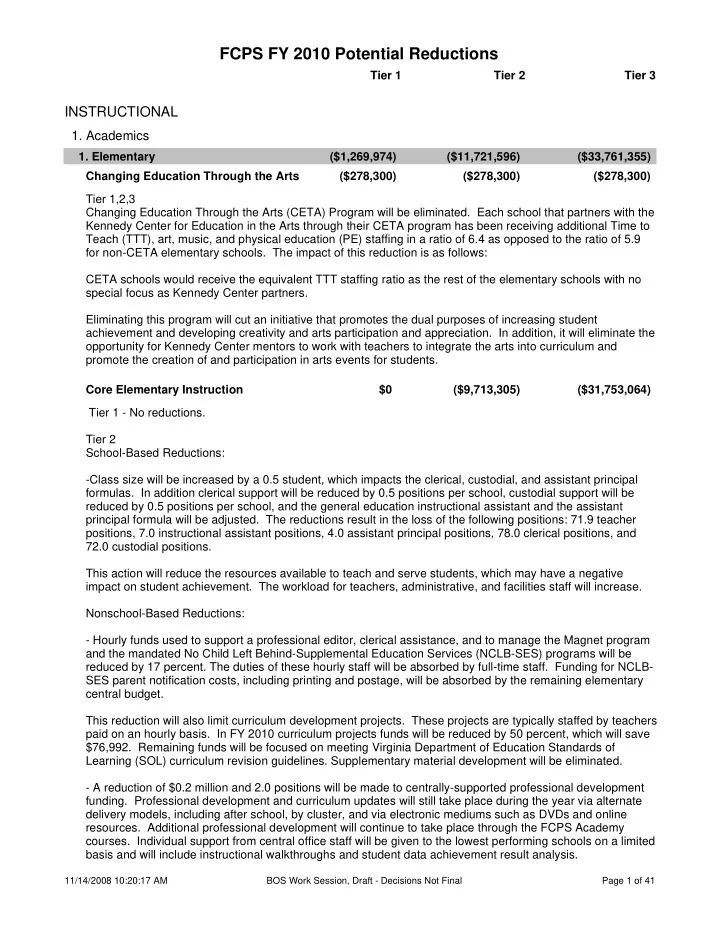
($1,269,974) ($11,721,596) ($33,761,355) Changing Education Through the Arts Tier 1,2,3 Changing Education Through the Arts (CETA) Program will be eliminated. Each school that partners with the Kennedy Center for Education in the Arts through their CETA program has been receiving additional Time to Teach (TTT), art, music, and physical education (PE) staffing in a ratio of 6.4 as opposed to the ratio of 5.9 for non-CETA elementary schools. The impact of this reduction is as follows: CETA schools would receive the equivalent TTT staffing ratio as the rest of the elementary schools with no special focus as Kennedy Center partners. Eliminating this program will cut an initiative that promotes the dual purposes of increasing student achievement and developing creativity and arts participation and appreciation. In addition, it will eliminate the
- pportunity for Kennedy Center mentors to work with teachers to integrate the arts into curriculum and
promote the creation of and participation in arts events for students. ($278,300) ($278,300) ($278,300) Core Elementary Instruction Tier 1 - No reductions. Tier 2 School-Based Reductions:
- Class size will be increased by a 0.5 student, which impacts the clerical, custodial, and assistant principal
- formulas. In addition clerical support will be reduced by 0.5 positions per school, custodial support will be
reduced by 0.5 positions per school, and the general education instructional assistant and the assistant principal formula will be adjusted. The reductions result in the loss of the following positions: 71.9 teacher positions, 7.0 instructional assistant positions, 4.0 assistant principal positions, 78.0 clerical positions, and 72.0 custodial positions. This action will reduce the resources available to teach and serve students, which may have a negative impact on student achievement. The workload for teachers, administrative, and facilities staff will increase. Nonschool-Based Reductions:
- Hourly funds used to support a professional editor, clerical assistance, and to manage the Magnet program
and the mandated No Child Left Behind-Supplemental Education Services (NCLB-SES) programs will be reduced by 17 percent. The duties of these hourly staff will be absorbed by full-time staff. Funding for NCLB- SES parent notification costs, including printing and postage, will be absorbed by the remaining elementary central budget. This reduction will also limit curriculum development projects. These projects are typically staffed by teachers paid on an hourly basis. In FY 2010 curriculum projects funds will be reduced by 50 percent, which will save $76,992. Remaining funds will be focused on meeting Virginia Department of Education Standards of Learning (SOL) curriculum revision guidelines. Supplementary material development will be eliminated.
- A reduction of $0.2 million and 2.0 positions will be made to centrally-supported professional development
- funding. Professional development and curriculum updates will still take place during the year via alternate
delivery models, including after school, by cluster, and via electronic mediums such as DVDs and online
- resources. Additional professional development will continue to take place through the FCPS Academy
- courses. Individual support from central office staff will be given to the lowest performing schools on a limited
basis and will include instructional walkthroughs and student data achievement result analysis. $0 ($9,713,305) ($31,753,064)
Page 1 of 41 11/14/2008 10:20:17 AM BOS Work Session, Draft - Decisions Not Final
SLIDE 2 Tier 2 Tier 1 Tier 3
FCPS FY 2010 Potential Reductions
Prolonged reduction in funds available for continuous professional learning for teachers will impact teachers' ability to meet recertification requirements and limit their exposure to the newest research-based best instructional practices. This will ultimately have an adverse impact on student achievement, particularly for students needing differentiated instruction.
- A $0.1 million reduction will be made in the eCART project funding. This will impact the maintenance and
expansion of eCART. The eCART project was conceptualized and planned to become the consistent method
- f delivering curriculum, resources, and assessments to school-based staff across the division.
Currently, the tool supports SOL tested subject curricula and multiple choice assessment items. The project plan requires sustained efforts by central office staff to create and maintain curriculum, instructional resources, and assessment items. The project plan further calls for the expansion of the curriculum database to include non-SOL tested subjects and the creation of authentic assessments including teacher observable assessments and other question types beyond multiple choice questions. This reduction will suspend the expansion of eCART's functionality and content. Special education, ESOL, and advanced academic resources scheduled to migrate to eCART from various electronic mediums will be suspended leaving school-based staff with multiple locations to find resources. Additional eCART reductions being made in the Instructional Services and Information Technology departments will require a suspension
- f enhancements to support divisionwide priorities such as the Grade 6 Fine Arts Assessment project and the
Grade 5 Global Awareness Technology project. These projects are directly related to attaining Student Achievement Goals 1.2, 1.4., and 1.5. Tier 3 Class size will increase by 2.5 students, which impacts the clerical, custodial, and assistant principal
- formulas. In addition clerical support will be reduced by 0.5 positions per school, custodial support will be
reduced by 0.5 positions per school, and the general education instructional assistant and the assistant principal formula will be adjusted. The reductions result in the loss of the following positions: 332.4 teacher positions, 17.0 instructional assistant positions, 9.0 assistant principal positions, 98.0 clerical positions, and 80.5 custodial positions. This action will significantly reduce the resources available to teach and serve students, which will have a negative impact on student achievement. The workload for teachers, administrative, and facilities staff will increase significantly.
- In addition to the NSB reductions included in tier 2, the per pupil allocation will be reduced from $96.39 to
$79.14, resulting in a savings of $1.5 million. This allocation is used for consumable supplies, instructional supplies, flexibility reserve, science DVDs, and textbooks. Principals will have less discretion, given Instructional Services' spending guidelines, to be flexible with these limited funds. This reduction will impact every elementary school in every department and could have an adverse impact on student achievement if adequate materials are not available. Elementary Focus Tier 1,2,3 A 10 percent reduction in the budget will reduce the number of Focus schools in FY 2010. The remaining schools will have a well-articulated purpose for the allocated funds, with documented impact on student
- achievement. Focus school funds will be designed to be given only for a three-year period.
Next year, each of the current 14 focus schools will be asked to submit a renewal application that specifies (at a minimum): the nature and purpose of the school's focus; rationale for the focus initiative; services to be provided to students and impact on student enrollment; impact on student achievement; other supplemental resources provided to the school; and a plan for sustaining the focus after a three-year funding cycle. A team from instruction, grants, and cluster offices will review each proposal and make a decision regarding funding. ($253,357) ($253,357) ($253,357)
Page 2 of 41 11/14/2008 10:20:17 AM BOS Work Session, Draft - Decisions Not Final
SLIDE 3 Tier 2 Tier 1 Tier 3
FCPS FY 2010 Potential Reductions
A minimum of 20 percent of the remaining Elementary Focus funds will be redirected to Project 1-6 recommendations for providing support to low-performing schools. Project Excel Tier 1 This $738,317 reduction represents a 10 percent reduction in this program. Tier 2,3 This $1,476,634 reduction represents a 20 percent reduction in this program. The current 20 EXCEL schools were identified in the late 1990's. The process for providing support to high- need schools will be reassessed using current data. A project team (SAG Project 1-6, Support to Low- Performing Schools) is designing a process for identification and support to replace EXCEL using existing (but reduced) budgets. Fewer schools will be served due to the reduction of funds and all elementary schools will revert to the same calendar, with early dismissal on Monday. ($738,317) ($1,476,634) ($1,476,634)
$0 ($2,837,878) ($9,759,499) Core Middle School Instruction Tier 1 - No reductions. Tier 2 School-Based Reductions:
- Class size will be increased by a 0.5 student, resulting in a loss of 25.9 teacher positions. Based on the
staffing formula, the class size increase will also generate a reduction of 2.0 custodian positions. In addition, a 1.0 clerical and a 1.0 custodian position will be eliminated in each school (a total of 52.0 positions) and schools will be limited to 2.0 assistant principal positions regardless of size (no impact based on FY 2010 membership projections). This action will reduce the resources available to teach and serve students, which may have a negative impact on student achievement. The workload for teachers, administrative, and facilities staff will increase. Nonschool-Based Reductions:
- A reduction of $38,867 in hourly funding will limit curriculum development projects. These projects are
typically staffed by teachers paid on an hourly basis. Remaining funds will be focused on meeting Virginia Department of Education SOL curriculum revision guidelines. Supplementary material development will be eliminated.
- A reduction of $10,902 in substitute, hourly teacher, professional development and supply funding used to
support the middle school Vanguard Teams will reduce the time spent from 4 days to 1.5 days per year. These teams work to ensure technology is integrated into the core curriculum at every middle school.
- A $20,329 reduction in substitute funding will limit professional development opportunities. Professional
development and curriculum updates will still take place during the year via alternate delivery models, including after school, by cluster, and via electronic mediums such as DVDs and online resources. Additional professional development will continue to take place through the FCPS Academy courses. Individual support from central office staff will be given to the lowest performing schools on a limited basis and will include instructional walkthroughs and student data achievement result analysis. Prolonged reduction in funds available for continuous professional learning for teachers will impact teachers' $0 ($2,837,878) ($9,759,499)
Page 3 of 41 11/14/2008 10:20:17 AM BOS Work Session, Draft - Decisions Not Final
SLIDE 4 Tier 2 Tier 1 Tier 3
FCPS FY 2010 Potential Reductions
ability to meet recertification requirements and limit their exposure to the newest research-based best instructional practices. This will ultimately have an adverse impact on student achievement, particularly for students needing differentiated instruction.
- An $11,424 reduction will eliminate the Grade 8 Civics Court Tours for 1,760 middle school students. This
site-based field trip brings the court system alive for students and helps reinforce the lessons learned in class.
- An $18,169 reduction in the Physical Education budget will eliminate Grade 9 Cardiopulmonary
Resuscitation(CPR)/Automated External Defibrillators (AED) teacher training currently provided by part-time hourly staff.
- The Middle School Core Program will also be impacted by the suspension of the maintenance and
expansion of eCART described in the elementary core program. Tier 3
- Class size will be increased by 2.5 students, resulting in a loss of 119.8 teacher positions. Based on the
staffing formula, the class size increase will also generate a reduction of 5.5 custodian positions. In addition, a 1.0 clerical and a 1.0 custodian position will be eliminated in each school (a total of 52.0 positions) and schools will be limited to 2.0 assistant principal positions regardless of size (no impact based on FY 2010 membership projections). This action will significantly reduce the resources available to teach and serve students, which will have a negative impact on student achievement. The workload for teachers, administrative, and facilities staff will increase significantly.
- The per pupil instructional material and textbook allocation will be reduced from $123.78 to $107.55,
resulting in a savings of $0.4 million. This allocation is used for consumable supplies, instructional supplies, flexibility reserve, and textbooks. This reduction will give principals less discretion, given Instructional Services' spending guidelines, to be flexible with these limited funds. This reduction will impact every middle school in every department and could have an adverse impact on student achievement if adequate materials are not available. The Middle School Core Program includes funding to support language arts, mathematics, science, social studies, SOL/NCLB, and Health and Physical Education.
($432,693) ($5,795,980) ($18,327,771) Core High School Instruction Tier 1 - No reductions. Tier 2 School-Based Reductions:
- Class size will be increased by a 0.5 student, resulting in a loss of 37.2 teacher positions (including career
and technical education teachers). Based on the staffing formula, the class size increase will also generate a reduction of 1.5 custodian positions. In addition, a 1.0 clerical and a 1.0 custodian position will be eliminated in each school (a total of 50.0 positions), and schools will be limited to 4.0 assistant principal positions regardless of size (reduction of 19.0 positions). The clerical formula at secondary schools will be adjusted to reflect the middle and high school individual formulas, resulting in a reduction of 21.0 positions. This action will reduce the resources available to teach and serve students which may have a negative impact on student achievement. The workload for teachers, administrative, and facilities staff will increase. Nonschool-Based Reductions: $0 ($5,363,287) ($17,667,899)
Page 4 of 41 11/14/2008 10:20:17 AM BOS Work Session, Draft - Decisions Not Final
SLIDE 5 Tier 2 Tier 1 Tier 3
FCPS FY 2010 Potential Reductions
- A $15,000 reduction in hourly funds will limit curriculum development projects. These projects are typically
staffed by teachers paid on an hourly basis. Remaining funds will be focused on meeting Virginia Department
- f Education SOL curriculum revision guidelines. Supplementary material development will be eliminated.
- A reduction of $35,000 will be made to centrally-supported professional development funding. Professional
development and curriculum updates will still take place during the year via alternate delivery models, including after-school, by cluster, and via electronic mediums such as DVDs and online resources. Additional professional development will continue to take place through the FCPS Academy courses. Individual support from central office staff will be given to the lowest performing schools on a limited basis and will include instructional walkthroughs and student data achievement result analysis. Tier 3 School-Based: Class size will increase by 2.5 students, resulting in a loss of 173.58 teacher positions (including career and technical education teachers). Based on the staffing formula, the class size increase will also generate a reduction of 5.5 custodian positions. In addition, a 1.0 clerical and a 1.0 custodian position will be eliminated in each school (a total of 50.0 positions), and schools will be limited to 4.0 assistant principal positions regardless of size (reduction of 19.0 positions). The clerical formula at secondary schools will be adjusted to reflect the middle and high school individual formulas, resulting in a reduction of 21.0 positions. This action will further reduce the resources available to teach and serve students which may have a negative impact on student achievement. The workload for teachers, administrative, and facilities staff will increase significantly.
- The per pupil instructional supply and textbook allocation will be reduced from $144.51 to $123.96, resulting
in a savings of $1.1 million. This allocation is used for consumable supplies, instructional supplies, and textbooks. This reduction will give principals less discretion, given Instructional Services' spending guidelines, to be flexible with these limited funds. This reduction will impact every high school in every department and could have an adverse impact on student achievement if adequate materials are not available. The High School Core Program includes funding for, language arts, mathematics, science, social studies, SOL/NCLB, and K-12 Foreign Language and K-12 Fine Arts. High School Academies Tier 1,2,3 Five positions at academies (Chantilly, Edison, Fairfax, Marshall, and West Potomac) will be eliminated. Remaining academy staff members will be responsible for absorbing the duties performed by the reduction. Academy students will experience a delay in services from academy administrative staff, and recruitment efforts will be curtailed. ($432,693) ($432,693) ($432,693) International Baccalaureate High School Tier 1,2 - No reductions. Tier 3 A reduction in technical training, supplies, and staff development will be made. The International Baccalaureate schools' budget will be eliminated for technical training and staff development, leaving $500 for Mid-Atlantic Regional Coalition of International Baccalaureate Schools (MARC) (outside services) and $1,000 for supplies and textbooks at each school. No support for the administrative functions of IB coordinators will be available. Other reductions in instructional supplies and textbooks (for courses not part of a subject textbook adoption such as Theory of Knowledge) will impact the purchase of such books and supplies for IB courses, the extended essay, and the community service program. $0 $0 ($227,179)
Page 5 of 41 11/14/2008 10:20:17 AM BOS Work Session, Draft - Decisions Not Final
SLIDE 6 Tier 2 Tier 1 Tier 3
FCPS FY 2010 Potential Reductions
($6,614,441) ($6,614,441) ($10,811,056) Career and Transition Services Tier 1,2,3 This program will be reduced by 13.0 resource teacher positions, and there will be a decrease in contract length for 38.0 teacher positions. In addition, 50 percent reductions will be made in textbook, instructional supply, and equipment funds. Staff reductions and shortened contracts will result in increased caseloads and reduced pay. Career development, job placement, and assessment services will be affected. ($1,258,637) ($1,258,637) ($1,258,637) Elementary Special Education Tier 1,2 In elementary special education, Category A (learning disability and emotional disability services) has a minimum ratio of 11 students per teacher, and Category B (mild and moderate retardation services; physical, non-categorical, and severe disability services) has a minimum ratio of 6.5 students per teacher. Category A and Category B minimum ratios will each increase by a 0.5 student per teacher. Schools at or below these ratios will not be staffed with additional ratio-based positions in these categories except to meet the elementary Applied Behavior Analysis (ABA) ratio, which will change from 2:1 to 3:1. In addition, the redesign
- f Department of Special Services central office supervision will result in a reduction of central office staff.
Tier 3 The minimum ratio will increase by an additional 0.5 student, for a total increase of 1.0 student. ($1,037,266) ($1,037,266) ($2,701,007) Preschool Tier 1,2,3 The redesign of the Department of Special Services central office supervision will result in a reduction of central office staff. Reductions to this program will result in the elimination of 2.0 positions. ($189,726) ($189,726) ($189,726) Secondary Special Education Tier 1,2 For secondary special education, Category A (learning disability and emotional disability services) has a minimum ratio of 11 students per teacher, and Category B (mild and moderate retardation; physical, non- categorical, and severe disabilities) has a minimum ratio of 6.5 students per teacher. Category A and Category B minimum ratios will each increase by a 0.5 student per teacher. Schools at or below these ratios will not be staffed with additional ratio-based positions in these categories. In addition, the redesign of Department of Special Services central office supervision will result in a reduction of central office staff. Reductions in school-based and nonschool-based personnel will result in the combined elimination of 28.0 positions. Tier 3 The minimum ratio will increase by an additional 0.5 student for a total increase of 1.0 student. Reductions in school-based and nonschool-based personnel will result in the combined elimination of 70.0 positions. ($1,712,966) ($1,712,966) ($4,245,840) Therapy and Adapted Physical Education Services Tier 1,2,3 The student-to-occupational therapist ratio will increase from 53:1 to 59:1. As a result, caseloads will increase by an average of 6.0 students. A redesign of the adapted physical education (APE) delivery model will result in a decrease of positions and the reassignment of other central APE staff to school sites. APE services do not have a mandated state ratio. In addition to school-based services, the redesign of Department of Special Services central office supervision will result in a reduction of central office staff. Reductions in school-based and nonschool-based personnel will result in the combined elimination of 25.0 positions. ($1,681,038) ($1,681,038) ($1,681,038)
Page 6 of 41 11/14/2008 10:20:17 AM BOS Work Session, Draft - Decisions Not Final
SLIDE 7 Tier 2 Tier 1 Tier 3
FCPS FY 2010 Potential Reductions
Vision and Deaf/Hard-of-Hearing Tier 1,2,3 Student-to-teacher ratios in the Vision and Deaf/Hard-of-Hearing (DHOH) Program will increase as follows: vision from 12:1 to 13:1, hearing teachers from 12.5:1 to 18.5:1, and hearing technicians from 10:1 to 11.5:1. Ratio changes will result in approximately 7.0 fewer teacher positions and 5.0 fewer educational interpreters. As a result, class size for students in vision classes will increase by 1.0 student per teacher. Enrollment projections indicate, however, that DHOH class sizes will not increase significantly. Caseloads for hearing technicians will increase by 1.5 students per technician, on average. It is expected that the adjustments to ratio formulas will not negatively impact the delivery of mandated services. Replacement equipment purchases have also been postponed for a savings of $25,000. ($734,808) ($734,808) ($734,808)
($930,718) ($1,217,924) ($1,217,924) Achievement, Integrity, and Maturity (AIM) Tier 1 - No reductions. Tier 2,3 The Achievement, Integrity, and Maturity (AIM) Program will eliminate 4.0 instructional assistant positions and all hourly technical, staff development, and special functions funding. The impact of these reductions is that some classrooms will have only one adult in the classroom with up to 11 students who have a history of discipline/behavior concerns; less individual remedial instruction and supervision will be available; hourly safety and security support will not be available; staff will not be able to attend professional development activities targeting instruction for at-risk students; and graduation ceremonies will not be funded. $0 ($151,738) ($151,738) Alternative High Schools Tier 1,2,3 Reductions will be distributed evenly among Bryant, Mountain View, and Pimmit Hills, and specific reductions will be identified by each school. Reductions to alternative high school programs may cause diminished course offerings, reduced daily schedules, less supervision, or less guidance for at-risk students. ($348,963) ($348,963) ($348,963) Alternative Learning Centers Tier 1 - No reductions. Tier 2,3 This program will eliminate 4.0 instructional assistant positions and all hourly teacher, hourly parent liaison, staff development, and special functions funding. The impact of these reductions is that some classrooms will have only one adult in the classroom with up to 15 students who have a history of discipline/behavior concerns; less individual remedial instruction and supervision will be available; if enrollment exceeds program capacity, there will be no additional instructional support; parents will not have the support of a parent liaison as they deal with their younger children in the disciplinary process; staff will not be able to attend professional development activities targeting instruction for at-risk students; and monthly parent meetings will not be funded. $0 ($135,468) ($135,468) Interagency Alternative Schools Tier 1,2,3 This program will eliminate 6.0 teacher and 5.0 instructional assistant positions. FCPS anticipates possible elimination of county funding for the Enterprise School, which would end that program. If these programs are reduced or eliminated, at-risk students may not receive critical educational services. ($581,755) ($581,755) ($581,755)
($2,800,156) ($4,707,949) ($11,743,688) Advancement via Individual ($76,492) ($76,492) ($76,492)
Page 7 of 41 11/14/2008 10:20:17 AM BOS Work Session, Draft - Decisions Not Final
SLIDE 8 Tier 2 Tier 1 Tier 3
FCPS FY 2010 Potential Reductions
Determination (AVID) Tier 1,2,3 This represents a 10 percent reduction in this program. In addition, four programs, Advancement Via Individual Determination (AVID), the College Partnership Program (CPP), the Early Identification Program (EIP) and Pathways to the Baccalaureate, will be combined to achieve efficiencies. Each of these programs has a similar goal, which is to prepare traditionally underrepresented middle and high school students for post secondary education. AVID has an in-school curriculum, while EIP and CPP use out of school time for activities and workshops. The Pathways to the Baccalaureate program assists students from selected high schools with the transition from high school to college. Identified students will continue to be served. A project team will evaluate the most effective components of each of these programs to design an FCPS college access and preparation program at a reduced cost. Career and Technical Education (CTE) Tier 1,2 The increase in high school and middle school class size by 0.5 will increase CTE class size. The actual increases realized may be more than a 0.5 student in order to preserve the integrity and class size of SOL
- courses. School-based administrators may choose to lower their pupil-teacher ratio in an academic course
which consequently raises class size in elective programs such as CTE. A flat rate reduction in the instructional supply funding across all CTE programs will be based on enrollments at the beginning of the fiscal year. This reduction will provide the CTE programs with less funding for consumable supplies necessary to operate programs. With the reduction in hourly clerical funding, the impact is the elimination of one part-time position used to provide support to the schools. In addition, facility modifications such as lift replacements in auto technology and infrastructure changes necessary for appliance replacement will be reduced by 50 percent or $20,000. Lastly, the printing of publications such as academy applications, course guides, and program brochures will be reduced by 33 percent or $6,000. Tier 3 The increase in high school and middle school class size by 2.5 will increase CTE class size. The actual increases realized may be more than 2.5 students in order to preserve the integrity and class size of SOL
- courses. School-based administrators may choose to lower their pupil-teacher ratio in an academic course
which consequently raises class size in elective programs such as CTE. ($573,023) ($573,023) ($1,727,362) Character Education Tier 1,2,3 The character education project will be completed in FY 2009. Beginning in FY 2010, character education resources will be embedded in schools and central office support will no longer be required. This will result in the elimination of 2.0 positions. ($245,950) ($245,950) ($245,950) Early Identification Program (EIP) Tier 1,2,3 This represents a 10 percent reduction in this program. In addition, four programs, Advancement Via Individual Determination (AVID), the College Partnership Program (CPP), the Early Identification Program (EIP) and Pathways to the Baccalaureate, will be combined to achieve efficiencies. Each of these programs has a similar goal, which is to prepare traditionally underrepresented middle and high school students for post secondary education. AVID has an in-school curriculum, while EIP and CPP use out of school time for activities and workshops. The Pathways to the Baccalaureate program assists students from selected high schools with the transition from high school to college. Identified students will continue to be served. A project team will evaluate the most effective components of each of these programs to design an FCPS college access and preparation program at a reduced cost. ($5,915) ($5,915) ($5,915)
Page 8 of 41 11/14/2008 10:20:17 AM BOS Work Session, Draft - Decisions Not Final
SLIDE 9 Tier 2 Tier 1 Tier 3
FCPS FY 2010 Potential Reductions
English for Speakers of Other Languages Tier 1 - No reductions. Tier 2 Because English for Speakers of Other Languages (ESOL) staffing is based on the same formula used to determine class size, any increase in class size will result in a decrease in ESOL positions. An increase in the pupil-teacher ratio of a 0.5 student per teacher will result in the reduction of 20.73 ESOL teacher positions. Tier 3 An increase in the pupil teacher ratio of 2.5 students per teacher will result in the reduction of 57.71 ESOL teacher positions. This action will significantly reduce the resources available to teach and serve students, which will have a negative impact on student achievement. $0 ($1,370,058) ($3,743,835) Family Life Education (FLE) Tier 1,2 - No reductions. Tier 3 A reduction of $15,000 will result in the elimination of printed copies of Family Life Education (FLE) opt-out forms for every student; elimination of the Grade 2 FLE unit revision; elimination of FLECAC meetings except when curriculum revisions need to be reviewed; and elimination of other meetings. These reductions will inconvenience some families who intend to opt-out of FLE. The printing of forms using FCPS resources will occur only in certain circumstances. Notification of the FLE program and basic opt-out information will be sent home with students via fliers in registration packets. Opt-out forms will be made available online. Schools will print forms at the request of families without home computer access. $0 $0 ($15,000) Fine Arts Program Tier 1,2 - No reductions. Tier 3 A 5 percent reduction to this program represents $836,072 and 12.4 positions. The reductions will eliminate all part-time itinerant band and strings positions (the equivalent of 11.4 positions) and 1.0 full-time teacher. The loss of part-time teacher positions will eliminate am/pm partner school staffing. The remaining full-time teachers would need to be scheduled at only one school per day to make best use of available teaching time. The pay for a travel period for itinerant band and strings teachers is eliminated in this reduction. The elimination of this staffing reduces opportunities for school teams to conduct team meetings (common planning time), as they are arranged when students are receiving instruction from resource teachers. $0 $0 ($836,072) Library Media Tier 1,2,3 Reductions in school-based programs total $1.0 million and 6.0 positions; reductions in nonschool-based programs total $0.5 million and 3.0 positions. They include: School-Based:
- Funding for school library materials will be reduced by $0.3 million or 12 percent, limiting the amount of
materials that can be purchased.
- Full-time librarian positions in special education schools and centers with enrollment under 100 will be
eliminated, resulting in a loss of 2.0 librarian positions. ($1,489,984) ($1,489,984) ($1,489,984)
Page 9 of 41 11/14/2008 10:20:17 AM BOS Work Session, Draft - Decisions Not Final
SLIDE 10 Tier 2 Tier 1 Tier 3
FCPS FY 2010 Potential Reductions
The Burke School, Quander Road and Cedar Lane Centers would share one librarian. Library services will be reduced to maintaining the library collection and circulating materials. Information services, instruction and collaboration will be eliminated.
- Reduce librarian staffing at Secondary Schools from 4.0 to 3.0 per school, resulting in a loss of 4.0 positions.
Per Virginia SOQ, Hayfield, Robinson, Lake Braddock, and South County Secondary Schools are staffed as though they are each two schools. The proposed reduction would still satisfy the VDOE regulations as it is interpreted by ISD staff.
- Standardize the length of librarian contracts to 194 days for a savings of $0.3 million.
This would reduce 28 head high school librarian contracts by 24 days and 27 head middle school librarian contracts by four days. Nonschool-Based:
- The clerical staff and materials budget in the professional education library will be reduced, for a savings of
$32,107. Hours of operation will be reduced from 40 to 20 hours a week. The professional education collection will have fewer current titles added to the collection. Research materials for School Board inquiries and FCPS staff advanced education will be limited.
- This reduction would restructure the Library Information Services (LIS) staff resulting in a loss of 3.0
positions, one position conversion and a reduction in hourly funds for a savings of $0.4 million. In addition, the LIS operating budget would be reduced by $74,285 in the areas of professional development, substitutes and computer equipment maintenance. A reduction in staff to process and catalog library materials will cause a delay in processing materials to
- schools. School librarians will have more responsibility for managing their collections which will reduce
instructional time. In addition, LIS staff will not manage the library collections for the ESOL, Fine Arts and Parent Resource Libraries. These duties will have to be absorbed by staff working in specialized libraries. Middle and High School Enhancements Tier 1,2,3 This program, including 1.0 position, will be eliminated. This will impact students in the three participating schools by eliminating initiatives such as the Comprehensive Reading program at Stuart High School, the Saturday Academy at Hughes Middle Schools, and professional development and parent liaison funds provided through this program. ($211,678) ($211,678) ($211,678) Modified School Calendar Tier 1,2 This program will be eliminated at the middle and high school levels (3 schools). The related transportation costs are included in the reduction total. Tier 3 This program will be eliminated in all schools (10 schools). The 7.0 elementary intersession coordinator positions will be eliminated. The related transportation costs are included in the reduction total. Students, families, and teachers will be impacted by the change in the school year calendar, and students will no longer have the intersession courses available that previously provided year-round learning opportunities. ($197,114) ($197,114) ($2,739,063)
Page 10 of 41 11/14/2008 10:20:17 AM BOS Work Session, Draft - Decisions Not Final
SLIDE 11 Tier 2 Tier 1 Tier 3
FCPS FY 2010 Potential Reductions
Planetarium Tier 1 - No reductions. Tier 2,3 Reductions will eliminate planetarium funding that will result in a loss of planetarium staff and planetarium maintenance, and the closing of the planetariums for student learning and teacher training. FCPS planetariums provide experiential learning opportunities for elementary students throughout FCPS. The planetarium lessons are aligned with the Standards of Learning (SOL) and the science Program of
- Studies. In addition, with the recent adoption of new astronomy standards in the Science SOL, the
planetariums provided a needed venue for teacher content training. The elimination of the planetarium programs will no longer be available to over 15,000 students yearly to provide the opportunity to explore the universe. $0 ($537,735) ($537,735) Student Accountability Tier 1,2 - No reductions. Tier 3 This will reduce the funding available to staff these remedial classes with additional positions received above ratio by 10 percent. Remediation classes that exceed funds will be absorbed from the middle and high school staffing, further increasing class size in other courses. $0 $0 ($114,602)
($500,000) ($500,000) ($9,433,130) Elementary Early Intervention Tier 1,2 - No reductions. Tier 3 The elementary early intervention summer program will be eliminated. The summer school program was redesigned and costs were reduced in FY 2009. This school-based intervention program supports students who need additional time to learn during the summer and is designed to intervene with students at risk of
- failing. Eliminating this program will result in more students being retained in grade 6.
$0 $0 ($2,923,394) High School Summer Tier 1,2 - No reductions. Tier 3 This program, including 5.0 support positions, will be eliminated. The summer school program was redesigned and costs reduced in FY 2009. Elimination of this program will mean that high school students no longer have the opportunity for credit recovery, SOL remediation, acceleration, and ESOL elective credit. The students most at risk will be the students requiring summer school to complete requirements for graduation. $0 $0 ($3,981,316) Middle School Early Intervention Tier 1,2 - No reductions. Tier 3 The middle school early intervention summer program will be eliminated. The summer school program was redesigned and costs reduced in FY 2009. This program provides school-based intervention programs to support students who need additional time to learn during the summer and are designed to intervene with students at risk of failing. Eliminating this program will result in more students being retained in grade 8. $0 $0 ($2,028,420)
Page 11 of 41 11/14/2008 10:20:17 AM BOS Work Session, Draft - Decisions Not Final
SLIDE 12 Tier 2 Tier 1 Tier 3
FCPS FY 2010 Potential Reductions
Special Education ESY & Summer School Tier 1,2,3 In FY 2009 (summer 2008), FCPS implemented a new summer school model. As a result of these changes, FCPS anticipates saving $0.5 million in FY 2010 (summer 2009). Mandated services will not be impacted. ($500,000) ($500,000) ($500,000)
($2,129,387) ($2,129,387) ($2,129,387) Adult Education Tier 1,2,3 This reduction will eliminate the transfer to the Adult and Community Education Fund, making it self- supporting and resulting in a savings of $1.8 million and a reduction of 1.0 position in the operating fund. These funds were used primarily to support the Adult ESOL program. Because of this reduction in revenue to the ACE fund, corresponding expenditure reductions must be made to ACE programs. Courses and services to the community and the schools will be reduced or eliminated and increases in tuition and fees may be required. ($1,800,816) ($1,800,816) ($1,800,816) Teacher Leadership (Number of Extended Contracts) Tier 1,2,3 This is a reduction in the number of extended contracts awarded to teachers who are responsible for leading professional learning in schools in the areas of teacher collaboration and action research; increasing the use
- f research-based instructional practices; increasing the use of data to inform teaching, learning and decision-
making; providing tailored and timely interventions to students to increase academic achievement; and increasing parent involvement in student success initiatives. This reduction will cause this teacher-lead, school-specific professional learning and student support to decrease proportionally. ($328,571) ($328,571) ($328,571)
- 2. Instructional Support
- 1. Student
($11,333,862) ($11,333,862) ($11,583,862) Activities and Athletics Tier 1,2 This reduction reflects the program elimination of girls gymnastics. This will impact approximately 125 female
- athletes. The reduction of $221,000 is achieved through the elimination of 25 head coach supplements and
25 assistant coach supplements, officials fees, and transportation. Tier 3 In addition to the elimination of girls gymnastics, indoor track for all athletes will be eliminated ($250,000). ($221,000) ($221,000) ($471,000) After-School Initiatives Tier 1,2,3 The reduction of after-school program funding for all 27 middle schools by $3,000 each will result in the following impacts or combination of impacts:
- Reduce after-school program staffing by 120 staff hours at each middle school resulting in a reduced
number of activities offered and/or fewer after-school program hours each week - on average, a reduction of four hours of after-school programming each week.
- Eliminate all transportation for field trips, including college field trips for the College Partnership Program.
- Eliminate all vendors and all financially compensated partners in the after-school program.
($80,000) ($80,000) ($80,000)
Page 12 of 41 11/14/2008 10:20:17 AM BOS Work Session, Draft - Decisions Not Final
SLIDE 13 Tier 2 Tier 1 Tier 3
FCPS FY 2010 Potential Reductions
Other reductions could include:
- Eliminate funding for all middle school Early Start/Jump Start programs resulting in the loss of these summer
programs for over 1,100 at-risk students.
- Eliminate funding support for the middle school Girls' Conference and Boys' Conference.
Assistive Technology for Students w/Disabilities Tier 1,2,3 While the assistive technology student-to-teacher ratio for students receiving learning disability or emotional disability services (Category A) for less than 50 percent of the day (level 1) will remain at 250:1, the student-to teacher ratio for students receiving Category A services for at least 50 percent of the day (level 2) will increase from 125:1 to 250:1. The assistive technology student-to-teacher ratio for students receiving mental retardation, autism, and other Category B level 2 services will increase from 50:1 to 65:1. Reductions in these areas will result in simply meeting, rather than exceeding, services mandated in each individual student's IEP. In addition, the redesign of Department of Special Services central office supervision will result in a reduction of central office staff. Reductions in school-based and nonschool-based personnel will result in the combined elimination of 5.0 positions. ($410,234) ($410,234) ($410,234) Cluster Services and Programs (Special Education) Tier 1,2,3 The redesign of Department of Special Services central office supervision and the redefinition of school support roles based on student need will result in the reduction of central office staff. Reductions to this program will result in the elimination of 34.5 positions. ($2,441,275) ($2,441,275) ($2,441,275) College Partnership Program (CPP) Tier 1,2,3 This represents a 10 percent reduction in this program. In addition, four programs, Advancement Via Individual Determination (AVID), the College Partnership Program (CPP), the Early Identification Program (EIP) and Pathways to the Baccalaureate, will be combined to achieve efficiencies. Each of these programs has a similar goal, which is to prepare traditionally underrepresented middle and high school students for post secondary education. AVID has an in-school curriculum, while EIP and CPP use out of school time for activities and workshops. The Pathways to the Baccalaureate program assists students from selected high schools with the transition from high school to college. Identified students will continue to be served. A project team will evaluate the most effective components of each of these programs to design an FCPS college access and preparation program at a reduced cost. ($89,764) ($89,764) ($89,764) Contract Services Tier 1,2,3 The Department of Special Services central office redesign will result in a reduction of staff supporting this section, resulting in a caseload increase of more than 10 percent. Reductions to this program will result in the elimination of 1.0 position. ($98,739) ($98,739) ($98,739) Family and School Partnership Program Tier 1,2,3 The impact of a 5 percent budget reduction will result in a general decrease in quality and quantity of services and programs available to FCPS schools and families, resulting in decreased Work Performed for Others (WPFO) revenue. School volunteers will not receive public recognition due to cancellation of the annual Volunteer Reception; school-based staff, including parent liaisons, will have negligible opportunities to learn ($41,227) ($41,227) ($41,227)
Page 13 of 41 11/14/2008 10:20:17 AM BOS Work Session, Draft - Decisions Not Final
SLIDE 14 Tier 2 Tier 1 Tier 3
FCPS FY 2010 Potential Reductions
parent involvement/engagement strategies to promote student achievement; parenting class materials sold statewide will be of lower quality, resulting in less WPFO income; some program costs will need to be passed
- n to clients, and Family and School Partnerships staff will have fewer hours and resources to adequately
serve the schools and families. Guidance and Career Services Tier 1,2,3 The student-to-school counselor ratio will increase from 300:1 to 330:1 in middle schools and from 270:1 to 300:1 in high schools. Reductions in school-based and nonschool-based personnel will result in the combined elimination of 53.0 positions. ($3,741,354) ($3,741,354) ($3,741,354) Mentor Works Tier 1,2,3 This will eliminate the entire MentorWorks program and the related central office support of school-based mentors, including recruiting, training, and retaining. ($41,629) ($41,629) ($41,629) Monitoring and Compliance Tier 1,2,3 The redesign of Department of Special Services central office supervision will result in a reduction of central
- ffice staff. Reductions to this program will result in the elimination of 2.0 positions.
($182,407) ($182,407) ($182,407) Parent Resource Center Tier 1,2,3 This reduction eliminates a part-time hourly special education parent liaison and requires the closing of the Parent Resource Center located at Aldrin Elementary School. This center and position supports the parents of Clusters 1, 7, and 8 by providing neutral consultation, collaboration, and guidance through complex situations to achieve a positive school-based resolution of parental concerns. The loss of this support and center will create a vacuum for the parents and educators in Clusters 1, 7, and 8 who have or work with children with special needs. ($13,548) ($13,548) ($13,548) Pathways to the Baccalaureate Tier 1,2,3 This represents a 10 percent reduction in this program. In addition, four programs, Advancement Via Individual Determination (AVID), the College Partnership Program (CPP), the Early Identification Program (EIP) and Pathways to the Baccalaureate, will be combined to achieve efficiencies. Each of these programs has a similar goal, which is to prepare traditionally underrepresented middle and high school students for post secondary education. AVID has an in-school curriculum, while EIP and CPP use out of school time for activities and workshops. The Pathways to the Baccalaureate program assists students from selected high schools with the transition from high school to college. Identified students will continue to be served. A project team will evaluate the most effective components of each of these programs to design an FCPS college access and preparation program at a reduced cost. ($10,742) ($10,742) ($10,742) Positive Behavior Support Tier 1,2,3 There will be a funding reduction of 50 percent in the training that can be offered to support schools' Positive Behavior Support (PBS) programs. As a result, fewer new schools than planned will implement this program in FY 2010, and ongoing training for participating schools will be reduced. ($112,508) ($112,508) ($112,508)
Page 14 of 41 11/14/2008 10:20:17 AM BOS Work Session, Draft - Decisions Not Final
SLIDE 15 Tier 2 Tier 1 Tier 3
FCPS FY 2010 Potential Reductions
Preschool Diagnostic Center Tier 1,2,3 The Department of Special Services central office redesign will result in a decrease in positions supporting this function. Reductions to this program will result in the elimination of 3.0 positions. ($239,887) ($239,887) ($239,887) Psychological and Preventive Services Tier 1,2,3 Psychologist ratios will increase from 2,000:1 to 2,350:1. Contract lengths will also be reduced. In addition, the redesign of Department of Special Services central office supervision will result in a reduction of central
- ffice staff. Reductions in school-based and nonschool-based personnel will result in the combined
elimination of 17.0 positions. ($1,919,228) ($1,919,228) ($1,919,228) Safe and Drug Free Youth Tier 1,2,3 This program will reduce hourly and operating expenses by 33 percent. ($80,033) ($80,033) ($80,033) Social Work and Support Services Tier 1,2,3 Social worker ratios will increase from 2,200:1 to 2,500:1. Contract lengths will also be reduced. In addition, the redesign of Department of Special Services central office supervision will result in a reduction of central
- ffice staff. Reductions in school-based and nonschool-based personnel will result in the combined
elimination of 14.0 positions. ($1,610,287) ($1,610,287) ($1,610,287)
($146,933) ($614,103) ($614,103) Embedded Professional Development Tier 1,2,3 This will be the second year of a 5 percent cut to the Embedded Professional Development program. This will continue to seriously curtail capacity building and effectiveness of the FCPS workforce.
- National Board Certified Teachers (NBCT) at nonhigh-risk schools will no longer be able to earn an
additional stipend by completing a project. This will reduce the income of NBCT in nonhigh-risk schools by $1,750 for an estimated savings of $21,000. FCPS will no longer pay for many of the fees associated with National Board Certification resulting in an estimated savings of $3,250, and this reduction may cause fewer teachers to apply to participate in this nationally recognized program of outstanding teacher quality. This will result in an estimated savings of candidacy fees of $100,000.
- Services to new teachers will be decreased. This decrease could result in higher turnover rates of new
- teachers. Service decreases will be in the area of professional development for the mentors and a reduction
in the time new teachers will have access to mentors. Because release time for mentors will no longer be funded, this cut will take away the opportunity for mentors to visit the new teachers' classrooms while school is in session to model lessons or to observe the novice teacher with his/her students. This will result in an estimated savings of $49,000. This reduced support by mentors could result in new teachers leaving the
- profession. The elimination of seminars and mentor-mentee special functions along with reductions in travel
to professional development will yield additional savings of $19,000.
- Reducing the number of substitute days for Teacher Researcher (a valuable tenet of Professional Learning
Communities) from six half-days to four half-days will eliminate critical action-based research projects in FCPS and will curtail valuable innovation and collaboration at the school level. This reduction will save $7,500. The elimination of the Support Employees Career Fair and Office Personnel Conference as well the planned Leadership Development Initiative will result in a savings of $11,700. ($50,000) ($303,687) ($303,687)
Page 15 of 41 11/14/2008 10:20:17 AM BOS Work Session, Draft - Decisions Not Final
SLIDE 16 Tier 2 Tier 1 Tier 3
FCPS FY 2010 Potential Reductions
- Elimination of training in cognitive coaching in conjunction with the elimination of the substitute days set
aside for those coaches to attend this two-day instruction seminar will result in savings of $6,172. In addition, professional development for instructional coaches will be reduced to cover necessities, resulting in saving of $17,113.
- Travel across all of the activities listed above will be extremely limited. This reduces the exposure of FCPS
employees to the latest trends, innovations, and best practices. Eliminating travel also reduces the visibility of FCPS as a leader in education because employees will no longer be funded to make presentations at nationa
- events. The savings for travel has been included in the breakdowns above for each of the activities listed.
Instructional and Support Professional Development Tier 1,2,3 This will be the second year of a 5 percent cut in Instructional and Support Professional Development which will continue to limit the ability of employees to stay current in education. Fewer university courses will be
- ffered to educational employees and this may reduce the ability of some teachers to be fully licensed and
highly-qualified, especially in special education. Six university course offerings will be eliminated from the FCPS Academy Catalog as well as two FCPS academy courses for FY 2010 resulting in a savings of $67,800. One online staff development course for mentors will be eliminated from the current level of three. Efforts to train and support all teachers and leaders in Professional Learning Communities will be severely cut and this effort is a central piece in reducing the achievement gap among FCPS students. A reduction in training dollars will also impact the implementation of the FCPS Achievement Goals, especially in the area of Professional Development to Support Access, Participation, and Success in Advanced Academics. Total savings in these activities is $152,128.
- A reduction in tuition reimbursement budget will result in approximately 166 employees not being
reimbursed in FY 2010 at a savings of $0.1 million. This reduction will not allow FCPS the opportunity to raise the rate of reimbursement. While college costs have continued to rise, the reimbursement rate has remained level since 2002. Fewer FCPS employees may decide to pursue higher degrees since they will not get a pay raise and they will not receive the benefit of tuition reimbursement. The elimination of a two-year educational cohort in a critical field will result in the savings of $27,481. Total savings in these activities are $148,632. Finally, travel to national conferences will be severely curtailed. The Leadership Conference, which was cut in half last year, will be reduced by another 10 percent, and Leadership Seminars and Principal Induction will be processed in house instead through outsourcing resulting in savings in these activities of $18,946. ($50,000) ($263,483) ($263,483) Instructional Technology Tier 1,2,3 A reduction in this funding will reduce FCPS' ability to support and provide needed services to newly-hired and/or School Based Technology Specialists (SBTS) who are changing educational service levels (ES to HS). Specifically, the Mentor Protégé Program for SBTS utilizing cognitive coaching will be eliminated. ($40,000) ($40,000) ($40,000) Special Education Instructional Staff Development Tier 1,2,3 Reductions in supplies and special functions will result in a 15 percent reduction in operating expenses for this office. ($6,933) ($6,933) ($6,933)
- 3. Staffing Initiatives
- 2. State/Federal
($1,078,071) ($1,078,071) ($1,078,071) Title II Class Size Reduction/Coach Program ($1,078,071) ($1,078,071) ($1,078,071)
Page 16 of 41 11/14/2008 10:20:18 AM BOS Work Session, Draft - Decisions Not Final
SLIDE 17 Tier 2 Tier 1 Tier 3
FCPS FY 2010 Potential Reductions
Tier 1,2,3 Funding the benefits for 30.0 positions out of the Title II-A grant will result in fewer positions for schools (coaches or classroom teachers). The schools that will be impacted are schools that have the highest number
- f new hires, the highest number of teachers who have not achieved highly qualified status, and schools who
have not met the Adequate Yearly Progress benchmarks. This will also reduce the professional development in math, language arts, reading, and science.
SUPPORT
- 1. Departments
- 1. School Board
($68,035) ($136,068) ($136,068) School Board Office Tier 1 - Professional development, equipment, supplies. Tier 2,3 The impact of a 10 percent reduction in the School Board Office budget will potentially include a reduction in the number of staff positions and consequently will require a realignment of duties within the office, affecting the timeliness of responses to constituents and FCPS staff and the amount of staff support available to assist Board members in accomplishing their duties as elected officials. The reductions will decrease professional development opportunities, severely limit the Board's ability to contract with consultants to support the Board's work, and reduce funding for equipment and supplies for both School Board members and School Board Office staff members. The Code of Virginia requires that each Board member must participate in at least one professional development activity annually, and the reduced funds would limit those opportunities. ($68,035) ($136,068) ($136,068)
- 2. Division Superintendent
($331,309) ($885,068) ($885,068) Administration Tier 1 - One position will be eliminated. Tier 2,3 The proposed cuts in Administration will have an impact across all services provided by the office. The loss of
- ur receptionist has resulted in an increased work load on the remaining staff who take more phone calls and
have increased administrative duties. This personnel reduction is in addition to the loss of an executive staff assistant in the previous year when that work was redistributed to office staff. Offices will have to back up deadlines for document review and signature. Travel and professional development will be severely curtailed. Funding for the projects tied to the School Board's strategic goals has been cut by more than ten percent. Some of those projects will have to be abandoned. The Superintendent's Office has historically contributed to professional development for the principals and that funding will be cut for FY 2010. This will be the second year this cut has been taken. ($43,058) ($296,085) ($296,085) Divisionwide Legal Tier 1,2,3 To reach the target, a fourth attorney, or two part time attorneys, will be hired. They will handle student discipline and land use, which will result in projected savings of $217,099. The projected cost in outside counsel fees for discipline and land use is $323,841. The remaining cost savings of $178,016 will result from reducing staff access to outside law firms, and negotiating rate reductions with those firms. If rate reductions cannot be achieved with existing firms, legal work will be allocated to a firm with lower rates. The result of limiting staff access to outside counsel will be that staff waits longer for legal advice from Division Counsel, and in some cases staff may not receive legal assistance at all---resulting in a deferred cost increase if the legal issue is significant and has not been properly or promptly addressed. Selecting outside counsel on the basis of cost alone is likely to result in a diminution in quality of preventive services and litigation outcomes. ($197,558) ($395,115) ($395,115)
Page 17 of 41 11/14/2008 10:20:18 AM BOS Work Session, Draft - Decisions Not Final
SLIDE 18 Tier 2 Tier 1 Tier 3
FCPS FY 2010 Potential Reductions
Government Relations Tier 1 - No reductions. Tier 2,3 The proposed FY 2010 cut will eliminate hourly funding to assist in tracking federal legislation and will also necessitate reducing the availability of existing hourly funds which currently provide for full time service during the Virginia General Assembly session (January through March). These positions were created as a lower cost alternative to help cover the responsibilities of a full time specialist position that was lost in FY 2009. $0 ($22,919) ($22,919) Hearings Tier 1 - One position will be eliminated. Tier 2,3 During the 2007-08 school year there were eight hearing officers as well as the director who also conducts
- hearings. One hearing officer position was eliminated for the 2008-09 school year. Two years ago decision
letters took an average of 14 days to be processed. Last year, with the additional hearing officer, the average number of days was reduced to 11. Last year with the additional position we were able to handle 950 hearings and reduce the average number of days for completing the process and mailing letters to parents from 14 days to 11 days. While there were 80 fewer cases last year than during the 2006-07 school year, the cases were more complicated. One case went to Federal Court which took hundreds of staff hours. If we lose an additional hearing officer, it will take longer for the decision letters to be sent. While the students are out of school, teachers will have to provide assignments and special education students will have to receive home-based services for an extended period until the expulsion process is completed. Hearing officers will not be available to provide training. From July 2008 through November 2008 hearing
- fficers provided training to all elementary, middle, and high school principals. Hearing officers also provided
four training sessions for assistant principals. Two training sessions were held for administrative assistants to help them prepare packets and support the administrative staff in the discipline process. In addition, hearing
- fficers have provided training annually for summer school administrators, school social workers and
psychologists, individual school administrative teams, and alternative school staffs, and accommodated requests to speak at cluster meetings and assistant principal forums. An additional impact of reduced staffing is that hearing officers will not have the time or funds to access professional development opportunities. For the past two years, three hearing officers per year attended a conference on student discipline and Virginia school law, the only job specific professional development the hearing officers have received. With the loss of a position, there will be no time for professional development because all hearings must be done by a student's 10th day of suspension. Hearings are scheduled in compliance with time lines, which means that the Hearings Office has been required to schedule as many as 12 hearings a day. ($90,693) ($109,321) ($109,321) Internal Audit Tier 1 - No reductions. Tier 2,3 The FY 2010 proposed figures represent a severe reduction in funding used to support the office. This includes the elimination of funding for the hourly professional that is used to meet the demands of the office. The elimination of the hourly funding reduces the time available for audits and other assistance by 13 percent which represents the elimination of 10 procurement card audits from the audit plan and 2 special
- assignments. In addition, the proposal assumes the natural attrition of office staff through retirement. Upon
the retirement of an auditor during FY 2010, the position will be eliminated for a savings of $18,000 which will eliminate one full audit and several special reviews. The overall impact of eliminating the hourly funding and the position is a reduction of 17 percent in time available for audits and assistance provided to others. There will be a reduction in the audits listed in the audit plan and internal audit's availability to provide proactive $0 ($61,628) ($61,628)
Page 18 of 41 11/14/2008 10:20:18 AM BOS Work Session, Draft - Decisions Not Final
SLIDE 19 Tier 2 Tier 1 Tier 3
FCPS FY 2010 Potential Reductions
assistance to FCPS schools and departments will have to be prioritized and requests for all but those deemed high priority would be denied. In addition, audit will not be able to respond to some concerns brought forth by citizens and employees which would have previously warranted a response.
($97,000) ($234,392) ($234,392) Support to Schools Tier 1,2,3 The reduction to cluster office funds will limit their ability to provide assistance to schools for: unanticipated needs; support and interventions for struggling students; full and part-time teaching positions and instructional assistants; staff development on a cluster and school level; substitutes for School Improvement Planning (SIP) over and above what is provided by the Department of Accountability; before and after-school and Saturday programs; consultants. In addition, $126,000 was taken from cluster Total School Approach (TSA) funds and placed into a central fund to support schools in need. ($97,000) ($234,392) ($234,392)
($56,400) ($278,640) ($278,640) Administration Tier 1,2,3 Proposed budget reductions in major funded areas include: 1. Elimination of a 1.0 office technician position ($52,780). 2. Printing ($10,000). 3. Office supplies ($2,000). 4. Minority Student Achievement Oversight Committee Hourly Teacher ($30,000). 5. Minority Student Achievement Oversight Committee, Hourly Office Assistant ($20,908). The impact of these cuts will: 1. Limit services for reporting and communicating information to schools and the offices of other departments, clusters, the Superintendent and the School Board that pertain to the activities of the department. 2. Eliminate printing of additional copies of the Advocacy Handbook for Parents and associated resources as well as workshop materials which provide outreach to parents and school
- communities. 3. Limit or eliminate services provided to copy/reproduce and disperse materials within and
- utside of the department as well as materials for Leadership Academy Seminars and other training and
- workshops. 4. Limit meetings, workshops, and orientations as well as communication with and outreach to
parents and school communities. The Office of the Assistant Superintendent for Accountability has primary oversight for administration of the Virginia State Assessment Program and the FCPS Testing Program; development of accountability procedures, analysis, interpretation, and reporting of annual division, cluster, school, and individual student achievement data; comprehensive program evaluations as required by the Superintendent and School Board; provision of technical assistance in planning, testing, research, and program evaluation to central offices, cluster offices, and schools; developing and monitoring policy for the school division in the areas of testing, research, planning, and evaluation; coordination of the development of the FCPS Divisionwide Comprehensive Plan and related division strategic goals; coordination of secondary school accreditation through Southern Association of Colleges and Schools Council on Accreditation and School Improvement; and the planning and facilitation of community boundary meetings, focus groups and Superintendent's advisory councils and task forces. ($12,400) ($115,774) ($115,774) Educational Planning Tier 1,2,3 Proposed budget reductions in major funded areas include: 1. Elimination of a 1.0 educational planning specialist position ($95,000). 2. Substitute funds ($40,000). The impact of these cuts will: 1. Reduce individualized delivery of services to schools and training of school and central office staffs in improvement strategies. 2. Not provide compensation for school-based teams to work on school improvement plans prior to the start of the school year. The primary mission of the Office of Educational Planning (OEP) is to promote best practices in strategic ($44,000) ($134,863) ($134,863)
Page 19 of 41 11/14/2008 10:20:18 AM BOS Work Session, Draft - Decisions Not Final
SLIDE 20 Tier 2 Tier 1 Tier 3
FCPS FY 2010 Potential Reductions
planning and to provide tools to stakeholders in the pursuit of continuous improvement. Educational planning specialists provide subject matter expertise for professional development of and formal guidance on strategic planning, school improvement planning (SIP), continuous improvement, accreditation, and gap-closing strategies for SIP and Teacher Leadership Development grant teams to consider, cultivating non-evaluative,
- bjective relationships with school SIP teams and other staff members and serving as a sounding board for
informal advice and guidance. Currently, each of the four OEP specialists are liaisons to two clusters (approximately 50 schools), and teams with other specialists in all clusters in order to perform services previously mentioned for all schools. They lead SIP teams to printed and electronic research sources as well as experts in Instructional Services (and
- ther FCPS departments) in order to develop SIP rationales and strategies. They coordinate the
development of the FCPS Divisionwide Comprehensive Plan, conduct training on the SIP process for schools and cluster offices, oversee the coordination of secondary school accreditation through the Southern Association of Colleges and Schools Council on Accreditation and School Improvement, and plan and facilitate focus groups for community boundary meetings, parent and staff task forces and the Superintendent's advisory councils. Program Evaluation Tier 1 - No reductions. Tier 2,3 Proposed budget reductions in major funded areas include: 1. General office supplies ($5,000). 2. Professional development ($16,000). The Office of Program Evaluation (OPE) has two primary and unique functions in FCPS: to conduct program evaluations as defined by School Board policy and to provide technical assistance for division-level decisions requiring empirical, statistical and psychometric expertise. For example, OPE guides the measurement of School Board Achievement Goals 1, 2 and 3, including design/identification of appropriate measures for all indicators, data collection, statistical analysis and reporting. The impact of these cuts will: 1. Limit services to create, print, and distribute program evaluation and other technical reports, and background materials and resources for presentations and meetings with central office and school staffs. 2. Limit awareness, interactions, and development of new and emerging skills and techniques to guide the use of 21st century measurements and instruments for assessing new School Board goals. $0 ($28,003) ($28,003)
- 5. Communications and Community
Outreach ($30,000) ($192,500) ($192,500) Administration DCCO Tier 1 - No reductions. Tier 2,3 Eliminating travel funding for the assistant superintendent will limit professional development and national representation of FCPS. $0 ($4,000) ($4,000) Business and Community Partnership Tier 1 - No reductions. Tier 2,3 Ending FCPS' participation in the annual county "Celebrate Fairfax" for a savings of $7,000 will eliminate promotion of FCPS to fair attendees. $0 ($17,600) ($17,600)
Page 20 of 41 11/14/2008 10:20:18 AM BOS Work Session, Draft - Decisions Not Final
SLIDE 21 Tier 2 Tier 1 Tier 3
FCPS FY 2010 Potential Reductions
Reducing Partnership in Education awards and the business partnership launch and training at the beginning
- f the year by $10,600 will reduce FCPS' visibility and contact with business partners.
Media Relations and Crisis Communication Tier 1 - No reductions. Tier 2,3 Reducing materials and equipment funding by 33 percent will limit ability to upgrade computers and update
$0 ($2,100) ($2,100) Strategic Communications Tier 1 - Hourly Tier 2,3 Cutting the printing budget for the FamilyGram for $59,385 will eliminate hard copies and move the newsletter
- nline. Reducing the printing budget for the FCPS Student Handbook by $40,000 will mean that there will be
fewer copies for distribution and that most families will have to access the handbook online. Cutting the printing budget for the Bond Referendum Fact Sheet will save $13,900, with the hope that a business coalition will pick up the cost. Reducing hourly support $30,000 will reduce project and office efficiency. ($30,000) ($143,285) ($143,285) Web Services Tier 1 - No reductions. Tier 2,3 Cutting the FCPS phone hotline by $20,600 will eliminate phone messages that parents and employees listen to when they call regarding specific situations. Cutting the annual web curator conference by $3,000 will eliminate the opportunity for school-based webmasters to convene and learn new skills. Reducing materials and equipment by $1,915 will limit the ability to upgrade computers and update materials. $0 ($25,515) ($25,515)
- 6. Facilities and Transportation
($3,000,000) ($7,889,320) ($8,659,923) Administrative Services Addl Equipment Tier 1 - No reductions. Tier 2,3 The proposed reduction represents an 80 percent cut in this cost category and will significantly reduce the ability to purchase and replace outdated equipment. The three year expenditures trend is $10,000. The reduction eliminates the ability to respond to equipment needs throughout the year resulting from breakage and changes in technology. The funds are used to purchase items such as printers, keyboards, computer monitors, and other peripherals used in the day-to-day service delivery efforts of the office. $0 ($28,000) ($28,000) Administrative Services General Office Supplies Tier 1 - No reductions. Tier 2,3 The proposed reduction represents a 33 percent cut in this cost category and will reduce the amount of supplies that can be purchased. The three year expenditure trend has been $13,700; therefore, the reduction will significantly reduce the ability to purchase office supplies to support program and service delivery efforts. $0 ($5,000) ($5,000)
Page 21 of 41 11/14/2008 10:20:18 AM BOS Work Session, Draft - Decisions Not Final
SLIDE 22
Tier 2 Tier 1 Tier 3
FCPS FY 2010 Potential Reductions
Administrative Services Membership Fees Tier 1 - No reductions. Tier 2,3 The proposed reduction represents a 90 percent cut in this cost category. The cost category would be level funded to the FY 2008 and prior year expenditure level. The remaining funds are not sufficient to cover professional memberships and dues for the office, which has expanded to include two procurement teams, logistical services, and infrastructure management, in addition to the community use and property management sections. Membership fees will be offset with funding from professional development funding. $0 ($20,000) ($20,000) Administrative Services Other Professional Service Tier 1 - No reductions. Tier 2,3 The proposed reduction represents a decrease in support for the departmental Customer Service Team. This decrease will reduce the on-site, technical application support for our facilities management system and the bus routing system. $0 ($14,000) ($14,000) Administrative Services Printing Tier 1 - No reductions. Tier 2,3 The proposed reduction represents a 90 percent cut in this cost category and will curtail printing activities within the office. Printing activities for FY 2010 includes routing slips and brochures for the anticipated office name change. $0 ($4,000) ($4,000) Administrative Services Reference Books Tier 1 - No reductions. Tier 2,3 The proposed reduction represents a 66 percent cut in this cost category and will significantly reduce the ability to purchase and replace reference texts. The reference materials are used by professional procurement and finance staff holding certifications requiring continuing education and need to remain abreast of legal, legislative and procedural changes as well as industry standards for methods of operation. $0 ($2,000) ($2,000) Administrative Services Technical Training Tier 1 - No reductions. Tier 2,3 The proposed reduction represents a 66 percent cut in this cost category. The use of funds within professional development will help offset this reduction. $0 ($2,000) ($2,000) Community Use Tier 1,2 - No reductions. Tier 3 FCPS would be required to increase rental rates by an average of 15 percent to achieve additional revenue of $250,000. Since our current long-term users, such as religious activities and cultural schools, represent the vast majority (85 percent) of our revenue-generating activities, they are the groups that will bear the burden of $0 $0 ($250,000)
Page 22 of 41 11/14/2008 10:20:18 AM BOS Work Session, Draft - Decisions Not Final
SLIDE 23 Tier 2 Tier 1 Tier 3
FCPS FY 2010 Potential Reductions
the fee increases. We would anticipate that a small amount of these users may not be able to afford using our facilities and would discontinue the long-term contracts, thereby reducing the amount of revenues; however, we also believe that some would stay for convenience. We believe that a 15 percent increase is realistic. Enrollment Growth Tier 1 - No reductions. Tier 2,3 Overcrowding Program - the impact of reducing funding for temporary classrooms to meet enrollment growth will impede the ability to respond to situations when classrooms are insufficient to meet the needs of the
- schools. After this reduction, $3.75 million will remain to handle those situations where increased class size
is insufficient to meet the needs of schools. $0 ($250,000) ($250,000) Facilities Management Field Custodians Tier 1,2 - No reductions. Tier 3 Plant Operations Program - This will eliminate field custodians and schools will no longer have access to temporary coverage for school-based staff who are absent. In addition a short-term impact is the inability of a school to receive assistance of the field custodian crew for various special projects occurring at a school, as well as the elimination of support to the Office of Facilities Management (OFM) for minor and major maintenance projects. OFM regularly calls on the field custodians to handle special projects, such as assisting with minor school renovations. For example, when carpet is replaced in office areas the field custodians are called in to perform furniture moves prior to and following the completion of such projects. A long-term impact includes the loss of expertise - field custodians are trained on all FCPS regulations and county-recognized cleaning procedures. Field custodians are routinely called upon to assist schools and have an understanding and practical application of these procedures. In addition, this reduction would eliminate emergency response field custodians who are called into schools to assist with the clean-up of floods, fire, and vandalism incidents which occur throughout the school system. The field custodians are on call 24/7. $0 $0 ($520,603) Facilities Management Flooring Technicians Tier 1 - No reductions. Tier 2,3 Plant Operations Program - This reduction will directly impact the schools. Schools will face the elimination of the flooring technicians, responsible for support in maintaining the flooring surfaces within FCPS facilities (especially troublesome in the summer months). Elimination of technical expertise is the long-term impact of this reduction. In many instances, school-based custodians look to the flooring technicians for technical support when they are unable to troubleshoot specific problem areas concerning floor surfaces. Another long-term impact includes the elimination of emergency
- response. The flooring technicians are on call 24/7. Often the flooring technicians, along with the field
custodians, are the only groups available to respond to an incident. $0 ($152,223) ($152,223) Infrastructure and Environmental Engineering $0 ($2,850,970) ($2,850,970)
Page 23 of 41 11/14/2008 10:20:18 AM BOS Work Session, Draft - Decisions Not Final
SLIDE 24
Tier 2 Tier 1 Tier 3
FCPS FY 2010 Potential Reductions
Tier 1 - No reductions. Tier 2,3 The long-term impact of reducing funding towards nonfixed infrastructure items as well as athletics will be a reduction to a level that addresses asset replacement/refurbishment only based on failure or safety criteria rather than the desired proactive replacement of assets based on projected life-cycle criteria. Reductions to infrastructure directly impacts planetarium seat replacements, gym and stage floor refinishing, folding door replacements, exterior facility painting, gym divider replacement, playground replacements, window replacements, auditorium seat replacements, and locker painting. Reductions to athletics directly impacts interior bleacher replacements and baseball backstop replacements. The loss of these funds will be mitigated, in part, by proffer funds and increased infrastructure bond funds. Property Management Facility Modifications Tier 1 - No reductions. Tier 2,3 The reduction of $25,000 represents a 50 percent decrease and will reduce the number of improvements/enhancements to the Gatehouse Administrative Center (GAC) I facility, such as systems furniture reconfigurations, grounds and parking garage enhancements, etc. $0 ($25,000) ($25,000) Property Management Hourly Technician Assistant Tier 1 - No reductions. Tier 2,3 Elimination of this funding will result in decreased timeliness in customer service to Gatehouse I occupants. The fiscal impact in FY 2010 is $22,032. Savings of $10,000 could be achieved in FY 2009 beginning at midyear. $0 ($22,032) ($22,032) Property Management Maintenance Contracts Tier 1 - No reductions. Tier 2,3 The reduction of $2,968 will result in less frequent cleaning cycles and reductions in other maintenance activities. $0 ($2,968) ($2,968) Safety and Security Administrative Assistant Tier 1 - No reductions. Tier 2,3 Safety and Security Program Management - The elimination of this position will result in the described duties having to be absorbed by other office staff. The Office of Safety and Security will be left with a 1.0 administrative assistant position to support approximately 49.0 positions. Telephone answering and other service responsiveness capabilities will be impacted. $0 ($52,780) ($52,780)
Page 24 of 41 11/14/2008 10:20:18 AM BOS Work Session, Draft - Decisions Not Final
SLIDE 25
Tier 2 Tier 1 Tier 3
FCPS FY 2010 Potential Reductions
Safety and Security Facility Modifications Tier 1 - No reductions. Tier 2,3 Safety and Environmental Health Program - The impact of this reduction is a significantly reduced ability to mitigate safety hazards. This reduction will require some safety projects to be postponed or denied. Critical projects will be handled by the assistant superintendent's reserve. $0 ($20,000) ($20,000) Safety and Security Hourly Office Assistant Tier 1 - No reductions. Tier 2,3 Safety and Security Program Management - The impact of this reduction is limited. $0 ($832) ($832) Safety and Security Medical Fees Tier 1 - No reductions. Tier 2,3 Safety and Environmental Health Program - The impact of this reduction is limited as the Office of Safety and Security (OSS) typically does not utilize the full allocation of funding due to efficient contracting. $0 ($8,000) ($8,000) Safety and Security Other Services Contracts Tier 1 - No reductions. Tier 2,3 Safety and Environmental Health Program - This reduction may reduce the ability to improve existing technologies. $0 ($30,000) ($30,000) Safety and Security Professional Development Tier 1 - No reductions. Tier 2,3 Safety and Security Program Management - only training for specific, required, certifications will be provided. Training events for FCPS personnel will be significantly reduced or eliminated. $0 ($12,000) ($12,000) Security Planning Officer Tier 1 - No reductions. Tier 2,3 Security Program - reduction of a 1.0 security planning officer position requires reducing staffing for this unit from three to two positions. This cut will reduce the time available for training opportunities and increase the turn-around time in conducting assessments. In some cases, this will be significant (more than 1 month). $0 ($54,902) ($54,902) Transportation, Academy Tier 1 - No reductions. Tier 2,3 $0 ($440,810) ($440,810)
Page 25 of 41 11/14/2008 10:20:18 AM BOS Work Session, Draft - Decisions Not Final
SLIDE 26 Tier 2 Tier 1 Tier 3
FCPS FY 2010 Potential Reductions
The impact of this reduction is the discontinuation of academy transportation for runs with five or fewer
- riders. Ninety-three bus runs transport approximately 260 students to academies on buses with five or fewer
- riders. These buses shuttle students from their base schools to academy sites and return them to their base
schools in the early morning or midday. The immediate and long-term impact of this reduction is fewer students attending academy programs if they cannot arrange for private transportation. Of the $1.0 million cost of all academy transportation, the elimination of the lightly loaded buses will save $440,810. The following details the cost of transporting five or fewer students. Number of Number of Students Buses Cost 1 21 $95,702 2 22 $110,451 3 18 $81,301 4 18 $90,105 5 14 $63,251 Total 93 $440,810 Transportation, Elementary School Magnet Tier 1 - No reductions. Tier 2,3 The elementary school magnet program will be negatively impacted by the elimination of this transportation. Elimination of transportation for the magnet programs reduces expenditures for driver pay and bus operating
- costs. A reduction in driver time would jeopardize the substantial gains made over the past several years in
driver strength. One reason for driver recruitment and retention success is that drivers are guaranteed 35 hours per week. Reducing driver hours has the potential of causing a return to the days of substantial driver shortages. Students will lose the opportunity to attend magnet programs unless their parents are able to provide or arrange other transportation to the program location. Schools will lose the magnet programs that have been created to diversify their populations and fill their
- buildings. Bailey's ES, at 97 percent capacity with the magnet program, will suffer from the loss of these
- students. However, Hunters Woods ES, at 126 percent capacity, would benefit from the available capacity
created by the reduction of the magnet program. A potentially negative consequence of returning many or all of the magnet students to their base schools is the impact of additional students on the populations at the base schools. Ridership will decrease on some Hunters Woods buses. Extended GT runs now transport a large number of magnet students from Area 3 to Hunters Woods. The number of bus runs at both Hunters Woods and Bailey's will be reduced. Each school has three runs dedicated to magnet students. The elimination of these runs will not translate to reduced buses as each of the buses has other runs. However, those six buses could be used to help at other schools by shortening existing runs. Eliminating the countywide runs will save fuel and extensive deadhead travel time for the drivers. $0 ($110,438) ($110,438) Transportation, Gifted and Talented Tier 1 - No reductions. Tier 2,3 Reduction and eventual elimination of bus service will have an impact on the Gifted and Talented (GT) centers, the base schools, and affected families. Undoubtedly, some parents will not be able to transport $0 ($208,000) ($208,000)
Page 26 of 41 11/14/2008 10:20:18 AM BOS Work Session, Draft - Decisions Not Final
SLIDE 27 Tier 2 Tier 1 Tier 3
FCPS FY 2010 Potential Reductions
their children to the center and will have to make the decision to return them to their base schools. If this decision is made by many parents, it could impact the viability of the GT centers as they may lack sufficient
- enrollment. Base schools will accept these returning students but may not have sufficient room for the
increased enrollment. This could mean that classroom trailers will be required at these base schools. Despite these possibilities, this reduction in service appears reasonable considering the need to reduce current program costs. Transportation, Late Run Tier 1 - No reductions. Tier 2,3 Having one vs. two late buses per week at the high school level will primarily center on nondriving, nonathletic students who participate in academic remediation. Maintaining one late bus day a week will mitigate that impact, and schools with greater numbers of walkers and student drivers will be less impacted. Students who are dependent on late bus transportation may have to make choices between academic remediation with teachers and participation in nonsport club activities that meet after school. Additionally, a reduction in late run transportation will also reduce driver time and miles driven. While this would reduce expenditures for driver pay and bus operating costs, overall reductions in driver time would jeopardize the substantial gains made over the past several years in driver strength. One reason for driver recruiting and retention success is that drivers are guaranteed 35 hours per week. Reducing driver hours has the potential of reverting to the days of substantial driver shortages. If program support is reduced, the associated fuel costs would be eliminated. $0 ($215,285) ($215,285) Transportation, Regular Tier 1,2,3 A $3.0 million reduction in regular transportation is based on changes to existing bell schedules that will lead to a reduction in transportation resources of about 65 drivers and buses. This review would be a detailed and time consuming process involving transportation planners, route supervisors, routing technicians, managers and other staff with required expertise. Until the review is completed, the changes to existing bell schedules, and the effects of those changes, are unknown. There will be changes, some minimal, some significant, to current starting and ending times for numerous schools. Changing bell schedules will have an adverse effect
- n many families as this would disrupt existing day care arrangements and work schedules.
($3,000,000) ($3,000,000) ($3,000,000) Transportation, TJHSST Tier 1 - No reductions. Tier 2,3 The proposed cuts would limit the afternoon service returning students to their base high schools, where they would either walk or receive private transportation to their homes. Service that takes the students into their neighborhoods would be discontinued. It is projected that only 37 buses would be required for the revised transportation plan. $0 ($358,080) ($358,080)
($250,000) ($1,487,917) ($1,772,917) Accounting, Financial Reporting and Controls Tier 1 - No reductions. Tier 2,3 Two positions will be eliminated. These reductions will limit our ability to develop comprehensive, longer-term strategic fixes to divisionwide financial processes and procedures. Current financial practices need to be evaluated and a plan for making efficient and effective enhancements must be developed. Customers of $0 ($145,604) ($145,604)
Page 27 of 41 11/14/2008 10:20:18 AM BOS Work Session, Draft - Decisions Not Final
SLIDE 28 Tier 2 Tier 1 Tier 3
FCPS FY 2010 Potential Reductions
Financial Services will be affected as a result of continued reliance on less than fully efficient current financial
- practices. For example, the support provided by this team was critical during the implementation of the new
- nline travel reimbursement system, which now typically pays employees for travel claims within 3 to 5
business days rather than the previous two to three months. A reduction in personnel will require that the duties performed by the current employees be redistributed to remaining office personnel who already have a full-time workload. This group currently handles all accounts receivables, bank reconciliations, audit liaison duties, year-end audit work, and the establishment and monitoring of financial internal controls. Administration Tier 1,2,3 Funding of $10,000 for professional development will be eliminated. This will reduce funding for department- wide professional development by 50 percent. ($10,000) ($10,000) ($10,000) Financial Systems and Support Tier 1 - No reductions. Tier 2 Functions of four separate Financial Services operating teams will be consolidated and 3.0 positions will be
- eliminated. The magnitude of this reduction will require a careful review of current requirements as well as
staffing and positions currently engaged in the various functions. This action will result in reduced training classes available to FCPS staff on accounting requirements, purchasing compliance, and financial systems
- peration. It will lead to a lack of standardization across Financial Services websites with regard to content
and appearance. Current staff will be adversely impacted and customer support to FCPS employees will be compromised. FAMIS and CASPS support funding will be reduced. These funds provide funding for the FCPS and Fairfax County shared FAMIS accounting and CASPS procurement systems. These funds augment the charge currently imposed on FCPS by the County for the use and operation of these legacy systems. If funds are reduced in this area, Financial Services' ability to respond to special reporting requirements for the School Board and FCPS management, and the creation of a comprehensive data warehouse of information will be negatively impacted resulting in our inability to capture the data necessary to complete Financial Services Operational Expectations. Our financial systems and data require regular support and upgrades that are funded from these resources. Tier 3 The cost of the Local School Activity Funds (LSAF) Audit will be transferred from FCPS appropriated funds to LSAF accounts for a savings of $285,000. Funding the state required annual audit of FCPS' LSAF would result in a small charge to each school's nonappropriated funds. The charge would likely be approximately
- ne-half of one percent of each school's annual cash receipts.
$0 ($408,033) ($693,033) Fiscal Planning, Monitoring, and Analysis Tier 1 - No reductions. Tier 2,3 One position will be eliminated. This will impact the timeliness in which trade and personnel control requests are processed. This will lengthen the amount of time that schools will wait to exchange positions, which will impact the speed with which they are able to hire traded-for positions. Leading up to the beginning of each fiscal year, the Office of Budget Services (OBS) is inundated with trade requests. Additionally, the time it takes to reconcile and close the budget system will be longer. This implies the need for a longer budget cycle
- r a reduction in the amount of time allotted for other budget cycle tasks.
$0 ($57,109) ($57,109) Grants Development $0 ($91,203) ($91,203)
Page 28 of 41 11/14/2008 10:20:18 AM BOS Work Session, Draft - Decisions Not Final
SLIDE 29 Tier 2 Tier 1 Tier 3
FCPS FY 2010 Potential Reductions
Tier 1 - No reductions. Tier 2,3 A 1.0 position will be eliminated, reducing the level of service provided to schools and departments seeking
- grants. There will still be 2.0 positions dedicated to this function, however, during peak times, the reduction in
staff will increase the lead time required for reviewing and submitting grants. For FY 2008, the grants development section submitted 65 competitive grants. In addition to competitive grants, the grants section submitted and was awarded 21 entitlement grants in FY 2008. Payment of Systemwide Obligations Tier 1 - No reductions. Tier 2,3 Eliminating a 1.0 position in Accounts Payable (AP) will cause delays in the full implementation of the automated accounts payable workflow system; will likely force delays in updating the County's and School's vendor database and causing payments to new vendors to occur less quickly; and will negatively impact our ability to rapidly reimburse school employees for travel-related expenses. Travel expense reimbursements could take up to two months to be received by employees as we would eliminate maintaining the separate vendor and employee databases required by the current travel reimbursement process. Hourly personnel funds will be eliminated. Hourly personnel support full-time staff by performing some routine tasks (such as data entry, daily transaction processing, and back-up support for telephone response lines),enabling full-time staff to focus their efforts on developing processing efficiencies, trouble shooting, and responding to FCPS staff and vendor inquiries. Eliminating funds for hourly personnel would lead to lower levels of support by the Comptroller's Office for FCPS' in-house customers. This will significantly impact our ability to fully implement an electronic AP system that will enable us to aggressively pursue all vendor discounts. $0 ($108,524) ($108,524) Payroll Tier 1 - No reductions. Tier 2,3 One position will be eliminated. With the elimination of this position, the Office of Payroll Management (OPM) will be challenged to continue to meet the many federal, state, and contractual deadlines associated with our
- ffice such as tax payments, payroll-related vendor payments, garnishment processing, and subpoena
- responses. Savings may be offset by an increase in overbase and overtime charges as a result of reduced
resources supporting an increased workload. Hourly office assistance will be reduced by $10,000. OPM uses hourly assistance to ensure the timely processing of employee data such as tax changes, direct deposit changes, and name/address changes, particularly during peak periods and vacancies. There continues to be an increased volume in these types of transactions and reducing hourly assistance will likely result in increased turnaround times. Currently all such changes are updated within a single payroll cycle; however, employees may see delays of up to two payroll cycles in some instances. While OPM continues to look at efficiencies such as online address changes and electronic pay advices to reduce the workload in our office, reducing hourly funds will impact the resources available to work on such business process redesigns. Funding for replacement equipment will be reduced. OPM will be unable to replace computers that become
- bsolete and/or are unable to handle increasingly complex system requirements. This will result in increased
processing times, slower response time to data inquiries, and a reduced ability to take advantage of new technology that could provide faster and more efficient processes. $0 ($71,506) ($71,506)
Page 29 of 41 11/14/2008 10:20:18 AM BOS Work Session, Draft - Decisions Not Final
SLIDE 30 Tier 2 Tier 1 Tier 3
FCPS FY 2010 Potential Reductions
There are few, if any, non-core business processes in the Office of Payroll Management (OPM). The only voluntary programs requiring OPM resources are associated with tax-deferred annuities (TDAs), United Givers Fund/Combined Charitable Campaign, and professional organizations dues. Fees to cover administrative costs associated with such programs are already in place for TDAs and professional
Purchasing and Contracts Tier 1 - No reductions. Tier 2,3 Office supplies/staff development/equipment will be reduced and eSchoolMall will be eliminated. The Office
- f Procurement Services (OPS) maintains minimal office supplies to support daily administrative activities
including preparation of materials for approximately 20 classes taught by staff to FCPS personnel. Supplies include printer cartridges, labels, notebooks, special contract folders, and desk supplies. A reduction will result in not being able to meet basic office supply needs and to provide course training materials. OPS manages a large staff that requires professional development training to obtain and maintain
- certification. A reduction in professional development funds will result in jeopardizing certification
requirements currently held by OPS staff. A reduction in equipment will decrease the ability to replace obsolete office equipment. Schools have the capability of ordering textbooks through the eSchoolMall web application. Eliminating eSchoolMall will require schools to place orders directly with individual publishers via telephone, fax, or using online services rather than having a one-stop shopping portal. $0 ($80,370) ($80,370) Warehouse Operations Tier 1 Currently, central offices and high schools have postage meters and process outgoing mail at their separate
- locations. This reduction will remove all postage meters and mail will be processed centrally which will qualify
FCPS for a lower presort postage rate. Tier 2,3 Hourly and equipment funds will be reduced and 1.5 positions eliminated. The Forte Center and Instructional Programs Service Center (IPSC) facilities are maintained partially by hourly personnel. A reduction in these funds will result in reducing the cleanliness of the building especially during the winter when salt/sand is tracked throughout the warehouse creating a major safety hazard for personnel and equipment. Summer school hourly personnel prepare science kits as well as pulling and packing items to fill orders for
- pening of school requirements. A reduction in summer hourly personnel will result in science kits not being
assembled and delivered to schools in a timely manner and not being able to effectively meet advance order deliveries before school opens. Having summer hourly support allows our full-time staff to focus on daily required warehouse operations without interrupting services to our schools/departments. Graduation support requires warehouse drivers to load and unload graduation supplies/equipment at various schools, Constitution Hall in Washington, DC, and the Patriot Center during June. Additional hours and
- vertime are required to pay warehouse staff. A reduction in funds will decrease graduation support required
by schools. Warehouse operations will eliminate providing SACC with setting up summer camp at designated locations and eliminate loading and unloading voting machines at FCPS locations. The warehouse will also reduce support with food services surplus equipment, piano pickup and deliveries, and decrease support to the NOVA emergency operation response teams. Warehouse operations will operate with a reduction in personnel by eliminating one part-time and one full-time position. ($240,000) ($515,568) ($515,568)
Page 30 of 41 11/14/2008 10:20:18 AM BOS Work Session, Draft - Decisions Not Final
SLIDE 31 Tier 2 Tier 1 Tier 3
FCPS FY 2010 Potential Reductions
Also, a reduction in equipment will impact the ability to replace warehouse equipment and to maintain equipment repairs such as ramps and forklifts.
($631,719) ($1,626,241) ($1,626,241) Benefits Tier 1,2,3 Realigning 4.0 business operations assistant positions to the health fund more accurately reflects work function and assigns resources to the appropriate cost center. Elimination of 1.0 business operations assistant position reduces timeliness and level of support for the Integrated Disability Management program. Professional services funding will be reduced to support deferred compensation program. ($135,715) ($342,567) ($342,567) Client Services Tier 1 - No reductions. Tier 2,3 A 1.0 orientation specialist position will be eliminated and duties will be reassigned to hourly support staff. Orientations will be conducted by multiple hourly staff, decreasing consistency of information presented and data reporting and analyses of orientation activities. $0 ($46,203) ($46,203) Compensation Tier 1 Redesigning the distribution of the total compensation statement for employees to an online system and a reduction in hourly support will result in a savings of $101,004. Tier 2,3 One (1.0) compensation specialist position will be eliminated, and reclassification reserve funding and hourly support will be reduced. The elimination of this position reduces the ability to review positions for the purpose
- f ensuring that individual employees are working within their class specifications and position descriptions.
This will require that managers keep employee assignments within the job specification or the potential for grievances will increase. The reduction in hourly support increases response time for employee salary verifications, teacher experience verifications, and slows updating employee files and purging personnel file information. ($101,004) ($273,203) ($273,203) Compliance Tier 1 - No reductions. Tier 2,3 Eliminating 1.0 administrator position in the Office of Equity and Compliance (OEC) reduces both internal and external client services; increases turnaround time for responses to internal and external discrimination and harassment complaints; delays efforts toward addressing diversity initiatives; and reduces administrators and program managers access to senior level expertise/knowledge of equity and compliance issues. $0 ($102,627) ($102,627) Employee Recognition Tier 1,2,3 Suspending the service award program and its hourly support and the Outstanding Performance Award program will eliminate the ability to monetarily reward support employees for job performance above and beyond that normally required in their positions and financially recognize employees for length of service with FCPS. Also included in the reduction is the hourly funding to support the service award programs. ($355,000) ($455,000) ($455,000)
Page 31 of 41 11/14/2008 10:20:18 AM BOS Work Session, Draft - Decisions Not Final
SLIDE 32 Tier 2 Tier 1 Tier 3
FCPS FY 2010 Potential Reductions
Employment Tier 1 - No reductions. Tier 2,3 Eliminating 1.0 administrative assistant position will result in increased response time and follow-up with employment of principals, assistant principals, psychologists, and social workers. $0 ($52,781) ($52,781) HR Systems Tier 1 - No reductions. Tier 2,3 Eliminating 1.0 business operations technician position will impact technology support related to database maintenance (security group maintenance, code table maintenance, troubleshooting problems, etc.) for HR mission critical systems such as Lawson and Kenexa and other locally developed databases (in Access) that address functionality gaps. $0 ($70,769) ($70,769) Recruitment Tier 1 A reduction in recruitment advertising of $40,000 will be taken. Tier 2,3 One (1.0) coordinator of recruitment position will be eliminated; the George Washington University/Marshall Road Intern Program will be eliminated; the George Washington University Transition to Teaching Intern Program will be eliminated; and recruitment travel and advertisement funding will be reduced. These reductions will affect the planning and delivery of recruitment efforts. The functions will be broken down and disseminated to other supervisors in the office; reduce FCPS' presence in local and national recruitment efforts; reduce our ability to develop new and innovative recruitment strategies; require individual departments to fund special advertisement requests; reduce the number of well prepared teacher candidates through intern programs; and decrease the number of career professionals transitioning into critical need areas. ($40,000) ($283,091) ($283,091)
- 9. Information Technology
$0 ($3,128,799) ($3,834,099) Clock Support Tier 1 - No reductions. Tier 2,3 Technology Equipment and Infrastructure Systems Support - Eliminate the repair and replacement of system clocks in schools. When clocks are not repaired or replaced, bell schedules will be impacted. $0 ($134,093) ($134,093) Closed Captioning Services Tier 1 - No reductions. Tier 2,3 Multimedia Services - This reduction will eliminate the funding required to support closed captioning of School Board meetings. * Note: closed captioning of meetings would not be required if the reduction for televising School Board meetings is taken. Citizens would have to request transcripts from the School Board office to get a record of what was said. The instructional programs will be impacted as well as this reduction will also eliminate captioning of classroom video materials for Deaf and Hard-of-Hearing programs. $0 ($25,000) ($25,000) Divisionwide IT Maintenance - KIT and $0 ($169,100) ($169,100)
Page 32 of 41 11/14/2008 10:20:18 AM BOS Work Session, Draft - Decisions Not Final
SLIDE 33 Tier 2 Tier 1 Tier 3
FCPS FY 2010 Potential Reductions
SIRSI Tier 1 - No reductions. Tier 2,3 Instructional and Business Application Development and Maintenance - Eliminate the outreach call-out functionality in Keep in Touch. Schools will no longer use the call-out feature to notify parents of outreach school information, PTA meetings, and other special events. ($125,000) Eliminate the book cover feature in the online library system. When students search the FCPS on-line library catalog, pictures of book jackets will no longer be displayed. ($44,100) Electronic Media Library Tier 1 - No reductions. Tier 2,3 Multimedia Services - The electronic media library lending and circulation services and 2.0 media technician positions will be eliminated. Funding to purchase rights to new instructional titles will be eliminated. Instruction will be impacted as media materials to support classroom instruction will be significantly limited to those titles available online through Discovery Education Streaming. This reduction will eliminate funding for subscriptions to technical and job specific trade magazines and books and in addition eliminate funding of hourly staff that support the Skillport product and/or provide instructor-led training for enterprisewide office automation applications and school curator technical support. $0 ($199,482) ($199,482) Expansion of eCART Tier 1 - No reductions. Tier 2,3 Instructional and Business Application - The eCART reduction eliminates our ability to expand eCART assessments beyond the four-core curriculums. Further, it impairs our ability to maintain the existing curriculum within eCART and eliminates the ability to expand it to alternative assessment types, such as teacher observable assessments. $0 ($190,973) ($190,973) Floater Student Info Assist & Functional Appl Spec Tier 1 - No reductions. Tier 2,3 Technology Support - This reduction will eliminate 1.0 Student Information Assistant (SIA) floater position. Schools will no longer have access to SASI support and services on site. This means that some critical school functions (such as enrollment, scheduling or grading) might be delayed and that schools would have to pull resources away from other duties to complete SASI transactions. Training for new SIAs would have to wait until the next available scheduled classes, and direct instruction for new SIAs would no longer be
- provided. This staff reduction will also eliminate one Functional Application Specialist resulting in significant
delays in responding to requests for support and training in mission critical applications including FCPS 24/7 Learning, MyPLT, EDSL and SASI. $0 ($146,105) ($146,105) Information and Records Management and Reporting Tier 1 - No reductions. Tier 2,3 Preparation of student and other records for format conversion and archival preservation in compliance with $0 ($65,239) ($65,239)
Page 33 of 41 11/14/2008 10:20:18 AM BOS Work Session, Draft - Decisions Not Final
SLIDE 34 Tier 2 Tier 1 Tier 3
FCPS FY 2010 Potential Reductions
Library of Virginia requirements will be significantly delayed up to one year. Response times for collecting and shredding sensitive documents will increase--increasing the risk of improper disclosure. Further, elimination
- f backup microfilm records increases the risk of loss due to single electronic copy.
IT Student Intern Program Tier 1 - No reductions. Tier 2,3 Technology Program Planning and Assessment - Funding for the IT Student Intern program, which provided FCPS high school students excellent paid hands-on training opportunities in the IT field within the FCPS IT department, will be eliminated. $0 ($36,952) ($36,952) Library Security Systems Tier 1 - No reductions. Tier 2,3 Technology Equipment and Infrastructure Systems Support - The maintenance contract for Library Security Systems used in high schools will be eliminated. These systems deter the unauthorized removal of books from school libraries. $0 ($23,000) ($23,000) Magic Tier 1 - No reductions. Tier 2,3 Instructional and Business Applications - The use of the help desk application, Magic, will be eliminated in the school system. All users of Magic (i.e. Human Resources staff) will be converted to Remedy (the system used by the IT Service Desk), thus eliminating the need to maintain the Magic contract. $0 ($12,092) ($12,092) Maintenance for Postage Meters Tier 1 - No reductions. Tier 2,3 Technology Equipment and Infrastructure Systems Support - The maintenance contract for postage meters at all of the high schools and meters at ACE, ERFC, Food Services, and Leis Center will be eliminated. $0 ($25,500) ($25,500) Maintenance for Tandberg Distance Learning Tier 1 - No reductions. Tier 2,3 Technology Equipment and Infrastructure Systems Support - The Tandberg Communications Systems contract support for distance learning equipment used in the following twelve schools will be eliminated: Mantua ES, Frost MS, Woodson HS, Hunters Woods ES, Clermont ES, West Springfield HS, Canterbury Woods ES, Wakefield Forest ES, Olde Creek ES, Little Run ES, Kent Gardens ES, and Stone MS. Sites will have to fund individual repairs as systems break. If they cannot fund the repairs, then the schools will need to discontinue use of these systems for electronic field trips and distance learning opportunities. $0 ($23,000) ($23,000) Maintenance of Two-way Radios Tier 1 - No reductions. Tier 2,3 $0 ($40,000) ($40,000)
Page 34 of 41 11/14/2008 10:20:18 AM BOS Work Session, Draft - Decisions Not Final
SLIDE 35 Tier 2 Tier 1 Tier 3
FCPS FY 2010 Potential Reductions
Technology Equipment and Infrastructure Systems Support - The maintenance of all two-way radios out of warranty will be eliminated. Two-way radio repair, two-way repeater installations, and bi-directional amplification systems will be eliminated. This will impair internal school radio communications including emergency situations. Network & Enterprise Syst. Support After Hours Tier 1 - No reductions. Tier 2,3 The Network Operation center will no longer provide after-hour and weekend phone support to FCPS instructional and operational partners. Reduced funding for equipment in the data center will result in a reduction of server and monitoring equipment purchases that support 24/7 monitoring ability. Reduction in level 1 help desk provider for FCPS (Service desk after-hour support) will dramatically impact after-hour and weekend support for all customers including School Board and Leadership Team members. $0 ($80,000) ($80,000) Public Address & Fire Alarm Replacement Tier 1 - No reductions. Tier 2,3 Technology Equipment and Infrastructure Systems Support - Reduce Public Address (PA) & Fire Alarm System replacement/upgrades. This will result in the inability to procure replacement hardware for aging life safety and telecommunications infrastructure equipment. This reduction will force the extension of the useful life of legacy buildingwide public address and fire alarm systems by reducing the number of systems for replacement/upgrade. As failures continue to occur with the outdated hardware, costs will rise and reliability and performance will decrease. $0 ($335,000) ($335,000) Public School Profiles Tier 1 - No reductions. Tier 2,3 Instructional and Business Applications - Public School Profiles for all schools will no longer be published on the web, which includes information on membership, test scores, demographics, accreditation, staffing, and
- safety. The public will need to go to state resources to find similar information on our schools. This will require
eliminating the School Board technology operational expectation indicator 5.f. for timeliness of data. $0 ($389,853) ($389,853) Server & Network Support from 24/7 to 8/5 Tier 1,2 - No reductions. Tier 3 Technology Equipment and Infrastructure Systems Support - Reductions in Network Service contracts will reduce the ability to conduct emergency repairs and replacements on servers and network equipment. This will result in reduced system and network uptime and availability potentially impacting both instructional and administrative applications and services. This will negatively impact School Board Technology Operational Expectation Indicator 1.a. for network uptime. In addition, this reduction will modify the server and network equipment replacement cycle from the current five year replacement period. With older equipment comes increased hardware failures. Therefore, maintenance costs would increase accordingly along with a decline in reliability and performance. Maintenance coverage will change on systems from 24/7 to 8/5. $0 $0 ($450,000) Stage Lighting Support $0 ($111,634) ($111,634)
Page 35 of 41 11/14/2008 10:20:18 AM BOS Work Session, Draft - Decisions Not Final
SLIDE 36 Tier 2 Tier 1 Tier 3
FCPS FY 2010 Potential Reductions
Tier 1 - No reductions. Tier 2,3 Technology Equipment and Infrastructure Systems Support - The 1.0 stage lighting IT field service technician position will be eliminated. All in-house, contract, and maintenance support of stage lighting will be
- eliminated. This impacts all black box theatre, auditoriums, and cafetoriums. School theater and other fine
arts productions will be impacted. Student safety is a concern with this item if students attempt to repair the equipment themselves. Strategic Technology Planning Tier 1 - No reductions. Tier 2,3 Technology Program Planning and Assessment - The positions of Director of Technology Planning and Assessment / Chief Information Technology Architect (CITA) and the administrative assistant associated with the CITA will be eliminated, reducing the ability to strategically plan for IT and FCPS technology in the future. Elimination of these positions also reduce technology business partnerships. $0 ($168,133) ($168,133) Support for FCPS-County Joint ERP Project Tier 1 - No reductions. Tier 2,3 Instructional and Business Applications - Technology expertise from IT for the joint FCPS-County Enterprise Resource Planning (ERP) Project will be reduced during the vendor selection and implementation stages of this project, due to a cut in the professional services that are required to backfill IT staff who are supporting the project. $0 ($50,000) ($50,000) Support for Planetariums Tier 1 - No reductions. Tier 2,3 Technology Equipment and Infrastructure Systems Support - The maintenance contract for school planetariums will be eliminated. As equipment breaks in the existing nine planetariums, it will no longer be repaired unless schools fund the repair. $0 ($29,000) ($29,000) Technology Assessments Tier 1 - No reductions. Tier 2,3 Technology Program Planning and Assessment - Completion time for technical assessments for hardware and instructional and business software will be increased from an average of three weeks to nine weeks. Hardware purchases used to support technical assessments will also be reduced, impacting thorough testing
- f systems prior to implementation in schools.
$0 ($151,788) ($151,788) Technology Support Services Tier 1 - No reductions. Tier 2,3 Technology Support - This reduction will eliminate one manager of technology support services. This will significantly increase the span of control for managing TSSpecs and providing second tier technical support. This cut will result in delayed response times to principals and administrators within FCPS regarding $0 ($305,261) ($305,261)
Page 36 of 41 11/14/2008 10:20:18 AM BOS Work Session, Draft - Decisions Not Final
SLIDE 37
Tier 2 Tier 1 Tier 3
FCPS FY 2010 Potential Reductions
technology support issues and initiatives which affect their schools. This staff reduction will also eliminate one Functional Application Support Specialist resulting in a significant delay in delivery time for all IT Service Management Requests including requests for basic administration, changes, reports, training, incident response and resolution for IT Service Management systems including RequestIT and Service Catalog. This could potentially negatively impact instruction and business operations if customers are unable to request services and support needed via these systems and/or if support staff are unable to effectively access and utilize these systems to manage these requests. Reduced funding in the TSSC computer supply account will reduce the quality of diagnostic and technology support software and tools used by TSSpecs in support of all FCPS schools and centers. This will negatively impact instruction by increasing response times and problem resolution. Telephone Support Tier 1 - No reductions. Tier 2,3 Technology Equipment and Infrastructure Systems Support - Eliminate funding for moves, adds or changes for telephone systems at thirteen Administrative Centers and TJHSST. Eliminate funding for hardware replacement of desktop telephones for all sites. Sites will need to fund replacements, moves, adds and changes. $0 ($100,000) ($100,000) Televised School Board Meetings Tier 1 - No reductions. Tier 2,3 Multimedia Services - The funding for hourly technical personnel and technician overtime required for video support of 36 televised School Board meetings each year will be eliminated. School Board meetings will no longer be televised. $0 ($30,800) ($30,800) TMPC Technician Position Tier 1 - No reductions. Tier 2,3 Multimedia Services - Elimination of the Teacher Materials Preparation Center (TMPC) position would reduce multimedia support to schools, specifically in the area of digital video editing. This position is responsible for providing consultation services to schools wishing to purchase editing systems, and on-site support and troubleshooting for existing systems. This position is also responsible for providing instruction in video editing, and oversees school client editing sessions in the TMPC. Support for the annual Video Fairfax student video competition, sponsored by the Arts Council of Fairfax County would be eliminated. $0 ($61,794) ($61,794) Triennial School Census Tier 1, 2 - No reductions. Tier 3 Instructional and Business Applications - The reduction to the Triennial School Census eliminates our ability to perform the FY 2011 Census. This will necessitate the state to adopt alternate measures for formulating fund distributions such as those proposed by the Virginia Senate Finance Subcommittee on Education. The census is key in determining approximately $161 million in state revenue and the use of an alternative method could result in a substantial reduction in state revenue. $0 $0 ($65,300) UConnect and 24/7 HRIS Support $0 $0 ($190,000)
Page 37 of 41 11/14/2008 10:20:18 AM BOS Work Session, Draft - Decisions Not Final
SLIDE 38 Tier 2 Tier 1 Tier 3
FCPS FY 2010 Potential Reductions
Tier 1, 2 - No reductions. Tier 3 Instructional and Business Applications - The use of UConnect (the application that allows employees to access their Human Resources and payroll information online) will be eliminated in the school system. This will require a return to manual processes for employee self-service, teacher performance evaluation and open
- enrollment. Further, technical support will be cut across the range of business applications. As a result, the
ability to provide 24/7 coverage and weekend support will be eliminated. UPS Upgrades Tier 1 - No reductions. Tier 2,3 Technology Equipment and Infrastructure Systems Support - Eliminate Uninterruptible Power Supply (UPS) support in schools located in the Intermediate Distribution Frames (IDFs) in the school network closets, thus reducing the response and repair times on these devices, causing significant network and server outages caused by power surges. Significantly reduces computer repair parts inventory which will deplete stock and will cause repair times to double Service Level Agreement standards. $0 ($225,000) ($225,000)
- 10. Instructional Services
($60,000) ($60,000) ($60,000) Curriculum Materials Development and Production Tier 1,2,3 A reduction in funding will limit FCPS' ability to provide quality curriculum materials and guides used by teachers as well as consumable materials used by students. These materials include: teacher directories; in- service booklets; leadership conference materials; Program of Studies (POS) materials; training manuals to support the SOL; new teacher packet contents; walkthrough materials for presentation to schools' staff; fine arts program guides; internet safety books; eCART color card stock; subject guides for Advanced Placement (AP) institutes; posters for professional development workshops; curriculum pacing guides; Gifted and Talented (GT) handbooks for different grade levels; orientation booklets for new students and parents; K-6 Model thinking lessons; GT program handbook for parents; parent information brochures; GT resource teacher guides; Grades 5-6 & 7-12 Family Life Education (FLE) training documents; and safe teen driving parent education programs. ($60,000) ($60,000) ($60,000)
- 11. Professional Learning and Training
$0 ($29,217) ($29,217) Administration Tier 1 - No reductions. Tier 2,3 Reductions in hourly accounts of $29,217 will result in a reduction of 10 percent in the Department of PLT's administrative office. This reduction will decrease the ability of employees to efficiently and effectively conduct their job related responsibilities, especially in the busiest times of the year. $0 ($29,217) ($29,217)
($492,936) ($832,095) ($832,095) Administration Tier 1,2,3 Reductions in the assistant superintendent's office will result in the loss of clerical support. ($36,436) ($89,217) ($89,217) Alternative Program Support Tier 1,2,3 Redesign of Department of Special Services central office supervision will result in a reduction in central ($96,194) ($96,194) ($96,194)
Page 38 of 41 11/14/2008 10:20:18 AM BOS Work Session, Draft - Decisions Not Final
SLIDE 39 Tier 2 Tier 1 Tier 3
FCPS FY 2010 Potential Reductions
Data Management Tier 1,2,3 A reduction in positions and other resources will impair office ability to provide more than minimal support to Department of Special Services functional offices. ($92,412) ($92,412) ($92,412) Financial Management Tier 1,2,3 A reduction in positions and other resources will impair office ability to provide more than minimal support to Department of Special Services functional offices. ($104,586) ($222,831) ($222,831) Special Education Program Support Tier 1,2,3 The redesign of Department of Special Services central office supervision will result in a reduction of central
($123,308) ($291,441) ($291,441) Student Services Program Support Tier 1,2,3 There will be a reduction of 22 percent that will reduce printed materials available to schools. ($40,000) ($40,000) ($40,000)
- 2. Centrally Managed
- 1. Centrally Managed
($3,324,935) ($5,524,935) ($10,884,935) Building Leases Tier 1,2,3 If FCPS acquires Gatehouse II, current leases totaling $1.5 million will no longer be required. ($1,454,935) ($1,454,935) ($1,454,935) Leases and Maintenance Contracts Tier 1 This reduction will increase copier contract terms from 36 to 48 months, thus increasing down time as copiers age and wait time for teachers and staff waiting to make copies. In addition, the central copier account will no longer fund copier maintenance for school-purchased copiers beyond the allocated number of copiers stated in Regulation 6310. Tier 2,3 In the short-term, reducing the FY 2009 bus purchase program by $1.0 million would decrease the total number of new buses from 91 to 45. This would increase the average age of buses from 6.7 years to 7.1 years old. This reduction also increases the number of buses that exceed replacement policy from 74 buses to 108 buses or 6.8 percent of the fleet. Reducing the FY 2010 bus purchase by $1.0 million would decrease the total number of new buses purchased from 89 to 44. This would increase the already impacted average age of buses from 7.1 years to 7.5 years old. This reduction also increases the number of buses that exceed the replacement policy from 108 buses to 148 buses or 9.3 percent of the fleet. FCPS buys buses on a five-year lease purchase program, therefore the initial FY 2009 savings of $1.0 million will be recurring for the next four years. If the FY 2010 bus buy is reduced by $1.0 million, the FY 2010 savings would be a total of $2.0 million. In summary, each $1.0 million reduction of the bus buy will recur for a total of five years and equate to $5.0 million over those years. ($1,350,000) ($2,350,000) ($2,350,000)
Page 39 of 41 11/14/2008 10:20:18 AM BOS Work Session, Draft - Decisions Not Final
SLIDE 40 Tier 2 Tier 1 Tier 3
FCPS FY 2010 Potential Reductions
An additional impact of reducing the new bus purchase in FY 2009 is increased Department of Vehicle Services (DVS) maintenance costs by $0.1 million in FY 2009 (if the buses were to arrive halfway through the year) and $0.3 million in FY 2010. The DVS maintenance costs would also increase in FY 2010 should the new bus purchase be reduced. Long-term this reduction in school bus replacements will negatively impact the overall age of the fleet and add time to the replacement rate so that additional funds over the current $2.2 million will need to be added in
- rder to catch up to the pre-reduction levels.
Paper Forms Tier 1,2,3 Reduction in central forms account. Eliminates printing of many paper and multi-part forms used by school and FCPS staff. All staff will be required to access forms on-line, which will be difficult for some staff who have limited access to computers. ($20,000) ($20,000) ($20,000) Replacement Equipment Oversight Committee (REOC) Tier 1,2 - No reductions. Tier 3 Nearly all of the divisionwide replacement equipment funding would be eliminated. $0 $0 ($5,000,000) Short-Term Disability Insurance Tier 1,2 - No reductions. Tier 3 Reduce the short-term disability insurance allocation by $0.4 million or 20.2 percent. Savings will be redirected to employee compensation initiatives. $0 $0 ($360,000) Technology Plan- Inst. Initiatives & Comp. Leases Tier 1 This will result in a significant reduction in the instructional technology initiatives funded. Elimination of initiative for mobile labs in middle schools for mathematics and in high schools for Algebra. Elimination of the implementation of Scholastic System 44 a solution to address the critical needs of non-reading students in middle schools. The Digital Input Technologies project will not be expanded from 3 to 10 schools. This course prepares students to use new hardware and software such as tablet PCs and blogs and wikis in
- school. Funds for customization and support for DRA-2 an online state-required test will be reduced
- significantly. Elimination of funding for e-CART will increase the amount of time that it will take to complete
the realignment of FCPS-owned Abacus assessment items to the curriculum in eCART and build the bank of resources for teachers. It will also slow down the pace at which additional content areas can be added into eCART. Tier 2,3 4,000 school computers coming off a 5-year lease in 2009-2010 will not be replaced as planned, significantly increasing the age of the school computer inventory. As computers get older, many instructional applications used by students and teachers will not run on the aging technology. School Board Technology Operational Expectation Indicator 2.a. will be significantly impacted by this funding cut. ($500,000) ($1,700,000) ($1,700,000)
- 2. Additional Expenditures
($6,900,000) ($52,600,000) ($79,230,000) COLA $0 ($35,700,000) ($35,700,000)
Page 40 of 41 11/14/2008 10:20:18 AM BOS Work Session, Draft - Decisions Not Final
SLIDE 41
Tier 2 Tier 1 Tier 3
FCPS FY 2010 Potential Reductions
Tier 1 - No reductions. Tier 2,3 Eliminate the proposed 2.0 percent Cost of Living Adjustment (COLA), totaling $35.7 million. Employee salaries would be adversely impacted. FCPS may lose its ability to effectively compete in the job market and risk its ability to retain high performing personnel. Delay Step Increments to Employees Tier 1,2 - No reductions. Tier 3 Step increments will be delayed for all employees resulting in a savings of half of the full cost of step. $0 $0 ($18,630,000) Eliminate Inflation Factor Tier 1,2,3 By eliminating funding to cover anticipated cost increases resulting from inflation, FCPS purchasing power will be effectively reduced. The 3.0 percent inflation assumption is conservative relative to the current inflation rate of 4.9 percent [Source: Moore Inflation Predictor (MIP)]. ($6,900,000) ($6,900,000) ($6,900,000) Furlough Employees - 1 day Tier 1,2 - No reductions. Tier 3 All employees will be furloughed for one work day during FY 2010. $0 $0 ($8,000,000) GASB 45 Tier 1 - No reductions. Tier 2,3 FY 2010 funding to the School Other Post-Employment Benefits (OPEB) Fund of $10.0 million will be deferred. In anticipation of the implementation of Government Accounting Standards Board (GASB) statement 45, the School OPEB was established as a mechanism to accumulate and invest assets in an effort to reduce unfunded actuarial accrued liabilities. In the interim, costs related to post-employment health care and other non-pension benefits would continue to be covered using the health and flexible benefits fund. GASB 45 addresses how the school system should account for and report costs related to post-employment healthcare and other non-pension benefits. $0 ($10,000,000) ($10,000,000) ($42,478,569) ($123,456,383) ($219,115,941) Total
Page 41 of 41 11/14/2008 10:20:18 AM BOS Work Session, Draft - Decisions Not Final