Low back pain in the United States: incidence and risk factors for - - PDF document

low back pain in the united states incidence and risk
SMART_READER_LITE
LIVE PREVIEW

Low back pain in the United States: incidence and risk factors for - - PDF document

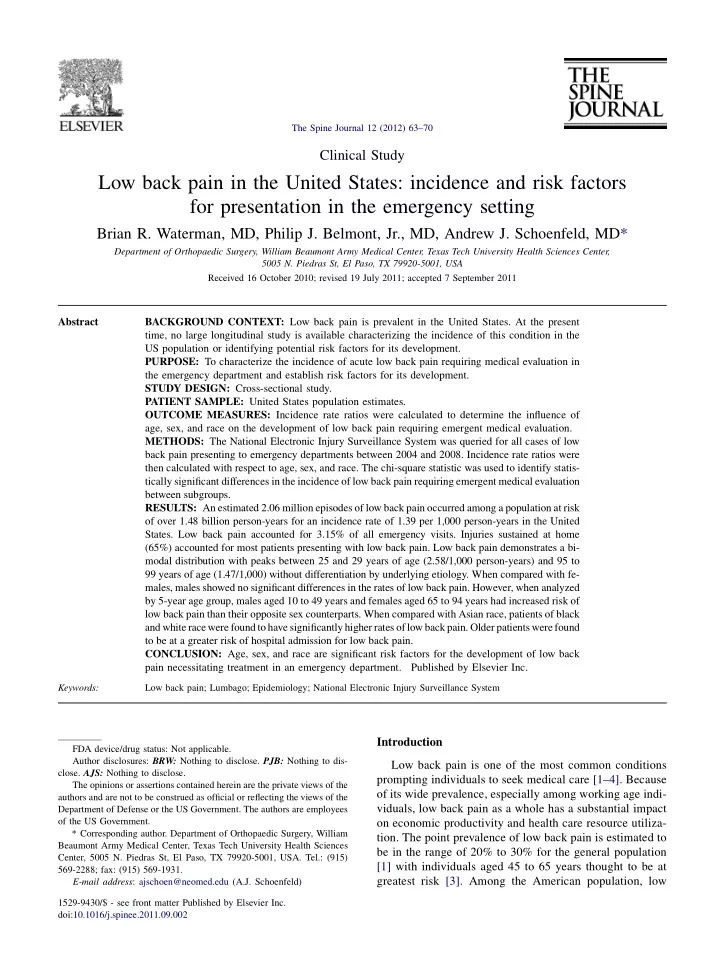
The Spine Journal 12 (2012) 6370 Clinical Study Low back pain in the United States: incidence and risk factors for presentation in the emergency setting Brian R. Waterman, MD, Philip J. Belmont, Jr., MD, Andrew J. Schoenfeld, MD* Department


slide-1
SLIDE 1

Clinical Study

Low back pain in the United States: incidence and risk factors for presentation in the emergency setting

Brian R. Waterman, MD, Philip J. Belmont, Jr., MD, Andrew J. Schoenfeld, MD*

Department of Orthopaedic Surgery, William Beaumont Army Medical Center, Texas Tech University Health Sciences Center, 5005 N. Piedras St, El Paso, TX 79920-5001, USA Received 16 October 2010; revised 19 July 2011; accepted 7 September 2011

Abstract BACKGROUND CONTEXT: Low back pain is prevalent in the United States. At the present time, no large longitudinal study is available characterizing the incidence of this condition in the US population or identifying potential risk factors for its development. PURPOSE: To characterize the incidence of acute low back pain requiring medical evaluation in the emergency department and establish risk factors for its development. STUDY DESIGN: Cross-sectional study. PATIENT SAMPLE: United States population estimates. OUTCOME MEASURES: Incidence rate ratios were calculated to determine the influence of age, sex, and race on the development of low back pain requiring emergent medical evaluation. METHODS: The National Electronic Injury Surveillance System was queried for all cases of low back pain presenting to emergency departments between 2004 and 2008. Incidence rate ratios were then calculated with respect to age, sex, and race. The chi-square statistic was used to identify statis- tically significant differences in the incidence of low back pain requiring emergent medical evaluation between subgroups. RESULTS: An estimated 2.06 million episodes of low back pain occurred among a population at risk

  • f over 1.48 billion person-years for an incidence rate of 1.39 per 1,000 person-years in the United
  • States. Low back pain accounted for 3.15% of all emergency visits. Injuries sustained at home

(65%) accounted for most patients presenting with low back pain. Low back pain demonstrates a bi- modal distribution with peaks between 25 and 29 years of age (2.58/1,000 person-years) and 95 to 99 years of age (1.47/1,000) without differentiation by underlying etiology. When compared with fe- males, males showed no significant differences in the rates of low back pain. However, when analyzed by 5-year age group, males aged 10 to 49 years and females aged 65 to 94 years had increased risk of low back pain than their opposite sex counterparts. When compared with Asian race, patients of black and white racewere found to have significantly higher rates of low back pain. Older patients were found to be at a greater risk of hospital admission for low back pain. CONCLUSION: Age, sex, and race are significant risk factors for the development of low back pain necessitating treatment in an emergency department. Published by Elsevier Inc.

Keywords: Low back pain; Lumbago; Epidemiology; National Electronic Injury Surveillance System

Introduction Low back pain is one of the most common conditions prompting individuals to seek medical care [1–4]. Because

  • f its wide prevalence, especially among working age indi-

viduals, low back pain as a whole has a substantial impact

  • n economic productivity and health care resource utiliza-
  • tion. The point prevalence of low back pain is estimated to

be in the range of 20% to 30% for the general population [1] with individuals aged 45 to 65 years thought to be at greatest risk [3]. Among the American population, low

FDA device/drug status: Not applicable. Author disclosures: BRW: Nothing to disclose. PJB: Nothing to dis-

  • close. AJS: Nothing to disclose.

The opinions or assertions contained herein are the private views of the authors and are not to be construed as official or reflecting the views of the Department of Defense or the US Government. The authors are employees

  • f the US Government.

* Corresponding author. Department of Orthopaedic Surgery, William Beaumont Army Medical Center, Texas Tech University Health Sciences Center, 5005 N. Piedras St, El Paso, TX 79920-5001, USA. Tel.: (915) 569-2288; fax: (915) 569-1931. E-mail address: ajschoen@neomed.edu (A.J. Schoenfeld) 1529-9430/$ - see front matter Published by Elsevier Inc. doi:10.1016/j.spinee.2011.09.002 The Spine Journal 12 (2012) 63–70

slide-2
SLIDE 2

back pain is the fifth most common reason individuals seek medical care [2,3], and 30–50 billion health care dollars are spent on the treatment of this condition annually [2–4]. There are numerous factors that can result in symptoms

  • f low back pain. Specific etiologies, such as tumors, spinal

instability, and infections, may be immediately treatable. There are other conditions such as degenerative disc disease and spondylotic processes whose contribution to back pain is incompletely understood. Still, in some patients, nonspe- cific factors are felt to contribute to the origin of back pain, and these individuals may be especially difficult to effec- tively treat [4]. Some authors have maintained that close to 85% of patients with acute back pain have nonspecific etiologies for their condition [2–5]. Such individuals may be at greater risk for developing chronic back pain, and it is these cases that bear a disproportionate share of the bur- den of health care costs related to back pain [2,4]. In fact, less than 5% of patients with low back pain consume up to 75% of attributable health care costs [6]. Obstacles to the effective study of this condition include its near ubiquity among the population in terms of lifetime risk, as well as the disparate number of conditions that can manifest with symptoms of low back pain. In terms of non- specific back pain, a number of factors have been postulated to play a role in its development, including age [7–10], sex [8,10,11], genetic predisposition [12–15],

  • ccupation

[7,8,16,17], smoking [6,9,13,14,18], race [10], job satisfac- tion [16,19], psychological issues [2,19], anthropometry, and posture [10]. Limitations within prior investigations, such as sample size and a reliance on select populations of unique occupation or ethnic group, have limited the applica- bility of findings to the population at large. At present, no large study has been able to identify the incidence of low back pain necessitating emergency medical evaluation, or risk factors for its development, among the general American population. This investigation sought to determine the incidence and epidemiology of low back pain necessitating emergency medical evaluation in the United States from 2004 to

  • 2008. In addition, this research also endeavored to describe

the effect of age, sex, and race on the development of low back pain. To the best of our knowledge, this report is the first of its kind, documenting findings that may be represen- tative of the general American population as a whole. Methods This cross-sectional descriptive epidemiological study was approved by our institutional review board and used cases of low back pain identified in the Consumer Product Safety Commission’s (CPSC) National Electronic Injury Surveillance System (NEISS) database. A full description

  • f the design and utilization of this system has been

published on the CPSC electronic web page [20–22]. Fur- thermore, the NEISS has served as a reliable and reproduc- ible source for a wide range of prior epidemiological investigations [23–30], and our methods have been described in prior publications [23,24]. The NEISS database was originally created by stratifying all hospitals in the United States based on three baseline var- iables (geographic location, hospital size, and emergency room volume). From this pool, 100 sample hospitals were designated through a process of randomized selection, and data from each hospital were assigned statistical sample weights to create a national probability sample of hospitals in the United States and its territories. Patient information and injury characteristics are collected from each hospital for every emergency visit related to injury. Encounters per- taining to the following are not reported in the NEISS data- base: traffic or transportation accidents (eg, automobiles, motorcycles, planes, and trains), intentional, nonaccidental injuries (eg, assault), occupational injuries (ie, injuries that

  • ccur during work eligible for compensation), or other in-

juries previously treated at a given hospital. In the present study, the NEISS database was queried in 1-year intervals for all injuries between January 1, 2004 and December 31, 2008 classified in the NEISS database as ‘‘strain- or sprain-’’ type injuries in the ‘‘lower trunk’’region. The diagnosis of ‘‘strain or sprain’’ in the NEISS database represents a catch-all category not just for true lumbosacral sprains or strain (846.0–848.9), but a variety of conditions with specific (degenerative disc disease [722.52], spinal ste- nosis [724.0], spondylosis [721.3]) and nonspecific etiolo- gies (eg, lumbago [724.2], backache [724.5], trunk injury [959.1], myalgia, or myositis [729.1]) not otherwise covered Context Knowledge of the incidence of low back pain within a society may be useful at the policy level, specifically by establishing priorities for care and providing insight for estimates into potential societal costs. Contribution In this study using information obtained from NEISS, the authors found that about 2 million people in the United States went to emergency rooms for low back pain between 2004 and 2008, accounting for about 3%

  • f all ER visits.

Implication This information is valuable as a snapshot of back pain at the societal level. It can serve as an impetus for fur- ther investigation. As with most database analyses, the information is insufficiently specific to be used to guide care of individual patients, as the authors have acknowl- edged in their discussion of the weaknesses inherent in such studies. —The Editors

64 B.R. Waterman et al. / The Spine Journal 12 (2012) 63–70

slide-3
SLIDE 3

in the database. Conditions with evident spinal fractures, ra- dicular features, or soft-tissue contusions are recorded in

  • ther diagnostic categories (‘‘fracture,’’ ‘‘nerve damage,’’

and ‘‘contusion or abrasion,’’respectively) and were not con- sidered in this study. Subsequent narrative fields including ‘‘hip,’’ ‘‘groin,’’ or ‘‘abdomen’’ were excluded, yielding 52,465 patient encounters. Query results were pooled and analyzed for any redundancy by use of the unique case iden- tifier (CPSC case number). Initial analysis focused on overall demographics of this cohort with nonoccupational, mechan- ical low back pain in the estimated mean annual population at risk in the United States (297,048,260 persons) during the study period. Because of the nature of the NEISS probability sample design, all proportions are calculated based on weighted estimates. Using SAS statistical software (SAS In- stitute Inc., Cary, NC, USA) and SAS programming codes provided by the CPSC for the NEISS model, the gross sample population (denoted n) with low back pain was converted to the US population estimates (N ) with 95% confidence inter- vals (CIs). Statistical analysis Weighted totals for the incidence of low back pain were used to analyze the proportional demographic data of the NEISS sample population as well as that of specific sub- groups (eg, age, sex, and race) with respect to location of in- jury event, patient disposition, and activity at time of injury. Additional statistical analyses including the chi-square and Wald’s chi-square were performed to identify statistically significant differences between subgroups. United States Census Bureau population estimates were used to calculate at-risk person-years for the both the US population and specific subgroups throughout the defined time period, al- lowing the calculation of incidence rate (IR) with 95% CIs. Because of the off-cycle nature of US population estimates (index date July 1) relative to the NEISS sample (data range, January 1–December 31 of given year), at-risk person-years were calculated by including the full population estimates for each year from 2004 to 2007 and half the population estimate for 2003 and 2008. Incidence rates are expressed as the number of cases of low back pain per 1,000 at-risk person-years and are calculated as the number of estimated cases of low back pain divided by at-risk person-years in the United States during the study period. When necessary, subgroups were combined to facilitate statistical analysis. Incidence rate ratio (IRR) is a unit-less expression of risk in the comparison of IRs between two separate subgroups, with the incidence rate of an identified referent subgroup serving as the denominator in all calculations. In all statisti- cal analyses, p value less than .05 was considered significant. Results A total of 1.82 million emergency room visits were re- corded in the sample network over the 5-year study period (N565.63 million). Of these,a total of 52,465actual low back pain–related encounters were identified in the NEISS data- base, resulting in an estimated 2.07 million cases of low back pain (413,416/year) among an at-risk population of over 1.48 billion person-years. This patient cohort comprised approxi- mately 3.15% of all estimated emergency room visits. The es- timated IR of low back pain presenting to emergency departments in the general US population is 1.39 per 1,000 person-years. Over the study period, no statistically signifi- cant differences were noted in the overall and sex-specific IR of low back pain presenting to US emergency departments. Age Low back pain demonstrated a bimodal distribution, with peaks during 25 to 29 years of age (2.58/1,000 person-years) and 95 to 99 years of age (1.47/1,000) (Fig. 1). However, when analyzed by 5-year age group, males aged 10 to 49 years and females aged 65 to 94 years had increased risk of low back pain than their opposite sex counterparts. Mean pa- tient age was 38.8 years (95% CI, 38.6–38.9). Patients aged 20 to 39 years had the highest incidence of low back pain, with an IRR of 5.19 (95% CI, 4.65–5.72; p!.0001) when compared with individuals younger than 20 years. Incidence rates by 20-year age group are listed in Table 1. Sex When analyzed by sex, males accounted for an esti- mated 51.5% episodes of low back pain, whereas females accounted for 48.5%. Males and females had overall IRs

  • f 1.46 and 1.33 per 1,000 person-years, respectively, for

an IRR of 1.09 (95% CI, 0.94–1.25; p5.23). The peak male and female incidence occurred between 25 and 29 years of age, with an IR of 1.39 and 1.19 per 1,000 person-years, respectively (Fig. 2). Males aged 10 to 49 years and females aged 65 to 94 years had signifi- cantly higher risk for developing low back pain than their

  • pposite sex counterparts (p5.045).

Race Racial category demographic data were available for an es- timated 77.0% of individuals. Low back pain IRs were 2.10 among Native Americans, 1.38 among blacks, 1.23 among whites, 0.40 among Hispanics, and 0.20 among Asians per 1,000 person-years. When compared with Asian race, white race 6.04 (95% CI, 1.03–11.05; p5.049) and black race 6.78 (95% CI, 1.05–12.51; p5.028) had statistically significantly increased risk for developing low back pain requiring treat- ment, whereas Hispanic and Native American race demon- strated no statistically significant differences (Table 2). Furthermore, comparisons between black, white, and Native American race demonstrated no statistically significant differ-

  • ences. When analyzing by race and sex, males and females of

white and black race also had significantly higher rates of low back pain than the Asian cohorts (Table 2).

65 B.R. Waterman et al. / The Spine Journal 12 (2012) 63–70

slide-4
SLIDE 4

Location Location of injury was available in 79.7% of patient en-

  • counters. Most injuries occurred in or around the home

(81.0%), followed by place of recreation or sport (8.1%),

  • ther public property (5.7%), school (1.7%), and street or

highway (1.5%). Males were more likely to sustain low back pain in a recreational/athletic setting than females (IRR, 2.45; 95% CI, 2.20–2.69; p!.0001). No other significant dif- ferences were detected when stratified by sex and location of

  • injury. When evaluating by age, individuals aged 20 to 40

years were more likely to be injured at home or in a recrea- tional/athletic setting than those individuals younger than 20 years (p!.0001) and older than 60 years (p!.05). Activity/mechanism of injury Activities of daily living accounted for the majority of all episodes of low back pain. Lifting was the most commonly re- ported mechanism, accounting for nearly one-third (32.70%)

  • f all visits, followed by slip or fall (27.07%) and twisting

movement (3.74%). Sports or recreational activity were asso- ciated with 23.97% of all injuries, with aerobic exercise (2.77%), weightlifting (2.58%), baseball (2.53%), and bicy- cling (2.02%) being the most commonly reported. Disposition Of all patients, only 1.22% of patients required hospital admission or temporary observation, whereas the majority were treated on an outpatient basis and discharged from the emergency department (98.42%). Of those patients ad- mitted, 61.1% (95% CI, 56.1–66.1) were female and 38.9% (95% CI, 33.9–43.9) were male. Males (51.6%; 95% CI, 50.6–52.7) were more frequently treated and released than their female counterparts (48.4%; 95% CI, 47.3–49.4). Av- erage age of admitted patients was 61.8 (95% CI, 59.0– 64.5) compared with 39.1 (95% CI, 38.2–40.0) in patients discharged from emergency department. When analyzed by 20-year age group, patients older than 80 years were at a 175-fold increased risk of hospital admission for low back pain than their younger counterparts (Table 3). Among those patients admitted, no statistically significant differ- ences were detected by race. Discussion Low back pain is a widespread condition among the American population and one that exerts a significant toll

  • n the workforce and health care system [1–5,10]. Despite

Table 1 Incidence rates of low back pain by 20-year age group, 2004–2008 Age (y) Estimated low back pain IR (per 1,000 person-years) 95% Confidence interval Risk ratio (95% CI) p Value Under 20 184,822 0.45 0.39–0.52 N/A 20–39 960,361 2.34 1.91–2.77 5.19 (4.65–5.72) !.0001 40–59 687,096 1.66 1.35–1.97 3.68 (3.24–4.12) !.0001 60–79 169,260 0.85 0.64–1.07 1.89 (1.51–2.26) !.0001 Over 80 65,453 1.21 0.89–1.53 2.68 (2.10–3.26) !.0001 IR, incidence rate; 95% CI, 95% confidence interval. N/A5not applicable because this category was used as the referent. Incidence rate is expressed as per 1,000 person-years.

  • Fig. 1. Incidence rate of low back pain by 5-year age group, 2004–2008.

66 B.R. Waterman et al. / The Spine Journal 12 (2012) 63–70

slide-5
SLIDE 5

its prevalence [1–5,10,17,31], remarkably little is known regarding the incidence of this condition or its risk factors for development. Obstacles to such determinations in the past have included the inability to identify a population at risk, as well as studies conducted among small cohorts of specific background and ethnicity that precluded broader applicability to the general population. Relying on data ob- tained from the NEISS database, this investigation sought to determine the incidence of low back pain necessitating emergency medical evaluation for the general US popula- tion along with risk factors contributing to its etiology. Ad- vantages of using data gathered from the NEISS system include the fact that a population at risk can be determined and that estimates can be extrapolated to the general popu- lation of the United States. Prior studies have established the use of the NEISS database to make estimates for the in- cidence and epidemiology of orthopedic conditions [22,23]. This study is the first of its kind, however, to attempt to characterize the incidence and epidemiology of clinically significant low back pain in the United States. The present study indicates that age, sex, and race all play a role in the incidence and ultimate disposition of low back pain. This investigation found that back pain pres- ents in a bimodal distribution among age groups, with the preponderance of cases occurring in young- to middle- aged adults and, to a lesser extent, the elderly (Fig. 1). When sex is considered, younger males appear to account for most individuals in the earlier age-related peak, whereas women

  • Fig. 2. Incidence rates and incidence rate ratios of low back pain among males and females by 5-year age group, 2004–2008.

Table 2 Incidence rates and incidence rate ratio of low back pain by race, 2004– 2008 Race IR* 95% CI IRRy 95% CI p Value White All 1.23 0.90–1.56 6.04 1.03–11.05 .049 Male 1.28 0.94–1.62 6.04 1.01–12.12 .042 Female 1.18 0.85–1.51 6.04 1.39–10.68 .033 Black All 1.38 0.88–1.88 6.78 1.05–12.51 .028 Male 1.40 0.91–1.89 6.59 1.03–12.19 .048 Female 1.36 0.85–1.88 6.98 1.34–12.61 .038 Native American All 2.10 0.0–4.99 10.34 0–26.64 .258 Male 1.93 0–4.67 9.08 0–24.44 .299 Female 2.28 0–5.35 11.65 0–29.39 .236 Hispanic All 0.40 0.16–0.63 1.95 !0.01–3.89 .335 Male 0.42 0.20–0.64 1.97 0–4.09 .369 Female 0.36 0.11–0.62 1.85 0–3.70 .363 Asian All 0.20 0.03–0.37 N/A Male 0.21 0.01–0.41 N/A Female 0.20 0.06–0.35 N/A IR, incidence rate; IRR, incidence rate ratio. N/A5not applicable because this category was used as referent. * Denotes IR by race per 1,000 person-years.

y Denotes an IRR of total, male, and female populations by race with

Asian race as the referent. Table 3 Hospital admission rates for low back pain by 20-year age group, 2004– 2008 Age (y) IR* 95% CI IRRy 95% CI p Value Under 20 0.0007 0.0002–0.0013 N/A 20–39 0.011 0.007–0.014 15.01 4.21–25.80 .012 40–59 0.015 0.011–0.020 21.07 4.66–37.48 .017 60–79 0.037 0.027–0.047 51.46 13.12–89.80 .011 Over 80 0.13 0.087–0.17 175.00 36.94–313.05 .014 IR, incidence rate; IRR, incidence rate ratio. N/A5not applicable because this category was used as referent. * Incidence rate denotes hospital admission rate by 20-year age group per 1,000 person-years.

y Incidence rate ratio denotes an incidence rate ratio of the total pop-

ulations by 20-year age group with the under 20 years old group as the referent. 67 B.R. Waterman et al. / The Spine Journal 12 (2012) 63–70

slide-6
SLIDE 6

appear to be at greater risk beyond the age of 65 (Fig. 2). These factors may reflect a disproportionate exposure to at-risk activity among young males [7,8,17] and the in- creased rate of occult compression fractures, other osteopo- rotic or age-related conditions, and secondary low back pain described in elderly women [32,33]. Additionally, women and the elderly were found to be at greater risk for hospital admission for their back pain. Those reported as Asian were found to be at the lowest risk for clinically significant back pain, whereas whites and blacks demonstrated a significantly increased risk. In most respects, our findings are consistent with earlier reports on the epidemiology of low back pain [1–3,7, 8,11,17]. For example, many investigations have docu- mented an increased incidence of clinical low back pain in middle-aged patients [3,8,34]. Knox et al. [8] encoun- tered an increased risk among patients older than 35 years, whereas Lebouef-Yde et al. [34] cited greatest risk in indi- viduals aged 20 to 41 years. However, there is limited doc- umentation of the epidemiology of low back pain in the

  • elderly. In fact, the prevalence and burden of low back pain

in the elderly has been historically underrepresented, with reported prevalence rates between 6% and 47% [33]. Such a finding was not possible in the works of Knox et al. and Lebouef-Yde et al. because of demographic limitations of their respective cohorts. Our description of greater hospital admission among female patients echoes the finding of Chenot et al. [11] that women are more severely affected by low back pain and more frequently use health care re-

  • sources. Contrary to prior investigations [8,10,11], this

study did not substantiate the fact that, overall, females are at a greater risk of developing clinically significant low back pain than male counterparts. Conclusions presented here regarding the impact of race

  • n the incidence of low back pain are relatively novel, in

that no substantial research among a large series of patients has previously been performed. One study has suggested that black when compared with white adolescents may be at greater risk of low back pain [10]. In their study on the prevalence of low back pain within the population of North Carolina, Carey et al. [35] reported that 72% of patients seeking care for chronic low back pain were white, whereas

  • nly 5% were Hispanic. Such findings may be borne out in

the results presented here, although the outcomes published by Carey et al. can also be viewed as a reflection of the racial demographic peculiar to the region where their study was

  • conducted. Although Native Americans had the highest in-

cidence of low back pain and previous works have substantiated an increased predisposition toward its devel-

  • pment [1], the small sample population has precluded

meaningful statistical comparisons in the present study. To date, no other studies have rigorously evaluated the compar- ative IRs of low back pain in multiple racial categories in the broader US population, and further research is required to determine whether these differences are the byproduct of so- cioeconomic status, differential health care utilization, or underlying anthropomorphic differences. Few studies have been able to calculate an incidence for clinically significant low back pain, mainly because of the fact that most prior works were unable to determine a popu- lation at risk. Two prior investigations have characterized the incidence of low back pain amidst fixed populations [8,17], although both were conducted in a military setting, thereby limiting their applicability to the general population. This is evidenced in the fact that in both these military stud- ies, the estimated incidence of low back pain far exceeds that documented in the present investigation (Table 4). It is possible, however, that the findings presented by Knox et al. [8] and Mattila et al. [17] are merely reporting on the initial age- and sex-related peak encountered in this study without the additional details afforded by access to a data set that includes younger individuals and the elderly. Moreover, environmental determinants such as the rigorous physical demands and heavy lifting requirements of military personnel may place individuals at even greater risk of low back pain than their nonuniformed counterparts. In the pres- ent study, the estimated population at risk encompasses the entire average population of the United States, a wider de- mographic than previous investigations. In comparison with other studies on musculoskeletal con- ditions performed using the NEISS database, low back pain figures among one of the more common conditions requiring treatment in an emergency room [22,23]. In previous inves- tigations, ankle sprain was found to have an incidence slightly higher than low back pain (2.15/1,000 person- years) [23], whereas distal radius fractures and shoulder dis- locations were exceedingly lower at 0.62 and 0.24 per 1,000 person-years, respectively [22]. The NEISS data set has been accepted as a tool for calculating injury IRs for the American population [22–30], although it has not been widely used in the area of musculoskeletal medicine. Nonetheless, when compared with other reports on musculoskeletal conditions evaluated using this same system, our findings regarding the incidence of low back pain appear to coincide with what is known about this condition and its prevalence relative to

  • ther orthopedic issues.

Table 4 Previous studies calculating incidence of low back pain Study Population Injuries Population at risk (person-years) Incidence rate (per 1,000 person-years) Knox et al. (2010) [8] Military, United States 557,059 13,754,261 40.5 Mattila et al. (2009) [17] Military, European 7,240 267,700 19.1 Present study General, United States 2,067,081 1,485,241,300 1.39 68 B.R. Waterman et al. / The Spine Journal 12 (2012) 63–70

slide-7
SLIDE 7

There are several limitations to the present investiga- tion that must be taken into account when reviewing the results. Chief among these is the fact that this is a da- tabase study and subject to the limitations inherent to such research design. For example, patient-specific infor- mation regarding each individual case of low back pain was not recorded in the system, and mitigating factors, such as medical comorbidities, family history, spinal sur- geries or prior fractures, smoking history, and drug use, are not available for consideration. Additionally, the data set is limited by the fact that there is no means in the system to isolate and control for visits related to acute-

  • n-chronic low back pain or clinical errors in misdiagno-

sis, as the medical record and adjunctive radiographic workups were unavailable. Also, the specific etiologies for mechanical low back pain are well elucidated and would warrant more advanced radiographic imaging not typically obtained or recommended in the emergency set- ting [36,37]. Another limitation is the fact that, by design, our sample

  • nly captures those patients who present to an emergency

room seeking treatment. Our definition of ‘‘clinically sig- nificant back pain,’’ meaning that which necessitates med- ical evaluation takes this into account, although admittedly those patients who present to a primary care practitioner or

  • ther specialist for treatment for their back pain would also

have a clinically significant condition that is not captured in this data set. Similarly, patients with true occupational low back injuries or those inappropriately identified as ‘‘work related’’ were not included in this analysis. Therefore, our calculated incidence of low back pain is likely an underes- timation and suffers from sampling bias. While accepting the potential drawbacks of the NEISS data set, one must also recognize that the system’s proto- cols have been accepted as accurate determinations for the incidence and epidemiology of other injuries within the American population [22–30]. The NEISS cohort used in this study was obtained in the modern period and rep- resents the general population of the United States to the fullest extent possible. At the present time, our estima- tions regarding the incidence of, as well as risk factors for, clinically significant low back pain can be accepted as representing the best available evidence for this condition. In conclusion, our study documented an incidence of clinically significant low back pain of 1.39 per 1,000 person-years. To varying degrees, age, sex, and race were all found to play a role in influencing the development of the condition, as well as final disposition and health care re- source utilization. Our findings identify at-risk groups that can be targeted in future prospective investigations to better isolate any underlying pathology contributing to the devel-

  • pment of low back symptoms. With further directed re-

search, directed interventions among potential populations at risk may help to mollify the development of clinically significant low back pain. Acknowledgments The authors would like to thank Julia O. Bader, PhD, for her assistance in the statistical analyses performed in this study. References

[1] Deyo RA, Mirza SK, Martin BI. Back pain prevalence and visit rates: estimates from US national surveys, 2002. Spine 2006;31: 2724–7. [2] Chou R, Chekelle P. Will this patient develop persistent disabling low back pain? JAMA 2010;303:1295–302. [3] Dickman RD, Zigler JE. Discogenic back pain. In: Spivak JM, Connolly PJ, eds. Orthopaedic knowledge update: Spine 3. Rose- mont, IL: North American Spine Society, 2006:319–29. [4] Nordin M, Lis AM, Weiser SR, et al. Nonspecific low back pain: cur- rent issues in treatment. In: Frymoyer JW, Wisel SW, eds. The adult and pediatric spine. 3rd ed. Philadelphia, PA: Lippincott Williams and Wilkins, 2004:307–22. [5] Jarvik JG, Deyo RA. Diagnostic evaluation of low back pain with emphasis on imaging. Ann Intern Med 2002;137:586–97. [6] Katz JN. Lumbar disc disorders and low-back pain: socioeconomic factors and consequences. J Bone Joint Surg Am 2006;88:21–4. [7] Mattila VM, Sahi T, Jormanainen V, Pihlajamaki H. Low back pain and its indicators: a survey of 7,040 Finnish male conscripts. Eur Spine J 2008;17:64–9. [8] Knox J, Orchowski J, Scher DL, et al. The incidence of low back pain in active duty United States military service members. Spine 2011;36:1492–500. [9] Hicks GE, Morone N, Weiner DK. Degenerative lumbar disc and facet disease in older adults: prevalence and clinical correlates. Spine 2009;34:1301–6. [10] Duggleby T, Kumar S. Epidemiology of juvenile low back pain: a re-

  • view. Disabil Rehabil 1997;19:505–12.

[11] Chenot JF, Becker A, Leonhardt C, et al. Sex differences in presen- tation, course, and management of low back pain in primary care. Clin J Pain 2008;24:578–84. [12] Nyman T, Mulder M, Iliadou A, et al. High heritability for concurrent low back and neck-shoulder pain—a study of twins. Spine 2010 Dec

  • 29. [Epub ahead of print].

[13] Cheung KM. The relationship between disc degeneration, low back pain, and human pain genetics. Spine J 2010;10:958–60. [14] Batti e MC, Videman T. Lumbar disc degeneration: epidemiology and

  • genetics. J Bone Joint Surg Am 2006;88:3–9.

[15] Batti e MC, Videman T, Gibbons LE, et al. 1995 Volvo Award in clin- ical sciences. Determinants of lumbar disc degeneration. A study re- lating lifetime exposures and magnetic resonance imaging findings in identical twins. Spine 1995;20:2601–12. [16] Landry MD, Raman SR, Sulway C, et al. Prevalence and risk factors associated with low back pain among health care providers in a Kuwait hospital. Spine 2008;33:539–45. [17] Mattila VM, Sillanpaa P, Visuri T, Pihlajamaki H. Incidence and trends of low back pain hospitalization during military service—an analysis of 387,070 Finnish young males. BMC Musculoskeletal Disord 2009;10:10. [18] Mikkonen P, Leino-Arjas P, Remes J, et al. Is smoking a risk factor for low back pain in adolescents? A prospective cohort study. Spine 2008;33:527–32. [19] Mitchell T, O’Sullivan PB, Burnett A, et al. Identification of modifi- able personal factors that predict new-onset low back pain: a prospec- tive study of female nursing students. Clin J Pain 2010;26:275–83. [20] Schroeder, T, Ault, K. The NEISS sample (design and implementa- tion) 1997 to present. U.S. Consumer Product Safety Commission Di- vision of Hazard and injury data systems. 2001. http://www.cpsc.gov/ neiss/2001d011-6b6.pdf. Accessed October 2009. 69 B.R. Waterman et al. / The Spine Journal 12 (2012) 63–70

slide-8
SLIDE 8

[21] The National Electronic Injury Surveillance System: A tool for Re-

  • searchers. U.S. Consumer Product Safety Commission Division of

Hazard and injury data systems. 2000. http://www.cpsc.gov/neiss/ 2000d015.pdf. Accessed December 2009. [22] NEISS Coding Manual. U.S. Consumer Product Safety Commission Division of Hazard and injury data systems. 2007. http://www.cpsc. gov/neiss/completemanual.pdf. Accessed December 2009. [23] Zacchilli MA, Owens BD. Epidemiology of shoulder dislocations presenting to emergency departments in the United States. J Bone Joint Surg Am 2010;92:542–9. [24] Waterman BR, Belmont PJ Jr, Davey S, et al. Ankle sprain in the United States population. J Bone Joint Surg Am 2010;92:2279–84. [25] McGeehan J, Shields BJ, Wilkins JR 3rd, et al. Escalator-related in- juries among children in the United States, 1990-2002. Pediatrics 2006;118:e279–85. [26] Leininger RE, Knox CL, Comstock RD. Epidemiology of 1.6 mil- lion pediatric soccer-related injuries presenting to US emergency departments from 1990 to 2003. Am J Sports Med 2007;35: 288–93. [27] Quinlan KP, Thompson MP, Annest JL, et al. Expanding the National Electronic Injury Surveillance System to monitor all nonfatal injuries treated in US hospital emergency departments. Ann Emerg Med 1999;34:638–45. [28] Vollman D, Smith GA. Epidemiology of lawn mower-related injuries to children in the United States, 1990-2004. Pediatrics 2006;118: e273–8. [29] Yard EE, Knox CL, Smith GA, Comstock RD. Pediatric martial arts injuries presenting to emergency departments, United States 1990-2003. J Sci Med Sport 2007;10:219–26. [30] Loder RT. The demographics of equestrian-related injuries in the United States: injury patters, orthopaedic specific injuries, and ave- nues for injury prevention. J Trauma 2008;28:447–60. [31] Suzuki N, Ogikubo O, Hansson T. The course of acute vertebral body fragility fracture: its effect on pain, disability, and quality of life dur- ing 12 months. Eur Spine J 2008;17:1380–90. [32] Livshits G, Ermakov S, Popham M, et al. Evidence that bone mineral density plays a role in degenerative disc disease: the UK Twin Spine

  • study. Ann Rheum Dis 2010;69:2102–6.

[33] Bressler HB, Keyes WJ, Rochon PA, Badley E. The prevalence of low back pain in the elderly. Spine 1999;24:1813–9. [34] Leboeuf-Yde C, Kyvik KO. At what age does low back pain become a common problem? A study of 29,424 individuals aged 12-41 years. Spine 1998;23:228–34. [35] Carey TS, Freburger JK, Holmes GM, et al. A long way to go: prac- tice patterns and evidence in chronic low back pain care. Spine 2009;34:718–24. [36] Friedman BW, Chilstrom M, Bijur PE, Gallagher EJ. Diagnostic test- ing and treatment of low back pain in United States emergency de-

  • partments. Spine 2010;35:E1406–11.

[37] Chou R, Qaseem A, Owens DK, et al. Diagnostic imaging for low back pain: advice for high-value health care from the American College of Physicians. Ann Intern Med 2011;154:181–9. 70 B.R. Waterman et al. / The Spine Journal 12 (2012) 63–70