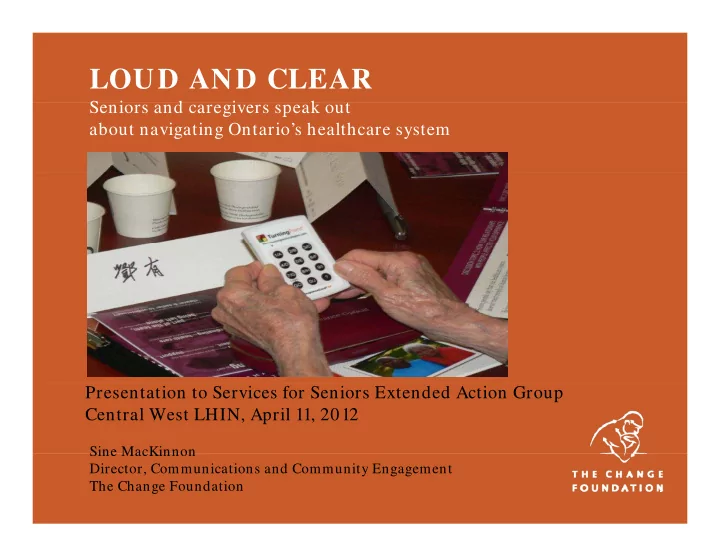
LOUD AND CLEAR Seniors and caregivers speak out S i d i k t - - PowerPoint PPT Presentation

loud and clear
SMART_READER_LITE
LIVE PREVIEW

LOUD AND CLEAR Seniors and caregivers speak out S i d i k t - - PowerPoint PPT Presentation

LOUD AND CLEAR Seniors and caregivers speak out S i d i k t about navigating Ontarios healthcare system Presentation to Services for Seniors Extended Action Group Central West LHIN, April 11, 2012 Sine MacKinnon Sine MacKinnon


slide-1
SLIDE 1

LOUD AND CLEAR

S i d i k t Seniors and caregivers speak out about navigating Ontario’s healthcare system Presentation to Services for Seniors Extended Action Group Central West LHIN, April 11, 2012

Sine MacKinnon Sine MacKinnon Director, Communications and Community Engagement The Change Foundation

slide-2
SLIDE 2

&

change the debate, change the practice, change the experience.

Today: Tales of healthcare transitions and their place and purpose in our plan – and their place and purpose in our plan

  • Preview findings/ messages from LOUD and CLEAR –

to be released later this month

  • Shared understanding of what The Change Foundation

is doing – and why – and how it relates to other efforts

  • The role of public engagement in implementing our

plan – the planning and process of teasing out those tales of transitions tales of transitions

  • How we will continue the conversations with health

system users– as conduit to patient-centred healthcare system users– as conduit to patient-centred healthcare

H E A L T H C A R E D E S E R V E S O U R F I N E S T T H O U G H T

2

slide-3
SLIDE 3

2010/ 2011 Strategic Plan Hearing the stories, changing the story

Engagement in today’s climate: danger and opportunity? Engagement in today s climate: danger and opportunity?

  • Deficits
  • Ontario’s Action
  • Demographics

d

  • New emphasis on

primary and community Plan for Health Care

  • Drummond
  • Difficult decisions

p y y care – new integration levers?

  • Evidence for action on
  • Devil in the details

quality agenda

  • Excellent Care for All

requirements

3

H E A L T H C A R E D E S E R V E S O U R F I N E S T T H O U G H T

slide-4
SLIDE 4

&

change the debate, change the practice, change the experience.

Th Ch F d ti i t i The Change Foundation 1-m inute prim er:

  • Endowed by the Ontario Hospital

Association in 1996

  • Spent 10 years as a granting agency

Spent 10 years as a granting agency focused on local system change R i d i 2007 H lth li

  • Reorganized in 2007 – Health policy

think tank focused on issues of integration, quality improvement and

H E A L T H C A R E D E S E R V E S O U R F I N E S T T H O U G H T

4

patient experience.

slide-5
SLIDE 5

&

change the debate, change the practice, change the experience.

Where we are now

  • Implementing strategic plan, Hearing the stories,

changing the story

  • The Goal:

..to improve the experience of individuals and caregivers as they move in, out of, and across the h l h i h i h l h healthcare system over time, as their health changes. The population of focus: Seniors with chronic health

  • The population of focus: Seniors with chronic health

conditions and their informal caregivers

H E A L T H C A R E D E S E R V E S O U R F I N E S T T H O U G H T

5

slide-6
SLIDE 6

&

change the debate, change the practice, change the experience.

On the PATH

  • Key components of our signature project
  • Seniors with chronic health conditions
  • One community partnership (across sectors)

y p p ( )

  • Care transitions
  • Patient co-design
  • Successful community coalition announced in May

Successful community coalition announced in May

H E A L T H C A R E D E S E R V E S O U R F I N E S T T H O U G H T

6

slide-7
SLIDE 7

&

change the debate, change the practice, change the experience.

Aligning m ethods: all eyes on the prize Aligning m ethods: all eyes on the prize

h

  • Research
  • Care redesign/ co-design: PATH

g / g

  • Engagement

H E A L T H C A R E D E S E R V E S O U R F I N E S T T H O U G H T

7

slide-8
SLIDE 8

&

change the debate, change the practice, change the experience.

Engagem ent key part of plan Engagem ent key part of plan

  • Multiple components over time, integrated + iterative
  • Audience: healthcare’s stewards, stakeholders, users

F i i i f h lth l

  • Focus on users – missing piece of healthcare puzzle
  • Probing the experiences of seniors with chronic health

conditions, and caregivers, to understand where healthcare transition problems are what could healthcare transition problems are, what could improve them. Elem ents of engagem ent plan:

  • Regional engagem ent, round 1 (fall 20 11)

Regional engagem ent, round 1 (fall 20 11)

  • Citizens engagem ent panel (20 12-20 15)
  • Regional consultations, round 2 (fall 20 14)
  • Sum m it (2015)

Sum m it (2015)

H E A L T H C A R E D E S E R V E S O U R F I N E S T T H O U G H T

8

slide-9
SLIDE 9

&

change the debate, change the practice, change the experience.

Our Engagem ent Prem ise Our Engagem ent Prem ise

  • Lived realities and personal stories of people’s healthcare

experiences are legitimate sources of info

  • Experiences = evidence. Does our system deliver on the

promise of patient-centred healthcare? What do the experiences of seniors tell us about what adds value to our h lth t h t d fi i d h t' i i ? healthcare system, what needs fixing, and what's missing?

  • Health/ social care needs of seniors with chronic health

conditions and caregivers often complex – many cross- g p y sector transitions, multiple providers and settings

  • If we can reorient services, practices, processes to address

their transitions problems we can eliminate gaps dead

H E A L T H C A R E D E S E R V E S O U R F I N E S T T H O U G H T

9

their transitions problems, we can eliminate gaps, dead ends that inhibit improvements system-wide.

slide-10
SLIDE 10

&

change the debate, change the practice, change the experience.

Our Process Our Process

  • Pilot-tested methodology/ tools with several groups
  • Blended methods and tools to meet objectives (and budget!):

Blended methods and tools to meet objectives (and budget!):

  • face-to-face facilitated small group discussion across

province

  • webinar

li St b k

  • online Storybook
  • keypad voting on questions about transition experiences
  • informed discussion facilitated by Conversation Guide
  • evaluation incorporated at various points

p p

  • Aligned our questions with other research
  • Took partnership approach

H E A L T H C A R E D E S E R V E S O U R F I N E S T T H O U G H T

10

  • Took partnership approach
slide-11
SLIDE 11

&

change the debate, change the practice, change the experience.

Fram ing the conversation- our sweet spot Fram ing the conversation our sweet spot

H E A L T H C A R E D E S E R V E S O U R F I N E S T T H O U G H T

11

slide-12
SLIDE 12

&

change the debate, change the practice, change the experience.

Discussion Topics Discussion Topics

1. Your experience in navigating the healthcare i i i i system: Transitions & Communication

  • W here did you experience challenges or problem s (e.g.

any delays or disruptions, confusion, disconnects) along the w ay and w ho w as involved? y

  • In your experience, did your healthcare w orkers

com m unica te a nd sha re im portant inform ation about your care? (w ith each other; w ith you/ your about your care? (w ith each other; w ith you/ your caregiver)

  • What big or little thing w ould have im p rov ed your

experience?

H E A L T H C A R E D E S E R V E S O U R F I N E S T T H O U G H T

12

slide-13
SLIDE 13

&

change the debate, change the practice, change the experience.

Discussion Topics Discussion Topics

  • 2. How your relationships with people affected your experience
  • In your experience, have your healthcare providers

listened to y ou / y our ca regiv er to m ake sure that they understood your needs and w ishes? Did they know enough about you and your history to help?

  • Did and do you feel resp ected a nd p a rt of the

d iscussion about decisions about your health?

  • Was the plan to treat and m anage your health

conv enient for you and your caregiver?

  • Did you feel sup p orted a nd inform ed ?

H E A L T H C A R E D E S E R V E S O U R F I N E S T T H O U G H T

13

slide-14
SLIDE 14

2010/ 2011 Strategic Plan Hearing the stories, changing the story

On the road

  • Ottawa (Pilot), Feb. 2011, 25 people

(Bruyère Continuing Care)

  • Dryden, Nov. 13/2011, 23 people (Dryden

FHT, Dryden Regional Health Centre, Patricia Gardens)

  • Timmins, Nov. 15/2011, 18 people

(Timmins Regional Hospital) (

g p )

  • Peterborough, Nov. 28/2011, 16 people

(Canterbury Gardens)

  • London, Nov. 30/2011, 13 people (Council

for London Seniors) for London Seniors)

  • Toronto, Dec. 8th, 21 people (Toronto

Community Housing, Regent Park CHC)

  • Total = 116 people

14

H E A L T H C A R E D E S E R V E S O U R F I N E S T T H O U G H T

p p

slide-15
SLIDE 15

2010/ 2011 Strategic Plan Hearing the stories, changing the story

Online Online

15

H E A L T H C A R E D E S E R V E S O U R F I N E S T T H O U G H T

slide-16
SLIDE 16

&

change the debate, change the practice, change the experience.

Sifting through the stories

  • Loud and Clear highlights key findings based on:

– content analysis of the qualitative research from the in-person content analysis of the qualitative research from the in person engagements, the Share your Story website, and the webinar, as well as on tabulations from participants’ keypad voting on 10 closed-ended questions related to transitions in healthcare

  • It also includes details on the project methodology, participant

profiles, and a useful section on process design learning

  • And of course it shares the voices and views of Ontario seniors and

caregivers, to whom the report is dedicated.

16

H E A L T H C A R E D E S E R V E S O U R F I N E S T T H O U G H T

slide-17
SLIDE 17

&

change the debate, change the practice, change the experience.

  • Five Them es Em erged
  • THE PRIMACY – AND PROBLEMS – OF PRIMARY CARE

Stop the dead ends; m ake prim ary care accountable for guiding people’s transitions.

  • THE IMPORTANCE OF CONNECTIONS AND CLARITY ABOUT NEXT STEPS

THE IMPORTANCE OF CONNECTIONS AND CLARITY ABOUT NEXT STEPS "Connect the Docs." Connect all healthcare providers and services -- to, for, and w ith patients and caregivers. Clarify and sim plify the process.

  • THE COMMUNICATION DEFICIT

THE COMMUNICATION DEFICIT Com m unicate early, often and w ell– provider to patient/ caregiver, provider to provider, system to system .

  • THE INCLUSION FACTOR – HEY, WHAT ABOUT US?

THE INCLUSION FACTOR HEY, WHAT ABOUT US? INCLUDE patients, fam ilies and caregivers in decisions that affect their lives and health.

  • ISSUES OF EQUITY -- Don’t let people w ho are facing barriers fall behind.

H E A L T H C A R E D E S E R V E S O U R F I N E S T T H O U G H T

17

slide-18
SLIDE 18

&

change the debate, change the practice, change the experience.

The numbers on navigating healthcare transitions

  • the majority (55%) of the participants in our in-person and online engagements

told us that they had experienced problem navigating transitions; less than one- fifth (16%) said that they had not.

N=95

H E A L T H C A R E D E S E R V E S O U R F I N E S T T H O U G H T

18

slide-19
SLIDE 19

&

change the debate, change the practice, change the experience.

.

… On disruptions in care due to poor communication

p p

  • Over half of participants said they had experienced a disruption in

their care because of poor communication between health workers

H E A L T H C A R E D E S E R V E S O U R F I N E S T T H O U G H T

19

slide-20
SLIDE 20

&

change the debate, change the practice, change the experience.

fi di t t k th t t ..on finding answers to take the next step

I can easily navigate through the healthcare system to find the answers I need to take the next step in my care. Strongly Disagree 22.7% Disagree 26.1% Neutral 9.1% Agree 28.4% Strongly Agree 6.8% I Don't Know 6.8%

H E A L T H C A R E D E S E R V E S O U R F I N E S T T H O U G H T

20

slide-21
SLIDE 21

&

change the debate, change the practice, change the experience.

And the narrative …

“ If som eone had just sat dow n w ith us to explain w hat w as next in our care, it w ould have m ade a huge difference ” “ difference

I’ve had four discharge experiences of hospital back to nursing hom es. The problem is that no one seem s to understand the system . There’s no system m ap to explain how it w orks to system . There s no system m ap to explain how it w orks to caregivers or people using it for the first tim e. You get the sense that, w ithout this m ap, you have no idea how it w orks. People explained parts of the system but not the overall system.”

I don’t know w hat’s happening next, but w here do you go to find the answ ers? Seem s like there are roadblocks set up in the system that m ake it hard.”

H E A L T H C A R E D E S E R V E S O U R F I N E S T T H O U G H T

21

hard.

slide-22
SLIDE 22

&

change the debate, change the practice, change the experience.

and more… and more…

” When I called the hospital to explain the problems with the transitions, because I believe problems like these are gifts for i ll “ f l hi b improvement, all I got was “I am sorry you feel this way about your dad's discharge, but he was ready to go.“ Great, then why was there no home safety assessment prior to getting home, Why was there no clear information about what was going to happen for my mom to clear information about what was going to happen for my mom to

  • understand. …

” I’ve never been asked as a caregiver, 'Wh t’ i t f ?' 'H ld

'What’s convenient for you?' or 'How would this work in your family?' Instead, it’s 'This is what we’re going to do for you.' There’s no discussion of collaboration.”

H E A L T H C A R E D E S E R V E S O U R F I N E S T T H O U G H T

22

slide-23
SLIDE 23

&

change the debate, change the practice, change the experience.

Pointing out the positives a willing nod Pointing out the positives – a willing nod

  • Seniors value/ appreciate their healthcare and those who provide it.
  • Positive experiences emerged in the stories, and keypad voting results.

– Team-based care and the growing use of Nurse Practitioners, – Support and clarity and coordination they received after a being diagnosed with certain conditions such as stroke or Alzheimer’s l l h l l h “ I w as alw ays clear on w hat w as happening next in our

  • care. From the start, the

health system snow balls to “ I w as alw ays clear on w hat w as happening next in our

  • care. From the start, the

health system snow balls to health system snow balls to help.”

  • Wife/ caregiver for m an

w ith Alzheim er’s, Tim m ins, health system snow balls to help.”

  • Wife/ caregiver for m an

w ith Alzheim er’s, Tim m ins,

H E A L T H C A R E D E S E R V E S O U R F I N E S T T H O U G H T

23

, , 2011 , , 2011

slide-24
SLIDE 24

&

change the debate, change the practice, change the experience.

Pointing out the positives a willing nod Pointing out the positives – a willing nod

  • Close to 60 per cent of participants said they trust the healthcare

k i l d i h i workers involved in their care; h 6 id h f l h h l h k d d

  • More than 6o per cent said they felt that healthcare workers do a good

job of treating them like a human being.

H E A L T H C A R E D E S E R V E S O U R F I N E S T T H O U G H T

24

slide-25
SLIDE 25

&

change the debate, change the practice, change the experience.

Overview Overview

  • Seniors and caregivers say they appreciate and value their healthcare

and the people who deliver it.

  • But findings also indicate many of them struggle to make successful

ut d gs a so d cate a y o t e st ugg e to a e success u

  • transitions. Their challenges range from
  • - being left in limbo after visits to primary care
  • - to dealing with communication breakdowns between facilities and

g providers,

  • - to not being heard or heeded.
  • Seniors said they worry about themselves, and worry more for those

without a family member or friend to advocate for them.

  • They spotted areas where no one seems to be responsible or

accountable – not surprising since our system wasn’t designed as a whole and is still thought of as having discrete “parts ” whole, and is still thought of as having discrete parts.

H E A L T H C A R E D E S E R V E S O U R F I N E S T T H O U G H T

25

slide-26
SLIDE 26

2010/ 2011 Strategic Plan Hearing the stories, changing the story

We need changes We need changes

:

  • in how primary care and specialist physicians and providers communicate and

collaborate with each other and with patients and caregivers;

  • in how patient health information is coordinated and shared;
  • in how health facilities transfer or move patients; and
  • in how both seniors and caregivers are informed about care options and involved in

making the decisions.

26

H E A L T H C A R E D E S E R V E S O U R F I N E S T T H O U G H T

slide-27
SLIDE 27

2010/ 2011 Strategic Plan Hearing the stories, changing the story

What’s Next? Putting their input to use g p

  • Establish baseline on how seniors/ caregivers

experiencing healthcare transitions in Ontario.

  • Compare views and experiences to (and with) input
  • Compare views and experiences to (and with) input

from other seniors and caregivers during round 2 consultations in 2014

  • Feed information into PATH project

p j

  • Become part of baseline evidence funneled into a

capstone Summit in 2015 to produce recommendations for change

  • To deliver on commitment to involve

patients/ caregivers in healthcare discussions to improve their experiences, health, quality of life -- and our system

27

H E A L T H C A R E D E S E R V E S O U R F I N E S T T H O U G H T

and our system.

slide-28
SLIDE 28

2010/ 2011 Strategic Plan Hearing the stories, changing the story

Questions? Q Com m ents? Com m ents? THANK YOU! THANK YOU!

28

H E A L T H C A R E D E S E R V E S O U R F I N E S T T H O U G H T

slide-29
SLIDE 29