LOOK FEEL SEADS Surface Anatomy Lateral and medial - - PowerPoint PPT Presentation

look
SMART_READER_LITE
LIVE PREVIEW

LOOK FEEL SEADS Surface Anatomy Lateral and medial - - PowerPoint PPT Presentation

12/10/2016 Disclosure Founder, RunSafe, RaceSafe Founder, SportZPeak Inc. Elbow Exam Sanofi, Investigator initiated grant Anthony Luke MD, MPH, CAQ (Sport Med) ABC s of MSK Care UCSF Sports Medicine December 10, 2016 LOOK


slide-1
SLIDE 1

12/10/2016 1

Elbow Exam

Anthony Luke MD, MPH, CAQ (Sport Med) UCSF Sports Medicine ABC’s of MSK Care December 10, 2016

Disclosure

  • Founder, RunSafe™, RaceSafe™
  • Founder, SportZPeak Inc.
  • Sanofi, Investigator initiated grant

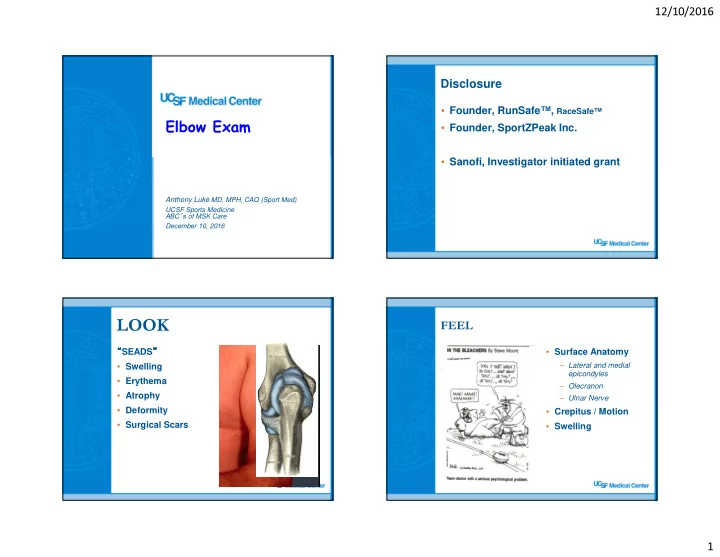
LOOK

“ “ “ “SEADS” ” ” ”

  • Swelling
  • Erythema
  • Atrophy
  • Deformity
  • Surgical Scars

FEEL

  • Surface Anatomy

– Lateral and medial epicondyles – Olecranon – Ulnar Nerve

  • Crepitus / Motion
  • Swelling
slide-2
SLIDE 2

12/10/2016 2 MOVE

  • Average flexion

0° ° ° ° to 145° ° ° ° +/- 10° ° ° °

  • Pronation ~ 80°

° ° ° and supination 85° ° ° °

Generalized Laxity

3 Basic P/E findings for tendinopathy

1. Tenderness on direct palpation 2. Reproduction of pain with resisted contraction (eccentric loading) 3. Reproduction of pain with passive stretch

Epicondyles tender

slide-3
SLIDE 3

12/10/2016 3 Special Tests

  • Pain
  • Instability
  • Dysfunction
  • Numbness
  • Provocative Tests
  • Stress Tests
  • Functional Tests
  • Neurological tests
  • Radicular signs

Valgus stress test

  • The patient’

’ ’ ’s wrist and hand are fixed and a valgus stress is applied with the patient’ ’ ’ ’s elbow at 30 degrees.

Milking Maneuver

  • Arm at 70°

° ° °

  • Apply valgus force

applied by supporting the elbow and tractioning the thumb

  • Similar to milking a

cow

Moving Valgus Stress Test

  • Shoulder abducted to 90°
  • Apply valgus force to the

elbow until the shoulder is fully externally rotated

  • While maintaining the valgus

torque, quickly extend the elbow to approximately 30°

  • Positive test: reproduces

pain at the UCL, typically

  • ccurring maximally

between 120° and 70° of flexion

slide-4
SLIDE 4

12/10/2016 4 Nerves

  • Ulnar Nerve
  • Passes behind the

medial epicondyle and lies over the ulnar collateral ligament

  • Then under the

bicipital aponeurosis and pronator teres

  • Radial Nerve
  • Passes posterior to

anterior at distal third

  • f the humerus
  • Posterior interosseous

nerve

  • Supplies deep

muscles

  • Passes under the

Arcade of Frohse near Supinator

Ulnar nerve – Cubital Tunnel

  • Ulnar nerve

compression, traction

  • r subluxation

Evaluation

  • Repetive extension

to flexion

  • Elbow Flexion test
  • Tinel’s

Cubital Tunnel Syndrome

Physical Exam

  • Positive Tinel’s

test

  • Positive

Froment’s sign (weakness with thumb/index finger pinch)

  • Decreased

sensation in 4th/5th digit

15

Cervical Spine

  • Referred or

radicular pain

– C4 – C5 – C6 – C7

slide-5
SLIDE 5

12/10/2016 5 Cervical Spine - Differentiation

  • Location of Referral

– Neck pain – Scapular pain – Pain distal to elbow – Paresthesia

  • Aggravating factors

– Ask about the neck – Spurling’s Test

Thoracic Spine

Thoracic Outlet Syndrome

– Repetitive upper extremity use

  • shoulder, elbow, hand

– assembly line – computer with mouse and phone

– Poor posture – Reaching – Stress

Adson’s Test

  • Seated patient extends and

turns head toward the tested shoulder,

  • Shoulder is slightly abducted

and extended. The subject inhales while the examiner palpates the ipsilateral radial pulse.

  • Positive findings: Diminution
  • r elimination of the pulse

and reproduction of the paresthesias

  • Studies have documented

the Adson’s maneuver to have poor to good specificity and good sensitivity.

Wright’s Hyperabduction Test

  • With patient seated, the

clinician hyperabducts and externally rotates the patient’s arm while assessing the ipsilateral radial pulse

  • Positive findings:

Diminution or elimination of the radial pulse and reproduction of the paresthesias

  • No studies have examined

validity

slide-6
SLIDE 6

12/10/2016 6 Roos Stress Test

  • Patient holds shoulders in

abduction and external rotation at 90 degrees with elbows flexed at 90 degrees and repeatedly open and close their hands for three minutes.

  • Positive findings: Reproduction of

their symptoms or a sensation of heaviness and fatigue.

  • No studies have examined validity
  • f the Roos stress test as it

pertains to thoracic outlet syndrome.

Vascular Problems

  • Complaints of

heaviness, fatigue, paresthesias, and effort-related pain