Long-term Vision and Five Future Goals Vision Five Future Goals - - PowerPoint PPT Presentation

long term vision and five future goals
SMART_READER_LITE
LIVE PREVIEW

Long-term Vision and Five Future Goals Vision Five Future Goals - - PowerPoint PPT Presentation

Long-term Long-term Vision and Five Future Goals Vision Five Future Goals Digital & consulting bank that opens up the future to Long-term vision customers and the region Envision the future to be realized from the perspectives of our five


slide-1
SLIDE 1

23

Long-term Vision and Five Future Goals

Long-term Vision

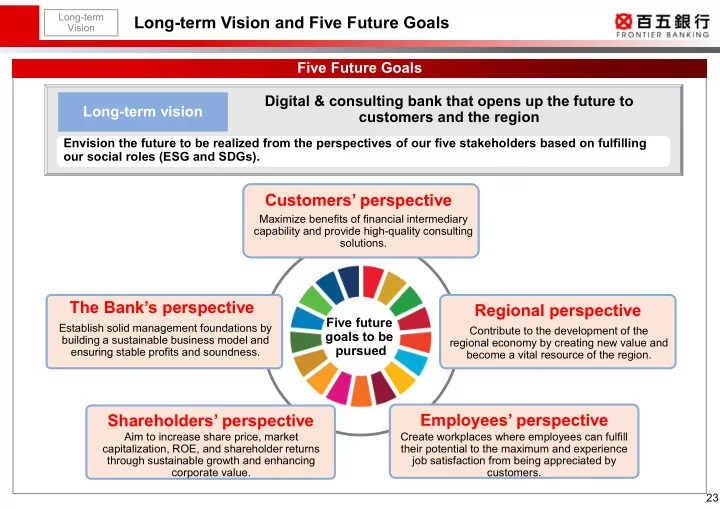
Digital & consulting bank that opens up the future to customers and the region Long-term vision

Envision the future to be realized from the perspectives of our five stakeholders based on fulfilling

  • ur social roles (ESG and SDGs).

Five future goals to be pursued

Customers’ perspective The Bank’s perspective Regional perspective Employees’ perspective Shareholders’ perspective

Maximize benefits of financial intermediary capability and provide high-quality consulting solutions. Contribute to the development of the regional economy by creating new value and become a vital resource of the region. Create workplaces where employees can fulfill their potential to the maximum and experience job satisfaction from being appreciated by customers. Aim to increase share price, market capitalization, ROE, and shareholder returns through sustainable growth and enhancing corporate value. Establish solid management foundations by building a sustainable business model and ensuring stable profits and soundness.

Five Future Goals

slide-2
SLIDE 2

Timeline for Realizing the Vision of the Bank within 10 Years

 After three years building the foundation, the Bank will shift to a sustainable business model and realize the vision

  • f the Bank within 10 years

Previous Medium- term Management Plan

The 140th anniversary

1st STAGE of Innovation

Next Medium-term Management Plan (FY2019-2021)

2nd STAGE of Innovation FY2022-2024 3rd STAGE of Innovation FY2025-2027 After 10 years

The 150th anniversary

Three years of building the foundation Three years of adopting aggressive strategies Three years of accelerating growth Item Core OHR Capital adequacy ratio Net income Targets In the 60% range 10% or more 15.0 billion yen or more

Sustainable business model

Vision of the Bank within 10 years (numerical targets)

Course of events with innovation

Realize the Vision of the Bank

First year

  • f

innovation

Impacts of innovations on boosting earnings Impacts of innovations on boosting earnings

Natural course of events Strategic IT investment to improve efficiency Strategic IT investment to improve efficiency Factor for temporary profit decline Tough external environment

  • Negative interest rates
  • Downsizing of regional market
  • Entries from other industries/shift

to cashless society

24

Long-term Vision

slide-3
SLIDE 3

Milestones Toward Realizing the Long-term Vision

 Steadily achieve the milestones set to realize the vision of the Bank within 10 years

Previous Medium-term Management Plan The 140th anniversary

1st STAGE of Innovation

FY2019-2021

2nd STAGE of Innovation

FY2022-2024

3rd STAGE of Innovation

FY2025-2027

After 10 years

The 150th anniversary

FY2018 (actual) FY2021 (targets) FY2024 (targets) FY2027 (targets) FY2028 (targets)

Net income Core OHR

Market share of loans in Mie Prefecture Number of personnel with professional qualifications

10.7 billion

yen

74.4% 36.8%

(*as of September 2018)

161

persons

10.0 billion

yen or more Less than

79%

Approx.

39% 300

persons or more

12.0 billion

yen or more Approx.

75%

Approx.

40% 450

persons or more

14.0 billion

yen or more Approx.

70%

Approx.

41% 600

persons or more

15.0 billion

yen or more In the 60% range

41% or

more

650

persons or more Timeline/ Target item

 Number of personnel with professional qualifications  1st Grade Certified Skilled Professional of Financial Planning, CFP, Small and Medium Enterprise Management Consultant

Three years of building the foundation Three years of adopting aggressive strategies Three years of accelerating growth

25

Long-term Vision

slide-4
SLIDE 4

Overview of the New Medium-term Management Plan

 Overview of the Medium-term Management Plan “KAI-KAKU 150 1st STAGE—Gateway to the Future” comprising three reform measures and 14 basic strategies

Streamline

  • rganization/

personnel (manpower savings)

Create new value Improve productivity further

Profit Structure Organization/ personnel IT & digital

(1) Strengthen topline (loan income) (3) Develop new businesses/new fields (4) Rebuild securities portfolio (5) Thoroughly review cost structure (6) Reform organizational culture (promote diversity) (7) Increase efficiency of

  • rganization/personnel

(8) Develop professional human resources (9) Strengthen business management system

(14) Initiatives for ESG/SDGs

(2) Strengthen topline (fees and commissions) (10) Mobile channel strategy (11) New business strategy (12) Operations digitization strategy (13) Branch office digitization strategy

Three innovation measures 14 basic strategies

Profit Structure innovation Organizational/ personnel innovation IT & digital innovation

Integrate physical (face-to-face sales) And digital channels

Strengthen consulting solutions

26

Gateway to the Future

slide-5
SLIDE 5

27

Numerical Targets (General)

 We set numerical targets designed to further strengthen the Bank’s management structure over three years in order to build the foundation while looking 10 years into the future.

Item FY 3/19 (actual) Final year FY 3/22 (target)

Net income

10.7 billion yen 10.0 billion yen or more

ROE (Shareholders’ equity base)

4.32% 3.7% or more

OHR (Core gross operating profit base)

74.43% Less than 79%

Capital adequacy ratio

9.74% 9.5% or more

Average balance of total deposit

(including negotiable certificates of deposit)

4,992.9 billion yen 5,230 billion yen or more

Average balance of total loans

3,246.2 billion yen 3,700 billion yen or more

Loan-to-deposit ratio (average

balance base)

65.0% 70.8% or more

Operating income from services to customers

1.5 billion yen 3.7 billion yen

Corporate solutions fees

941 million yen 2,000 million yen

Number of personnel with professional qualifications

161 persons 300 persons

Profitability indicator Capital efficiency indicator Efficiency indicator Soundness indicator Growth indicator Target achievement indicators Performance evaluation indicators

Numerical Targets of the Medium-term Management Plan

Profit indicator

Human resources development indicator

Gateway to the Future

slide-6
SLIDE 6

Profit Structure Innovation

Strengthening Loan Income (General)

 Increase average balance of loans, such as loans to local medium-sized companies/SMEs and consumer loans, by approx. 500 billion yen.

Total loans Average balance plan

FY 3/19 (actual)

FY 3/22

(final year of the Medium-term Management Plan)

Comparison with FY 3/19

Loan-to-deposit ratio 65.0% 70.8% or more +5.8P or more

Foreign currency-denominated loans Average balance plan

FY 3/19 FY 3/22

(Unit: 100 million yen)

30,845

JPY-denominated loans Foreign currency

  • denominated loans

1,617 2,146 32,462 37,043 34,897 + 458.1 billion yen

Average annual rate: +4.3% Average annual rate: +10.9%

FY 3/22 FY 3/19 FY 3/22 FY 3/19

Consumer loans

Housing loans Unsecured loans

(Unit: 100 million yen) (Unit: 100 million yen) Average annual rate: +3.4%

10,258 13,610 372 492 10,630 14,102

Average annual rate: +10.8% Average annual rate: +10.7%

  • Increase average balance of loans by approx. 50.0 billion yen by further

strengthening the operation system and based upon careful risk analysis.

  • Provide loans for excellent floating-rate loan deals that offer reasonable

spreads.

Improve loan-to-deposit ratio

JPY-denominated loans Average balance plan

Loans to medium-sized companies and SMEs in the region 10,725 11,841 28 +111.6 billion yen +347.2 billion yen

Gateway to the Future

slide-7
SLIDE 7

Profit Structure Innovation Strengthening Loan Income (Loans to Medium-sized Companies and SMEs)  Deepen business feasibility assessment to further strengthen financial intermediary capability and increase market share for loans.

Balance of loans based on the business feasibility assessment

FY 3/18 FY 3/19 FY 3/16 FY 3/17 1,616 2,389 3,068

Number of clients who received a business feasibility assessment

Change in volume of loans to medium-sized companies/SMEs in the region (average balance)

FY 3/18 FY 3/19 FY 3/22 FY 3/17 (Unit: 100 million yen)

Loans to medium-sized companies/SMEs in Aichi Prefecture (average balance during the fiscal year) Loans to medium-sized companies/SMEs in Mie Prefecture (average balance during the fiscal year)

8,086 6,968 7,123 3,354 3,755

11,841

2,957 3,166 10,725 10,289 9,925

Toward More Sophisticated Business Feasibility Assessments

・Business feasibility assessment ・One-on-one client support activity ・Cash flow support loans, etc.

Client supporting project

Improve level of business feasibility assessment activities

Support for core businesses

Propose solutions for enhancing corporate value

Establish sustainable business transactions

Win support Become their main bank

Achieve differentiation and superiority in loan transactions

Branches Head office Group External institutions

Collaboration

Change in the loan balance based on business feasibility assessment and number of clients who received a business feasibility assessment

3,721 630 clients 1,051clients 1,635 clients 2,167 clients

Average yield on loans based on business feasibility assessment

1.26%

FY 3/19

JPY-denominated loans (average yield) 0.91% 7,371

Previous business feasibility assessment activities Prepare the business feasibility assessment sheet/ support improving financial position

Place emphasis on identifying current status

Allowing execution of loans based on different criteria

29

Gateway to the Future

Expand share of loans Strengthen loan income

(Unit: 100 million yen)

slide-8
SLIDE 8

Annual execution of housing loans

Ensure steady execution

  • f housing loans of

200 billion yen or more

Profit Structure Innovation

Strengthening Loan Income (Housing Loan Strategy)

 Improve sales force and productivity to establish a system that secures an annual loan volume of 200 billion yen.

Housing loan promotion measures and numerical targets Average balance of housing loans (plan) (Unit: 100 million yen)

FY 3/18 FY 3/19 FY 3/16 FY 3/17

Single-year execution

  • f housing loans

1,238 1,120 1,636

Competitive interest rates Strengthen schemes of moneylenders Strengthen training for sales force Review administrative procedures Streamline

  • perations

Centralize back-office work to the Head Office Strengthen promotion of Flat 35 loans

2,354

Shift personnel to the Bank’s operations in Aichi Prefecture Consider reorganization

  • f personal plaza

FY 3/18 FY 3/19 FY 3/16 FY 3/17

8,146 7,509 8,908

FY 3/20 FY 3/21 FY 3/22 (plan) (plan) (plan)

11,525 12,633

13,610 10,258

(Unit: 100 million yen) Enhance promotion measures During Medium-term Management Plan period

Annual rate of increase

15.1% p.a.

Average rate of increase over three years

10.8

%

Accumulated strong sales know-how Accumulated strong sales know-how 30

Aichi Prefecture Mie Prefecture

Gateway to the Future

slide-9
SLIDE 9

Profit Structure Innovation

Strengthening Fees and Commissions (Corporate Solutions Fees)

 Enhance offerings of solutions and support system to address customers’ management issues and strengthen non- interest income

Corporate solutions fees

Solution Business Division

Personnel in charge of corporate customers Personnel in charge of individual customers 60 staff

  • rganization

423 FY 3/17 FY 3/18 FY 3/19 286 425

(Unit cases)

Number of cases of business succession consulting support provided

425 cases

Number of business matching meetings held

762 FY 3/17 FY 3/18 FY 3/19 421 1,343

1,343 cases

(Unit: cases)

Change in issue amount of private placement bonds

50 1,330 4,790 FY 3/17 FY 3/18 FY 3/19 2,010 3,950

Of which, issue amount of donation-type private placement bonds Issue amount of private placement bonds

2,060

(Unit: million yen)

4,790 million yen

Structured finance-related fees

311 FY 3/17 FY 3/18 FY 3/19 312 381

(Unit: million yen)

381 million yen

(Results as of March 31, 2019) (Results as of March 31, 2019) (Results as of March 31, 2019) (Results as of March 31, 2019)

1,139 1,554 2,000

FY 3/19 FY 3/20 FY 3/21 FY 3/22

(Unit: Million yen)

(actual) (plan) (plan) (plan)

941 +1,059

Breakdown for FY 3/22 (Unit: million yen)

FY 3/22 (plan) Comparison with FY 3/19

M&A

630 +422

Structured finance-related

478 +96

Business matching

300 +215

Derivatives

240 +189

Private placement bonds

150 +90

IT & digital-related

20 +20

Other 182 +24

Corporate solutions fees (plan)

Newly established

31

Number of cases of consultation on business succession provided

Gateway to the Future

slide-10
SLIDE 10

Trend of depository assets penetration ratio (combined total of the Bank and Securities) and plan

Profit Structure Innovation Strengthening Fees and

Commissions (Depository Assets-related Fees)

 Make customer-oriented proposals for depository assets according to their needs in order to increase the penetration ratio of depository assets and strengthen depository assets-related fees

Depository assets sales strategy to increase penetration ratio Numerical targets for depository assets-related fees

FY 3/19

(actual)

FY 3/22

(plan)

Increase

Investment trusts

820 1,176 +356

Insurance

1,143 1,496 +353

Financial instruments brokerage

68 225 +157

401K

(defined contribution pension)

79 100 +21

Total

2,110 2,997 +887

(Unit: million yen) (Unit: 100 million yen)

Total balance of deposits (as of fiscal year-end) * excluding negotiable certificates of deposit Balance of depository assets (as of fiscal year-end) * combined total of the Bank and Securities

Depository assets penetration ratio (%) Balance of depository assets Total balance of deposits + Balance of depository assets

=

Integrated management of deposits and depository assets through collaboration between the Bank and Securities

FY 3/19 FY 3/20 (plan) FY 3/21 (plan) FY 3/22 (plan)

48,829

4.41%

5.27% 5.08% 4.88%

2,689 2,834

49,552 50,270 50,988

Depository assets penetration ratio

2,255

Depository assets penetration ratio

Sales system and change of awareness

Allocation of sales force by segment New sales system based on collaboration between the Bank and Securities Improve efficiency of insurance consultation service locations

Based on customer-

  • riented principle

Propose importance

  • f asset formation

Shift from deposits to asset formation

2,544 32

Gateway to the Future

slide-11
SLIDE 11

Profit Structure Innovation

Strengthening Integrated Financial Service Capabilities

 Provide new financial service capabilities to establish a presence and ensure a sustainable competitive advantage in the sales area Financial support

Loans

Specialization: High

Non-financial support ( support in core businesses)

Business matching Industry- academia- government collaboration Utilize subsidies Support through funds (Establish the Bank’s own funds) Formulate management improvement plans Hands-on support in core businesses (Collaboration with consulting firms)

Know-how: High

Specialization: Low Know-how: Low Business succession measures M & A Support for

  • verseas

business development Syndicated loans Private placement bonds Liquidation of claims Diversification into new fields Differentiation from

  • ther banks

Integrated financial service capabilities

33

Gateway to the Future

The Bank’s Existing services

slide-12
SLIDE 12

Investment target Future investment policy Direction JPY-denominated bonds

  • Under the negative interest rate policy, the Bank will reduce JPY-denominated bond

investments.

Foreign currency- denominated bonds

  • The Bank will mainly invest in high-liquidity bonds, such as Ginnie Mae bonds and

European government bonds.

Securities

  • The Bank will maintain the balance at its current level and buy and sell individual

stocks flexibly while capturing the right timing.

Investment trusts, etc.

  • The Bank will increase investment trust holdings depending on timing from the

perspectives of both income and capital gains.

Profit Structure Innovation

Rebuilding the Securities Portfolio

 Aim to rebuild the Bank’s portfolio in order to earn stable income by reinvesting proceeds from large volumes of redemptions of JPY-denominated bonds and secure income

Change in average balance of securities

FY 3/19 FY 3/21 FY 3/20 FY 3/22 12,659 1,965 10,352

14,851

826 14,004 771

16,904

2,500 8,873

13,910

1,427 769

16,617

1,255 1,721

JPY-denominated bonds Foreign currency- denominated securities Shares Investment trusts, etc.

(Unit: 100 million yen) (actual) (plan) (plan) (plan)

Investment policy by investment target Plan for the securities portfolio

Other

45 40 769 1,721 43 769 1,721 46

Alternative investment targets for proceeds from redemptions of JPY-denominated bonds (500 billion yen) Shift to loans such as loans to medium-sized companies/SMEs and housing loans

Investment stance focusing on RORA/ Rebalance into a portfolio that is less susceptible to market fluctuations

34

Gateway to the Future

slide-13
SLIDE 13

Profit Structure Innovation Detailed Review of Cost Structure  Continue strategic IT investments and productivity improvement project to achieve reductions of expenses in the future Trend of expenses and core OHR and plan

417 412 409 FY 3/18 FY 3/19 FY 3/17

(Personnel expenses) 226 (Non-personnel expenses) 163 (Taxes) 20

416

FY 3/22

(plan)

During the medium-term management plan period

2nd STAGE

(target)

  • 8.8

Reducing expenses

+12

Consumption tax, etc.

+2.6 (Unit: 100 million yen) 80.24% 75.57% 74.43% Less than 79%

Strategic IT investment

To 400

  • r less

(Taxes) 22 (Non-personnel expenses) 176 (Personnel expenses) 217 Around 75%

Core OHR 35

(1) Launch of new branch office system (2) Introduction of tablet PCs (3) Digital transformation of operational processes (4) Consider adoption of smartphone banking, etc.

Gateway to the Future

slide-14
SLIDE 14

36

Organizational and Personnel Innovations

Promoting Diversity

 Create workplaces that support employees with diverse work styles to achieve their full potential and build an

  • rganization that offers job satisfaction and a sense of unity

Promoting diversity centered on work-style reforms

Previous work- style model

Realize work-style reforms

Previous Medium-term Management Plan (FY2016-2018)

Realize diversity management

New Medium-term Management Plan (FY2019-2021)

 Difficulty in securing human resources due to a decline in working population  A growing number of employees need reductions in working hours, etc.

Social issues

Standard perception Working long hours Dedicated employees High evaluation

Work style Promotion Office Work-style Reforms Promotion Office

Previous medium-term management plan

Break away

Take a step further

Create an environment that supports diverse work styles

Changing awareness Changing systems Changing work flow Going home early

“Kaeru Project”

  • Introduce

homeworking

  • Encourage male

employees’ participation in parenting

  • Review internal

meeting procedure

  • Promote BPR
  • Utilize RPA
  • Reduce total overtime

work hours

  • The Work-style

Reform Declaration

  • Work-style

Reforms Award

Diversity Management Division

New medium- term management plan

Support career development, etc. Support work-life balance (parenting/nursing care)

Establish and review systems Promote penetration

  • f contents

Promote active participation by female employees Promote active participation by senior employees Promote active participation by persons with disabilities

Other

Foundation

Pillar

Penetrate

  • rganization

Final goal Improve productivity through “Kaeru Project” (change/go home)

Further enhancement of job satisfaction Bring out maximum potential of diverse human resources

Foster workplace culture

Gateway to the Future Corporate value enhancement

slide-15
SLIDE 15

Number of branches consolidated through the branch-in-branch method

Organizational and Personnel Innovations

Optimizing the Branch Network

 Increase efficiency of branch network by eliminating inefficient overlapping of sales areas, while maintaining branch network and convenience for customers

Consolidate functions by adopting branch-in-branch method

Downsizing of Sub-branches

Promote improved operational efficiency by downsizing sales force and sharing and transfer of sales know-how.

Eliminate overlaps in branches in sales areas

Maintain and secure convenience of customers

A branch B branch A branch B branch

Newly established Sub-branch

No changes to branch code and account number.

Distance from main branches and neighboring branches Trends of customers visiting branches

Introduced first to Kiyamachi Plaza

(one employee and two part- timers)

  • Limited services offered

 Cash handling services and consulting services

  • Closed during lunch hours

 12:00 - 13:30

Study/ review

(1) Limiting the services offered (2) Changing business hours (3) Setting non- business days on weekdays

Rollout of “105 Plaza”

Branch operation with a small staff

(Two employees and two- four part-timers)

16 branches

  • ver three years

37

10 branches

  • ver three

years

Two branches are located in one building

Gateway to the Future

slide-16
SLIDE 16

Organizational and Personnel Innovations

Branch Strategy and Personnel Planning

Personnel plan (reallocation) in the Medium-term Management Plan  Set direction of branch strategy and aim for systematic reallocation of personnel while looking 10 years into the future

Optimization and streamlining of the Head Office and Branches

Prioritized personnel allocation toward realizing the basic strategies

Reduce the actual workforce by about 120 employees

Three-year personnel plan

Optimization of the branch network BPR of branch

  • perations

Improve the operational efficiency of depositary assets sales Streamline Head Office

  • perations

Strengthen sales force at branches Increase the sales force in the Head Office Strengthen human resource development Allocate personnel to various priority measures

  • Effects of branch

consolidation (branch-in- branch method)

  • Downsizing of sub-branches
  • Promote paperless

customer liaison operations

  • Consolidate back-office
  • perations to Head Office
  • Assign person in charge of

each segment

  • Efficient collaboration

between the Bank and Securities

  • Introduce CRM and BI tools
  • Improve data analysis

capability

  • Increase corporate customer

liaison professionals

  • Increase housing loan staff
  • Open new branches (Aichi

Prefecture)

  • Solution Business Division

 Also provide training to employees of branches

  • Internal Head Office trainees
  • External professional

trainees

  • Send young employees on-

loan to companies outside the Bank

  • Promote digital strategy
  • Promote diversity, etc.

About

230 employees

About

110 employees

Personnel reallocation

Work out surplus employees

38

Gateway to the Future

slide-17
SLIDE 17

IT & Digital Innovation

 The Bank will implement four strategies using IT & digital and create new value and profit opportunities

New business strategy

Form alliances Collaboration with local communities/other industries Cashless payment business IT digital consulting Information collection on new technologies Paperless Utilize RPA/AI Utilize tablet PCs Sort out data, utilize data

Operations digital transformation strategy

Next-generation branch (flexible deployment) No filling out forms, personal seal-less, and cashless Safe-less, approval stamp-less, and paperless

Branch digital transformation strategy Mobile strategy

Enhance smartphone banking Enhance API functions Practical use of biometric (face) authentication Passbook-less and personal seal-less banking transactions Provision of new customer experience

Digital Innovation Division

(Digital Strategy Section/ Tsunagaru @ Net Section)

Strengthen points of contact with customers

BPR

Business model creation FinTech

Mobile strategy

“Accessible anytime, anywhere”

New business strategy

“Creative responses to environmental changes”

Operations digital transformation strategy

“From partial optimization to total

  • ptimization”

Branch digital transformation strategy

“from clerical work base to consulting base”

Four strategies in IT & Digital innovation

New establishment 39

Gateway to the Future

slide-18
SLIDE 18

Initiatives for ESG/SDGs

Gateway to the Future

 The Bank will implement the 13 management strategies set out in the Medium-term Management Plan as initiatives for ESG/SDGs and practice sustainable management. Environ- ment Social Govern- ance Protecting global and regional environments Strengthening business management systems Work-style reforms Promoting diversity Creating regional economy

Priority issues SDGs to be addressed Specific action items

Sustainably developing regional societies

 Provide investments and loans/support for renewable energy- related projects  Provide environmentally sensitive products  Conduct forest preservation activities  Conduct energy saving, recycling, and CO2-reducing activities  Support persons with disabilities to live independently/participate in society  Conduct contribution activities to support regional societies  Provide support for financial education and asset management education, etc.  Support regional companies to resolve issues (business succession, etc.)  Support regional companies to increase added value  Adapt to and support a cashless, digital society  Provide support to individual customers for asset management/inheritance, etc.  Conduct customer-oriented business operations  Promote women’s active participation in workplaces, employment of persons with disabilities, and work-style reforms  Support development of sophisticated human resources  Strengthen corporate governance  Strengthen risk management system  Strengthen compliance

E S G

40