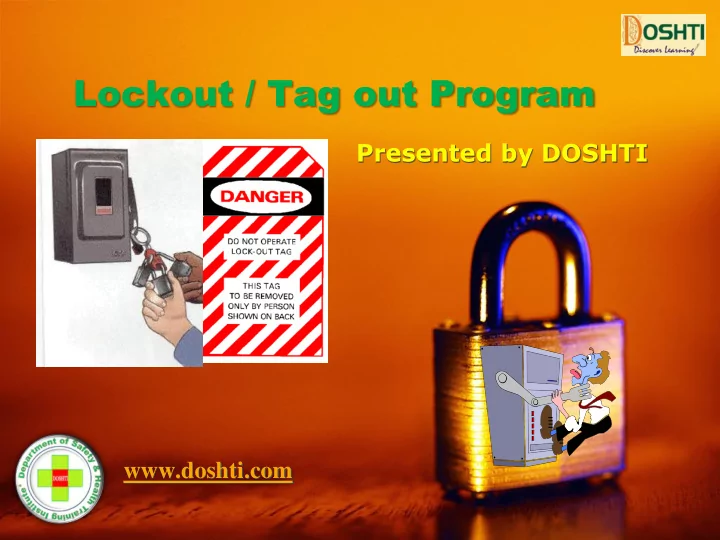
Lockout / Tag out Program Presented by DOSHTI www.doshti.com You - - PowerPoint PPT Presentation
Lockout / Tag out Program Presented by DOSHTI www.doshti.com You will learn Purpose of Lockout- Tag out Requirements for LOTO Types of Hazardous Energy Procedures for LOTO LOCKOUT/TAGOUT The OSHA Standard for the Control of
You will learn…
Purpose of Lockout- Tag out Requirements for LOTO Types of Hazardous Energy Procedures for LOTO
LOCKOUT/TAGOUT
The OSHA Standard for the Control
- f Hazardous Energy Lockout / Tag
Out) covers the servicing and maintenance of machines and equipment in which the unexpected start-up or the release of stored energy could cause injury to employees.
Why Is Lockout/Tag out Important?
This practice helps safeguard employees from hazardous
energy while they are performing service or maintenance
- n machines and equipment.
The OSHA standard, identifies the practices and procedures necessary: a written program and lockout procedures, shut down and lockout or tagout of machines and equipment, employees training in their role in the lockout/tag out program, and periodic inspections conducted to maintain or enhance the energy control program.
LOCKOUT/TAGOUT Definitions
Authorized employee – An employee who performs servicing or maintenance on machines and equipment. Lockout or tagout is used by these employees for their
- wn protection.
Affected employee – An employee who performs the duties of his or her job in an area in which the energy control procedure is implemented and servicing or maintenance operations are performed. Other employees - All employees who are or may be in an area where energy control procedures may be utilized.
What activities or operations are covered?
Electrical Hydraulic Pneumatic Thermal Chemical Mechanical Gravity Other Types Covered Activities
Constructing, installing, setting up, adjusting, inspecting, modifying, maintaining and/or servicing machines or equipment, including lubrication, cleaning or un jamming of machines or equipment, and making adjustments or tool changes, where employees could be exposed to the unexpected energization
- r startup of the equipment or release of hazardous energy.
What are lockout devices? Lockout device: Any device that uses a positive
means, such as a lock, blank flanges and bolted slip blinds, to hold an energy-isolating device in a safe position, thereby preventing the energizing of machinery
- r equipment.
¤ Standardize All Locks and Tags. ¤ Identify The User. ¤ Must Be Durable. ¤ Used Only For Lockout/Tagout.
What are Energy-Isolating devices?
- Energy-isolating device: A mechanical device that
physically prevents the transmission or release of energy, including but not limited to the following: A manually operated electrical circuit breaker; a disconnect switch; a line valve; a block; and any similar device used to block or isolate energy. Push buttons, selector switches and other control circuit type devices are not energy isolating devices. Valve Devices Circuit Breaker Device Plug out
LOCKOUT/TAGOUT Written Procedures
Must identify the information that authorized employees must know in order to control hazardous energy during service or maintenance. Preparation for shutdown Shutting down the equipment Equipment isolation Application of Lockout/Tagout devices Release of stored energy Verifying equipment isolation
LOCKOUT/TAGOUT
Preparation for Shutdown
Know the types and amounts of energy that power it. Know the hazards of that energy. Know how the energy can be controlled. Lockout vs. Tagout If an energy-isolating device is capable of being locked
- ut, it must be locked out unless it can be shown that a
tagout system provides full employee protection. Develop Procedures on how you will Communicate with Contractors on LO/TO. Who What When Where How
LOCKOUT/TAGOUT
Shutting Down the Equipment
Shut the system down by using operating controls. Follow whatever procedure is right for the equipment to avoid endangering anyone during shutdown
Equipment Isolation
Operate all energy-isolating devices so that the equipment is isolated from its energy sources. Be sure to isolate all energy sources (secondary power supplies as well as the primary supplies). Never remove a fuse instead of disconnecting.
LOCKOUT/TAGOUT
Application of Devices
All energy-isolating devices are to be locked, tagged or both. Only standardized devices can be used and they are not to be used for anything else. Use a lockout device if your lock cannot be placed directly on the energy control. When lockout is used, every employee in the work crew must attach his personal lock.
Release of Stored Energy
Inspect the system to make sure all parts have stopped moving. Relieve trapped pressure. Block or brace parts that could fall due to gravity. Bleed lines and vent valves open. If stored energy can re accumulate, monitor it to make sure it stays below hazardous levels.
LOCKOUT/TAGOUT
Verifying Equipment Isolation
Make sure all danger areas are clear of personnel. Verify that the main disconnect switch or circuit breaker can’t be moved to the on position. Press all start buttons and other activating controls on the equipment itself and return controls to the off position when the testing is complete.
Performing the Work
Look ahead and avoid doing anything that could reactivate the equipment. Don’t bypass the lockout when installing new piping or wiring.
LOCKOUT/TAGOUT
Removing Lockout/Tagout
Make sure the equipment is safe to operate by removing all tools from the work area and making sure the system is fully assembled. Safeguard all employees by conducting a head count to make sure everyone is clear of the equipment. Also notify everyone in the work area that lockout/tagout is being removed. Remove the lockout/tagout devices. Each device must be removed by the person who put it on.
LOCKOUT/TAGOUT
Contractors
The outside contractor and the on-site employer must exchange lockout/tagout information. Employees on site must understand rules used by the contractor. Be alert for new types of lockout or tagout devices.
Shift Changes
If servicing lasts more than one shift, lockout/tagout protection must not be interrupted. When the employee who applied device is not there to remove it, it can be removed only in an emergency and
- nly under the direction of the supervisor.
LOCKOUT/TAGOUT
Lockout/Tagout Devices
Durable – Lockout and tagout devices must withstand the environment to which they are exposed for the maximum duration of the expected exposure. Tagout devices must be constructed and printed so that they do not deteriorate or become illegible, especially when used in corrosive or wet environments. Standardized – Both lockout and tagout devices must be standardized according to either color, shape, or size. Tagout devices must also be standardized according to print and format. Substantial – Lockout and tagout devices must be substantial enough to minimize early or accidental removal. Tag means
- f attachment must be non-reusable, attachable by hand, self-
locking and non-releasable, with a minimum unlocking strength of no less than 50 pounds (one-piece nylon cable tie). Identifiable – Locks and tags must clearly identify the employee who applies them. Tags must also warn against hazardous conditions if the machine or equipment is energized and must include a legend such as: DO NOT START, DO NOT OPEN, DO NOT CLOSE, DO NOT ENERGIZE, DO NOT OPERATE.
LOCKOUT/TAGOUT
Periodic Inspections
Inspections must be performed at least annually to assure that the energy control procedures continue to be implemented properly and that the employees are familiar with their responsibilities.
What happens if a Lockout procedure changes?
The rule requires that a periodic inspection or audit of each procedure, be performed at least annually to assure that the lockout procedures continue to be implemented properly and that employees are familiar with their responsibilities under those procedures. It is the responsibility of the Top Management to periodically conduct audits to ensure compliance with the Safety Lockout/Tagout procedure.
LOCKOUT/TAGOUT
Scope and Application
Activities Not Covered
Minor tool changes and adjustments, and other minor servicing activities that take place during normal
- perating production operations which are routine,
repetitive, and integral to the use of that production equipment, as long as workers are effectively protected by alternative measures. Work on cord and plug connected equipment if the equipment is unplugged from the energy source and the authorized employee has exclusive control of the plug. Hot tap operations that involve transmission and distribution systems for gas, steam, water, or petroleum products on pressurized pipelines if continuity of service is essential, shutdown of the system is impractical, documented procedures are followed, and employees are effectively protected by special equipment.
LOCKOUT/TAGOUT
Who can remove e Locks s & & Ta Tags?
Only the employee who placed the tag
- r
a supervisor, after obtaining permission from the worker who placed the tag
A piec iece of equipm ipment nt alr lready has a loc lock and tag. Do Do I have to plac lace my own wn loc locks & & tags?
- YES. Each person working on the equipment must
place their own locks and tags to ensure their safety.
Lo Lockout
- ut-Tagou
agout t Prot
- tec
ects ts YOU!!! !!!
USE Prope per r Lock ckout
- ut - Tagou
- ut Proce
cedures ures Ple lease se be care reful ul when n work rking ing on equipmen ipment
Lo Lockout
- ut-Tagou
agout t Prot
- tec