Caching / Performance ofgset 1 data valid tag data valid tag - - PowerPoint PPT Presentation

caching performance
SMART_READER_LITE
LIVE PREVIEW

Caching / Performance ofgset 1 data valid tag data valid tag - - PowerPoint PPT Presentation

Caching / Performance ofgset 1 data valid tag data valid tag cache operation (associative) 2 ( B5 ) data is hit? ( 1 ) 00 11 OR AND AND tag = = index 1 11 10 1 33 44 = ( B5 ) data ofgset is hit? ( 1 ) OR AND AND tag =


slide-1
SLIDE 1

Caching / Performance

1

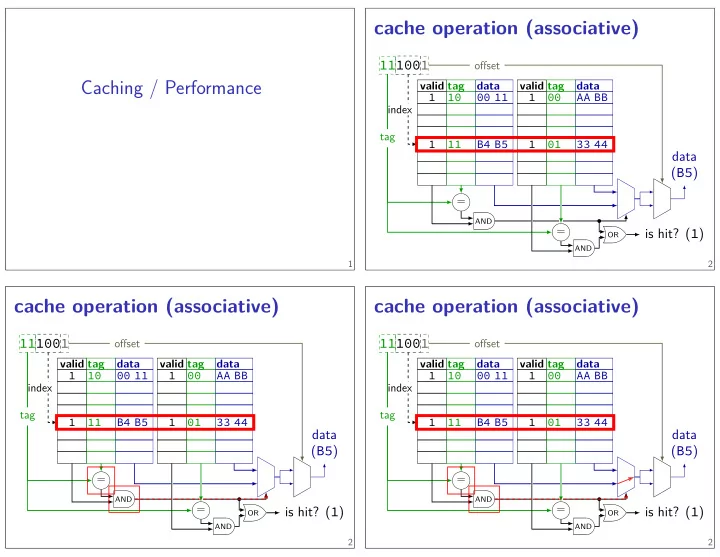
cache operation (associative)

valid tag data valid tag data 1 10 00 11 1 00 AA BB 1 11 B4 B5 1 01 33 44

100 11 1

index = = tag

AND AND OR

is hit? (1)

  • fgset

data (B5)

2

cache operation (associative)

valid tag data valid tag data 1 10 00 11 1 00 AA BB 1 11 B4 B5 1 01 33 44

100 11 1

index = = tag

AND AND OR

is hit? (1)

  • fgset

data (B5)

2

cache operation (associative)

valid tag data valid tag data 1 10 00 11 1 00 AA BB 1 11 B4 B5 1 01 33 44

100 11 1

index = = tag

AND AND OR

is hit? (1)

  • fgset

data (B5)

2

slide-2
SLIDE 2

writing to caches

CPU Cache RAM write 10 to 0xABCD write 10 to 0xABCD

  • ption 1: write-through — always

ABCD: 10 (dirty)

  • ption 2: write-back (later)

read 10 from 0x11CD (confmicts) (later) write 10 to ABCD … when replaced — send value to memory

3

writing to caches

CPU Cache RAM write 10 to 0xABCD write 10 to 0xABCD

  • ption 1: write-through — always

ABCD: 10 (dirty)

  • ption 2: write-back (later)

read 10 from 0x11CD (confmicts) (later) write 10 to ABCD … when replaced — send value to memory

3

writing to caches

CPU Cache RAM write 10 to 0xABCD write 10 to 0xABCD

  • ption 1: write-through — always

ABCD: 10 (dirty)

  • ption 2: write-back (later)

read 10 from 0x11CD (confmicts) (later) write 10 to ABCD … when replaced — send value to memory

3

writing to caches

CPU Cache RAM write 10 to 0xABCD write 10 to 0xABCD

  • ption 1: write-through — always

ABCD: 10 (dirty)

  • ption 2: write-back (later)

read 10 from 0x11CD (confmicts) (later) write 10 to ABCD … when replaced — send value to memory

3

slide-3
SLIDE 3

writeback policy

index valid tag value dirty valid tag value dirty LRU 1

000000

mem[0x00] mem[0x01]

1

011000

mem[0x60]* mem[0x61]* 1

1 1 1

011000

mem[0x62] mem[0x63]

2-way set associative, 4 byte blocks, 2 sets

changed value! 1 = dirty (difgerent than memory) needs to be written if evicted

4

allocate on write?

processor writes less than whole cache block block not yet in cache two options: write-allocate

fetch rest of cache block, replace written part

write-no-allocate

send write through to memory guess: not read soon?

5

write-allocate

index valid tag value dirty valid tag value dirty LRU 1

000000

mem[0x00] mem[0x01]

1

011000

mem[0x60]* mem[0x61]* 1

1 1 1

011000

mem[0x62] mem[0x63]

2-way set associative, LRU, writeback

writing 0xFF into address 0x04? index 0, tag 000001

6

write-allocate

index valid tag value dirty valid tag value dirty LRU 1

000000

mem[0x00] mem[0x01]

1

011000

mem[0x60]* mem[0x61]* 1

1 1 1

011000

mem[0x62] mem[0x63]

2-way set associative, LRU, writeback

writing 0xFF into address 0x04? index 0, tag 000001 step 1: fjnd least recently used block

6

slide-4
SLIDE 4

write-allocate

index valid tag value dirty valid tag value dirty LRU 1

000000

mem[0x00] mem[0x01]

1

011000

mem[0x60]* mem[0x61]* 1

1 1 1

011000

mem[0x62] mem[0x63]

2-way set associative, LRU, writeback

writing 0xFF into address 0x04? index 0, tag 000001 step 1: fjnd least recently used block step 2: possibly writeback old block

6

write-allocate

index valid tag value dirty valid tag value dirty LRU 1

000000

mem[0x00] mem[0x01]

1

011000

0xFF mem[0x05]

1 1 1

011000

mem[0x62] mem[0x63]

2-way set associative, LRU, writeback

writing 0xFF into address 0x04? index 0, tag 000001 step 1: fjnd least recently used block step 2: possibly writeback old block step 3a: read in new block – to get mem[0x05] step 3b: update LRU information

6

write-no-allocate

index valid tag value dirty valid tag value dirty LRU 1

000000

mem[0x00] mem[0x01]

1

011000

mem[0x60]* mem[0x61]* 1

1 1 1

011000

mem[0x62] mem[0x63]

2-way set associative, LRU, writeback

writing 0xFF into address 0x04? step 1: is it in cache yet? step 2: no, just send it to memory

7

fast writes

CPU Cache RAM write 10 to 0xABCD 0xABCD: 10 write bufger

8

slide-5
SLIDE 5

matrix sum

int sum1(int matrix[4][8]) { int sum = 0; for (int i = 0; i < 4; ++i) { for (int j = 0; j < 8; ++j) { sum += matrix[i][j]; } } }

access pattern:

matrix[0][0], [0][1], [0][2], …, [1][0] …

9

matrix sum: spatial locality

[0][0]

  • iter. 0

miss [0][1]

  • iter. 1

hit (same block as before) [0][2]

  • iter. 2

miss [0][3]

  • iter. 3

hit (same block as before) [0][4]

  • iter. 4

miss [0][5]

  • iter. 5

hit [0][6]

  • iter. 6

… [0][7]

  • iter. 7

[1][0]

  • iter. 8

[1][1]

  • iter. 9

… … matrix in memory (4 bytes/row)

8-byte cache block?

10

matrix sum: spatial locality

[0][0]

  • iter. 0

miss [0][1]

  • iter. 1

hit (same block as before) [0][2]

  • iter. 2

miss [0][3]

  • iter. 3

hit (same block as before) [0][4]

  • iter. 4

miss [0][5]

  • iter. 5

hit [0][6]

  • iter. 6

… [0][7]

  • iter. 7

[1][0]

  • iter. 8

[1][1]

  • iter. 9

… … matrix in memory (4 bytes/row)

8-byte cache block?

10

matrix sum: spatial locality

[0][0]

  • iter. 0

miss [0][1]

  • iter. 1

hit (same block as before) [0][2]

  • iter. 2

miss [0][3]

  • iter. 3

hit (same block as before) [0][4]

  • iter. 4

miss [0][5]

  • iter. 5

hit [0][6]

  • iter. 6

… [0][7]

  • iter. 7

[1][0]

  • iter. 8

[1][1]

  • iter. 9

… … matrix in memory (4 bytes/row)

8-byte cache block?

10

slide-6
SLIDE 6

block size and spatial locality

larger blocks — exploit spatial locality … but larger blocks means fewer blocks for same size less good at exploiting temporal locality

11

alternate matrix sum

int sum2(int matrix[4][8]) { int sum = 0; // swapped loop order for (int j = 0; j < 8; ++j) { for (int i = 0; i < 4; ++i) { sum += matrix[i][j]; } } }

access pattern:

matrix[0][0], [1][0], [2][0], …, [0][1], …

12

matrix sum: bad spatial locality

[0][0]

  • iter. 0

[0][1]

  • iter. 4

[0][2]

  • iter. 8

[0][3]

  • iter. 12

[0][4]

  • iter. 16

[0][5]

  • iter. 20

[0][6]

  • iter. 24

[0][7]

  • iter. 28

[1][0]

  • iter. 1

[1][1]

  • iter. 5

… … matrix in memory (4 bytes/row)

8-byte cache block? miss unless value not evicted for 4 iterations

13

matrix sum: bad spatial locality

[0][0]

  • iter. 0

[0][1]

  • iter. 4

[0][2]

  • iter. 8

[0][3]

  • iter. 12

[0][4]

  • iter. 16

[0][5]

  • iter. 20

[0][6]

  • iter. 24

[0][7]

  • iter. 28

[1][0]

  • iter. 1

[1][1]

  • iter. 5

… … matrix in memory (4 bytes/row)

8-byte cache block? miss unless value not evicted for 4 iterations

13

slide-7
SLIDE 7

confmict misses?

[0][0]

  • iter. 0

[0][1]

  • iter. 4

[0][2]

  • iter. 8

[0][3]

  • iter. 12

[0][4]

  • iter. 16

[0][5]

  • iter. 20

[0][6]

  • iter. 24

[0][7]

  • iter. 28

[1][0]

  • iter. 1

[1][1]

  • iter. 9

… … [2][0]

  • iter. 3

[2][1]

  • iter. 11

matrix in memory (4 bytes/row)

8-byte cache block? set index 0? set index 1? set index 2? set index 3? set index 4? set index 0? (8 total sets)

14

confmict misses?

[0][0]

  • iter. 0

[0][1]

  • iter. 4

[0][2]

  • iter. 8

[0][3]

  • iter. 12

[0][4]

  • iter. 16

[0][5]

  • iter. 20

[0][6]

  • iter. 24

[0][7]

  • iter. 28

[1][0]

  • iter. 1

[1][1]

  • iter. 9

… … [2][0]

  • iter. 3

[2][1]

  • iter. 11

matrix in memory (4 bytes/row)

8-byte cache block? set index 0? set index 1? set index 2? set index 3? set index 4? set index 0? (8 total sets)

14

associativity: avoiding confmicts

really hard to avoid cache confmicts with matrices, etc. more associativity — less likely to have problems

15

cache organization and miss rate

depends on program; one example: SPEC CPU2000 benchmarks, 64B block size LRU replacement policies data cache miss rates:

Cache size direct-mapped 2-way 8-way fully assoc. 1KB 8.63% 6.97% 5.63% 5.34% 2KB 5.71% 4.23% 3.30% 3.05% 4KB 3.70% 2.60% 2.03% 1.90% 16KB 1.59% 0.86% 0.56% 0.50% 64KB 0.66% 0.37% 0.10% 0.001% 128KB 0.27% 0.001% 0.0006% 0.0006%

Data: Cantin and Hill, “Cache Performance for SPEC CPU2000 Benchmarks” http://research.cs.wisc.edu/multifacet/misc/spec2000cache-data/

16

slide-8
SLIDE 8

cache organization and miss rate

depends on program; one example: SPEC CPU2000 benchmarks, 64B block size LRU replacement policies data cache miss rates:

Cache size direct-mapped 2-way 8-way fully assoc. 1KB 8.63% 6.97% 5.63% 5.34% 2KB 5.71% 4.23% 3.30% 3.05% 4KB 3.70% 2.60% 2.03% 1.90% 16KB 1.59% 0.86% 0.56% 0.50% 64KB 0.66% 0.37% 0.10% 0.001% 128KB 0.27% 0.001% 0.0006% 0.0006%

Data: Cantin and Hill, “Cache Performance for SPEC CPU2000 Benchmarks” http://research.cs.wisc.edu/multifacet/misc/spec2000cache-data/

16

is LRU always better?

least recently used exploits temporal locality

17

making LRU look bad

* = least recently used direct-mapped (2 sets) fully-associative (1 set) read 0 miss: mem[0]; — miss: mem[0], —* read 1 miss: mem[0]; mem[1] miss: mem[0]*, mem[1] read 3 miss: mem[0]; mem[3] miss: mem[3], mem[1]* read 0 hit: mem[0]; mem[3] miss: mem[3]*, mem[0] read 2 miss: mem[2]; mem[3] miss: mem[2], mem[0]* read 3 hit: mem[2]; mem[3] miss: mem[2]*, mem[3] read 1 hit: mem[2]; mem[1] hit: mem[1], mem[3]* read 2 hit: mem[2]; mem[1] miss: mem[1]*, mem[2]

18

constructing bad access patterns in general

step 1: fjll the cache step 2: keep accessing the thing just replaced real question: what do typical programs do? typically: locality (spatial and temporal) typically: some confmicts in low-order bits

19

slide-9
SLIDE 9

cache optimizations

miss rate hit time miss penalty increase cache size better worse — increase associativity better worse worse increase block size depends worse worse add secondary cache — — better write-allocate better — worse writeback better — worse LRU replacement better ? worse total time = hit time + miss rate × miss penalty

20

a note on matrix storage

A — N × N matrix represent as array makes dynamic sizes easier:

float A_2d_array[N][N]; float *A_flat = malloc(N * N); A_flat[i * N + j] === A_2d_array[i][j]

21

matrix squaring

Bij =

n

  • k=1

Aik × Akj

/* version 1: inner loop is k, middle is j */ for (int i = 0; i < N; ++i) for (int j = 0; j < N; ++j) for (int k = 0; k < N; ++k) B[i*N+j] += A[i * N + k] * A[k * N + j];

22

matrix squaring

Bij =

n

  • k=1

Aik × Akj

/* version 1: inner loop is k, middle is j*/ for (int i = 0; i < N; ++i) for (int j = 0; j < N; ++j) for (int k = 0; k < N; ++k) B[i*N+j] += A[i * N + k] * A[k * N + j]; /* version 2: outer loop is k, middle is i */ for (int k = 0; k < N; ++k) for (int i = 0; i < N; ++i) for (int j = 0; j < N; ++j) B[i*N+j] += A[i * N + k] * A[k * N + j];

23

slide-10
SLIDE 10

matrix squaring

Bij =

n

  • k=1

Aik × Akj

/* version 1: inner loop is k, middle is j*/ for (int i = 0; i < N; ++i) for (int j = 0; j < N; ++j) for (int k = 0; k < N; ++k) B[i*N+j] += A[i * N + k] * A[k * N + j]; /* version 2: outer loop is k, middle is i */ for (int k = 0; k < N; ++k) for (int i = 0; i < N; ++i) for (int j = 0; j < N; ++j) B[i*N+j] += A[i * N + k] * A[k * N + j];

23

performance

100 200 300 400 500 600 N 0.0 0.2 0.4 0.6 0.8 1.0 1.2

billions of instructions ijk kij

100 200 300 400 500 600 N 0.0 0.2 0.4 0.6 0.8 1.0

billions of cycles ijk kij

24

alternate view: cycles/instruction

100 200 300 400 500 600 N 0.2 0.3 0.4 0.5 0.6 0.7 0.8 0.9

cycles/instruction

25

loop orders and locality

loop body: Bij+ = AikAkj kij order: Bij, Akj have spatial locality kij order: Aik has temporal locality … better than … ijk order: Aik has spatial locality ijk order: Bij has temporal locality

26

slide-11
SLIDE 11

loop orders and locality

loop body: Bij+ = AikAkj kij order: Bij, Akj have spatial locality kij order: Aik has temporal locality … better than … ijk order: Aik has spatial locality ijk order: Bij has temporal locality

26

matrix squaring

Bij =

n

  • k=1

Aik × Akj

/* version 1: inner loop is k, middle is j*/ for (int i = 0; i < N; ++i) for (int j = 0; j < N; ++j) for (int k = 0; k < N; ++k) B[i*N+j] += A[i * N + k] * A[k * N + j]; /* version 2: outer loop is k, middle is i */ for (int k = 0; k < N; ++k) for (int i = 0; i < N; ++i) for (int j = 0; j < N; ++j) B[i*N+j] += A[i * N + k] * A[k * N + j];

27

matrix squaring

Bij =

n

  • k=1

Aik × Akj

/* version 1: inner loop is k, middle is j*/ for (int i = 0; i < N; ++i) for (int j = 0; j < N; ++j) for (int k = 0; k < N; ++k) B[i*N+j] += A[i * N + k] * A[k * N + j]; /* version 2: outer loop is k, middle is i */ for (int k = 0; k < N; ++k) for (int i = 0; i < N; ++i) for (int j = 0; j < N; ++j) B[i*N+j] += A[i * N + k] * A[k * N + j];

27

matrix squaring

Bij =

n

  • k=1

Aik × Akj

/* version 1: inner loop is k, middle is j*/ for (int i = 0; i < N; ++i) for (int j = 0; j < N; ++j) for (int k = 0; k < N; ++k) B[i*N+j] += A[i * N + k] * A[k * N + j]; /* version 2: outer loop is k, middle is i */ for (int k = 0; k < N; ++k) for (int i = 0; i < N; ++i) for (int j = 0; j < N; ++j) B[i*N+j] += A[i * N + k] * A[k * N + j];

27

slide-12
SLIDE 12

L1 misses

100 200 300 400 500 600 N 20 40 60 80 100 120 140

read misses/1K instructions k inner k outer

28

L1 miss detail (1)

50 100 150 200 N 20 40 60 80 100 120 140 matrix smaller than L1 cache

read misses/1K instruction

29

L1 miss detail (2)

50 100 150 200 N 20 40 60 80 100 120 140 matrix smaller than L1 cache N = 93; 93 * 11 210 N = 114; 114 * 9 210 N = 27

read misses/1K instruction

30

confmict misses

powers of two — lower order bits unchanged A[k*93+j] and A[(k+11)*93+j]:

1023 elements apart (4092 bytes; 63.9 cache blocks)

64 sets in L1 cache: usually maps to same set A[k*93+(j+1)] will not be cached (next i loop) even if in same block as A[k*93+j]

31

slide-13
SLIDE 13

L2 misses

100 200 300 400 500 600 N 2 4 6 8 10

L2 misses/1K instructions k inner k outer

32

systematic approach (1)

for (int k = 0; k < N; ++k) for (int i = 0; i < N; ++i) for (int j = 0; j < N; ++j) B[i*N+j] += A[i*N+k] * A[k*N+j];

goal: get most out of each cache miss if N is larger than the cache: miss for Bij — 1 comptuation miss for Aik — N computations miss for Akj — 1 computation efgectively caching just 1 element

33

systematic approach (2)

for (int k = 0; k < N; ++k) { for (int i = 0; i < N; ++i) { Aik loaded once in this loop (N 2 times): for (int j = 0; j < N; ++j) Bij, Akj loaded each iteration (if N big): B[i*N+j] += A[i*N+k] * A[k*N+j];

2N3 + N2 loads N3 multiplies, N3 adds about 1 load per operation

34

array usage: kij order

Aik to to Akj Bij for all k: for all i: for all j: Bij+ = Aik × Akj N calculations for Aik 1 for Akj, Bij reused in innermost loop (over ) defjnitely cached reused in next middle loop (over ) cached only if entire row fjts reused in next outer loop probably not kept in cache

35

slide-14
SLIDE 14

array usage: kij order

Aik Ak0 to AkN Bi0 to BiN for all k: for all i: for all j: Bij+ = Aik × Akj N calculations for Aik 1 for Akj, Bij reused in innermost loop (over ) defjnitely cached reused in next middle loop (over ) cached only if entire row fjts reused in next outer loop probably not kept in cache

35

array usage: kij order

Aik Ak0 to AkN Bi0 to BiN for all k: for all i: for all j: Bij+ = Aik × Akj N calculations for Aik 1 for Akj, Bij Aik reused in innermost loop (over j) defjnitely cached reused in next middle loop (over ) cached only if entire row fjts reused in next outer loop probably not kept in cache

35

array usage: kij order

Aik Ak0 to AkN Bi0 to BiN for all k: for all i: for all j: Bij+ = Aik × Akj N calculations for Aik 1 for Akj, Bij reused in innermost loop (over ) defjnitely cached Akj reused in next middle loop (over i) cached only if entire row fjts reused in next outer loop probably not kept in cache

35

array usage: kij order

Aik Ak0 to AkN Bi0 to BiN for all k: for all i: for all j: Bij+ = Aik × Akj N calculations for Aik 1 for Akj, Bij reused in innermost loop (over ) defjnitely cached reused in next middle loop (over ) cached only if entire row fjts Bij reused in next outer loop probably not kept in cache

35

slide-15
SLIDE 15

a transformation

for (int kk = 0; kk < N; kk += 2) for (int k = kk; k < kk + 2; ++k) for (int i = 0; i < N; i += 2) for (int j = 0; j < N; ++j) B[i*N+j] += A[i*N+k] * A[k*N+j];

split the loop over k — should be exactly the same

(assuming even N)

36

a transformation

for (int kk = 0; kk < N; kk += 2) for (int k = kk; k < kk + 2; ++k) for (int i = 0; i < N; i += 2) for (int j = 0; j < N; ++j) B[i*N+j] += A[i*N+k] * A[k*N+j];

split the loop over k — should be exactly the same

(assuming even N)

36

simple blocking

for (int kk = 0; kk < N; kk += 2) /* was here: for (int k = kk; k < kk + 2; ++k) */ for (int i = 0; i < N; i += 2) for (int j = 0; j < N; ++j) for (int k = kk; k < kk + 2; ++k) B[i*N+j] += A[i*N+k] * A[k*N+j];

now reorder split loop

37

simple blocking

for (int kk = 0; kk < N; kk += 2) /* was here: for (int k = kk; k < kk + 2; ++k) */ for (int i = 0; i < N; i += 2) for (int j = 0; j < N; ++j) for (int k = kk; k < kk + 2; ++k) B[i*N+j] += A[i*N+k] * A[k*N+j];

now reorder split loop

37

slide-16
SLIDE 16

simple blocking – expanded

for (int kk = 0; kk < N; kk += 2) { for (int i = 0; i < N; i += 2) { for (int j = 0; j < N; ++j) { /* process a "block": */ B[i*N+j] += A[i*N+kk] * A[kk*N+j]; B[i*N+j] += A[i*N+kk+1] * A[(kk+1)*N+j]; } } }

38

simple blocking – expanded

for (int kk = 0; kk < N; kk += 2) { for (int i = 0; i < N; i += 2) { for (int j = 0; j < N; ++j) { /* process a "block": */ B[i*N+j] += A[i*N+kk] * A[kk*N+j]; B[i*N+j] += A[i*N+kk+1] * A[(kk+1)*N+j]; } } }

Temporal locality in Bijs

38

simple blocking – expanded

for (int kk = 0; kk < N; kk += 2) { for (int i = 0; i < N; i += 2) { for (int j = 0; j < N; ++j) { /* process a "block": */ B[i*N+j] += A[i*N+kk] * A[kk*N+j]; B[i*N+j] += A[i*N+kk+1] * A[(kk+1)*N+j]; } } }

More spatial locality in Aik

38

simple blocking – expanded

for (int kk = 0; kk < N; kk += 2) { for (int i = 0; i < N; i += 2) { for (int j = 0; j < N; ++j) { /* process a "block": */ B[i*N+j] += A[i*N+kk] * A[kk*N+j]; B[i*N+j] += A[i*N+kk+1] * A[(kk+1)*N+j]; } } }

Still have good spatial locality in Akj, Bij

38

slide-17
SLIDE 17

improvement in read misses

100 200 300 400 500 600 N 5 10 15 20read misses/1K instructions of unblocked

blocked (kk+=2) unblocked

39

simple blocking (2)

same thing for i in addition to k?

for (int kk = 0; kk < N; kk += 2) { for (int ii = 0; ii < N; ii += 2) { for (int j = 0; j < N; ++j) { /* process a "block": */ for (int k = kk; k < kk + 2; ++k) for (int i = 0; i < ii + 2; ++i) B[i*N+j] += A[i*N+k] * A[k*N+j]; } } }

40

simple blocking — expanded

for (int k = 0; k < N; k += 2) { for (int i = 0; i < N; i += 2) { for (int j = 0; j < N; ++j) { /* process a "block": */

Bi+0,j

+= Ai+0,k+0 * Ak+0,j

Bi+0,j

+= Ai+0,k+1 * Ak+1,j

Bi+1,j

+= Ai+1,k+0 * Ak+0,j

Bi+1,j

+= Ai+1,k+1 * Ak+1,j } } }

Now reused in inner loop — more calculations per load!

41

simple blocking — expanded

for (int k = 0; k < N; k += 2) { for (int i = 0; i < N; i += 2) { for (int j = 0; j < N; ++j) { /* process a "block": */

Bi+0,j

+= Ai+0,k+0 * Ak+0,j

Bi+0,j

+= Ai+0,k+1 * Ak+1,j

Bi+1,j

+= Ai+1,k+0 * Ak+0,j

Bi+1,j

+= Ai+1,k+1 * Ak+1,j } } }

Now Akj reused in inner loop — more calculations per load!

41

slide-18
SLIDE 18

array usage (better)

Aik to Ai+1,k+1 Ak0 to Ak+1,N Bi0 to Bi+1,N N calculations for each Aik 2 calculations for each Bij (for k, k + 1) 2 calculations for each Akj (for k, k + 1)

42

generalizing cache blocking

for (int kk = 0; kk < N; kk += K) { for (int ii = 0; ii < N; ii += I) { load and reuse I by K block of A: for (int jj = 0; jj < N; jj += J) { load and reuse K by J block of A, I by J block of B: for i, j, k in I by J by K block: B[i * N + j] += A[i * N + k] * A[k * N + j]; } } }

43

generalizing cache blocking

for (int kk = 0; kk < N; kk += K) { for (int ii = 0; ii < N; ii += I) { load and reuse I by K block of A: for (int jj = 0; jj < N; jj += J) { load and reuse K by J block of A, I by J block of B: for i, j, k in I by J by K block: B[i * N + j] += A[i * N + k] * A[k * N + j]; } } }

Bij used K times for one miss

43

generalizing cache blocking

for (int kk = 0; kk < N; kk += K) { for (int ii = 0; ii < N; ii += I) { load and reuse I by K block of A: for (int jj = 0; jj < N; jj += J) { load and reuse K by J block of A, I by J block of B: for i, j, k in I by J by K block: B[i * N + j] += A[i * N + k] * A[k * N + j]; } } }

Aik used > J times for one miss

43

slide-19
SLIDE 19

generalizing cache blocking

for (int kk = 0; kk < N; kk += K) { for (int ii = 0; ii < N; ii += I) { load and reuse I by K block of A: for (int jj = 0; jj < N; jj += J) { load and reuse K by J block of A, I by J block of B: for i, j, k in I by J by K block: B[i * N + j] += A[i * N + k] * A[k * N + j]; } } }

Akj used I times for one miss

43

generalizing cache blocking

for (int kk = 0; kk < N; kk += K) { for (int ii = 0; ii < N; ii += I) { load and reuse I by K block of A: for (int jj = 0; jj < N; jj += J) { load and reuse K by J block of A, I by J block of B: for i, j, k in I by J by K block: B[i * N + j] += A[i * N + k] * A[k * N + j]; } } }

catch: IK + KJ + IJ elements must fjt in cache

43

array usage: block

Aik block (I × K) Akj block (K × J) Bij block (I × J) inner loop keeps “blocks” from A, B in cache calculation uses strips from calculations for one load (cache miss) calculation uses strips from , calculations for one load (cache miss) (approx.) fully cached calculations for loads

44

array usage: block

Aik block (I × K) Akj block (K × J) Bij block (I × J) inner loop keeps “blocks” from , in cache Bij calculation uses strips from A K calculations for one load (cache miss) calculation uses strips from , calculations for one load (cache miss) (approx.) fully cached calculations for loads

44

slide-20
SLIDE 20

array usage: block

Aik block (I × K) Akj block (K × J) Bij block (I × J) inner loop keeps “blocks” from , in cache Bij calculation uses strips from A K calculations for one load (cache miss) calculation uses strips from , calculations for one load (cache miss) (approx.) fully cached calculations for loads

44

array usage: block

Aik block (I × K) Akj block (K × J) Bij block (I × J) inner loop keeps “blocks” from , in cache calculation uses strips from calculations for one load (cache miss) Aik calculation uses strips from A, B J calculations for one load (cache miss) (approx.) fully cached calculations for loads

44

array usage: block

Aik block (I × K) Akj block (K × J) Bij block (I × J) inner loop keeps “blocks” from , in cache calculation uses strips from calculations for one load (cache miss) calculation uses strips from , calculations for one load (cache miss) (approx.) KIJ fully cached calculations for KI + IJ + KJ loads

44

cache blocking efficiency

load I × K elements of Aik, do > J multiplies with each load K × J elements of Akj, do I multiplies with each load I × J elements of Bij, do K adds with each bigger blocks — more work per load! catch: IK + KJ + IJ elements must fjt in cache

45

slide-21
SLIDE 21

cache blocking goal

fjll the whole cache and do as much work as possible from that example: my desktop 32KB L1 cache I = J = K = 48 uses 482 × 3 elements, or 27KB. assumption: confmict misses aren’t important

46

view 2: divide and conquer

partial_square(float *A, float *B, int startI, int endI, ...) { for (int i = startI; i < endI; ++i) { for (int j = startJ; j < endJ; ++j) { ... } square(float *A, float *B, int N) { for (int ii = 0; ii < N; ii += BLOCK) ... /* segment of A, B in use fits in cache! */ partial_square( A, B, ii, ii + BLOCK, jj, jj + BLOCK, ...); }

47

cache blocking ugliness — fringe

full block partial block

48

cache blocking ugliness — fringe

for (int kk = 0; kk < N; kk += K) { for (int ii = 0; ii < N; ii += I) { for (int jj = 0; jj < N; jj += J) { for (int k = kk; k < min(kk+K, N) ; ++k) { // ... } } } }

49

slide-22
SLIDE 22

cache blocking ugliness — fringe

for (kk = 0; kk + K <= N; kk += K) { for (ii = 0; ii + I <= N; ii += I) { for (jj = 0; jj + J <= N; ii += J) { // ... } for (; jj < N; ++jj) { // handle remainder } } for (; ii < N; ++ii) { // handle remainder } } for (; kk < N; ++kk) { // handle remainder }

50

cache blocking and miss rate

100 200 300 400 500 600 N 5 10 15 20 25 30 35 40

read misses/1K instructions unblocked blocked

51

what about performance?

100 200 300 400 500 600 N 0.00 0.05 0.10 0.15 0.20 0.25

billions of cycles [less optimized loop] unblocked blocked

100 200 300 400 500 600 N 0.00 0.02 0.04 0.06 0.08 0.10 0.12

billions of cycles [optimized loop] unblocked blocked

52

  • ptimized loop???

performance difgerence wasn’t visible at small sizes until I optimized arithmetic in the loop (by supplying better options to GCC) 1: loading Bi,j through Bi,j+7 with one instruction 2: doing adds and multiplies with less instructions but… how can that make cache blocking better???

53

slide-23
SLIDE 23
  • ptimized loop???

performance difgerence wasn’t visible at small sizes until I optimized arithmetic in the loop (by supplying better options to GCC) 1: loading Bi,j through Bi,j+7 with one instruction 2: doing adds and multiplies with less instructions but… how can that make cache blocking better???

53

  • verlapping loads and arithmetic

time load load load multiply add multiply multiply multiply multiply add add add speed of load might not matter if these are slower

54

register reuse

for (int k = 0; k < N; ++k) for (int i = 0; i < N; ++i) for (int j = 0; j < N; ++j) B[i*N+j] += A[i*N+k] * A[k*N+j]; // optimize into: for (int k = 0; k < N; ++k) for (int i = 0; i < N; ++i) { float Aik = A[i*N+k]; // hopefully keep in register! // faster than even cache hit! for (int j = 0; j < N; ++j) B[i*N+j] += Aik * A[k*N+j]; } }

can compiler do this for us?

55

can compiler do register reuse?

Not easily — What if A = B?

for (int k = 0; k < N; ++k) for (int i = 0; i < N; ++i) { // want to preload A[i*N+k] here! for (int j = 0; j < N; ++j) { // but if A = B, modifying here! B[i*N+j] += A[i*N+k] * A[k*N+j]; } } }

56

slide-24
SLIDE 24

Automatic register reuse

Compiler would need to generate overlap check:

if ((B > A + N * N || B < A) && (B + N * N > A + N * N || B + N * N < A)) { for (int k = 0; k < N; ++k) { for (int i = 0; i < N; ++i) { float Aik = A[i*N+k]; for (int j = 0; j < N; ++j) { B[i*N+j] += Aik * A[k*N+j]; } } } } else { /* other version */ }

57

“register blocking”

for (int k = 0; k < N; ++k) { for (int i = 0; i < N; i += 2) { float Ai0k = A[(i+0)*N + k]; float Ai1k = A[(i+1)*N + k]; for (int j = 0; j < N; j += 2) { float Akj0 = A[k*N + j+0]; float Akj1 = A[k*N + j+1]; B[(i+0)*N + j+0] += Ai0k * Akj0; B[(i+1)*N + j+0] += Ai1k * Akj0; B[(i+0)*N + j+1] += Ai0k * Akj1; B[(i+1)*N + j+1] += Ai1k * Akj1; } } }

58

cache blocking: summary

reorder calculation to reduce cache misses: make explicit choice about what is in cache perform calculations in cache-sized blocks get more spatial and temporal locality temporal locality — reuse values in many calculations

before they are replaced in the cache

spatial locality — use adjacent values in calculations

before cache block is replaced

59

avoiding confmict misses

problem — array is scattered throughout memory

  • bservation: 32KB cache can store 32KB contiguous

array

contiguous array is split evenly among sets

solution: copy block into contiguous array

60

slide-25
SLIDE 25

avoiding confmict misses (code)

process_block(ii, jj, kk) { float B_copy[I * J]; /* pseudocode for loop to save space */ for i = ii to ii + I, j = jj to jj + J: B_copy[i * J + j] = B[i * N + j]; for i = ii to ii + I, j = jj to jj + J, k: B_copy[i * J + j] += A[k * N + j] * A[i * N + k]; for all i, j: B[i * N + j] = B_copy[i * J + j]; }

61

prefetching

processors detect sequential access patterns e.g. accessing memory address 0, 8, 16, 24, …? processor will prefetch 32, 48, etc. another way to take advantage of spatial locality part of why miss rate is so low

62