Local-Scale Planning, Climate Change and Resilience 22nd Council of - - PowerPoint PPT Presentation

local scale planning climate change and resilience
SMART_READER_LITE
LIVE PREVIEW

Local-Scale Planning, Climate Change and Resilience 22nd Council of - - PowerPoint PPT Presentation

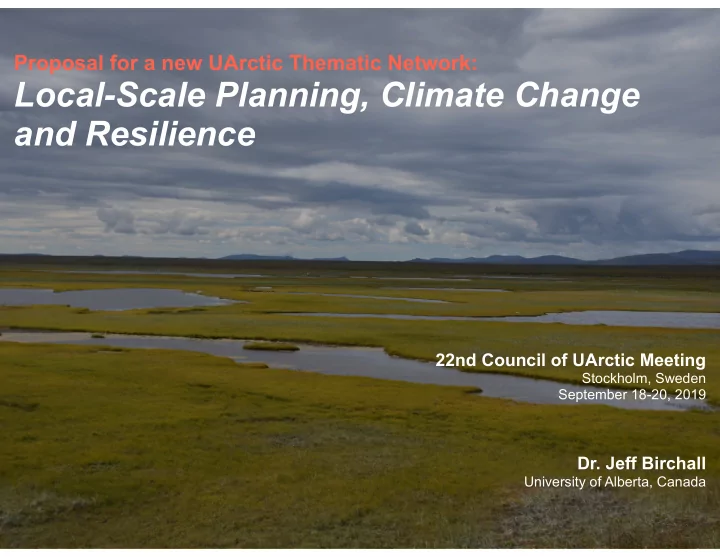
Proposal for a new UArctic Thematic Network: Local-Scale Planning, Climate Change and Resilience 22nd Council of UArctic Meeting Stockholm, Sweden September 18-20, 2019 Dr. Jeff Birchall University of Alberta, Canada Global Climate Change


slide-1
SLIDE 1

Proposal for a new UArctic Thematic Network:

Local-Scale Planning, Climate Change and Resilience

22nd Council of UArctic Meeting

Stockholm, Sweden September 18-20, 2019

  • Dr. Jeff Birchall

University of Alberta, Canada

slide-2
SLIDE 2
  • Ocean heat content has increased
  • Rate of mean sea level rise has increased
  • Heatwaves and wildfire have become more

intense

  • Glacial volume has decreased
  • Precipitation has become more variable
  • Weather extremes more frequent

Global Climate Change Impacts

(b)

Observed change in surface temperature 1901–2012 (°C)

−0.6 −0.4 −0.2 0.2 0.4 0.6 0.8 1.0 1.25 1.5 1.75 2.5

With warming temperatures observed around the globe…

(IPCC 2013; Vogel et al. 2019)

Global average sea level change

1900 1920 1940 1960 1980 2000 −50 50 100 150 200

Year (mm)

(d)

1900 1920 1940 1960 1980 2000 −20 −10 10 20

Year (1022 J)

Change in global average upper ocean heat content

(c) (d)

−100 −50 −25 −10 −5 −2.5 2.5 5 10 25 50 100

(mm yr-1 per decade)

1901– 2010 1951– 2010

Observed change in annual precipitation over land

slide-3
SLIDE 3

(IPCC 2013; Birchall & Bonnett 2019)

Climate Change Impacts in the Arctic

As a result:

  • Permafrost is more active

= increased maintenance for buildings + utilities

  • Sea-ice extent is reduced in the fall/ winter - resulting in

larger ocean fetch and weaker shore fast ice = increased vulnerability to erosion + flooding

  • Storm season has lengthened

= increased exposure of assets + infrastructure

  • Rain on snow events are occurring more frequently

= increased occurrence of overland flooding

Impacts are even more pronounced in the Arctic, where temperatures are rising 2x the global rate…

slide-4
SLIDE 4

Cont.

Higher temperatures also mean…

  • Vegetation zones are shifting north and up
  • Wildlife populations are experiencing new challenges/ competition

WHITEHORSE

BERING SEA JUNE

Influence on harvesting and related practices Impacts on cultural and social wellbeing

slide-5
SLIDE 5

Arctic communities are used to environmental change… Local Scale Planning

(IPCC 2013; Arctic Council 2016)

Possible temperature responses in 2081-2100 to high emission scenario RCP8.5 Possible temperature responses in 2081-2100 to low emission scenario RCP2.6

  • 2 -1.5 -1-0.5 0 0.5 1 1.5 2

3 4 5 7 9 11

(°C)

However, with rising temperatures, the rate of change in the north is

  • ccurring faster

Need for adaptation at the local scale is becoming immediate

slide-6
SLIDE 6

Cont.

Local decision-makers

= Level of government closest to the impacts + People directly affected by the impacts Yet Local government actions on climate adaptation are

  • ften fragmented and reactionary:
  • lack of buy-in/ mandate
  • peripheral agenda
  • displaced by other priorities
  • problem for the future
  • lack of capacity
slide-7
SLIDE 7

Empirical

  • Establish a network of researchers with an eye on climate change and resilience/

adaptation policy in the Arctic

  • Document how climate stressors manifest on a local scale
  • Examine the enabling factors and barriers to resilience and transformation
  • Acquire a better understanding of local expertise and needs
  • Contribute to policy debates on resilience and action for sustainable livelihoods

and local and regional economies

Practical

  • Work collaboratively with local actors/ key stakeholders to identify current and

future environmental challenges

  • Work within and across scales from larger urban centres to small communities,

including attention to Indigenous forms of community planning for climate resilience

Our Objectives

slide-8
SLIDE 8

The TN will centre its work on the following principles:

  • Promote knowledge sharing and co-development of experience
  • Facilitate inclusiveness and local stakeholder engagement
  • Foster collaborative outcomes from engagement with various stakeholders as well

as diverse academic disciplines

  • Facilitate on-going learning

ALL informed and guided by:

Arctic Resilience Assessment Report’s (2016) best practices on the meaningful engagement of Indigenous peoples and local communities.

Our Guiding Principles

slide-9
SLIDE 9

Initial Participants

Confirmed Interest Countries (Institutions) Northern Research Areas

15

Canada
 United States Greenland Denmark Sweden
 Ireland Germany Canada United States
 Greenland
 Denmark
 Finland Iceland Russia United Kingdom

  • 10 researchers, from 8 different Universities; 4 UArctic-member Institutions
  • University of Alberta, Canada
  • University of Northern British Columbia, Canada
  • University of Greenland, Greenland
  • Aalborg University, Denmark
  • 3 research centres
  • Arctic Institute of Community-Based Research, Canada
  • Greenland Climate Research Centre, Greenland
  • Nordregio, Sweden
  • 1 town (Dawson City, Canada)
  • 1 First Nation (Tr’ondek Hwech’in, Canada)
slide-10
SLIDE 10

Cont.

Thematic Network Lead

  • Dr. Jeff Birchall

Assistant Professor, School of Urban and Regional Planning (University of Alberta, Canada) Lead, Climate Adaptation and Resilience Lab

Thematic Network Collaborators

  • Dr. Mark Nuttall

Professor + Henry Marshall Chair of Anthropology (University of Alberta, Canada) Affiliated Professor (University of Greenland + Greenland Climate Research Centre, Greenland)

  • Dr. Kristof van Assche

Professor, School of Urban and Regional Planning (University of Alberta, Canada) Research Fellow, ZEF/ Institute for Development (Bonn University, Germany)

  • Dr. Rob Shields

Professor + Henry Marshall Chair of Sociology (University of Alberta, Canada)

  • Dr. Tristan Pearce

Associate Professor + Canada Research Chair in Cumulative Impacts of Environmental Change (University of Northern British Columbia, Canada)

  • Dr. Mark Groulx

Assistant Professor, School of Environmental Planning (University of Northern British Columbia, Canada)

  • Dr. Timothy Heleniak

Senior Research Fellow (Nordregio, Sweden)

  • Dr. Martin Lehmann

Associate Professor, Department of Planning (Aalborg University, Denmark)

  • Dr. James Fitton

Postdoc Fellow, Marine and Renewable Energy Ireland (University College Cork, Ireland)

  • Dr. Liette Vasseur

Professor + UNESCO Chair in Community Sustainability (Brock University, Canada)

  • Dr. Cynthia Rosenzweig

Senior Research Scientist, NASA Goddard Institute and Centre for Climate Systems Research (Columbia University, United States)
slide-11
SLIDE 11

Cont.

Research Scope/ Interests (current collaborators)

  • Impacts of urbanization on the Arctic and its governance
  • Evolution and innovation in governance, with focus in spatial, environmental and

development policy

  • Vulnerability and adaptation of communities and socio-ecological systems to

climate change

  • Community-based ecosystem management and resilience
  • Importance of community engagement and placemaking in effective

collaborative planning

  • Human-environment relations (climate change, locality, industries, geopolitics)
  • Sustainable and socially just approaches to increase resilience
  • How coastal communities are affected by climate variability, and the decision

dynamics around how adaptation is incorporated into strategic planning

slide-12
SLIDE 12

Anticipated Outputs

Near-term (year 1)

  • Special Session, Arctic Science Summit Week (Iceland, Mar/Apl 2020)
  • Theme: Climate change stressors and local response
  • Purpose: Stimulate discussion; facilitate research collaborations
  • Aim to co-host with the Icelandic Centre for Research and the University of Akureyri
  • Workshop (Alberta/ Yukon, July 2020)
  • Theme: The influence of climate change on the individual and their daily activities
  • Purpose: Understand how climate change affects different stakeholders; nurture/ facilitate collaborative

research agenda for local scale climate resilience

  • Participants: researchers, students, public sector, Indigenous communities, stakeholders
  • Seminar, UArctic Congress (Iceland, Oct 2020)
  • Theme: Arctic resilience and ways of preparing for rapid environmental change
  • Purpose: provide forum to discuss broad aspects of Arctic resilience; facilitate research collaborations
  • Aim to co-host with local researchers from Iceland and network collaborators
slide-13
SLIDE 13

Longer-term

  • Massive Open Online Course
  • Arctic resilience - community planning and development (in a changing climate)
  • University of Alberta + Tromso University
  • Visiting scholar, School of Urban and Regional Planning, University of Alberta
  • delivery of an intensive course on planning and resilience in the Arctic
  • foster research collaborations
  • Graduate student co-supervision and exchange w TN members
  • Journal Special Issue
  • planning for resilience in the Arctic
  • Information toolkit for local decision-makers

Cont.

slide-14
SLIDE 14

Next Steps

  • Confirm a Vice-lead (non-Canadian collaborator)
  • Confirm a Russian collaborator (North-Eastern Federal University,

Siberian Environmental Center, Russian Academy of Sciences)

  • Expand the TN:
  • Expand network of UArctic members (increase circumpolar representation)
  • Engage the research networks of our collaborators
  • Engage with communities (municipal, Indigenous) where our collaborators are

active

  • Explore existing TNs for further cross-linkages (Arctic Northern Governance;

Natural Hazards; Arctic Sustainable Resources and Social Responsibility)

  • Realize the near-term outputs
  • Apply for grants to facilitate longer-term outputs
slide-15
SLIDE 15

Summary

This TN is unique in it’s…

scale of interest (local government)

+

scope of research (community planning, local actors)

Through an interdisciplinary team of collaborators, this TN will…

  • Advance knowledge on local-scale planning, climate change and

resilience in the Arctic

slide-16
SLIDE 16

Thanks for your time!

For further discussion, please contact me at:

jeff.birchall@ualberta.ca

Climate Adaptation + Resilience Lab School of Urban and Regional Planning Department of Earth and Atmospheric Sciences University of Alberta Canada This proposal was generously supported by

UAlberta North + Dept. of Earth and Atmospheric Sciences

University of Alberta

Last Modified: September 9, 2019