LLC Operating Agreements Crafting Provisions on Fiduciary Duties, - - PowerPoint PPT Presentation

llc operating agreements
SMART_READER_LITE
LIVE PREVIEW

LLC Operating Agreements Crafting Provisions on Fiduciary Duties, - - PowerPoint PPT Presentation

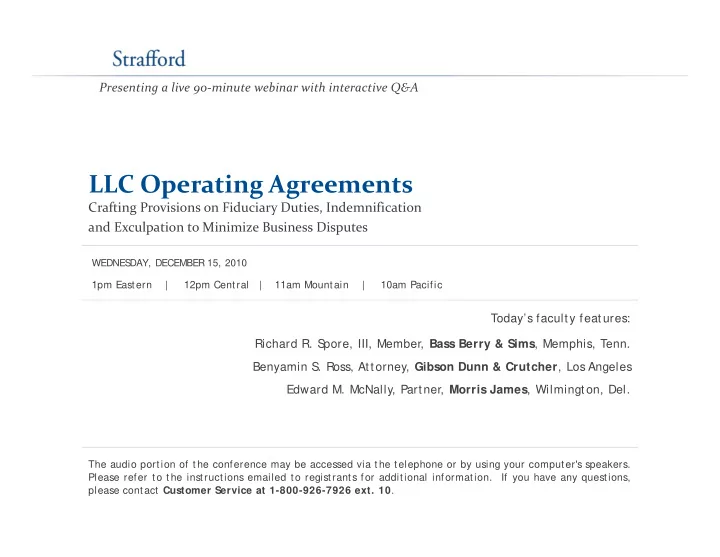
Presenting a live 90 minute webinar with interactive Q&A LLC Operating Agreements Crafting Provisions on Fiduciary Duties, Indemnification and Exculpation to Minimize Business Disputes WEDNES DAY, DECEMBER 15, 2010 1pm Eastern |


slide-1
SLIDE 1

Presenting a live 90‐minute webinar with interactive Q&A

LLC Operating Agreements

Crafting Provisions on Fiduciary Duties, Indemnification and Exculpation to Minimize Business Disputes

T d ’ f l f

1pm Eastern | 12pm Central | 11am Mountain | 10am Pacific WEDNES DAY, DECEMBER 15, 2010

Today’s faculty features: Richard R. S pore, III, Member, Bass Berry & Sims, Memphis, Tenn. Benyamin S . Ross, Attorney, Gibson Dunn & Crutcher, Los Angeles Edward M. McNally, Partner, Morris James, Wilmington, Del.

The audio portion of the conference may be accessed via the telephone or by using your computer's speakers. Please refer to the instructions emailed to registrants for additional information. If you have any questions, please contact Customer Service at 1-800-926-7926 ext. 10.

slide-2
SLIDE 2

Continuing Education Credits

FOR LIVE EVENT ONLY

For CLE and/ or CPE purposes, please let us know how many people are listening at your location by completing each of the following steps:

  • In the chat box, type (1) your name, (2) your company name and (3) the

number of attendees at your location number of attendees at your location

  • Click the arrow to send
slide-3
SLIDE 3

Tips for Optimal Quality

S d Q lit S

  • und Quality

If you are listening via your computer speakers, please note that the quality of your sound will vary depending on the speed and quality of your internet connection. If the sound quality is not satisfactory and you are listening via your computer speakers, you may listen via the phone: dial 1-866-873-1442 and enter your PIN when prompted Otherwise please send us a chat or e mail when prompted. Otherwise, please send us a chat or e-mail sound@ straffordpub.com immediately so we can address the problem. If you dialed in and have any difficulties during the call, press *0 for assistance.

Viewing Qualit y

To maximize your screen, press the F11 key on your keyboard. To exit full screen, press the F11 key again press the F11 key again.

slide-4
SLIDE 4

COMMON LAW FIDUCIARY DUTIES OF LLC MEMBERS DUTIES OF LLC MEMBERS

Richard Spore p Bass, Berry & Sims PLC (901) 543-5902 rspore@bassberry.com

4

slide-5
SLIDE 5

INTRODUCTION TO FIDUCIARY DUTIES AMONG BUSINESS OWNERS AMONG BUSINESS OWNERS

  • Fiduciary duties apply in situations in which the parties

iti f i l t t d th l f “ t

  • ccupy positions of special trust, and the rule of “caveat

emptor” is an inadequate standard of conduct.

  • Fiduciary duty law among business owners first

developed in the context of general partnerships.

  • General partners have co-equal agency and

management rights. management rights.

  • General partners are jointly and severally

liable for partnership obligations.

5

slide-6
SLIDE 6

MEINHARD V. SALMON, 165 N.E. 545 (N Y 1928) (N.Y. 1928)

  • “Joint adventurers, like co-partners, owe to one another,

while the enterprise continues the duty of the finest loyalty while the enterprise continues, the duty of the finest loyalty. Many forms of conduct permissible in a workaday world for those acting at arm's length, are forbidden to those bound b fid i ti N t h t l b t th tili f by fiduciary ties… Not honesty alone, but the punctilio of an honor the most sensitive, is then the standard of behavior.”

  • Note (i) the references to partners, and (ii) the extension
  • f partnership principles to a different but analogous form
  • f business entity.

6

slide-7
SLIDE 7

EXTENSION OF OWNER FIDUCIARY DUTIES TO CLOSE CORPORATIONS TO CLOSE CORPORATIONS

  • Courts have analogized close corporations to partnerships.
  • Although corporations in theory follow a much different

governance model than partnerships, in practice a close corporation may operate much like a general partnership.

  • Courts have therefore looked at substance over form and

asked why owners of close corporations should be treated any differently than general partners? See, for example, y y g p , p , Anderson v. Wilder, 2003 Tenn. App. LEXIS 819 (Tenn. Ct.

  • App. Nov. 21, 2003).

7

slide-8
SLIDE 8

EXTENSION OF FIDUCIARY DUTIES TO LIMITED LIABILITY COMPANIES LIABILITY COMPANIES

  • LLCs emerged on the scene in the early to mid-1990’s and

have developed into the entity of choice for most closely have developed into the entity of choice for most closely held enterprises.

  • Many courts have followed their past practice of extending

fiduciary duty concepts from general partners to other kinds

  • f business owners by imposing common law fiduciary

duties on LLC members. See, for example, Out of the Box Promotions LLC v. Koschitzki, 15 Misc. 3d 1134(A), 2007 WL 1374501 (N.Y. Sup.).

  • However confusion persists in the area of fiduciary duties
  • However, confusion persists in the area of fiduciary duties
  • f LLC members and managers.

8

slide-9
SLIDE 9

SOURCES OF CONFUSION

  • LLCs are still relatively new, compared to partnerships

and corporations and corporations.

  • There is no “gold standard” uniform LLC act, and state

LLC acts differ widely LLC acts differ widely.

  • There are various governance models for LLCs, some

more like general partnerships some more like limited more like general partnerships, some more like limited partnerships, and some more like corporations.

9

slide-10
SLIDE 10
  • Non-business practitioners (including some judges) still do

not understand LLCs See for example Pointer vs not understand LLCs. See, for example, Pointer vs. Castellani, 455 Mass. 537, 918 N.E. 2d 805 (2009): “It is uncontested that [Fletcher Granite Company, LLC] is a l ti i th t it h ‘(1) ll b f close corporation in that it has ‘(1) a small number of stockholders; (2) no ready market for the corporate stock; and (3) substantial majority stockholder participation in the di i d i f h i ’” management, direction and operations of the corporation.’”

  • A failure to distinguish among different kinds of business

entities is typical of fiduciary duty cases but adds to the confusion.

10

slide-11
SLIDE 11

THE CONFUSION CONTINUES

  • What exactly does an LLC member’s common law fiduciary

duty encompass? duty encompass?

  • A duty of loyalty?
  • A duty of care?

y

  • A duty of good faith and fair dealing?
  • See for example Section 404 of the Revised Uniform
  • See, for example, Section 404 of the Revised Uniform

Partnership Act which describes the duties owed by general partners in these terms.

  • To whom are these duties owed? The LLC, the other

members, or both?

11

slide-12
SLIDE 12

THE CONFUSION CONTINUES…

  • See, for example, VGS, Inc. v. Castiel, et al., 2000 WL

1277372 (Del Ch ) (duty of loyalty owed to LLC owners and 1277372 (Del. Ch.) (duty of loyalty owed to LLC owners and managers). See also, Anderson v. Wilder, cited above (LLC member owes a fiduciary duty to other members even th h T ’ LLC A t t t th t th fid i d t though Tennessee’s LLC Act states that the fiduciary duty runs in favor of the LLC).

12

slide-13
SLIDE 13

A “TYPICAL” FIDUCIARY DUTY CASE FACT PATTERN PATTERN

  • A, B and C each owns a 33 1/3% membership interest in an

LLC The LLC’s operating agreement requires unanimous

  • LLC. The LLC s operating agreement requires unanimous

member approval of certain fundamental actions. If there is a deadlock on such an action (i.e., if only 2 of the 3 members approve it), the two members who approve the action can buy approve it), the two members who approve the action can buy

  • ut the third for a stipulated formula price.

A and B secretly negotiate with a public company strategic buyer y g p p y g y to sell the LLC’s business at a big premium to the operating agreement’s formula price. Before signing a purchase contract

  • r disclosing the existence of negotiations, A and B manufacture

a deadlock with C and use that deadlock as the basis for buying him out at the agreed formula price in accordance with the LLC’s

  • perating agreement. They subsequently sell the LLC’s assets

at a big profit

13

at a big profit.

slide-14
SLIDE 14
  • Assume that the applicable state LLC statutes are silent
  • n the topic of fiduciary duties (e.g., like Delaware). Have

A and B violated the operating agreement or the state’s A and B violated the operating agreement or the state s LLC statutes? Have they harmed the LLC in any way?

  • Have A and B acted in good faith as to C?
  •  A member may be found to have acted in bad faith

when he has frustrated the reasonable expectations

  • f another member

See for example Pointer v

  • f another member. See, for example, Pointer v.

Castellani, cited above.

  •  In this example, could C reasonably expect to receive

his proportionate share of the purchase price his proportionate share of the purchase price premium paid by the strategic buyer?

14

slide-15
SLIDE 15

POSSIBLE SCOPE OF STATE LAW FIDUCIARY DUTIES FIDUCIARY DUTIES

  • Statutory, common law and contractual.
  • C

l d t t l b t t t t t

  • Common law and contractual, but not statutory.
  • Statutory and contractual, but not common law.

15

slide-16
SLIDE 16

Defining or Eliminating Fiduciary Duties in Limited Liability Companies

slide-17
SLIDE 17

<Presentation Title/Client Name>

Introduction Introduction

– Statutory fiduciary duties – Statutory approaches to waiving or modifying fiduciary duties – Recent judicial interpretations – Practical considerations in drafting waivers of fiduciary duties Practical considerations in drafting waivers of fiduciary duties

333 South Grand Avenue Los Angeles, California 90071

Presented by:

Ben Ross

i

Tel: 213 229 7048 bross@gibsondunn.com

Associate Los Angeles Office

17

slide-18
SLIDE 18

<Presentation Title/Client Name>

Limited Liability Company Dispersion Limited Liability Company Dispersion

Percentage of LLC’s Formed by State, 2004-2007

7% 10% Delaware Florida

  • Principal place of

business.

5% 5% 4% California Texas New Jersey New York Oth

  • Large firms prefer

Delaware. D l Li i d

4% 65% Other

  • Delaware Limited

Liability Company Act disproportionately guides statutes of other states.

Source: Rodney D. Chrisman, LLCS are the New King of the Hill: An Empirical Study of the Number of New

18

y , g f p y f f LLCs, Corporations, and LPs Formed in the United States Between 2004-2007 and How LLCs were Taxed for Tax Years 2002-2006, 15 Fordham J. Corp. & Fin. L. 459, 468-76 (2010).

slide-19
SLIDE 19

<Presentation Title/Client Name>

Who Owes Fiduciary Duties? Who Owes Fiduciary Duties?

  • Managers and managing

Non-Managing Members Statutory Fiduciary Duties (weighted by LLC formations 2004-2007)

members.

  • Non-managing members?

29% 7% 10%

  • Controlling members?

– Kelly v Blum 2010 WL

31% 13% 10%

– Kelly v. Blum, 2010 WL 629850 (Del. Ch., February 24, 2010).

31%

Delaware - No Provision Florida - Members Owe Duties Even If Manager-Managed New York - May Transact Business with LLC y RULLCA - No Member Duties if Manager-Managed ULLCA - Combination of New York & RULLCA Other

19

Sources: Chrisman, LLCS are the New King of the Hill, 468-76. Ribstein and Keatinge on LLCs, 583-585.

slide-20
SLIDE 20

<Presentation Title/Client Name>

To Whom are Fiduciary Duties Owed? To Whom are Fiduciary Duties Owed?

M b d th LLC

  • Members and the LLC.
  • But are fiduciary duties ever
  • But are fiduciary duties ever
  • wed to creditors of the LLC?
  • Delaware – “Section 18-1002 does not grant standing to creditors.” CML V,

LLC, v. Bax, 6 A.3d 238 (Del. Ch., Nov. 3, 2010).

20

slide-21
SLIDE 21

<Presentation Title/Client Name>

Duty of Care Duty of Care

  • Delaware – silent; reliance on

reports

Statutory Duty of Care (weighted by LLC formations 2004-2007)

reports.

  • ULLCA – liable only for gross

negligence, bad faith,

Delaware - Generally Silent ULLCA - Liable for Bad Faith , etc RULLCA - Prudent Person Other

recklessness or equivalent conduct.

  • RULLCA – prudent person in

26% 7%

  • RULLCA – prudent person in

similar circumstances.

  • California (other) – partner style

28%

duties.

  • Applicable?

39%

21

Sources: Chrisman, LLCS are the New King of the Hill, 468-76. Ribstein and Keatinge on LLCs, 574-576.

slide-22
SLIDE 22

<Presentation Title/Client Name>

Duty of Loyalty Duty of Loyalty

  • Delaware – no statutory provision.
  • RULLCA – detailed definition (RULLCA § 409(b))
  • Dealing with the company’s property

Dealing with the company s property

  • Self-dealing
  • Business opportunities and competition

22

slide-23
SLIDE 23

<Presentation Title/Client Name>

Waiver of Fiduciary Duties Waiver of Fiduciary Duties

  • Definition: Eliminating (or otherwise restricting) the duties of a member
  • r manager in the LLC agreement
  • r manager in the LLC agreement.
  • Distinguished: Not a limitation of liability (exculpation) or a right of

payment or reimbursement (advancement and indemnification).

– Solar Cells, Inc. v. True North Partners, LLC, 2002 WL 749163 (Del. Ch., 2002)

23

slide-24
SLIDE 24

<Presentation Title/Client Name>

Waiver of Fiduciary Duties Waiver of Fiduciary Duties

Statutory Limitations on Waiver of Fiduciary Duties (weighted by LLC formations 2004-2007)

Freedom of Contract

  • Most states permit the (near)

complete waiver and elimination of fiduciary duties.

Delaware - No Limitation on Waiver Silent New York - Some Limitations RULLCA - Manifestly Reasonable and Approved

8% 18%

Other

18% 41% 19% 14% 24

Sources: Chrisman, LLCS are the New King of the Hill, 468-76. Ribstein and Keatinge on LLCs, 580-582.

slide-25
SLIDE 25

<Presentation Title/Client Name>

Delaware’s Limitations on Waivers of Fiduciary Duties Delaware s Limitations on Waivers of Fiduciary Duties

  • Bad faith exception:

“provided that a limited liability company agreement may not limit or eliminate liability for any act or omission that constitutes a bad faith violation of the implied contractual covenant of good faith and fair dealing ” Del Code Ann tit implied contractual covenant of good faith and fair dealing. Del Code Ann tit 6, § 18-1101.

  • Clear and unambiguous.

25

slide-26
SLIDE 26

<Presentation Title/Client Name>

Practical Considerations in Drafting Waivers of Practical Considerations in Drafting Waivers of Fiduciary Duties

Proven Approaches pp

  • Build “Express Standards” – Waive all fiduciary duties, “except as explicitly

provided in the Agreement.”

– Fisk Ventures, LLC v. Segal, 2008 WL 1961156 (Del. Ch., May 7, 2008)

  • Addressing Conflicts of Interest – May help further avoid the implied

Addressing Conflicts of Interest May help further avoid the implied covenant.

– Lonergan v. EPE Holdings LLC, 2010 WL 3987173 (Del. Ch., Oct. 11, 2010) – Consider addressing corporate opportunities and affiliate transactions.

26

slide-27
SLIDE 27

<Presentation Title/Client Name>

Practical Considerations in Drafting Waivers of Practical Considerations in Drafting Waivers of Fiduciary Duties

Use Caution When Use Caution When

  • Trimming Duties – Adopt fiduciary duties, “except as explicitly provided

in the Agreement ” in the Agreement.

– Kahn v. Portnoy, 2008 WL 5197164 (Del. Ch., December 11, 2008)

  • Overbuilding – Multiple clauses can create ambiguities.

l – Bay Center Apartments Owner, LLC v. Emery Bay PKl, LLC, 2009 WL 1124451 (Del. Ch., April 20, 2009)

27

slide-28
SLIDE 28

<Presentation Title/Client Name>

Practical Considerations in Drafting Waivers of Practical Considerations in Drafting Waivers of Fiduciary Duties

Additional Considerations M b d P i d T f

  • Members and Permitted Transfers
  • Withdrawal
  • Intellectual Property

28

slide-29
SLIDE 29

<Presentation Title/Client Name>

Addressing Conflicts of Interest Addressing Conflicts of Interest

  • Know your limitations.

Required Authorizations for Conflicts of Interest (weighted by LLC formations 2004-2007)

  • Between whom?

– Kahn v. Portnoy I A l E R LLC

35% 8% 7%

– In re Atlas Energy Resources, LLC, 2010 WL 1979050 (Del. Ch., 2010)

  • Waive duties.

9% 30% 11%

Waive duties.

– Solar Cells

  • Define approval standard.

9% 30% Delaware - No Provision UPA - Consent New York Disinterested Approval or Fairness

– Brinckherhoff v. Texas Eastern Products, 986 A.2d 370 (Del. Ch., 2008)

New York - Disinterested Approval or Fairness Prototype - Disinterested Approval RULLCA - Manifestly Reasonable and Approved Other

29

Sources: Chrisman, LLCS are the New King of the Hill, 468-76. Ribstein and Keatinge on LLCs, 577-579.

slide-30
SLIDE 30

Crafting Advancement Indemnification Crafting Advancement, Indemnification and Exculpation Clauses in LLC Operating Agreements LLC Operating Agreements

Edw ard M. McNally

Morris James LLP 500 Delaware Avenue Wilmington, Delaware 19801 (302) 888-6880 Email: emcnally@morrisjames.com Website: www.morrisjames.com Blog: www.delawarecorporatelitgationreport.com

slide-31
SLIDE 31

Introduction

What This Presentation Covers

If you are sued as a result of your role as manager, member or agent of a limited liability company, you may avoid paying lawyer fees litigation costs and even an adverse judgment by a fees, litigation costs and even an adverse judgment by a combination of: Advancement – Advancement – Indemnification – Exculpation p Each of these has its own unique characteristics – but all should be provided for by your LLC operating agreement

31

be provided for by your LLC operating agreement.

slide-32
SLIDE 32

Advancement Advancement

Definition: the right to have your litigation costs advanced to g y g you by the company as the litigation progresses. Authorization: this is a right created by the terms of the LLC Authorization: this is a right created by the terms of the LLC agreement – it is not provided for by statute in Delaware or under the Uniform Act. (6 Del.C. § 18-108 and Uniform Act Section 408) Section 408). Cautionary Note: advancement is not the same thing as y g indemnification and will not be required by a simple “hold harmless” or “indemnify” clause. (See e.g. Majkowski v. Am. Imaging Mgmt. LLC, 913 A.2d 72 (Del. Ch. 2006).

32

ag g g t C, 9 3 d ( e C 006)

slide-33
SLIDE 33

Advancement (cont ) Advancement (cont.)

MAJOR ISSUES TO CONSIDER

  • 1. Scope of Advancement Right

(a) usually limited to litigant brought “by reason of” serving the LLC – does not cover other claims arising

  • ut of other circumstances, such as breach of contract

(b) may not cover acting as a plaintiff – law in conflict ( ) y g p (See e.g. Baker v. Impact Holding, Inc., 2010 WL 2979050 (Del. Ch.))

33

slide-34
SLIDE 34

Advancement (cont ) Advancement (cont.)

2. Amount of Advancement

(a) only limited by “reasonableness” standard if (a) only limited by reasonableness standard if not restricted by agreement (b) right to approve counsel clauses

34

slide-35
SLIDE 35

Indemnification Indemnification

Definition: the right to have your expenses and any damage g y p y g award against you paid for by the company at the end of litigation. Authorization: this is a right created by the terms of the LLC agreement – it is not required by the statute in Delaware but agreement – it is not required by the statute in Delaware, but is required in some cases by the Uniform Act. (Uniform Act Section 408). Cautionary Note: this is no substitute for D&O insurance as it t l d d bt f th

35

it creates only an unsecured debt of the company.

slide-36
SLIDE 36

Indemnification (cont ) Indemnification (cont.)

MAJOR ISSUES TO CONSIDER

  • 1. Who decides if indemnification required

(a) easy to resolve if you win your case (b) l t l if ttl l th (b) less easy to resolve if you settle or lose the case (c) consider alternatives, in this order: (i) independent committee of managers/members (ii) independent counsel

36

(iii) court

slide-37
SLIDE 37

Indemnification (cont ) Indemnification (cont.)

  • 2. Spell out the standard to be applied

(a) “reasonably believed [acted] in the best interests of the company” (b) “had no reasonable cause to believe the conduct was unlawful” (c) “fairly and reasonably” entitled

37

slide-38
SLIDE 38

Indemnification (cont ) Indemnification (cont.)

  • 3. Spell out what types of claims covered

(a) only claims by third parties (b) derivative claims

cautionary note: indemnification of damages awarded in a derivative suit may be against public policy in some

  • states. (See e.g. Arnold v. Society for Savings Bancorp Inc.,

states (See e g

  • d

Soc ety o Sa gs a co p c , 678 A.2d 533 (Del. Supr. 1996))

(c) criminal actions

38

( )

slide-39
SLIDE 39

Indemnification (cont ) Indemnification (cont.)

4. Is there a limit on the amount

(a) generally not limited in amount (b) f b l (b) attorney fees may be large cautionary note: consider right to approve counsel clause counsel clause

39

slide-40
SLIDE 40

Exculpation Clauses Exculpation Clauses

Definition: this is a right to avoid liability in litigation because the conduct alleged to be wrong is deemed to not be a valid basis to impose liability Basis of Exculpation: this is a right created both by statute and by the LLC Basis of Exculpation: this is a right created both by statute and by the LLC agreement, depending on the right involved Cautionary Note: while the right may seem clear decision law in the Cautionary Note: while the right may seem clear, decision law in the corporation context raises questions about its effectiveness (See Uebler, Reinterpreting Section 141(e) of Delaware’s General Corporations Law: Why Interested Directors Should be “Fully Protected” in Relying on Expert Advice Interested Directors Should be Fully Protected in Relying on Expert Advice, 65 Bus. Law. 1023 (2010)

40

slide-41
SLIDE 41

Exculpation Clauses (cont ) Exculpation Clauses (cont.)

1 V i t f l ti t t t

MAJOR ISSUES TO CONSIDER

1. Various types of exculpation statutes

(a) reliance on company records (a) reliance on company records (b) reliance on experts, including counsel (6 Del C § 18 406 and 18 1101) (6 Del. C. § 18-406 and 18-1101)

41

slide-42
SLIDE 42

Exculpation Clauses (cont ) Exculpation Clauses (cont.)

2. Contractual exculpation clauses

Cautionary note: as used here, exculpation is not the same as a limitation on duties owed to the entity or others; y ; this may become important as exculpation often is not self-

  • perating and requires following proper procedures to

apply

42

slide-43
SLIDE 43

Exculpation Clauses (

)

Exculpation Clauses (cont.)

(a) Who decides if exculpation applies:

(i) independent committee (ii) third party (iii) court (iii) court

43

slide-44
SLIDE 44

Exculpation Clauses (cont ) Exculpation Clauses (cont.)

(b) Spell out standard to be applied

(a) “reasonably believed [acted] in the best (a) reasonably believed [acted] in the best interests of the company” (b) “had no reasonable cause to believe the conduct was unlawful” (c) “fairly and reasonably” entitled

44

slide-45
SLIDE 45

Exculpation Clauses (cont ) Exculpation Clauses (cont.)

(c) Spell out procedures to be followed (i) what must committee do (ii) need for advisers or not

45

slide-46
SLIDE 46

Exculpation Clauses (cont ) Exculpation Clauses (cont.)

(d) Be clear on who is covered:

(i) managers (ii) members (iii) officers and directors

Cautionary Note: Not fully understanding all the parties involved in conflict situations may lead to omitting persons to be covered (See, e.g. In Re Atlas Energy Resources, LLC, 2010 WL 4273122 (Del. Ch.).

46

slide-47
SLIDE 47

Exculpation Clauses (cont ) Exculpation Clauses (cont.)

(e) Be clear and simple on what transactions are covered

(i) All conflict of interest transactions (ii) All compensation decisions (iii) Avoid multiple clauses that create ambiguities (See e.g. Kahn v. Portnoy, 2008 WL 5197164 (Del Ch ) 2008 WL 5197164 (Del. Ch.)

47

slide-48
SLIDE 48

CONCLUSION CONCLUSION

Contact Information:

Edward M. McNally 302-888-6880 emcnally@morrisjames.com y@ j Shannon S. Frazier 302-888-6916 302 888 6916 sfrazier@morrisjames.com Jason C. Jowers 302-888-6860 jjowers@morrisjames.com

48

slide-49
SLIDE 49

CONCLUSION (cont.) CONCLUSION (cont.)

Appendix Materials: Tab

Sample Indemnification/Ad ancement Pro isions 1 Sample Indemnification/Advancement Provisions ........................... 1 Sample Exculpation Provision .......................................................... 2 Chart of Relationships ...................................................................... 3 Baker v. Impact Holding, Inc. 2010 WL 2979050 (Del. Ch.) ……………………………………..4 In Re Atlas Energy Resources, LLC 2010 WL 4273122 (Del Ch.) …………………………………….. 5 Kahn v. Portnoy 2008 WL 5197164 (Del. Ch) …………………………………….. 6 ( )

49

slide-50
SLIDE 50

With over 50 lawyers and four offices, our attorneys work together across legal disciplines and use the depth of their collective knowledge of Delaware law with our daily experiences in Delaware courts to provide clients with creative solutions and outstanding service. Litigation The Litigation Group represents a wide variety of domestic and international clients in corporate/fiduciary litigation, bankruptcy and commercial litigation. Transactions Transactions The Transactional Group represents regional clients as well as international clients engaged in alternative entity practices, commercial and residential real estate transactions, and business tax and estate planning. DuPont Primary Law Firm Chosen by DuPont to handle their Delaware litigation Morris James has won three separate awards for representation in Chosen by DuPont to handle their Delaware litigation, Morris James has won three separate awards for representation in major litigation. Representative Clients DuPont’s trust in us is echoed by clients such as Christina Care Health System, Wilmington Trust Company and Wachovia Bank Bank. National Recognition Our attorneys are recognized as leaders in their field by some of the most respected guides and publishers such as Chambers USA, Martindale-Hubbell, Best Lawyers in America, Super Lawyers, and Benchmark: Litigation. Our corporate

50

litigation, bankruptcy, intellectual property litigation and employment law groups are among the top practices in Delaware.